


Most pet hotels hit the same wall somewhere around 40-50 kennels. The owner-operator model that worked perfectly at 20 kennels just stops working. Morning feeding takes 90 minutes instead of 45. Staff forget which dogs need meds. The afternoon play groups get messy fast. Revenue grows but profit shrinks because you're throwing people at problems instead of fixing the actual workflows.
The difference between a 30-kennel facility making decent money and a 120-kennel operation struggling to break even usually comes down to one thing: whether they built modular operations before scaling, or tried to retrofit them after everything already broke.
The three operational stages nobody explains properly
Pet hotels move through distinct operational phases that require completely different management approaches. What works at 25 kennels will destroy you at 75.
Stage 1: Owner-Operator (up to 35 kennels) Everything runs through the owner. You know every dog's quirks, every owner's preferences. Staff follow you around learning by osmosis. Documentation feels unnecessary because everyone just asks you. This works beautifully until you can't be there.
Stage 2: Delegation Crisis (35-70 kennels) The owner starts missing details. New staff make expensive mistakes. That aggressive German Shepherd ends up in the wrong play group. Someone misses a diabetic dog's insulin. You hire a manager but they don't know what you know. Revenue grows but mistakes multiply faster.
Stage 3: Systems-Driven (70+ kennels) Operations run on documented processes, not memory. Every task has an owner, a checklist, and a backup plan. Staff can handle 95% of situations without pulling a manager away. This is where profitable scaling actually becomes possible.
Most facilities get stuck in Stage 2 forever. They're too big to run on memory but never build the systems to get out of the chaos.
Building your foundational SOPs (the ones that actually get followed)
The SOPs gathering dust in binders share the same problem: they're paragraphs of text written by someone who's never cleaned a kennel at 6am. The ones that actually get used look completely different.
Never miss a booking or detail again.
GoPetel simplifies pet hotel operations by managing every reservation and pet profile seamlessly.
- Centralized booking management
- Automated client notifications
- Staff and kennel scheduling
No credit card required
Morning Operations SOP Template
Single-page task cards, not 10-page manuals:
6:00 AM - Initial Health Check
-
Visual scan
eating, drinking, elimination
-
Flag cards on kennels needing attention
-
Photo any concerns for vet/owner communication
-
Time allocation
15 seconds per kennel
6:15 AM - Feeding Protocol
-
Check feeding chart (posted at each zone)
-
Special diets served first (prevents mix-ups)
-
Medication administration with dual-sign off
-
Time allocation
2 minutes per standard feed, 4 minutes per special
7:00 AM - First Rotation Out
-
Zone A dogs to outdoor runs (list posted)
-
Clean Zone A while dogs outside
-
Rotate back, move to Zone B
-
Time allocation
20 minutes per zone
These aren't paragraphs. They're executable checklists with time targets. A new employee can follow them on day three.
Laminate single-page task cards and post them at point-of-use so staff can follow without searching a binder.
Critical SOPs by Priority:
-
Medication Administration - Non-negotiable documentation. Every dose logged, dual verification for controlled substances.
-
Incident Response - What happens when a dog bites another dog? When an owner complains? When someone gets hurt? Decision trees, not novels.
-
Emergency Evacuation - Which dogs go first? Who calls owners? Where's the rally point? This needs to be muscle memory.
-
Intake/Discharge - Your money-making moments. Standardized but personalized. Miss vaccination records here, deal with liability later.
-
Cleaning/Sanitation - Prevents outbreaks that can shut you down for weeks. Product dilation ratios, contact times, zone sequencing.
Every SOP needs to be short, actionable, and visible. Anything longer than a page doesn't get used.
Staffing mathematics that prevent the 5pm scramble
Base Coverage Model:
Weekday Standard:
-
1 staff per 15 kennels (basic care)
-
1 staff per 10 kennels (premium service with playtime)
-
1 float per 40 kennels (medications, special needs)
Weekend/Holiday:
-
1 staff per 12 kennels (higher interaction expectations)
-
1 additional for every 30 kennels on holidays
-
Manager on-call for 50+ kennel facilities
Peak Season Adjustments:
-
Add 20% staffing for 90%+ occupancy
-
Add 35% staffing for multi-pet families (more logistics)
-
Add evening shift at 80% occupancy (prevents morning bottlenecks)
Sample 60-Kennel Schedule:
Monday-Friday (75% occupancy = 45 dogs):
-
6am-2pm
3 kennel techs + 1 lead
-
2pm-7pm
2 kennel techs + 1 float
-
7pm-9pm
1 closer
Total hours: 44 daily / 220 weekly
Saturday-Sunday (85% occupancy = 51 dogs):
-
6am-2pm
4 kennel techs + 1 lead
-
2pm-7pm
3 kennel techs
-
7pm-9pm
1 closer
Total hours: 52 daily / 104 weekend
This model assumes cross-training. Your morning lead handles medications. Your afternoon float processes check-ins. Single-task specialists kill profitability in small operations.
The KPI dashboard that catches problems before they explode
Forget tracking 47 different metrics. These six numbers predict the majority of operational problems:
Daily Flash Report:
-
Occupancy Rate - Not just percentage, but distribution. Ten demanding dogs feel like thirty easy ones.
-
Staff Hours per Occupied Kennel - Should stay between 0.9-1.3. Higher means inefficiency. Lower means burnout incoming.
-
Incident Rate - Bites, escapes, medication errors per 100 dog-days. Anything over 0.5 needs immediate attention.
-
Morning Routine Completion Time - Track when morning tasks actually finish. Creeping past 10am means you're understaffed or have a process problem.
-
Check-in Duration - Average time from arrival to kennel. Over 8 minutes usually points to documentation or system issues.
-
Revenue per Available Kennel - Better than occupancy alone. Shows whether you're selling profitable services or just filling space.
Weekly Operational Review:
| Metric | Target | Actual | Variance | Action |
|---|---|---|---|---|
| Occupancy | 75% | 71% | -4% | Review pricing |
| Labor % of Revenue | 35% | 39% | +4% | Audit scheduling |
| Incidents | <2 | 3 | +1 | Review protocols |
| Add-on Service Rate | 40% | 31% | -9% | Train on upsells |
| On-time Departures | 95% | 88% | -7% | Fix PM process |
More than 10% variance in either direction needs investigation, not just a note in the margin.
Decision trees that eliminate the "let me ask the manager" delays
Most operational delays happen when staff hit an edge case nobody documented. Build decision trees for the common ones:
Aggressive Dog Handling Tree: Dog shows aggression at check-in? → Has stayed before? → YES: Check previous notes → Previous aggression noted? → YES: Require muzzle, single kennel, no group play → NO: Flag for observation, standard intake → NO: New client protocol → Owner present? → YES: Demonstrate handling, get signed waiver → NO: Call owner immediately, document response
Medication Refusal Tree: Dog won't take medication? → Critical medication? (insulin, seizure meds) → YES: Try hiding in high-value food → Success? → NO: Call owner and vet immediately → NO: Non-critical medication → Document attempts → Notify owner at pickup
Capacity Override Tree: Full but customer insisting? → Regular client? (3+ stays) → YES: Check cancellation list → Available? → YES: Offer at premium rate (+25%) → NO: New customer → Add to waitlist → Offer partner facility
These trees turn new employees into competent decision-makers within days instead of months.
Change control workflow (because changing everything at once never works)
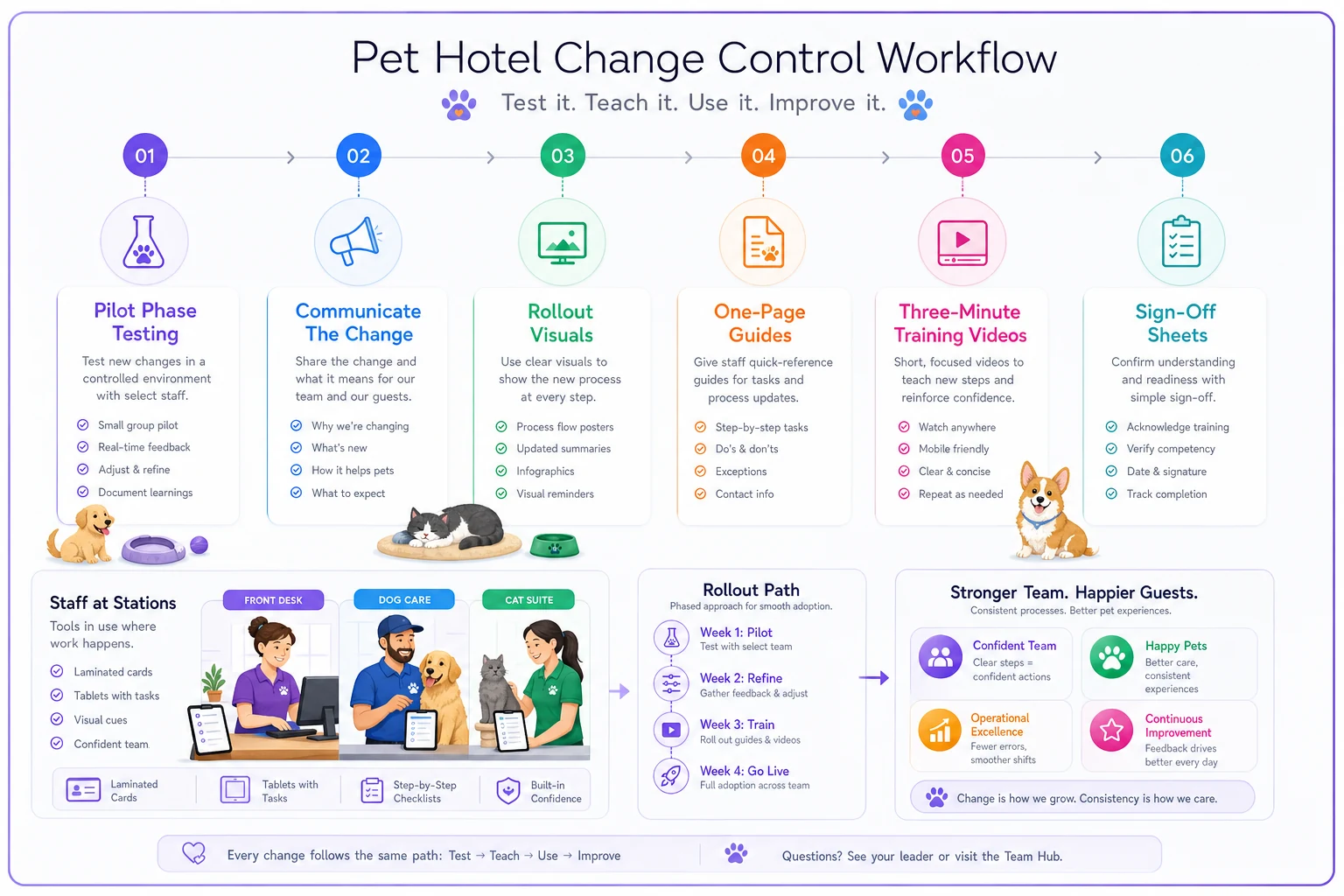
The biggest operational killer is implementing five new processes at once and watching them all fail. Here's a change control system that actually sticks:
The 2-Week Implementation Cycle:
Week 1: Pilot Phase
-
Pick ONE process change
-
Test with your strongest shift
-
Document every failure point
-
Modify based on feedback
Week 2: Rollout Phase
-
Train all shifts on the refined process
-
Post visual reminders at point of use
-
Lead shadows each shift once
-
Lock in or abort by Friday
Change Priority Matrix:
-
High impact + Low effort (medication logging)
-
Safety critical (evacuation procedures)
-
Customer-facing (check-in flow)
-
Efficiency gains (cleaning sequences)
-
Nice-to-haves (play group optimization)
Documentation Requirements:
-
One-page quick reference guide
-
Three-minute training video (phone video is fine)
-
Update to master operations manual
-
Sign-off sheet for all staff
Visual reference helps teams follow the cycle.
The facilities that successfully scale don't implement better ideas—they implement ideas better.
Real-world implementation pathway
A 45-kennel facility in Ohio used this exact playbook to scale to 95 kennels over 18 months. They started with broken owner-operator processes: feeding took two hours, medication errors happened weekly, and they were turning away business despite having empty kennels because operations couldn't absorb the load.
Phase 1 (Months 1-3): Built basic SOPs for morning routine, feeding, and medications. Nothing fancy, just one-page cards posted at stations. Morning routine dropped from 120 to 75 minutes.
Phase 2 (Months 4-6): Implemented the staffing model and KPI dashboard. Discovered they were overstaffed in afternoons and understaffed in mornings. Restructured schedules, saved around $2,200 monthly in labor.
Phase 3 (Months 7-9): Added decision trees and the change control process. Staff stopped interrupting managers constantly. New employees became productive in one week instead of three.
Phase 4 (Months 10-12): Built specialized SOPs for holidays and peak seasons. Thanksgiving went from their worst week to their most profitable.
Phase 5 (Months 13-18): Scaled from 45 to 95 kennels using the same systems. Revenue increased roughly 180% while labor costs only grew around 140%.
They didn't try to fix everything at once. Each phase built on the previous one.
Why most operations playbooks fail (and how to avoid it)
The playbooks gathering dust on office shelves share the same flaws: too complex, too rigid, or too generic. They read like someone who's never cleaned a kennel wrote them from a conference room.
Living documentation - Updated monthly based on what actually happens, not what should happen.
Role-specific - Kennel techs don't need manager procedures. Managers don't need detailed cleaning steps.
Accessible - Laminated cards at stations beat binders in offices. Quick reference beats comprehensive manuals every time.
Measurable - Every process should have a time standard or quality metric. "Clean thoroughly" means nothing. "All surfaces visibly clean, dry, no odor in 4 minutes" means something.
Operational software platforms now integrate these playbooks directly into daily workflows. Instead of checking a binder, staff see their next task on a tablet. Completed tasks automatically log. Exceptions trigger alerts. The playbook becomes the actual workflow, not a separate reference document someone has to remember to consult.
This matters more than most operators realize. The gap between "documented process" and "actual process" kills most operations. When your team has to remember to check the playbook, they won't. When the workflow system is the playbook, compliance becomes automatic.
Building your facility's custom playbook
Start with one operational area that's currently broken. Not slightly inefficient—genuinely broken. That's where you'll see immediate ROI and build momentum for broader implementation.
For most facilities, it's one of these:
-
Morning routines (taking too long, too chaotic)
-
Medication management (errors, missed doses)
-
Staff scheduling (constant coverage gaps)
-
Check-in/check-out (bottlenecks, missing information)
Pick one. Build its basic SOP. Test for a week. Refine based on what breaks. Roll out to all shifts. Measure the improvement. Then pick the next broken area.
Within six months, you'll have moved from chaos to consistency. Within a year, you'll wonder how you ever operated without clear systems. And unlike the facilities still stuck in Stage 2, you'll actually be ready to scale profitably instead of just adding more chaos to existing chaos.
Proper operations at 50 kennels makes more money than chaos at 100 kennels. Build the playbook, implement it modularly, and watch your facility shift from daily firefighting to predictable profitability.
Ready to optimize your pet hotel operations?
Join hundreds of pet hotels using GoPetel to save time, improve pet care, and increase booking reliability.