



Three weeks before Christmas, a pet hotel owner showed me their booking system. Fully booked through New Year's, waiting list twenty deep. Then she pulled up the actual occupancy report from last December: 78% filled.
The gap? Cancellations without deposits, last-minute no-shows, and what she called "phantom bookings" — reservations made months ahead that evaporated when the time came. Each empty kennel during peak season represented $85 per night in lost revenue, while families on the waitlist scrambled for alternatives.
Most pet boarding facilities treat cancellations as an unavoidable cost of doing business. They enforce policies inconsistently, skip deposit collection during slow periods, then wonder why revenue leaks accelerate during high-demand seasons. The real problem isn't whether you have a cancellation policy — it's whether your operational framework actually captures revenue from inevitable booking changes.
Why standard cancellation policies fail in pet boarding operations
Pet boarding cancellation dynamics differ fundamentally from hotels or restaurants. A family canceling their beach vacation feels disappointment. A pet owner canceling boarding often feels relief — they found a friend to watch Buddy, their trip got canceled, or they decided driving twelve hours with three dogs might work after all.
This emotional difference creates enforcement challenges. Staff hesitate to charge cancellation fees to regular clients. Managers waive penalties to avoid confrontation. The front desk applies policies differently depending on who's working that shift.
When inconsistent enforcement becomes standard practice, regular clients learn which staff members waive fees. Word spreads through local Facebook groups about which facilities "actually charge" their cancellation penalties. Your written policy becomes meaningless when enforcement depends on who answers the phone.
The booking conversion math compounds these problems. During peak periods, facilities often see 40% more initial bookings than actual stays. Without proper deposit structures, you're essentially providing free options to pet owners who may or may not show up. Meanwhile, committed clients can't secure spots because your system shows full capacity.
Building deposit structures that actually protect revenue
Effective deposit frameworks in pet boarding require different thinking than flat-fee approaches. The deposit amount needs to scale with both booking value and cancellation probability. A two-night stay in March doesn't carry the same revenue risk as a ten-night stay over Thanksgiving.
Never miss a booking or detail again.
GoPetel simplifies pet hotel operations by managing every reservation and pet profile seamlessly.
- Centralized booking management
- Automated client notifications
- Staff and kennel scheduling
No credit card required
| Booking Type | Deposit Amount | Collection Timing | Refund Window |
|---|---|---|---|
| Standard (under 3 nights) | 30% of total | At booking | 7 days before |
| Extended (4-7 nights) | 40% of total | At booking | 14 days before |
| Peak periods (holidays) | 50% of total | At booking | 21 days before |
| Last-minute (within 72 hrs) | Full payment | At booking | Non-refundable |
| Daycare add-ons | No deposit | At drop-off | N/A |
The structure acknowledges different risk levels. Holiday bookings require higher deposits and longer cancellation windows because demand exceeds supply. Last-minute bookings require full prepayment because there's no time to resell the space.
Collection timing matters as much as the amount. Deposits collected "at booking" mean immediately — not when they drop off, not "next time they come in." Every hour between reservation and deposit collection increases the probability you'll never see that money.
Some facilities worry higher deposits will reduce bookings. Serious pet owners understand and expect deposit requirements. The bookings you lose are typically the speculative ones — people holding multiple options who would likely cancel anyway. Your conversion rate might drop from 70% to 65%, but your actual occupancy and revenue increase because the remaining bookings are committed.
Sample messages that enforce policies without losing clients
The language you use when discussing deposits and cancellations determines whether clients comply or complain. Most facilities either sound apologetic or aggressive. Neither works well.
For initial booking with deposit requirement: "Perfect, I have you down for Bailey from December 20th through 27th. To confirm this reservation, we'll need a deposit of $196, which is 50% of the total. This deposit is fully refundable if you need to cancel before November 29th. Would you like to handle that over the phone now, or should I send you our secure payment link?"
When clients push back on deposit requirements: "I understand it's different from what we used to do. We made this change because we were turning away other pets for reservations that ended up canceling last minute. The deposit just ensures everyone who books actually needs the space. Most clients appreciate knowing their spot is genuinely secured."
For cancellations within the penalty window: "I see you're canceling your December 23-26 reservation for Max. Since we're within the 21-day window, the $127 deposit becomes a cancellation fee. This helps cover the fact that we've already turned away three other dogs for those dates. Would you like to apply this as a credit toward a future stay within the next 60 days?"
When enforcing no-show charges: "Hi Sarah, I'm following up on Milo's reservation this past weekend. Since we didn't hear from you and held his suite both nights, there's an outstanding balance of $170. We understand emergencies happen — would you prefer to settle this today or should we add it to your next visit?"
Critical element: no apologies, no lengthy explanations, just clear statement of fact. You're not asking permission to enforce your policy. You're informing them how your business operates.
The reconciliation checklist that catches revenue leaks
Most boarding facilities discover policy violations weeks later, when it's essentially impossible to collect. A daily reconciliation process catches issues while they're still manageable.
Every morning, before the chaos of drop-offs begins, someone needs to review:
Yesterday's cancellations:
-
Did each cancellation trigger the appropriate fee?
-
Were deposits properly converted to cancellation fees?
-
Did any staff member waive fees without manager approval?
-
Are there notes explaining any exceptions?
Today's arrivals:
-
Which reservations have zero deposit collected?
-
Are there any bookings made by staff that bypassed normal procedures?
-
Do we have current credit cards on file for all arrivals?
This week's upcoming bookings:
-
Which reservations still show unpaid deposits?
-
Are there any bookings in the "pending" status longer than 24 hours?
-
Have we sent deposit collection follow-ups for unbilled reservations?
No-show review:
-
Which yesterday reservations never arrived?
-
Has someone contacted these clients?
-
Have no-show fees been applied to their accounts?
-
Are there patterns with specific clients repeatedly no-showing?
This process takes roughly fifteen minutes when done daily. Wait a week, and you're looking at hours of detective work with much lower recovery rates.
Here's a simple daily reconciliation workflow.
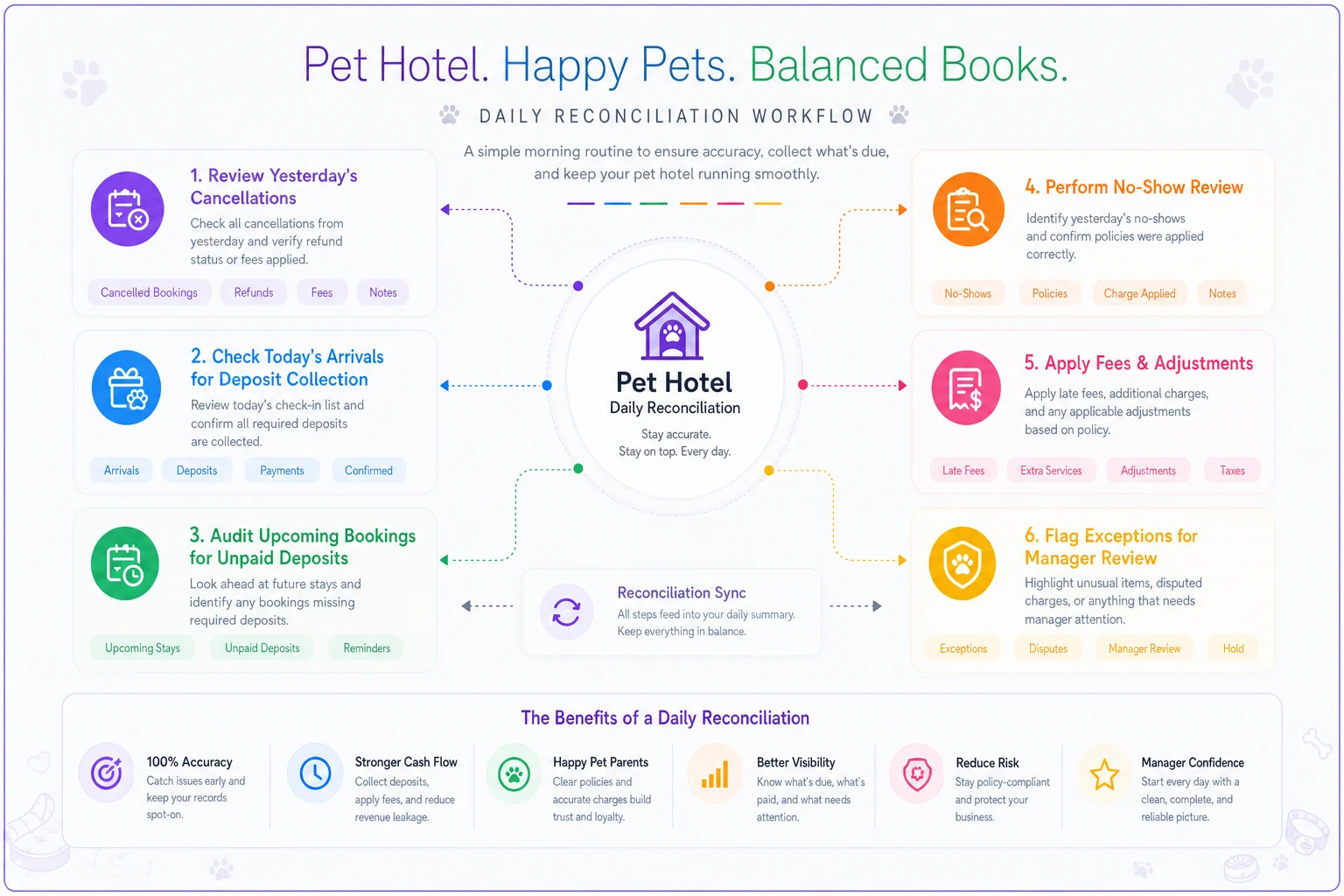
Run this routine before drop-off chaos to catch issues while recovery rates are high.
Tying deposit percentages to your actual conversion metrics
The standard advice says charge 50% deposits across the board. Your optimal deposit percentage depends on your specific market dynamics and operational costs. The math needs to balance three factors: booking conversion rates, cancellation frequency, and the revenue value of each booking.
Start by calculating your baseline metrics. Track for at least 60 days:
-
Total inquiries received
-
Bookings confirmed (with and without deposits)
-
Actual stays completed
-
Cancellations by timing (how far in advance)
-
No-shows
Say you receive 200 booking inquiries monthly. Without deposits, 140 confirm bookings, but only 95 actually stay. That's a 47.5% inquiry-to-stay conversion.
Now you implement 40% deposits. Inquiries stay at 200, but only 110 confirm bookings. However, 92 actually stay. Your inquiry-to-stay conversion is now 46% — nearly identical, but with deposits collected on 18 cancellations.
The formula for optimal deposit percentage: (Average cancellation loss per month ÷ Total monthly booking value) × 1.5
If you lose $3,000 monthly to cancellations and your total bookings value $25,000, your baseline should be 18%. The 1.5 multiplier accounts for the behavioral change deposits create — people cancel earlier when money's at stake, giving you time to resell.
This percentage should adjust seasonally. During peak periods when you're turning away business, increase deposits to 60-70%. During slow seasons when you need every booking, drop to 20-30%. The goal isn't maximum deposit collection — it's optimal revenue considering both deposits and occupancy.
Digital enforcement tools versus human discretion
The tension between consistent policy enforcement and maintaining client relationships often paralyzes pet boarding operations. Staff want flexibility to handle special situations. Owners want policies applied uniformly. Clients want exceptions for their specific circumstances.
Manual enforcement inevitably fails because humans aren't designed for uncomfortable consistency. Your most experienced staff member might expertly handle a difficult cancellation conversation. But what about the new weekend employee? What about when your manager is sick during Christmas week?
Operational software changes this dynamic. Instead of staff making individual decisions about policy enforcement, the system applies rules automatically. Deposits process at booking time. Cancellation fees trigger based on timing. No-show charges appear on accounts without anyone having to make a judgment call.
But pure automation without flexibility destroys client relationships. The solution isn't choosing between digital or human enforcement — it's creating clear escalation paths. The system handles 90% of standard situations automatically. Managers handle the 10% that genuinely need human judgment.
When long-time client Mrs. Patterson cancels within the penalty window because her husband had a heart attack, the system applies the fee, but flags it for manager review. The manager can then make an informed exception, documented in the system, without undermining overall policy enforcement.
AI-powered platforms take this further by identifying patterns. They notice which clients repeatedly book and cancel, which staff members consistently override policies, and which excuse patterns correlate with actual emergencies versus convenience cancellations. This intelligence helps you refine policies based on actual operational data, not gut feelings.
When strict policies become counterproductive
Not every facility needs aggressive cancellation policies. If you operate at 60% capacity year-round, harsh cancellation terms might do more harm than good.
Rural facilities with limited competition often find that community relationships matter more than policy enforcement. When you're the only boarding option within 40 miles, burning bridges over a $50 cancellation fee could cost thousands in lifetime value.
New facilities building their client base should focus on reducing friction, not maximizing protection. Better to fill kennels at lower margins initially than maintain strict policies that scare away early adopters. Once you've established reputation and regular demand, you can gradually introduce more protective measures.
Facilities with primarily daycare revenue and occasional boarding need different approaches. If boarding represents 15% of your revenue and clients primarily value your daycare services, aggressive boarding policies might damage your core business. Instead, consider member benefits that waive cancellation fees for regular daycare clients.
The seasonal nature of your business also matters. If 70% of annual revenue comes during six peak weeks, those weeks need maximum protection. The rest of the year, flexibility might generate more goodwill than the fees generate revenue.
Creating accountability without antagonizing good clients
The best cancellation policies prevent problems rather than penalize them. When clients understand expectations upfront and systems make compliance easy, enforcement becomes largely unnecessary.
Start with the booking process itself. Instead of mentioning deposits as an afterthought, build them into the initial conversation. "Our December availability requires a deposit to hold, which protects your spot and helps us manage our holiday scheduling. The deposit is fully refundable until December 1st if your plans change."
Payment infrastructure matters more than policy documents. If collecting deposits requires staff to manually process cards or chase down payments, enforcement will fail. Modern booking systems should automatically process deposits, send confirmation emails, and schedule reminder notices as cancellation deadlines approach.
Consider creating "policy tiers" based on client history. First-time clients follow standard policies. After three completed stays, they earn extended cancellation windows. After ten stays, they get one penalty-free cancellation annually. This rewards good behavior rather than only punishing bad behavior.
Send reminder notices seven days before the cancellation deadline to trigger early cancellations and free up space for waitlisted clients.
Communication timeline prevents surprise enforcement. Seven days before the cancellation deadline, send a reminder: "Your reservation for Buddy is coming up December 15-18. Remember, if you need to cancel, please let us know by December 8th to receive your full deposit refund." This simple notice often triggers early cancellations from uncertain clients, freeing space for waitlisted pets.
When enforcement is necessary, frame it as protecting all clients, not punishing individuals. "We enforce these policies because otherwise we'd have empty kennels during holidays while other families can't find care for their pets. The fees ensure people only book when they truly need space."
Measuring the real impact on revenue and occupancy
Six months after implementing structured pet boarding cancellation policy operations, you need to evaluate actual impact versus theoretical protection. Most facilities focus on the wrong metrics — total deposits collected or number of cancellation fees charged.
Revenue per available kennel night shows whether policies improve actual income. If you collected $5,000 in cancellation fees but occupancy dropped 8%, you might have net negative impact. Track this monthly and compare to the same periods from the previous year.
Booking-to-stay conversion rate indicates whether deposits filter out uncommitted bookings. A drop from 70% to 65% might actually represent improvement if the remaining bookings are more reliable.
Waitlist conversion during peak periods measures whether policies create availability for committed clients. If your Thanksgiving waitlist previously saw 10% get spaces, but now 35% get accommodated due to earlier cancellations, your policies are working.
Client lifetime value changes reveal whether enforcement damages relationships. Track whether clients who pay cancellation fees continue booking at previous rates. Some attrition is expected, but if lifetime values plummet, you're being too aggressive.
Staff time on payment collection quantifies operational efficiency. If your team spends three hours weekly chasing deposits and no-show fees, that's 150+ hours annually that could serve clients instead. Automation reduces this operational burden while improving consistency.
The compound effect of consistent enforcement
The biggest impact isn't the direct revenue from fees. It's the behavioral change that consistent enforcement creates across your entire client base.
When policies apply randomly, clients treat reservations casually. They book multiple facilities, waiting to decide later. They reserve "just in case" spots months in advance with no real intention of using them. They assume cancellation is always an option without consequence.
Consistent enforcement changes this entire dynamic. Clients book when genuinely committed. They cancel promptly when plans change, knowing delays cost money. They value their reservations because they've invested in them. Peak periods see less speculation and more actual utilization.
This shift typically takes 6-12 months to fully manifest. Initially, you'll face pushback, lose some clients, and question whether strict policies are worth it. But as word spreads that your policies are real, not theoretical, booking behavior changes. The clients you retain are the ones who value reliability — both yours and theirs.
The operational stability this creates extends beyond revenue. Staff stress decreases when they're not constantly juggling last-minute cancellations. Planning becomes possible when bookings are reliable. Quality improves when you're not scrambling to fill or empty spaces based on daily volatility.
Your good clients — the ones who always show up, pay on time, and follow policies — finally get the service they deserve. They can book peak periods knowing their reservations are secure. They receive consistent service because staff isn't overwhelmed with policy exceptions.
The path from casual reservation chaos to professional booking operations isn't complicated. It requires clear policies, consistent enforcement, and systems that remove human discretion from routine decisions. The transformation in revenue stability, operational predictability, and client quality makes the short-term discomfort worthwhile. Every pet boarding facility that's successfully scaled past the owner-operator stage has learned this lesson: protect your revenue by respecting your service's value, and clients who value that service will respect your policies in return.
Ready to optimize your pet hotel operations?
Join hundreds of pet hotels using GoPetel to save time, improve pet care, and increase booking reliability.