


Three weeks ago, a boarding facility in Austin lost $47,000 in two months. Not from equipment failure or staffing problems. From one dog with kennel cough that exposed 43 others before anyone caught it.
The owner thought she had solid protocols. Temperature checks at intake. Clean kennels. Vaccination records. But her infection control system had gaps she couldn't see until everything collapsed.
This wasn't about one sick dog or careless employee. The entire operational framework failed—from intake screening to isolation procedures to staff communication to compliance documentation. When state inspectors showed up after complaints, she couldn't produce proper incident reports or prove her staff followed protocols. The fines alone hit $8,500.
The hidden complexity of infection control in boarding operations
Most boarding facilities handle infection control like they're still running a 10-kennel operation out of their garage. Check vaccines, clean between stays, hope nothing spreads. Works fine until you're managing 40+ animals daily across multiple staff shifts.
The challenge isn't preventing every infection—that's impossible when you're housing stressed animals from different environments. It's building an operational system that catches problems early, responds fast, and documents everything for legal protection.
Consider what happens during a typical intake. Your morning staff checks in 8 dogs between 7-9am. One seems slightly lethargic but the owner mentions he's always slow in the mornings. Staff makes a mental note. Shift changes at 2pm. Evening staff has no idea about the morning observation. By day three, that dog has diarrhea, two neighboring dogs are showing symptoms, and nobody can remember exactly when signs started or who was exposed.
Multiply that scenario across holidays when you're at capacity, running with temporary staff, and every owner wants detailed health updates. Your infection control isn't just about medical protocols—it's about information flow, decision trees, and covering yourself legally when something inevitably goes wrong.
Where traditional approaches break at scale
Small operations can rely on one experienced person knowing every animal and catching subtle changes. But somewhere around 25-30 regular boarders, that model cracks.
Never miss a booking or detail again.
GoPetel simplifies pet hotel operations by managing every reservation and pet profile seamlessly.
- Centralized booking management
- Automated client notifications
- Staff and kennel scheduling
No credit card required
Most facilities doing $300K-$500K annually have basic morning intake processes with quick visual checks and vaccine paperwork verification. They assign kennels based on availability and maybe jot down notes if something seems off. Daily monitoring usually involves basic feed/water/walk schedules with general observations and verbal handoffs between shifts. When illness appears, they move the sick animal to a back kennel, call the owner, maybe bleach nearby areas, and hope nothing spreads.
This breaks down when you hit multiple issues simultaneously. Tuesday morning brings a dog with eye discharge, another refusing food, and a third with loose stool. Three different staff members noticed these issues at different times. Your experienced manager is off. The afternoon crew doesn't know if these are new problems or ongoing concerns.
The legal exposure compounds the operational chaos. Without proper documentation showing when symptoms appeared, what actions you took, and how you communicated with owners, you're vulnerable to lawsuits, negative reviews, and regulatory violations. One facility in Phoenix paid $31,000 in settlements last year simply because they couldn't prove they followed their own stated protocols.
Building an operational infection control framework
Effective infection control in boarding requires three interconnected systems: health monitoring workflows, escalation protocols, and compliance documentation. Miss any component and the whole framework fails when you need it most.
Intake health baselines that actually work
Forget basic visual checks. You need structured intake assessments that create real baselines for each animal while staying operationally realistic.
Every intake should capture body condition scores using standardized 1-9 scales, respiratory indicators including breathing rate and nasal discharge, digestive baselines covering last meals and stool quality, behavioral baselines measuring energy levels and stress signs, existing conditions disclosed by owners, and any special monitoring needs.
This stays operational through templated assessments staff can complete in under 3 minutes. Simple checkboxes and scales, not lengthy descriptions. A kennel tech with two weeks experience should handle the assessment accurately.
The intake form feeds directly into daily monitoring. Instead of "check if dog seems okay," staff compare against the specific baseline. Did the energetic Lab who scored 8/9 on energy suddenly drop to sluggish? That's an immediate flag, not a "wait and see" situation.
Isolation escalation that prevents spread
Traditional boarding thinks of isolation as binary—healthy or sick. Infection control needs graduated responses based on risk levels.
Level 1 - Observation Status: Animals showing mild changes from baseline remain in regular population but get flagged for enhanced monitoring. Staff checks every 2 hours instead of twice daily and documents specific symptoms. This catches problems before they become contagious.
Level 2 - Protective Isolation: Symptoms suggesting possible contagion like coughing, diarrhea, or eye discharge trigger immediate moves to transition areas—not full medical isolation but separated from general population. Staff uses basic PPE for interaction and contacts owners within 2 hours.
Level 3 - Medical Isolation: Confirmed or highly suspected infectious conditions require dedicated isolation spaces with separate ventilation when possible. Full PPE protocols apply, with dedicated staff members when feasible, no shared equipment or spaces, and mandatory veterinary consultation.
Making escalation decisions clear and removing guesswork helps staff follow specific protocols when they see specific symptoms instead of waiting for manager opinions.
Staff handoffs that preserve critical information
Shift changes kill infection control. Morning staff notices something, evening staff misses the context, overnight staff has no clue there's even a concern. You lose 24 hours of response time.
Structured handoff protocols include quick walkthroughs of any animals on observation or isolation status, reviews of monitoring logs highlighting baseline changes, identification of animals requiring enhanced monitoring next shift, updates on pending owner communications or veterinary consultations, and cleaning or disinfection tasks triggered by health concerns.
Use a simple standardized handoff form to force documentation of observation changes and required actions.
This isn't a casual conversation in the break room. Document the process with a standard form. Takes 5-10 minutes but prevents the communication failures that let infections spread.
One facility in Denver reduced infection transmission by roughly 60% just by implementing structured handoffs. They went from 3-4 outbreak incidents yearly to one minor case in 18 months. The difference wasn't better medical knowledge—it was better information flow.
Documentation that holds up legally
When an owner claims their dog got sick at your facility, your documentation becomes your defense. Most facilities create paperwork that won't survive legal scrutiny.
Common documentation mistakes include vague notes like "seemed tired" without timestamps, missing entries when "nothing happened," different staff recording differently, no clear decision trails for why actions were or weren't taken, and inability to reconstruct timelines of exposure.
Legally defensible documentation includes health monitoring logs with timestamps for every observation, specific symptoms using standardized terminology, actions taken or explicit notation of "monitored, no action needed," and staff initials for accountability.
Incident reports should cover when symptoms were first noticed, complete lists of potentially exposed animals, timelines of escalation decisions, communications with owners including time and method and content, veterinary consultations and recommendations, and outcomes with follow-up actions.
Compliance records need proof of staff training on protocols, cleaning and disinfection logs, vaccination verification for all animals, and state inspection readiness documentation.
The framework connects all these pieces. Intake baselines feed monitoring logs. Monitoring triggers incident reports. Incident reports drive compliance documentation. Everything traceable, defensible, and ready for inspection.
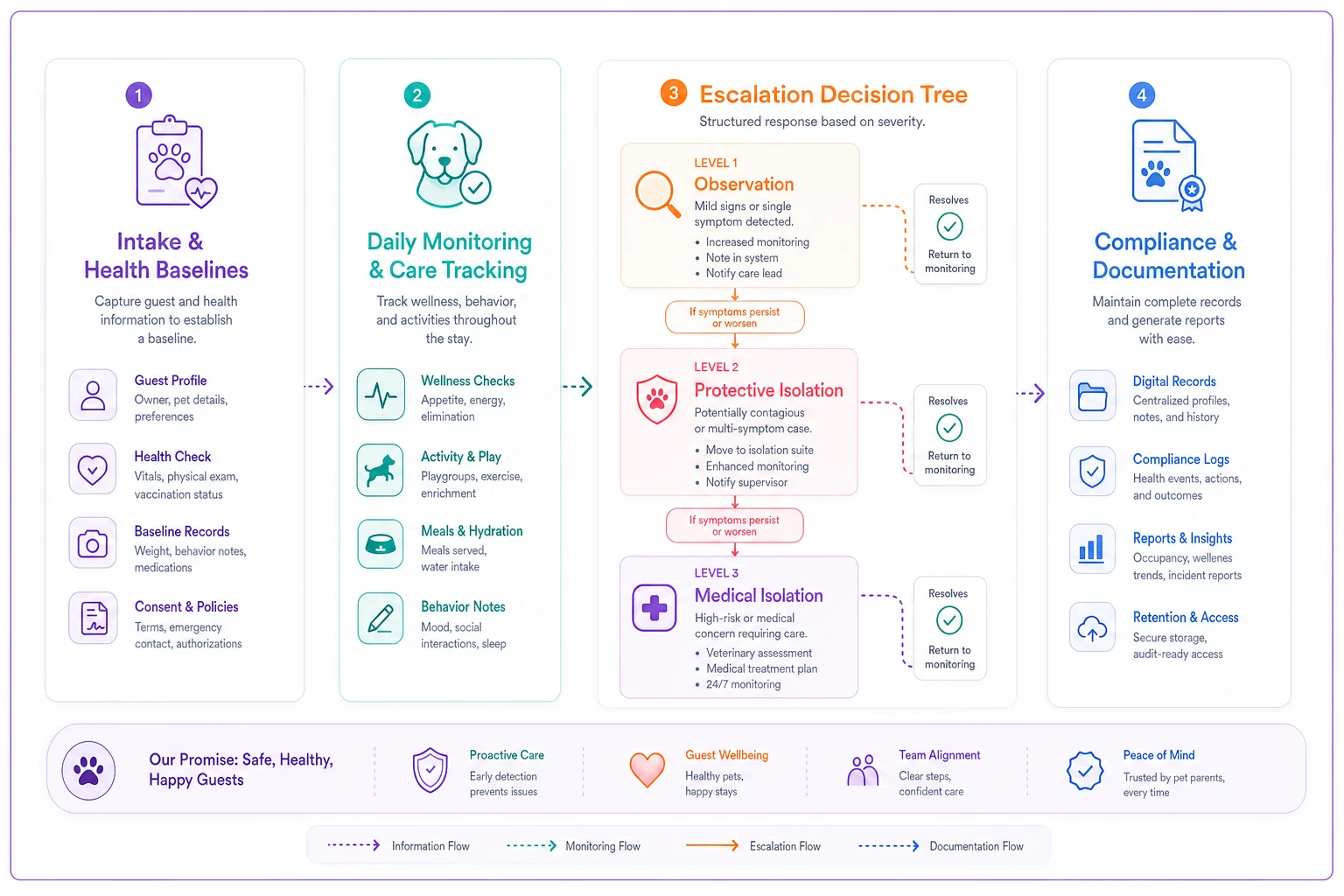
A simple diagram like this makes roles and handoffs obvious to every staff member.
Training staff without overwhelming operations
You can't just hand staff a manual and expect consistent execution. But you also can't pull everyone offline for extensive training. The solution is embedding training into actual workflows.
-
Start with one protocol at a time. Week one, everyone focuses on mastering intake assessments using real animals during actual check-ins. Experienced staff shadows new staff, correcting in real-time. By week two, the process becomes routine.
-
Week two adds isolation escalation. Run scenarios during quiet periods asking staff to respond to specific symptoms. Make decisions visible by posting the escalation chart prominently. Staff learns through repetition.
-
Week three introduces documentation standards. Pair new staff with experienced staff for their first few incident reports. Review documentation together at shift changes. Corrections happen immediately.
This rolling approach means operations never stop for training. Staff builds competence gradually through actual work. After 30 days, even new hires execute protocols consistently.
Regular reinforcement maintains standards through monthly scenario drills during staff meetings, quarterly documentation reviews, and annual certification refreshers. Always integrated into operations.
The actual cost of poor infection control
Facilities underestimate infection control costs because they only count immediate expenses—veterinary bills, refunds, maybe some overtime for deep cleaning. The real damage runs much deeper.
Direct costs from one moderate outbreak based on actual facility data include veterinary consultations and treatments running $2,800-$4,500, full facility deep cleaning costing $1,200-$2,000, refunds and compensation hitting $3,000-$5,000, additional staffing for isolation care adding $800-$1,500, and regulatory fines if reported ranging $2,000-$10,000.
| Cost category | Details |
|---|---|
| Direct costs | Veterinary consultations and treatments running $2,800-$4,500 |
| Direct costs | Full facility deep cleaning costing $1,200-$2,000 |
| Direct costs | Refunds and compensation hitting $3,000-$5,000 |
| Direct costs | Additional staffing for isolation care adding $800-$1,500 |
| Direct costs | Regulatory fines if reported ranging $2,000-$10,000 |
| Indirect costs | Lost bookings during outbreaks costing $8,000-$15,000 |
| Indirect costs | Reputation damage lasting 6-12 months worth $20,000-$40,000 |
| Indirect costs | Increased insurance premiums of $2,400-$4,800 annually |
| Indirect costs | Staff turnover from stress requiring $5,000-$8,000 in replacement costs |
| Indirect costs | Legal defense even if you win running $10,000-$25,000 |
A facility doing $400K annually can lose an entire quarter's profit from one poorly managed outbreak. The owner in Austin? She's still recovering financially eight months later. Her occupancy dropped from 85% to 60%. Three long-term clients left permanently. Insurance premiums jumped 40%.
Compare that to prevention costs. Proper intake assessment forms require a few hundred in setup time. Isolation protocol development might cost $1,500 in consulting. Staff training programs need 20-30 hours of management time. Documentation systems require basic templates and filing.
Prevention costs maybe $5,000-$8,000 to implement properly. One prevented outbreak saves twice that. Two prevented outbreaks and you've funded the system for years.
When automation makes the difference
Manual infection control works until it doesn't. You're tracking 40 animals, managing 8 staff members, juggling 15 different health observations, and trying to maintain documentation that would satisfy an inspector. Something always falls through the cracks.
AI-powered operational software changes this dynamic—not by replacing judgment but by ensuring nothing gets missed. Automated intake assessments flag variations from baseline. Escalation workflows trigger based on specific symptoms. Documentation generates automatically from staff inputs. Compliance reports stay ready for inspection at any moment.
The pet boarding infection control framework becomes truly bulletproof when technology handles the information flow while staff focuses on animal care. Health observations sync across shifts automatically. Isolation protocols trigger notifications to relevant staff. Owner communications log themselves. Training compliance tracks without manual spreadsheets.
A facility in Colorado implemented this type of operational platform last year after two expensive outbreaks. They haven't had a single infection spread beyond the initial case since. Not because the software prevents illness, but because it ensures protocols actually get followed, information doesn't get lost, and documentation stays bulletproof.
Building your facility's custom framework
Every boarding facility needs slightly different protocols based on size, layout, and clientele. A luxury pet resort with private suites has different infection risks than a traditional kennel with shared play areas. But the framework structure remains consistent.
Start by mapping your current infection touchpoints. Where do animals first interact? Which spaces share ventilation? When do staff transitions create information gaps? What decisions require rapid escalation? Which documentation would you need in court?
Build protocols addressing each touchpoint. Not generic "industry best practices" but specific procedures for your facility. If you have three buildings, define isolation procedures for each. If you run doggy daycare alongside boarding, create separate exposure protocols.
Test the framework with realistic scenarios. Not "what if a dog gets sick" but "Tuesday morning, 7:15am, part-time staff notices dog in kennel 15 coughing, manager not arriving until 9am, three dogs already in shared play area, owner flying back from vacation tomorrow." Run the scenario. Find the gaps. Adjust protocols.
Document everything in operational terms, not medical jargon. Your weekend staff should understand exactly what to do without calling for clarification. Clear decision trees. Specific action steps. No ambiguity about who does what when.
Review and refine quarterly. Each near-miss or actual incident teaches something. Maybe your isolation triggers need adjustment. Perhaps handoff procedures miss critical details. Small refinements based on actual operations prevent major failures.
The competitive advantage of operational excellence
Most boarding facilities compete on amenities—fancier suites, better play areas, premium services. But parents choosing boarding care about one thing above all: will their pet come home healthy?
A comprehensive infection control framework becomes your strongest differentiator. Not because you advertise it, but because outcomes speak. Zero outbreak incidents in 18 months. Detailed health updates that show professional monitoring. Confidence when health issues do arise because protocols kick in immediately.
Facilities with strong operational frameworks charge 20-30% premium rates. They maintain 90%+ occupancy even during slow seasons. They get veterinary referrals because vets trust their protocols. Insurance companies offer better rates recognizing lower risk.
More importantly, they operate with confidence. Staff knows exactly what to do. Owners trust the professional response. Inspectors find everything in order. The business runs smoothly even during challenges because systems handle complexity.
The Austin facility that lost $47,000? They're rebuilding with a comprehensive framework now. Intake assessments catch issues early. Isolation protocols prevent spread. Documentation satisfies inspectors and lawyers. They've gone from crisis to confidence in under a year.
Your facility doesn't need to learn these lessons the expensive way. Build the framework before you need it. Implement protocols while operations are calm. Train staff when you have bandwidth. Because when that first sick puppy arrives, you want systems, not scrambling.
Strong infection control isn't about preventing every illness—that's impossible when housing stressed animals from various environments. It's about building operational systems that respond fast, document everything, and protect your business legally and financially. The framework outlined here does exactly that, turning infection control from a liability into a competitive advantage.
Ready to optimize your pet hotel operations?
Join hundreds of pet hotels using GoPetel to save time, improve pet care, and increase booking reliability.