



Most pet hotels operate with pricing models that haven't changed since someone first decided dogs needed vacation spots. One flat rate for small dogs, another for large ones. Maybe a surcharge for medications. Meanwhile, actual hotels figured out dynamic pricing decades ago—squeezing every dollar from every available room with segmentation and yield optimization.
The gap between how pet hotels price versus human hotels isn't just embarrassing—it's expensive. A 40-kennel facility charging flat rates leaves roughly $8,000 to $12,000 on the table monthly compared to one using proper revenue management. That comes from tracking actual occupancy patterns, segmenting customers correctly, and adjusting pricing based on demand.
Why Pet Hotels Stay Stuck in Basic Pricing Mode
The kennel industry inherited its pricing from veterinary boarding—where the goal was breaking even on a service nobody wanted to provide. Vets boarded pets as a courtesy, not profit. They charged enough to cover staff time and kibble.
Standalone pet hotels operate differently. Your fixed costs dominate whether you're at 30% or 90% occupancy. Staff schedules stay relatively constant. Rent stays the same. Insurance, utilities, cleaning supplies—mostly fixed. Most operators price like they're selling physical products with variable costs, not perishable inventory that expires every night.
Customer behavior makes flat pricing worse. Regular customers who book monthly for daycare subsidize once-a-year holiday boarders who demand premium dates. Your bread-and-butter clients paying full rate for random Tuesday overnights generate the same revenue as the Thanksgiving week customer who booked six months ahead. The business traveler needing last-minute boarding pays the same as someone who planned their vacation a year out.
Airlines figured out yield management in the 1980s. Hotels perfected it in the 1990s. Even parking garages use dynamic pricing now. Pet hotels keep printing the same rate card year after year, watching their best customers get the worst deal while leaving premium revenue on the table during peak periods.
Building Your Segmentation Framework
Customer segmentation in pet hotels goes beyond "small dog" versus "large dog." Real segmentation starts with booking patterns and willingness to pay.
Never miss a booking or detail again.
GoPetel simplifies pet hotel operations by managing every reservation and pet profile seamlessly.
- Centralized booking management
- Automated client notifications
- Staff and kennel scheduling
No credit card required
Regular daycare clients represent one complete segment. These customers value routine, consistency, and relationships with specific staff. They book the same days weekly, rarely complain about incremental price increases, and provide predictable baseline revenue. Most facilities charge them the same rates as sporadic users, missing the chance to create loyalty programs that lock in recurring revenue while offering modest discounts for commitment.
Business travelers form another distinct segment. They book irregularly but frequently, often with short notice, and care primarily about availability and reliability. They'll pay premium rates for guaranteed last-minute space and flexible pickup times. A corporate account program with reserved capacity and 20-30% price premiums captures value these customers already expect to pay.
Vacation boarders book far in advance for specific dates, usually holidays or summer travel. They comparison shop extensively beforehand but rarely switch once committed. They want comprehensive services bundled together—grooming before pickup, multiple walks daily, photo updates. They're buying peace of mind, not kennel space.
Emergency boarders need immediate solutions. Family emergencies, sudden hospital stays, unexpected travel. These customers will pay almost anything for available space. Having a few kennels held back for true same-day emergency bookings at 2-3x normal rates serves this segment while maintaining capacity for crisis situations.
The overnight-only crowd differs from extended stay customers in ways that affect profitability. A dog staying one night requires the same intake processing, behavioral assessment, and paperwork as one staying two weeks, but generates a fraction of the revenue. Minimum stay requirements during peak periods or higher single-night rates offset these administrative costs.
Developing Tiered Service Packages
Once you understand your segments, you need products that capture different willingness to pay. This doesn't mean just adding a "luxury suite" and calling it done.
Start with your base tier—standard boarding covering essentials. Safe, clean kennels. Standard feeding schedule. Group playtime twice daily. Basic updates on request. Price this at your current rates to maintain accessibility for price-sensitive customers.
Your comfort tier adds elements that cost little to provide but significantly enhance perceived value. Individual playtime sessions instead of just group play. Bedtime treats. Daily photo updates pushed to an app. Midday snack or Kong toy. Price this 25-30% above base tier.
Position the comfort tier clearly between base and premium with a 25-30% uplift so customers see obvious incremental value without pricing themselves out.
The premium tier transforms boarding into an experience. Webcam access to check on pets remotely. Extended individual attention sessions. Premium bedding and toys from home allowed. Grooming services included. Dedicated staff member as primary caretaker. This tier should run 60-80% above base pricing.
Create a VIP tier for your highest-value customers. Reserved suites that never sell out. Flexible pickup and drop-off times. Monthly billing regardless of usage (subscription model). Concierge services like medication administration, special dietary accommodation, even pickup and delivery. Price this at 2-3x base rates or via monthly membership fees.
These tiers shouldn't just exist on paper. Your operational software needs to track which tier each pet is booked under, automatically adjust care protocols, assign appropriate staff resources, and generate the right communication touchpoints. When a premium tier dog arrives, staff should immediately know they need individual playtime logged, photos uploaded, and treats distributed on schedule.
Implementing Occupancy-Based Pricing
The simplest revenue optimization tool remains chronically underused in pet hotels: charging more when you're busy and less when you're not.
Track your actual occupancy patterns for the past year. Most facilities show predictable waves—dead zones in February and September, moderate demand through spring and fall, surge periods around every major holiday. They charge the same rate on February 15th (when they're at 20% capacity) as December 23rd (when they turn away a dozen requests).
Basic dynamic pricing starts with seasonal adjustments. Low season rates might drop 15-20% below standard. Shoulder seasons stay at standard. Peak seasons increase 30-50%. Holiday weeks can command 75-100% premiums. Instead of jarring customers with sudden price changes, publish your rate calendar annually so customers can plan ahead.
Day-of-week pricing adds another layer. Sunday through Wednesday nights typically run lower occupancy than Thursday through Saturday. A 10-15% discount for Sunday-Wednesday stays fills empty kennels while maintaining weekend revenues. Some facilities flip this model, offering corporate rates during the week while charging premium weekend rates for leisure travelers.
Advance booking incentives work differently than human hotels. While last-minute human hotel bookings usually cost more, pet hotels can incentivize early booking for peak periods to lock in revenue and plan staffing. A 10% early bird discount for holiday bookings made 60+ days in advance ensures you fill premium periods while maintaining pricing power for procrastinators.
Length-of-stay pricing drives profitability by reducing turnover costs. A dog staying seven nights requires one intake, one discharge, one set of paperwork. Seven different dogs staying one night each means seven times the administrative work. Graduated discounts—5% off stays of 5-7 nights, 10% off 8-14 nights, 15% off 15+ nights—push customers toward longer bookings while improving operational efficiency.
The Metrics That Actually Matter
Forget about just tracking "how many dogs stayed last month." Real revenue management requires understanding unit economics at a granular level.
Average Daily Rate (ADR) tells you what customers actually pay per night, accounting for all your discounts, packages, and tier mixing. If your rack rate is $50 but your ADR is $42, you're either discounting too heavily or your mix skews toward lower tiers. Track ADR by customer segment to identify which groups deliver the most value.
Revenue Per Available Run (RevPAR) multiplies your ADR by occupancy rate. A facility with 40 runs, $45 ADR, and 70% occupancy generates $1,260 daily RevPAR. Would you rather be 90% full at $40 average rate or 70% full at $50? RevPAR tells you the answer: $1,400 beats $1,260.
Revenue Per Customer (RPC) extends beyond single stays to capture total customer value. A daycare regular might spend $400 monthly on daycare plus $2,000 annually on boarding. That $6,800 annual customer value justifies different service levels than someone who boards once yearly for $300.
Contribution Margin Per Pet-Day digs into actual profitability. A basic tier dog generating $45 revenue might cost $12 in variable costs (food, labor, supplies) for $33 contribution. A premium tier dog at $75 might cost $18 in variable costs for $57 contribution. But if premium tier dogs require dedicated staff that pushes labor costs higher, the margin advantage shrinks.
| Metric | What It Measures | Why It Matters |
|---|---|---|
| Average Daily Rate (ADR) | Actual revenue per night across all discounts/tiers | Shows pricing effectiveness by segment |
| Revenue Per Available Run (RevPAR) | ADR × occupancy rate | Balances pricing vs. utilization |
| Revenue Per Customer (RPC) | Total annual customer value | Identifies highest-value relationships |
| Contribution Margin Per Pet-Day | Revenue minus variable costs per stay | Real profitability after service delivery |
| Service Attach Rate | Percentage adding ancillary services | Cross-selling and upselling performance |
Service Attach Rates measure how well you're capturing ancillary revenue. What percentage of boarding stays include grooming? How many customers upgrade to premium tiers? How many add training sessions or daycare days to their boarding stays? Low attach rates signal missed cross-selling opportunities.
Building Your Pricing Experiments
Testing pricing changes terrifies most operators, but structured experiments minimize risk while maximizing learning.
Start with time-boxed tests on specific segments. Instead of changing all pricing at once, test new rates on one customer segment for 60 days. Try increasing last-minute booking rates by 25% for customers booking within 72 hours. Track whether demand drops, shifts to advance booking, or stays constant. If revenue increases, roll out wider. If it drops, revert and try 15%.
A/B testing works for digital bookings. Show different prices to different website visitors (ensuring consistent pricing once they enter your system). Test whether a $49 "comfort tier" converts better than a $39 base tier with $10 in add-ons that reach the same price. Test whether showing per-week rates versus per-night rates increases average stay length.
Bundle experiments reveal price sensitivity. Create a "worry-free week" package that includes boarding, grooming, training session, and daycare transition day for a bundled price. If the bundle priced at 85% of à la carte rates increases uptake, you've found a way to increase revenue per customer while providing perceived value.
Geographic testing helps multi-location operators. If you run three locations, test new pricing at one while holding others constant. This isolates price elasticity from seasonal or market-wide effects.
Threshold testing identifies breaking points. Gradually increase prices for specific services by $2-3 monthly until you see customer resistance. Most operators discover they've been underpriced for years, with customers willing to pay 15-20% more than current rates for services they already value.
Revenue Management Implementation Process
Rolling out sophisticated pricing doesn't happen overnight. Most successful facilities follow this sequence:
-
Data Collection Phase (Month 1-2)
Track current occupancy patterns, customer segments, and service attach rates
-
Segmentation Implementation (Month 3)
Define customer categories and begin tailoring communications
-
Tiered Service Launch (Month 4-5)
Introduce service packages with clear differentiation
-
Dynamic Pricing Pilot (Month 6)
Test seasonal or occupancy-based adjustments on one segment
-
Full System Integration (Month 7-8)
Connect pricing rules with operational software and staff training
-
Optimization Phase (Ongoing)
Regular testing and refinement based on performance data
Each phase builds on the previous one. You can't effectively test dynamic pricing without clear customer segments. You can't deliver tiered services without operational systems that track and execute different protocols.
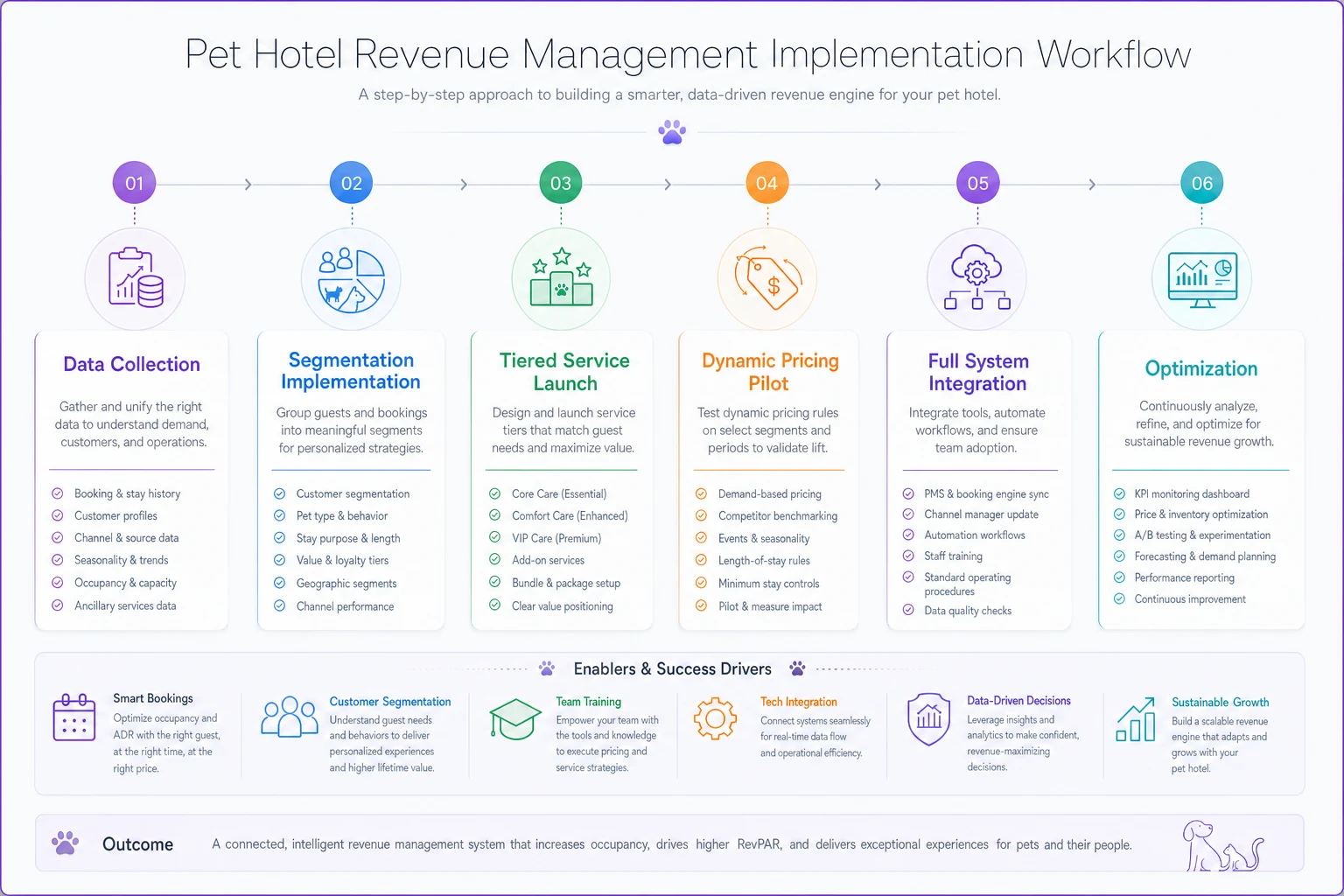
The biggest mistake is trying to implement everything simultaneously. Staff get overwhelmed, customers get confused, and you can't isolate which changes are working.
When Software Automation Transforms Revenue Management
Manual revenue management breaks down around 25-30 kennels. The complexity of tracking multiple tiers, segments, occupancy patterns, and pricing rules exceeds what spreadsheets can handle efficiently. You make gut decisions instead of data-driven ones.
Operational software designed for pet care facilities changes this completely. Modern platforms don't just track bookings—they continuously analyze patterns, suggest pricing optimizations, and automatically adjust rates based on rules you set. When occupancy for next week hits 80%, the system automatically increases prices 20% for new bookings. When a regular customer books, it applies their loyalty discount without staff intervention.
Integration across all operational areas provides the real power. Your pricing system talks to your booking system, which talks to your staff scheduling system, which talks to your customer communication system. A premium tier booking automatically triggers appropriate staff assignments, care protocols, and communication templates. Revenue management stops being a separate function and becomes embedded in every operational decision.
The biggest impact might be preventing revenue leakage. Every time staff quotes the wrong price, forgets to charge for an add-on service, or manually overrides pricing without documentation, revenue disappears. Automated pricing rules, integrated payment processing, and audit trails eliminate these thousand-dollar paper cuts that add up to serious money.
For a 40-kennel facility, the difference between manual and automated revenue management typically equals $4,000-8,000 monthly in captured revenue. That's not from raising prices—it's from consistently applying the right price to the right customer at the right time, capturing all ancillary services, and eliminating manual pricing errors.
The Path Forward
Your pet hotel doesn't need to become a hyper-optimized algorithmic pricing machine overnight. Pick one concept from this framework—maybe customer segmentation or basic peak/off-peak pricing—and implement it for 90 days. Track the results carefully. Once that feels stable, layer in another element.
The facilities making the most money in pet care aren't necessarily the ones with the fanciest buildings or the most services. They're the ones who understand their customers deeply, price according to value delivered, and use systems to ensure consistency.
They treat every kennel-night as perishable inventory, every customer segment as unique, and every pricing decision as testable. Professional revenue management isn't about squeezing every penny from customers. It's about aligning price with value, ensuring your best customers get rewarded, and generating enough profit to continuously improve your facility and services.
When done right, everyone wins—you make more money, customers get better service options, and pets receive higher quality care from a financially healthy business. The tools and techniques exist. The only question is whether you'll keep running your 2024 pet hotel with 1987 pricing, or finally start capturing the revenue you're already earning.
Ready to optimize your pet hotel operations?
Join hundreds of pet hotels using GoPetel to save time, improve pet care, and increase booking reliability.