


Most pet hotel owners think about chemicals exactly twice: when they buy them, and when an inspector asks about them. The rest of the time, disinfectants, flea treatments, drain cleaners, and pool-grade sanitizers sit in a back closet nobody wants to open. That gap—between purchase and scrutiny—is where the money leaks and the liability quietly builds.
Pet hotel chemical waste compliance isn't one problem. It's four separate operational systems that touch each other in ways that only become obvious when something goes wrong. What you store connects to how you dispose of it. What you buy connects to what your suppliers can actually prove. And whether you retrofit a wash bay or keep patching leaks connects to your insurance premium and your utility bill.
This isn't a "go green" pep talk. It's an operational breakdown of how these pieces fit, where they break as you grow, and how to phase changes so you're not gutting your budget or your workflow in the process.
Why chemical operations break the moment you scale past one building
At a single-site operation with 20–30 runs, chemical management is basically tribal knowledge. One manager knows the quaternary ammonium dilution ratio by heart. Someone remembers the vet-supply rep's cell number. Hazardous waste—spent disinfectant concentrate, expired meds, sharps from medical boarders—gets handled in a way that mostly works because the same three people always handle it.
Then you add a second location, or go from 30 runs to 70, or bring on rotating part-timers during peak season. Suddenly that tribal knowledge is a liability. A new hire mixes a bleach-based cleaner with an ammonia-based one because nobody wrote down which products can't touch. The expired flea dip sits in a corner for eight months because disposal was never anyone's actual job. An inspector shows up asking for Safety Data Sheets and you realize half of them are for products you stopped using two years ago.
-
Material selection — what you buy and why
-
Storage and handling — how it lives on-site without becoming a hazard
-
Disposal and waste tracking — how it leaves the building legally
-
Supplier and procurement discipline — who you buy from and what they can document
Treat these as one blob and you'll always be reactive. Treat them as connected systems with clear ownership and you can phase improvements without blowing up your daily operations.
Phase 1: Material substitution (start here, because it changes everything downstream)
Substitution is the highest-leverage move because every chemical you swap out changes your storage requirements, your disposal costs, and your regulatory exposure all at once. Replace a corrosive concentrate with a ready-to-use, lower-toxicity equivalent and you've just shrunk three problems simultaneously.
Never miss a booking or detail again.
GoPetel simplifies pet hotel operations by managing every reservation and pet profile seamlessly.
- Centralized booking management
- Automated client notifications
- Staff and kennel scheduling
No credit card required
Substitution done wrong, though, is worse than doing nothing. The classic mistake is swapping products based on the marketing label—"eco-friendly!"—without checking whether the new product actually kills the pathogens you need it to kill. A "green" disinfectant without proven efficacy against parvovirus or kennel cough isn't a sustainability win. It's an outbreak waiting to happen. Efficacy comes first, always.
The material substitution checklist
-
Efficacy match — Does it carry the kill claims you actually need (parvo, distemper, ringworm, Bordetella)? Contact time matters too—a product that needs 10 minutes of wet contact is useless if your cleaning workflow only allows 3.
-
Concentration format — Can you buy it ready-to-use or in controlled-dose packets instead of raw concentrate? Concentrates are cheaper per gallon but far more dangerous to store and mix.
-
Compatibility — Does it react with anything else in your closet? Map the "never mix" pairs explicitly.
-
Disposal profile — Is the spent solution drain-safe under your local rules, or does it require hazardous pickup? This single answer can swing your disposal costs dramatically.
-
PPE burden — Does it require respirators, chemical gloves, eye protection? More PPE means more training and more places for staff to cut corners.
-
Storage footprint — Flammable? Corrosive? Does it need a separate cabinet or ventilation?
-
Cost per use, not per gallon — Concentrate looks cheap until you factor in dilution errors, waste, and disposal.
A realistic example of how this plays out: a mid-size facility running heavy bleach and a separate ammonia-based glass/surface cleaner consolidates down to one accelerated hydrogen peroxide product for most surfaces. The peroxide breaks down into water and oxygen, so spent solution is generally drain-safe, the "never mix" risk with bleach disappears, and they've dropped from six SKUs to three. Fewer SKUs means simpler training, fewer SDS sheets to maintain, and less dead stock expiring in the closet.
When substitution is a bad idea
-
Don't substitute a proven disinfectant during peak season or an active health scare.
-
Don't swap products in the middle of onboarding a wave of seasonal staff—you'll be training people on a moving target.
-
Don't chase substitution on a product that represents a tiny fraction of your usage; the effort won't pay back.
Sequence it for a slow week, prove the new product works, then roll it into your SOPs.
Phase 2: Storage and disposal SOPs (the part inspectors actually check)
Storage is where good intentions go to die. You buy the safer products, and then someone stacks them above the food prep area or leaves the medical-boarder sharps container next to the mop bucket. The chemicals are fine. The placement and process is the exposure.
Storage is also where your cleaning workflow and your compliance workflow collide. If your disinfectant lives on the opposite side of the building from your wash bay, staff will decant it into unlabeled spray bottles to save trips—and now you've got mystery chemicals with no labels, which is both a safety hazard and an instant inspection flag. Your storage layout should follow your actual cleaning path, not wherever the closet happened to be. This connects directly to how you sequence turnaround work; if you haven't mapped your parallel-task cleaning flow, storage placement is basically guessing. (Worth revisiting the logic in timed parallel-task SOPs to cut kennel turnaround—storage location is a hidden variable in turnaround speed.)
A working storage & disposal SOP structure
-
Segregation map. Document which products cannot be stored near each other (oxidizers away from flammables, acids away from bases). Post it physically on the storage room door, not just in a binder.
-
Labeling rule. Every container—including secondary spray bottles—gets a label with product name, dilution, and date mixed. No exceptions. Unlabeled = disposed.
-
Dilution station. One designated spot for mixing, with ratios posted and the correct measuring tools present. Eyeballing dilutions is where both waste and injuries come from.
-
Expiry tracking. A simple first-in-first-out shelf system plus a monthly check. Expired chemicals are the most common thing sitting in disposal limbo.
-
Waste segregation. Separate streams for
drain-safe spent solution, hazardous liquid waste, sharps/medical waste, and empty containers. Each stream gets its own labeled container and a documented disposal path.
-
Disposal log. Every hazardous pickup logged with date, quantity, hauler, and manifest number. This log is your proof if anyone asks—and it's also how you spot that you're over-ordering.
-
Shift-handoff check. A 60-second closing check that the dilution station is clean, bottles are labeled, and nothing's been left out.
Keep disposal manifests and pickup records stored digitally alongside your SOPs so an auditor doesn't derail operations hunting for paper.
The disposal log deserves its own emphasis because it's the piece almost everyone skips and the piece that saves you in an audit. Manifests and pickup records are legally your responsibility to retain—usually for three years, sometimes longer depending on your state. "We use a hauler" is not a defense if you can't produce the paperwork. Store these digitally with the rest of your operational records so they're not sitting in a smudged folder in the back office.
Phase 3: Supplier scorecards (procurement is a compliance tool, not just a cost center)
A connection most owners miss: your suppliers are part of your compliance chain. If your disinfectant vendor can't hand you a current SDS on request, that's your problem during an inspection, not theirs. If a supplier keeps shipping concentrate when you asked for ready-to-use, your storage risk goes up. Procurement decisions ripple straight into safety and legal exposure.
| Factor | What you're checking | Why it matters |
|---|---|---|
| SDS availability | Current sheets provided fast, on request | Direct inspection exposure |
| Product consistency | Same formulation, no surprise reformulations | A reformulated product can change efficacy and disposal profile |
| Format flexibility | Can supply RTU or dosed formats | Lowers your storage/handling risk |
| Take-back / disposal support | Will they take back containers or expired product? | Cuts your disposal costs and paperwork |
| Lead time reliability | Consistent delivery windows | Prevents panic-buying riskier substitutes |
| Regulatory guidance | Do they flag regulation changes? | Free early warning on compliance shifts |
| Price transparency | Cost per use, not just per unit | Real cost comparison |
The cheapest supplier per gallon is frequently the most expensive supplier per risk. A vendor that offers container take-back and RTU formats might cost 8–12% more on paper but eliminate a hazardous-waste pickup line item entirely and shrink your storage hazard. Score them across all factors and the "expensive" one often wins.
This overlaps with how you should be evaluating vendors generally. The same scorecard discipline you'd use for food, bedding, or bulk supplies applies here—chemical suppliers just become another category with two extra columns for SDS and disposal support.
Phase 4: Retrofit ROI (spend money to stop bleeding money)
The final phase is the expensive one, and it's where owners either overspend on things that don't pay back or underspend and keep leaking. Retrofits—wash-bay drainage, ventilation, proper chemical storage cabinets, water recovery systems—only make sense when you can show the payback.
The mistake is treating retrofits as pure "sustainability" spending. Framed that way, they always lose to more urgent operational costs. Framed as risk reduction plus utility savings plus insurance impact, many of them pencil out fine.
A simple retrofit ROI estimate
-
Upfront cost (equipment + install)
-
Annual utility savings (water, gas, electric)
-
Annual disposal savings (fewer hazardous pickups, less waste)
-
Labor savings (faster, safer processes)
-
Risk-adjusted savings (reduced incident probability × typical incident cost, plus any insurance premium effect)
Then payback = upfront cost ÷ (sum of annual savings).
A realistic example: a facility installs a proper ventilated chemical storage cabinet and a wash-bay drain interceptor for roughly $6k–$8k all-in. On its own, the utility savings are modest. But it eliminates two hazardous-waste pickups a year (call it $1,200), reduces the odds of a chemical spill incident, and—because this shows up in the conversation with their carrier—nudges their premium and coverage terms in the right direction. The disposal and safety math is usually what drags payback down into the 3–5 year range, which for a fixed asset in your building is reasonable.
When a retrofit is a bad idea
If your lease is short and you can't take the improvement with you, or the landlord won't cost-share, most structural retrofits don't pay back. If you're pre-revenue-stable or tight on runway, prioritize the cheap wins—substitution and SOPs—first. Retrofits are Phase 4 for a reason. Do the free and cheap stuff, prove the savings, and let those savings partly fund the capital work.
A short real scenario
A two-site pet hotel, around 55 runs total, was spending on quarterly hazardous-waste pickups at both locations and had failed a routine inspection at one site over unlabeled secondary containers and missing SDS sheets. Nothing dramatic—just messy.
They ran the phases in order over about a quarter. Substitution knocked their chemical SKUs from roughly a dozen down to five, and moved most surface cleaning to a drain-safe peroxide product. Storage SOPs and a labeling rule cleared the failed-inspection issues. The disposal log revealed they'd been over-ordering concentrate at one site for months. Net result: hazardous pickups dropped from quarterly to twice a year, chemical spend came down noticeably, and they passed re-inspection clean. No retrofit yet—that's their next slow season.
Three of the four phases cost almost nothing but time and discipline. That's the point.
How the four phases connect
A simple workflow to visualize how the phases feed each other:
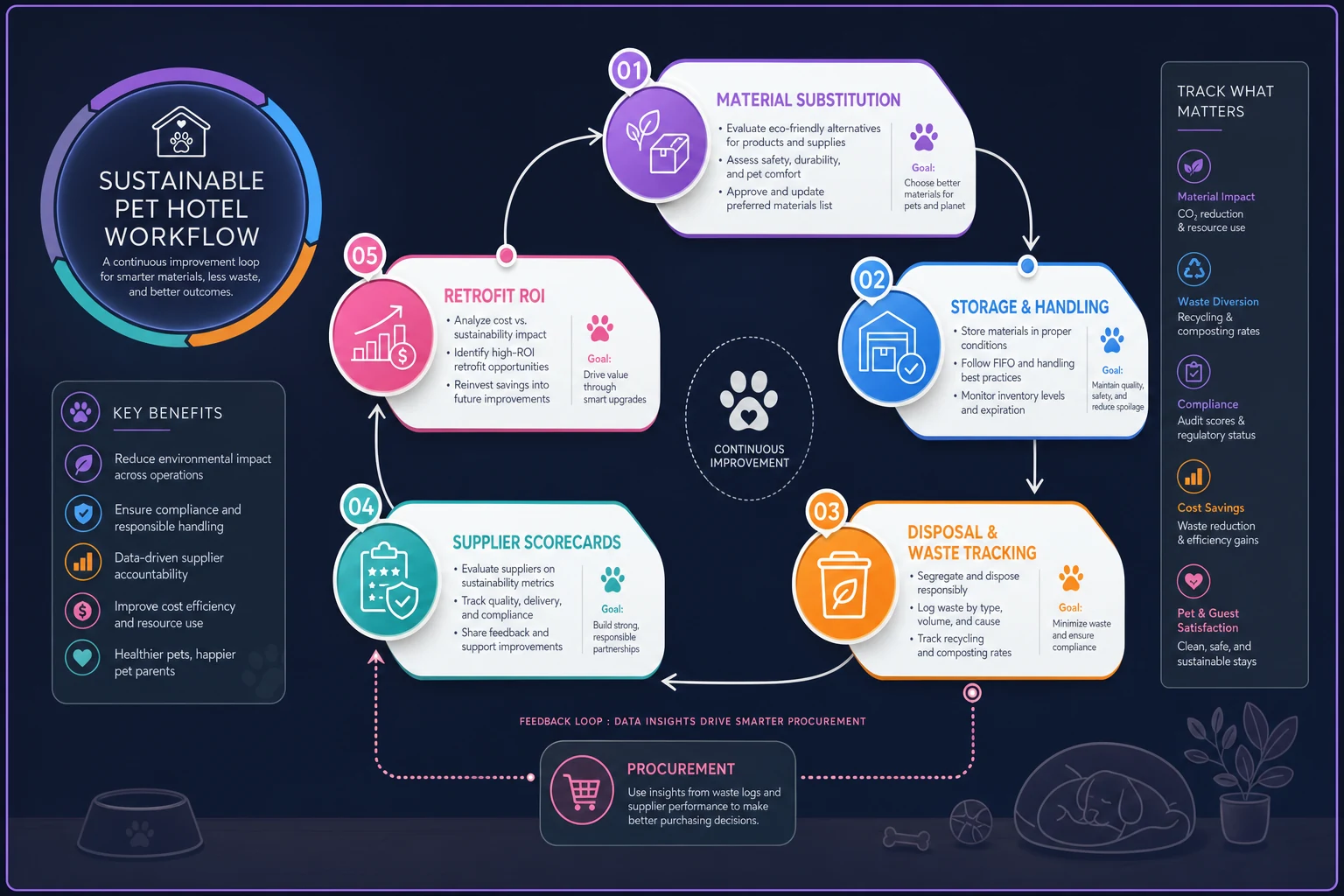
The whole thing works as one loop. Procurement decides what enters the building—so a good supplier scorecard means fewer risky products arrive in the first place. Those products flow into storage, where SOPs and labeling keep them from becoming hazards during daily use. Daily use generates waste, which the disposal system tracks and routes legally, and the disposal log feeds back into procurement by showing what you're actually consuming versus over-buying. Substitution sits over all of it, because every product swap simplifies storage, cheapens disposal, and tightens the supplier list. Retrofits are the capital layer you add once the process layer is solid.
The failure mode is running these as four disconnected chores owned by four different people who never talk. The fix is making the connection explicit—one owner for the whole chemical system, one place where SDS sheets, disposal manifests, labeling standards, and supplier scores all live. Platforms that centralize operational records can make this easier at scale, but even a well-organized shared folder is better than manifests stuffed in a drawer. The principle is the same either way: compliance paperwork should live where the rest of your operations live, so it's not a fire drill every time someone asks for it.
Bottom line for owners
Chemical waste and sustainability aren't a single line item you can throw money at. They're four connected systems—what you buy, how you store it, how you dispose of it, and whether you retrofit—and they break at exactly the moments your business grows: new hires, second sites, peak-season crews.
Phase the work. Start with substitution because it changes everything downstream. Lock down storage and disposal SOPs because that's what inspectors actually check. Use supplier scorecards to keep risk out of the building before it arrives. And only reach for retrofits once you can show the payback with insurance and disposal savings baked in.
None of this requires a big budget to start. It requires treating your back closet like the operational system it actually is.
Ready to optimize your pet hotel operations?
Join hundreds of pet hotels using GoPetel to save time, improve pet care, and increase booking reliability.