

Walk into any pet hotel at 11am during summer peak season and you'll see the same mess. Three staff members cleaning kennels, but only one actually working. Someone's waiting for disinfectant contact time. Someone else is walking to the supply closet for the fourth time. The third person stands outside a kennel holding a mop because they can't start mopping until the walls are done.
You've got a waitlist of eight dogs for tonight and three perfectly good kennels that won't be ready until 2pm because your team doesn't have a parallel workflow system. That's $240 in lost revenue tonight alone. Happens every busy weekend.
The problem isn't lazy staff. It's sequential thinking in a parallel world. Your team treats kennel cleaning like a single-file line when it should run like a Formula 1 pit stop.
The hidden math behind slow turnarounds
Most kennel managers time their cleaning process wrong. They clock someone cleaning a kennel start-to-finish and say "our standard is 35 minutes per kennel." But that's measuring elapsed time, not actual work time.
| Task | Active Work Time | Wait/Transit Time | Total Time |
|---|---|---|---|
| Remove bedding/toys | 3 min | 2 min (walking to laundry) | 5 min |
| Pre-rinse walls/floor | 4 min | 0 min | 4 min |
| Apply disinfectant | 2 min | 10 min (contact time) | 12 min |
| Scrub problem areas | 3 min | 0 min | 3 min |
| Final rinse | 3 min | 0 min | 3 min |
| Squeegee/dry | 4 min | 5 min (air dry) | 9 min |
| Replace bedding | 2 min | 3 min (getting supplies) | 5 min |
| Final inspection | 2 min | 0 min | 2 min |
| Totals | 23 min | 20 min | 43 min |
Nearly half the time is waiting or walking. That's for a standard 4x6 kennel with normal soil levels. A dog that had an accident or a luxury suite that needs extra attention? You're looking at an hour per kennel.
Why traditional SOPs fail in boarding facilities
Standard operating procedures for cleaning usually come from franchise manuals written by people who've never worked a Saturday turnover, or health department minimums that care about sanitization but not speed. Neither accounts for the realities of pet hotel operations.
Never miss a booking or detail again.
GoPetel simplifies pet hotel operations by managing every reservation and pet profile seamlessly.
- Centralized booking management
- Automated client notifications
- Staff and kennel scheduling
No credit card required
The franchise manual tells you to "thoroughly clean and disinfect each kennel between guests." Great. The health code says maintain 10-minute wet contact time for quaternary ammonium at 200ppm. Also great. But nobody's telling you how to clean six kennels simultaneously when you've got two staff members and one working hose.
Most facilities default to "cafeteria cleaning" - everyone grabs a kennel and works through it alone, start to finish. Feels organized because everyone's busy. But the inefficiencies compound. Sarah's waiting for disinfectant contact time in kennel 3 while Tom needs that same disinfectant sprayer for kennel 7. The floor squeegee sits unused because both cleaners are at the "scrubbing walls" stage.
Pet hotels treat cleaning like a craft when it should be treated like manufacturing. You don't need artists; you need assembly lines.
Building parallel-task cleaning systems
A parallel cleaning system splits the turnover process into overlapping phases that multiple people can execute simultaneously. Instead of one person owning one kennel, the team owns a zone and moves through it in synchronized waves.
-
Wave 1 (0-5 minutes) - Person A
Strip kennels 1-3 (bedding, toys, bowls) - Person B: Strip kennels 4-6
-
Wave 2 (5-10 minutes) - Person A
Pre-rinse kennels 1-3 - Person B: Pre-rinse kennels 4-6
-
Wave 3 (10-15 minutes) - Person A
Apply disinfectant to kennels 1-3, then start scrubbing kennel 1 - Person B: Apply disinfectant to kennels 4-6, then start scrubbing kennel 4
-
Wave 4 (15-25 minutes) - Person A
Continue scrubbing 2-3 while 1 sits for contact time - Person B: Continue scrubbing 5-6 while 4 sits for contact time
-
Wave 5 (25-35 minutes) - Person A
Final rinse and squeegee 1-3 - Person B: Final rinse and squeegee 4-6
-
Wave 6 (35-40 minutes) - Both
Replace bedding, final inspection
Six kennels, two people, 40 minutes. That's roughly 13 minutes per kennel per person, compared to 43 minutes working solo. Nobody stands around waiting for contact time because while kennel 1 sits with disinfectant, you're scrubbing kennel 2.
Visualize the synchronized waves as a simple workflow to help staff see who does what when.
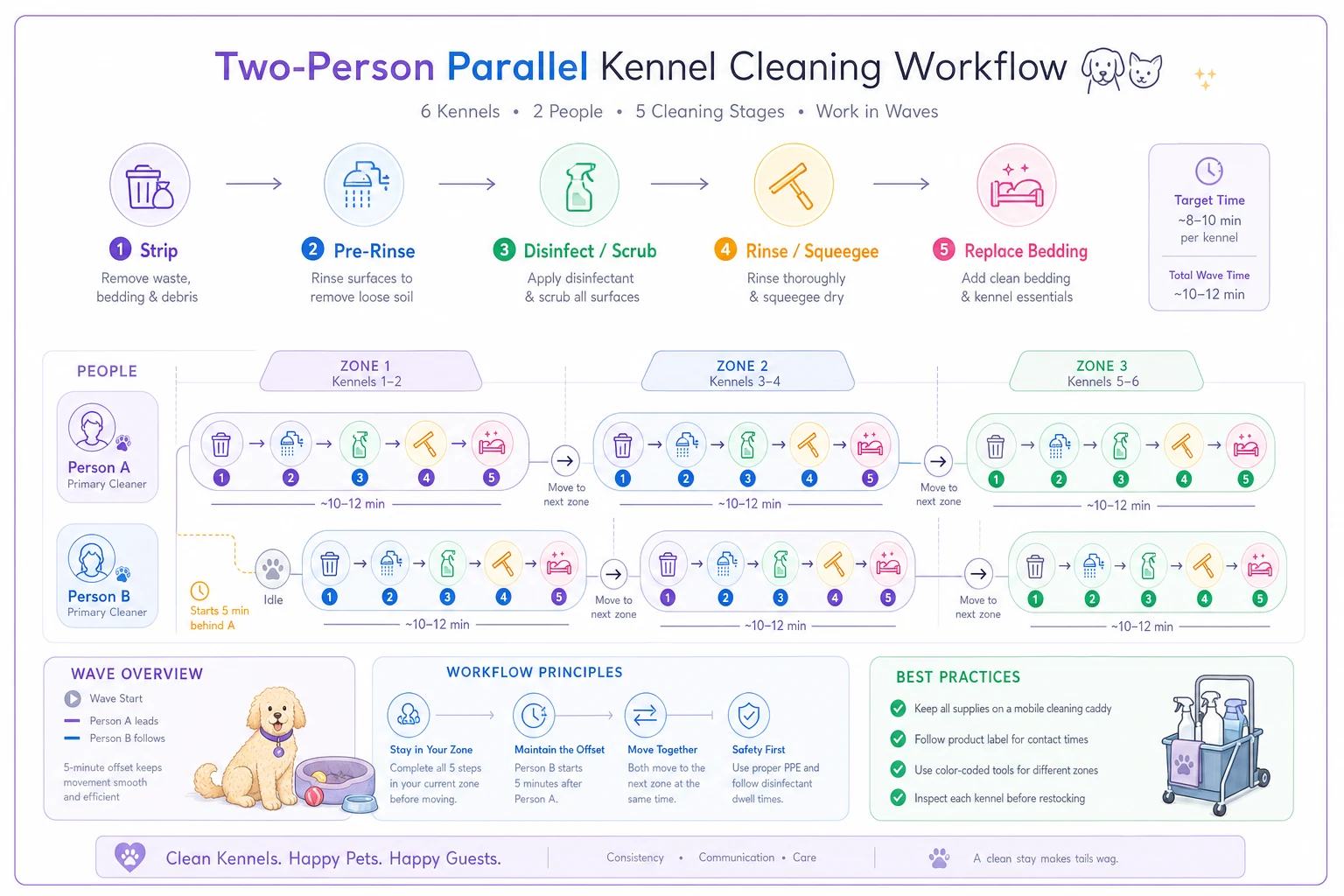
Six kennels, two people, 40 minutes. That's roughly 13 minutes per kennel per person, compared to 43 minutes working solo. Nobody stands around waiting for contact time because while kennel 1 sits with disinfectant, you're scrubbing kennel 2.
Chemical safety in compressed timelines
Speed kills - literally, if you're not careful with cleaning chemicals. When you compress turnaround times, the temptation is to skip safety steps. Some facilities have staff mix quaternary ammonium at double concentration "to clean faster" or skip PPE because "it slows them down."
-
Pre-shift chemical prep (5 minutes at start of day) - Mix all disinfectant solutions to proper concentration - Fill labeled spray bottles for each cleaning zone - Set out PPE stations at zone entry points - Test strips ready at each station
Your parallel SOPs need built-in safety checkpoints that don't compromise speed.
-
Zone-based safety rules - Only one chemical type active per zone at a time - No ammonia-based products in zones using bleach - Mandatory glove changes between chemical types - Eye protection required during all spray applications
Concentration and product rules must be unambiguous and easy to follow in the flow of work.
-
Concentration standards by kennel type - Standard kennels: Quat at 200ppm - Isolation kennels: Quat at 400ppm or bleach at 1:32 - Luxury suites with wood: Enzymatic cleaners only - Puppy areas: Accelerated hydrogen peroxide at 1:16
Make safety compliance faster than non-compliance. If your PPE station is 50 feet away, people won't use it. If they have to mix chemicals for each kennel, they'll eyeball it. Set up your zones so doing it right is the fastest path.
Keep pre-mixed, clearly labeled bottles at each zone entry so staff never have to stop the wave to mix solutions.
Make safety compliance faster than non-compliance. If your PPE station is 50 feet away, people won't use it. If they have to mix chemicals for each kennel, they'll eyeball it. Set up your zones so doing it right is the fastest path.
Different timing standards for different kennel types
Standard runs (4x4 to 4x6): These are your bread and butter. Concrete floors, chain link or wire sides, basic bedding. Target 15-20 minutes total time with parallel processing. Focus on speed through standardization - same cleaning pattern every time, same chemical application method, minimal variation.
Comfort kennels (5x8 to 6x10): Usually have sealed walls instead of chain link, sometimes rubber flooring, maybe a raised cot. These take longer because there's more surface area and the sealed walls mean more scrubbing (dogs rub against them more). Target 20-25 minutes with parallel processing.
Luxury suites (8x10 and up): Webcams, TVs, furniture, sometimes carpeted areas. You can't hose these down like standard runs. Plan 35-45 minutes even with parallel processing. The furniture alone adds 10 minutes - you're moving it, cleaning under it, wiping it down individually.
Isolation kennels: Doesn't matter what size. These get the full treatment every time. Higher concentration disinfectants, longer contact times, separate cleaning equipment. Budget 45 minutes minimum and never try to parallel process these with general population kennels.
Facilities make the mistake of trying to clean all kennel types on the same timeline. That luxury suite isn't going to be ready in 20 minutes no matter how fast your team moves. Build your scheduling around realistic turnover times for each kennel category.
Measuring actual availability gains
Track more than just cleaning time. The real metric is "time to next availability" - how long from checkout until that kennel can be sold again.
-
Checkout time
-
Cleaning start time
-
Cleaning completion time
-
Inspection completion time
-
System updated/available for booking
-
Next dog checks in
Most facilities have a 3-4 hour gap between checkout and next availability. With parallel SOPs, you should hit 90 minutes consistently. That's huge during peak season. If you're running at 95% occupancy Friday night, and Saturday morning you have 12 checkouts and 15 dogs on the waitlist, those 90 minutes versus 4 hours means you capture 12 additional nights instead of maybe 3.
At $40 per night average, that's $360 in additional revenue from one Saturday. Run that scenario every weekend June through August and you're looking at almost $5,000 in recovered revenue.
When parallel cleaning creates more problems than it solves
Not every facility should switch to parallel cleaning. If you're running under 60% occupancy most of the time, the complexity isn't worth it. Your constraint isn't cleaning speed; it's demand.
Small facilities with fewer than 20 kennels often struggle with parallel systems because you don't have enough volume to create efficient zones. You end up with people tripping over each other.
Single-staff shifts obviously can't run parallel systems. If you're solo from 3pm to close, you're stuck with sequential cleaning. That's fine - just adjust your checkout times accordingly. Don't promise noon availability if your morning shift ends at noon.
Some building layouts kill parallel efficiency. If your kennels are spread across multiple small rooms instead of organized in rows, the walking time between zones negates the parallel benefits. One facility in a converted house had kennels scattered across seven rooms on two floors. They tried parallel cleaning and actually got slower because of all the running around.
Where software actually helps (and where it doesn't)
Timing and task management for parallel cleaning is one area where operational software makes a substantial difference. Not for the actual cleaning - your staff still needs to physically scrub those kennels. But for orchestrating the complex dance of who does what when.
Manual tracking with clipboards and timers works until someone forgets to start the timer, or writes down the wrong time, or loses the clipboard. Then your carefully orchestrated parallel system falls apart because nobody knows which kennels are at which stage.
Good operations platforms handle the orchestration piece. Staff check off tasks on tablets mounted in each zone. The system tracks contact time automatically, sends alerts when kennels are ready for the next phase, and shows management real-time status of every kennel. More importantly, it prevents the common mistake of putting a dog in a kennel that looks clean but hasn't completed the full sanitization cycle.
The data side matters too. When you can see that Tuesday mornings consistently take 20% longer than Wednesday mornings, you start asking why. Maybe Tuesday's cleaner needs retraining. Maybe Monday nights have messier dogs for some reason. Without systematic tracking, these patterns stay hidden.
But don't expect software to fix fundamental process problems. If your staff doesn't understand parallel workflows, an app won't teach them. If your chemical concentrations are wrong, tracking won't make them right. The technology amplifies good processes; it doesn't create them.
Making the switch without losing your mind
Converting from sequential to parallel cleaning sounds simple on paper. In practice, it's like teaching someone to juggle while they're riding a bicycle. Everyone's confused, kennels get half-cleaned, and your inspection failures spike for two weeks.
Start with one zone during slow periods. Pick your six easiest standard kennels in a row. Train two people on just that zone's parallel process. Run it for a week during low-occupancy days when mistakes won't cost you bookings. Iron out the kinks before you expand.
Document everything obsessively during the trial. What takes longer than expected? Where do people get confused? What safety issues pop up? Your final SOPs should address every stumbling block you hit during testing.
Once that first zone runs smoothly, expand to similar kennel types. Don't jump from standard runs to luxury suites. Build competence gradually.
The hardest part is breaking your senior staff's habits. They've been cleaning kennels their way for years, and now you're telling them to completely change. Frame it as solving their problems, not fixing their mistakes. "Remember how you're always waiting for the disinfectant to work? This eliminates that waiting."
Making those minutes count
Parallel-task cleaning systems aren't revolutionary. Manufacturing figured this out a century ago. But most pet hotels still clean like it's 1985 - one person, one kennel, one long wait for disinfectant to work while potential revenue sits on your waitlist.
Cut your turnover time from 3 hours to 90 minutes and you've doubled your effective capacity during peak periods. That's not a marginal improvement; that's transformative for a business running at 95% occupancy with a waitlist.
The implementation is harder than the concept, but the patterns are predictable. Start small, document everything, train in waves, and build safety into the speed. Your staff will resist at first, then wonder how they ever worked the old way once they see six kennels ready in the time it used to take to finish two.
The goal isn't to clean faster for the sake of speed. It's to increase available nights and reduce labor costs per turnover. Every minute you shave off turnover time during peak season is money recovered. Every parallel task that eliminates waiting is labor cost reduced.
Ready to optimize your pet hotel operations?
Join hundreds of pet hotels using GoPetel to save time, improve pet care, and increase booking reliability.