

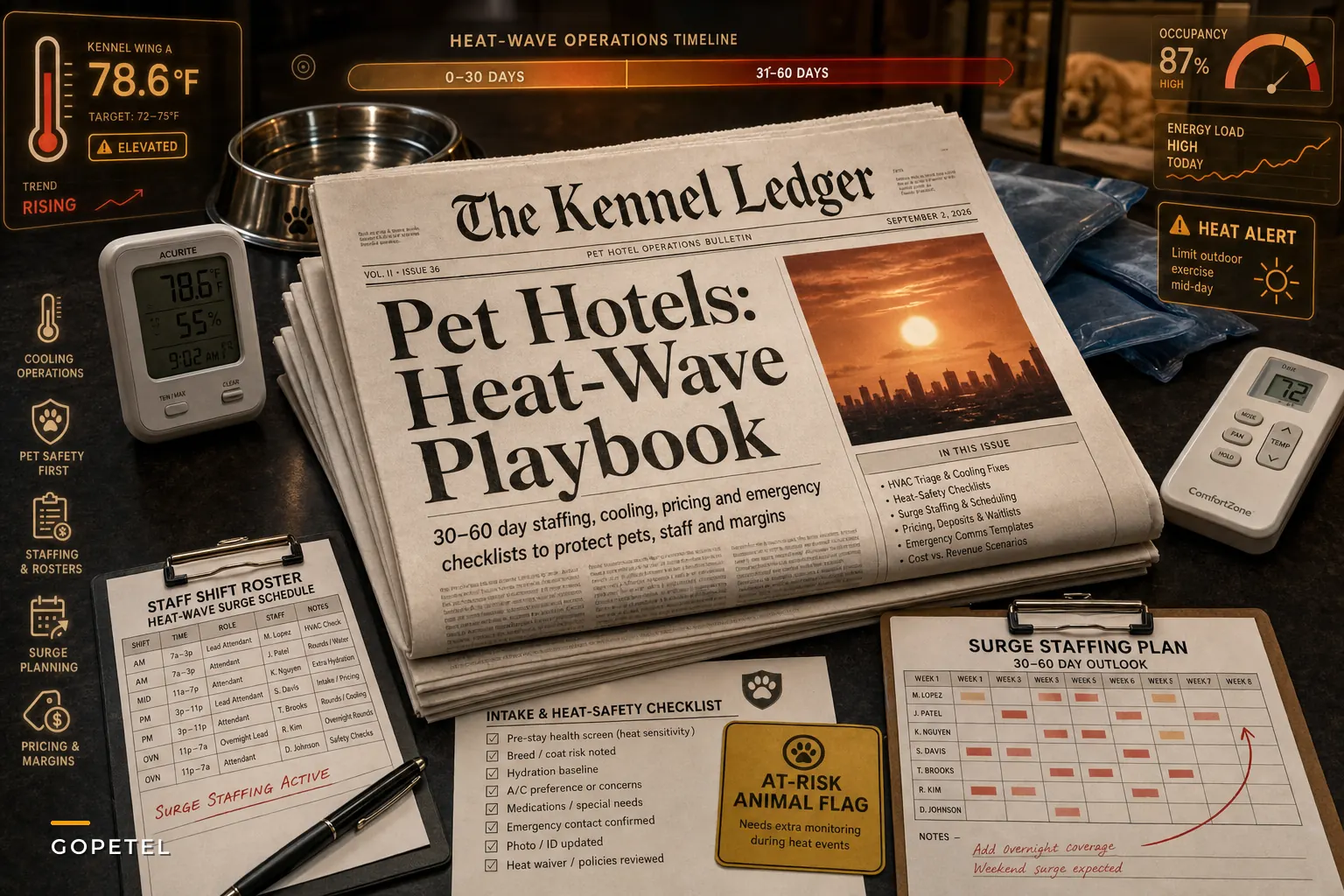

The heat episode moving across the country right now isn't behaving like a normal August. Daytime highs in the triple digits are one thing — pet hotels are built for hot afternoons. What's catching operators off guard is the nights. When overnight lows stay in the 80s, HVAC systems never get their recovery window, animals never fully cool down, and the compounding starts. NPR reported more than 80 million people under Extreme Heat Warnings or Advisories, with scientists linking the intensity to broader climate trends. For a boarding facility, that stretch of unrelieved warm nights is where the operational failures actually happen.
Most pet hotels have a hot-weather plan. Very few have a sustained heat plan — the kind you need when the load runs for eight or ten days and your equipment, staff schedule, and electricity budget were all designed around a system that gets to rest between peaks. That gap is what this is about.
The failure mode nobody plans for: cumulative load
A single 105°F day is a spike. Your AC works harder, your bill ticks up, and by 2 a.m. things are back to normal. Manageable.
The problem with an extended event is that nothing resets. In real operations, this usually shows up as a slow drift you don't notice until it's already a problem. Kennel zones that used to hold 72°F start sitting at 76°F by day four because the compressor is running near-continuously and losing efficiency as ambient temps climb. Older dogs and flat-faced breeds — the ones you'd normally check once on an overnight round — start needing checks every couple of hours. Your cleaning schedule slips because staff are moving slower in the heat and taking their mandated water breaks.
None of these is a crisis on its own. Stacked over a week, they create the exact conditions that cause a heat-stress incident, a burned-out overnight crew, and a utility bill that eats your late-summer margin.
The observation that matters most: extreme heat doesn't create new operational problems. It takes every weak point you already have — thin overnight staffing, deferred HVAC maintenance, loose intake screening — and puts pressure on all of them simultaneously.
Cooling: where your money and your risk actually sit
Before touching schedules or pricing, you need a clear read on your physical plant, because everything downstream depends on it.
Never miss a booking or detail again.
GoPetel simplifies pet hotel operations by managing every reservation and pet profile seamlessly.
- Centralized booking management
- Automated client notifications
- Staff and kennel scheduling
No credit card required
A useful way to think about cooling during a sustained event is in three layers: what keeps animals within safe temps, what keeps staff working safely, and what keeps your bill from spiraling. Those aren't the same interventions, and treating them as one budget line is a common mistake.
| Intervention | Primary benefit | Rough cost | When it's worth it |
|---|---|---|---|
| HVAC preventive service before peak season | Prevents mid-event failure | $200–$600 per unit | Always — cheapest insurance you have |
| Portable spot coolers / evaporative units | Backup for specific zones | $300–$900 each | If you have zones that run hot or single points of failure |
| Shade cloth / window film on sun-facing walls | Cuts solar load, lowers runtime | A few hundred to low thousands | High-exposure buildings, fast payback |
| Overnight setpoint strategy | Reduces peak-hour draw | Mostly free | Every facility, if your thermostat allows scheduling |
| Backup generator capacity check | Keeps cooling on during grid strain | Varies widely | If your region has any history of heat-driven outages |
The single highest-leverage move on that list is also the least exciting: get HVAC serviced before the event, not during it. Older rooftop units don't fail on mild days — they fail on day five of a heat run, when every HVAC contractor in the region is already booked and your emergency call goes to the back of a very long line. A $400 preventive service in June is a completely different situation than a $2,500 emergency repair with a three-day wait in August.
One thing easy to miss on the utility side: pre-cooling. If your setpoints are on a schedule, pushing zones a degree or two cooler in the early morning — before the grid peaks and before ambient temps spike — means your equipment isn't fighting the hottest part of the day from behind. Small habit, meaningful reduction in peak-hour draw over a long event.
When aggressive cooling investment is a bad idea
Not every facility should be buying spot coolers and generators the week a warning drops. If your building is newer, your HVAC was serviced this spring, and you have redundant units per zone, dumping cash into portable equipment during a panic is usually wasted money. The better spend is on monitoring and staffing. Save the CAPEX conversation for the off-season when you can think through it calmly.
If your HVAC was serviced this spring and you have redundant units, prioritize monitoring and staffing over panic CAPEX.
The better spend is on monitoring and staffing. Save the CAPEX conversation for the off-season when you can think through it calmly.
Staff safety is an operations problem, not just an HR one
This part gets underweighted consistently: heat rules that protect your people will change your throughput whether you plan for them or not.
When it's dangerously hot, staff need more frequent breaks, more hydration time, and they move slower during outdoor walks and yard rotations. If your daily schedule assumes a kennel tech can turn over a run in a fixed number of minutes, that assumption quietly breaks. The work still gets done — it just takes longer, which means either things slip or you need more hands on the floor.
-
Shift outdoor tasks to the cool windows. Move walks, yard rotations, and outdoor cleaning to before 9 a.m. and after 7 p.m. The middle of the day becomes indoor-only work.
-
Rotate the hardest jobs. Don't let one person handle all outdoor rotations. Spread high-heat-exposure tasks so no single staffer carries the full load.
-
Add a mid-shift check-in. A quick two-minute wellness check during the hottest hours catches early heat stress before it becomes a callout the next morning.
-
Pre-identify your backup coverage. Know before the event who you can call, and what you'll pay them, so you're not negotiating shift coverage at 6 a.m. during a callout.
-
Increase overnight monitoring capacity deliberately. Warm nights mean animals need more checks. That's real labor hours — it has to be scheduled, not assumed.
That fifth point is where a lot of facilities get caught. Overnight is usually the thinnest-staffed shift, and it's exactly the shift that needs to expand during a heat event because the animals aren't getting nighttime relief either.
Demand gets weird — and that's a margin decision
Extreme heat does two contradictory things to your booking flow at once.
On one side, last-minute cancellations — clients who decide not to travel because it's miserable out, or whose plans fell through. On the other side, emergency intake requests — someone's home AC failed, a client's regular sitter bailed, a family needs to board a pet during an unexpected evacuation. You're simultaneously losing confirmed nights and fielding urgent requests, sometimes on the same day.
This is the same surge-and-scarcity dynamic that shows up during holidays, and the systems that handle it well are the same ones. If you've built a real framework for prioritizing who gets a spot, how deposits protect you against last-minute drops, and how to triage a waitlist under pressure, extreme heat is just another trigger for those rules. The surge staffing calculator and waitlist scoring approach we broke down for holiday chaos translates almost directly — the mechanics of managing volatile demand don't care whether the cause is Thanksgiving or a heat dome.
-
Emergency intake is more expensive to serve. These animals often arrive stressed, sometimes already heat-affected, frequently without complete records, and usually outside normal intake hours. If you offer emergency boarding during heat events, price it to reflect the extra monitoring and off-hours labor — not as a penalty, but as an honest reflection of what it actually costs.
-
Deposits matter more, not less. With cancellations spiking, unprotected reservations cost you real nights. This isn't the moment to be loose about deposit enforcement.
-
Be careful with blanket surge pricing. Raising rates across the board during a public heat emergency reads badly and can genuinely hurt your reputation. A defensible emergency-intake fee tied to actual extra service is very different from jacking standard rates because demand spiked.
Who should not lean into emergency intake
If your facility is already running near capacity, your HVAC is marginal, or overnight staffing is thin, saying yes to emergency intakes during a heat event can be the decision that tips you into a welfare incident. Taking in a heat-stressed animal you can't adequately monitor is worse than turning it away with a referral. Know your real capacity ceiling before the phone starts ringing.
The monitoring gap that turns a hot day into an incident
What separates facilities that get through a heat event cleanly from the ones that end up with an incident report is almost always monitoring discipline.
During normal operations, temperature checks and welfare rounds happen on a comfortable rhythm. During a sustained heat event, that rhythm has to tighten — and it has to tighten reliably, on the exact days everyone is most tired and stretched thin. You need more consistency at precisely the moment human consistency naturally degrades.
A simple heat-response checklist that lives on the wall — and actually gets checked off — closes most of that gap:
-
Zone temperatures logged every 2 hours during peak (not "eyeballed")
-
At-risk animals flagged at intake
brachycephalic breeds, seniors, overweight, cardiac/respiratory conditions
-
Water refill checks tied to the same schedule as temp logs
-
Overnight rounds increased and documented, not assumed
-
HVAC status confirmed at shift change — every shift, no exceptions
-
A named person responsible for the heat protocol each shift
-
Clear escalation trigger
what temp or what animal behavior means "call the manager now"
The two items that get skipped most under pressure are documentation and the named-responsible-person. When everyone is responsible, no one is. Assign it per shift, in writing.
This is also where operational software earns its keep quietly — not as anything flashy, but as the thing that makes sure the extra rounds actually get logged. When welfare checks, temperature logs, and at-risk flags live in the same system that runs your bookings and shift schedule, reminders fire automatically and you get a real record that the protocol was followed. During a normal week that's a nice-to-have. During a ten-day heat event, having automated check reminders and a clean audit trail is the difference between "we followed our protocol" and "we think we did." That record also matters if an incident ever gets questioned by an owner or an insurer.
The diagram below illustrates a simple workflow for shift responsibilities and escalation during a heat event.
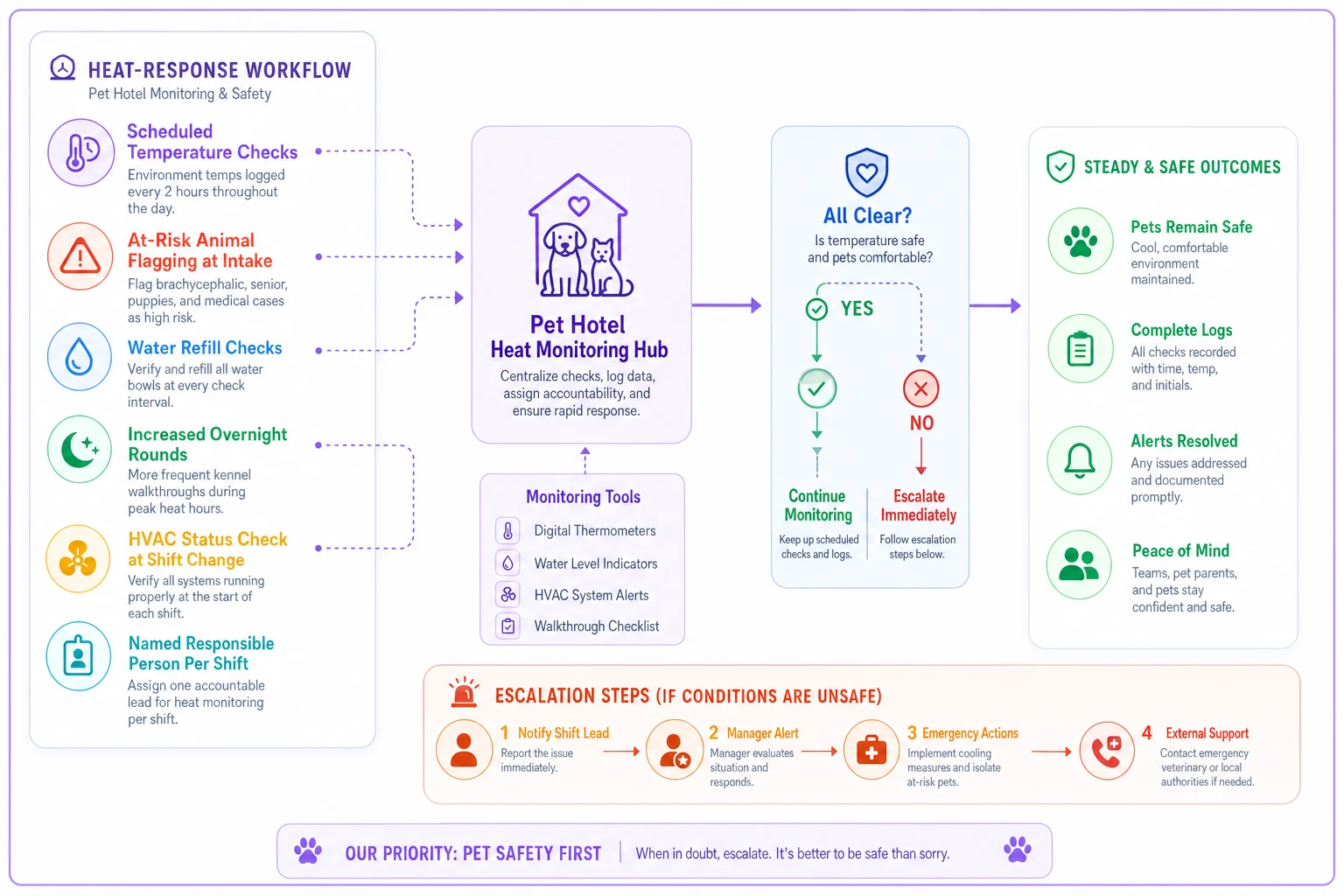
Use this workflow as a training and shift-handover reference so responsibilities are clear when staff are stretched thin.
A real scenario: the mid-size facility that got caught by night four
Consider a roughly 60-run facility in a hot inland market during a week-long heat run. Going in, their setup was typical: two rooftop HVAC units, one overnight staffer, a solid but informal welfare-check habit.
Days one and two were fine. By night three, one rooftop unit was struggling to hold setpoint and the overnight staffer — working alone — was splitting time between welfare rounds and troubleshooting the thermostat. On night four, that unit failed. Because they hadn't confirmed their emergency HVAC contact in advance, the earliest a tech could come out was 40 hours later. They moved animals to the functioning zone, cutting usable capacity in half mid-week, and scrambled to relocate a handful of guests.
No animal was seriously harmed — but only because a manager happened to come in early and caught it. The costs added up anyway: an emergency repair in the low four figures, a couple of comped stays, and an overnight employee who was rattled enough to call out the next two shifts.
The instructive part is how avoidable it was. A preventive service in early summer likely catches the failing unit. A pre-confirmed emergency HVAC contact cuts the 40-hour wait to hours. A second set of hands overnight means welfare rounds never compete with an equipment problem. None of those are expensive relative to what the failure actually cost — they're just decisions that have to be made before the heat, not during it.
What to lock down before the next episode
Almost every effective move has to happen ahead of time. Once you're in day five, your options narrow to expensive emergency measures. The real playbook is a pre-season one:
-
Service every HVAC unit before peak summer and confirm your emergency repair contact in writing
-
Identify your hottest zones and single points of cooling failure now, while you can plan calmly
-
Build a heat-response staffing buffer into your schedule, including expanded overnight coverage
-
Write your heat protocol, assign per-shift ownership, and make logging automatic rather than optional
-
Set your emergency-intake policy and pricing before the phone rings, and know your true capacity ceiling
-
Reuse your surge-demand framework so cancellations and emergency requests don't get handled ad hoc
Heat events like the current one aren't going to get rarer. The facilities that handle them well aren't the ones with the newest equipment or the biggest budgets — they're the ones that treated a predictable seasonal stressor as an operational plan instead of an emergency. The animals in your care can't tell you when they're overheating until it's serious, which is exactly why the systems around monitoring, staffing, and cooling have to carry the load. Build them when it's cool, and the next triple-digit week becomes something you manage instead of something that manages you.
Heat events like the current one aren't going to get rarer. The facilities that handle them well aren't the ones with the newest equipment or the biggest budgets — they're the ones that treated a predictable seasonal stressor as an operational plan instead of an emergency. The animals in your care can't tell you when they're overheating until it's serious, which is exactly why the systems around monitoring, staffing, and cooling have to carry the load. Build them when it's cool, and the next triple-digit week becomes something you manage instead of something that manages you.
Ready to optimize your pet hotel operations?
Join hundreds of pet hotels using GoPetel to save time, improve pet care, and increase booking reliability.