


Every November, pet boarding facilities face the same scramble. You know exactly when the holidays are coming, yet somehow the staffing math never quite works out. Too many bodies on slow days eating into margins, skeleton crews during unexpected rushes, and that brutal week between Christmas and New Year's where every decision feels wrong.
The difference between facilities that thrive during holiday seasons and those that barely survive? Having repeatable systems. Not gut feelings about when to add staff. Not hoping your best employees don't call out. Actual frameworks you can use year after year.
The Hidden Math Behind Holiday Boarding Chaos
Most boarding facilities treat holiday staffing like weather forecasting - lots of guessing, checking last year's notes, and crossing fingers. But there's a predictable pattern hiding in the chaos.
Your regular 15-minute check-in becomes 25 minutes because owners want extra reassurance before leaving town. Your typical 70% weekend occupancy jumps to 95%, but not evenly - certain room types book out weeks ahead while others sit empty. Staff who normally handle 12 dogs comfortably start making mistakes at 8 dogs because the mix changes. More anxious first-timers, more special needs cases, more detailed feeding instructions.
The operational load isn't just about body count. A facility at 95% capacity during holidays operates nothing like the same facility at 95% capacity in July. The dogs are different, the owners are different, the requests are different. Standard staffing ratios break down completely.
Holiday boarding attracts your least profitable customer segment. These once-a-year clients don't know your systems, require more hand-holding, and generate more incidents. They're necessary for hitting revenue targets, but they fundamentally change your operational requirements.
Building Your Surge Staffing Calculator
Forget the standard 1:10 staff-to-dog ratio you learned at that conference. Holiday staffing needs a completely different calculation model that factors in operational complexity, not just headcount.
Never miss a booking or detail again.
GoPetel simplifies pet hotel operations by managing every reservation and pet profile seamlessly.
- Centralized booking management
- Automated client notifications
- Staff and kennel scheduling
No credit card required
Start with your base staffing needs, then layer in multiplication factors:
Base Holiday Staffing Formula:
-
Core staff requirement = (Total dogs ÷ 8) × 1.4
-
Check-in surge staff = (Expected arrivals ÷ 4) × 1
-
Special needs multiplier = (Special needs dogs × 0.3)
-
First-timer anxiety factor = (New clients × 0.15)
During a typical December Saturday with 80 dogs, including 12 special needs and 20 first-timers:
-
Base need
14 staff hours
-
Check-in surge
5 additional hours (assuming 20 arrivals)
-
Special needs add
3.6 hours
-
First-timer factor
3 hours
-
Total
25.6 staff hours for that day
Compare that to your normal Saturday calculation of maybe 12-14 staff hours. That gap is where facilities fall apart.
Raw hours don't tell the whole story. You need the right mix of experience levels. New staff can handle basic feeding and cleaning, but they can't manage nervous owners or spot early signs of stress in unfamiliar dogs. Your calculator needs to specify minimum experience ratios: at least one senior staff member per 25 dogs, one medication-certified person per shift, one behavior-trained staff member during peak intake hours.
Here's a quick visual to map inputs to staffing outputs.
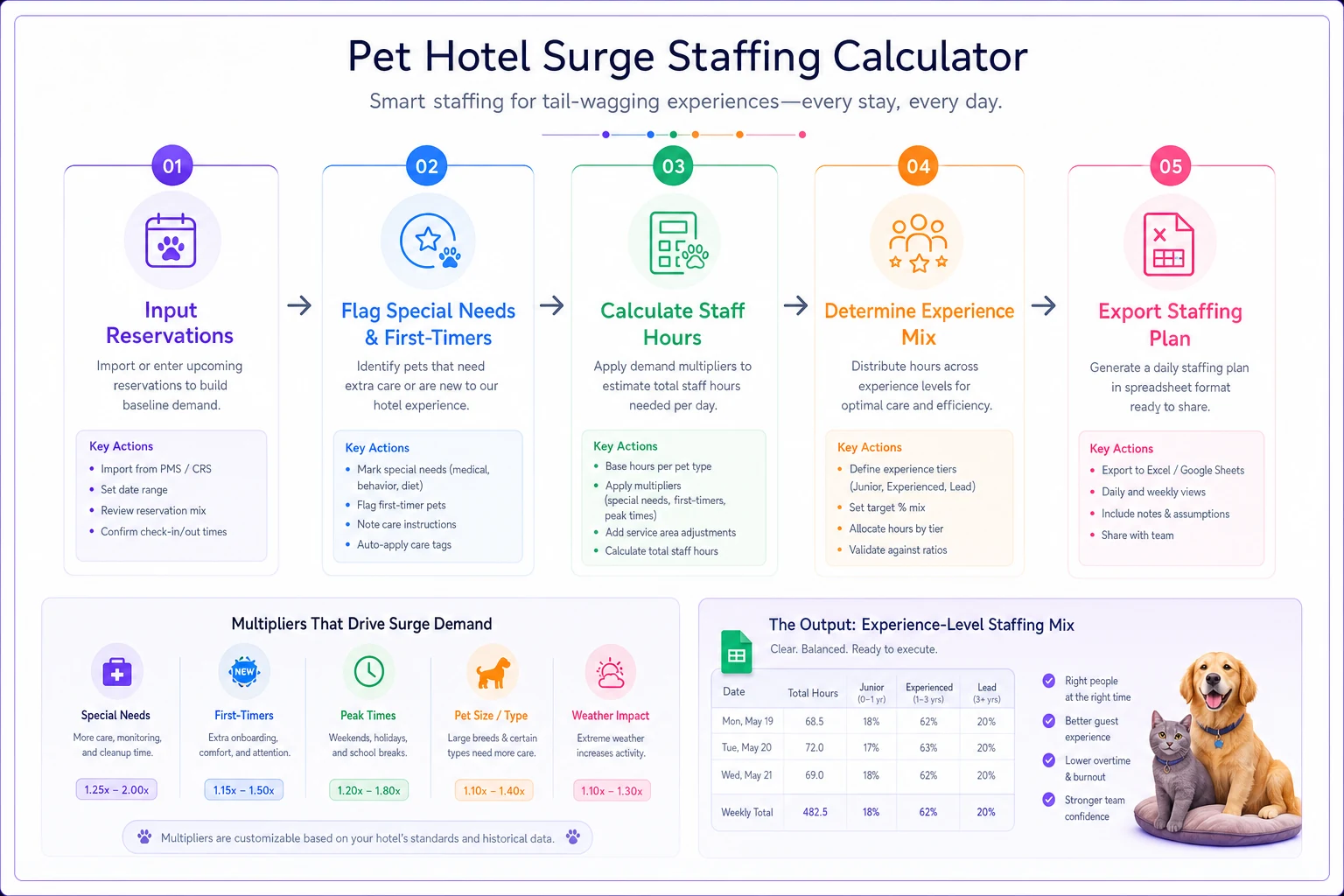
Schedule senior staff during peak intake hours to minimize mistakes and coach newer team members.
Build this into a simple spreadsheet that automatically adjusts based on your booking data. Input your reservations, flag special needs cases and first-timers, and watch your staffing requirements calculate automatically for each day of the season.
The Waitlist Scoring System That Actually Works
Every facility has a waitlist during holidays. Most manage it terribly, losing thousands in revenue to poor prioritization. The standard first-come-first-served approach leaves money on the table and frustrates your best clients.
Here's a scoring rubric that maximizes both revenue and client satisfaction:
Priority Scoring Matrix:
| Factor | Points | Why It Matters |
|---|---|---|
| Booking full stay (7+ nights) | 40 points | Reduces turnover labor, maximizes room revenue |
| Regular client (3+ stays/year) | 30 points | Lower operational cost, knows systems |
| Add-on services booked | 20 points | Grooming, training, daycare = margin multipliers |
| Flexible dates | 15 points | Allows optimal room tetris |
| Previous holiday stay | 10 points | Familiar with surge pricing, less sticker shock |
| Single pet | 5 points | Easier placement in remaining spaces |
| Medical needs (non-complex) | -5 points | Requires trained staff allocation |
| Specific suite request | -10 points | Reduces placement flexibility |
| Check-in outside standard hours | -15 points | Requires special staffing |
Score every waitlist entry, rank them, and work down systematically. A regular client booking 10 nights with grooming (90 points) gets priority over a new client wanting 3 nights in a specific suite (30 points), even if they called later.
This feels ruthless until you see the results. One facility in Colorado switched from first-come-first-served to scored prioritization and saw holiday revenue jump roughly 22% without adding a single kennel. They filled the same number of room-nights but with higher-value bookings.
The scoring also helps with difficult conversations. When someone asks why they're still waitlisted, you can explain the factors objectively instead of seeming arbitrary.
Overflow Partnership Rules That Protect Your Reputation
Most facilities handle overflow badly. They either turn clients away completely or hastily refer to competitors without structure. Smart operators build formal overflow partnerships with specific operational rules.
The key is creating mutual benefit agreements before you need them. Approach 2-3 facilities with different specialties - maybe one handles giant breeds better, another has superior medical capabilities, a third focuses on anxious dogs. Structure formal partnerships during slow season when nobody's desperate.
Your overflow rules document should specify:
Referral criteria: Which clients get referred versus waitlisted? Usually, new clients requesting short stays go to partners while regulars stay on your waitlist.
Quality standards: Partners must maintain equivalent vaccination requirements, carry similar insurance, and pass a facility inspection. You're lending them your reputation.
Communication protocol: Partners provide daily updates on referred clients. Any incidents get reported immediately. You remain the primary contact for the owner.
Financial structure: Typically, a 15-20% referral fee for successfully placed bookings. Some facilities prefer reciprocal referrals instead of cash.
Capacity sharing: Real-time visibility into partner availability prevents awkward "checking with them now" calls while clients wait.
One facility group in Texas formalized partnerships between three locations. During last year's Christmas week, they successfully placed an extra 47 dogs through overflow partnerships, generating around $8,400 in referral fees while keeping clients happy. Those clients rebooked directly the following year, turning temporary overflow into permanent relationships.
The operational efficiency comes from having pre-negotiated terms. No scrambling to figure out referral fees during busy season. No wondering if that facility down the street maintains proper infection control protocols. Everything is documented and agreed upon when you have time to think clearly.
Customer Expectation Scripts for Surge Pricing
The conversation about holiday pricing happens too late at most facilities. Clients book in October, find out about surge pricing in December, and feel ambushed. Even when it's clearly posted, the sticker shock creates unnecessary friction.
Build expectation-setting into every touchpoint starting in September. Not aggressive selling, just consistent education about holiday operations being different.
September email/text template: "Quick reminder as fall arrives - holiday boarding (Dec 15-Jan 5) includes a 25% surge pricing adjustment and requires a 50% deposit. This helps us maintain full staffing during family travel season. Regular rates and policies return January 6."
Booking confirmation script: "I've got Max confirmed for December 20-27. With holiday surge pricing, your total comes to $596 versus the normal $477. The extra coverage ensures full staffing even on Christmas morning. Should I send the invoice for your 50% deposit?"
Check-in preparation (one week out): "Max's holiday stay starts in 7 days! Reminder that holiday check-ins take a bit longer (plan for 20 minutes). We'll have extra staff on hand, but December 20 is our busiest arrival day. Can you come before 11am or after 3pm to avoid the rush?"
Pickup scheduling: "For December 27 pickup, we have regular windows at 8-10am or 4-6pm, or you can book a priority pickup slot for $15 that guarantees Max is ready exactly when you arrive. Which works better with your flight schedule?"
These scripts normalize surge pricing through repetition. They justify the cost through operational explanations. They offer choices that make clients feel in control. Most importantly, they prevent surprise anger that derails operations during your busiest period.
The numbers back this up. Facilities using proactive expectation scripts see roughly 70% fewer pricing complaints during holidays and around 15% higher adoption of premium services like priority pickup. The operational benefit is huge - fewer argued invoices means faster processing times when you need it most.
The Coordination Technology Layer
Manual coordination breaks down completely at holiday volumes. While you might manage 40 dogs using paper schedules and whiteboards, hitting 80+ dogs with special requests, medication schedules, and specific feeding instructions requires digital coordination.
This is where AI-powered operational software becomes essential. Not for the AI itself, but for the coordinated information flow. When your morning shift can instantly see what the overnight crew observed, when medication alerts push to the right phones automatically, when special instructions attach to the right dogs without manual transfer - that's when holiday operations become manageable.
The best platforms track patterns across seasons, showing you that December 23rd always sees 30% more check-ins than December 22nd, that clients booking stays over 10 days have 40% higher special request rates, that Thursday evening pickups create bottlenecks you need to staff around. This historical intelligence transforms planning from guesswork to science.
Modern systems also handle the surge communication load. Automated photo updates, scheduled reassurance messages, and standardized response templates let small teams handle volumes that would have required double the staff just five years ago. One person can manage conversations with 50 anxious pet parents when the system handles routine updates automatically.
The efficiency gain is measurable. Facilities using coordinated platform technology handle roughly 35% more holiday volume with the same size team compared to paper-based operations.
Making December Your Most Profitable Month
Holiday boarding doesn't have to mean operational chaos. With proper frameworks - a staffing calculator that accounts for complexity, a waitlist system that prioritizes value, overflow partnerships that maintain quality, and communication scripts that set expectations - December can become your most profitable month instead of your most stressful.
The facilities crushing holiday seasons aren't just working harder. They're deploying systematic approaches that turn surge periods into predictable operations. They know exactly how many staff they need on December 23rd. They know which waitlist clients to prioritize. They know where overflow capacity exists. They've already set pricing expectations.
Start building these systems now, during your slow season. Create the calculator spreadsheet. Draft the partnership agreements. Write the communication templates. When November arrives and everyone else starts panicking, you'll be ready to execute a plan that's already proven.
The difference between chaos and profit isn't effort - it's systems. Build them once, refine them each season, and watch holiday boarding transform from a necessary evil into your competitive advantage.
Start building these systems now, during your slow season. Create the calculator spreadsheet. Draft the partnership agreements. Write the communication templates. When November arrives and everyone else starts panicking, you'll be ready to execute a plan that's already proven.
The difference between chaos and profit isn't effort - it's systems. Build them once, refine them each season, and watch holiday boarding transform from a necessary evil into your competitive advantage.
Ready to optimize your pet hotel operations?
Join hundreds of pet hotels using GoPetel to save time, improve pet care, and increase booking reliability.