


The hiring market just flipped weird — and your July roster is already at risk
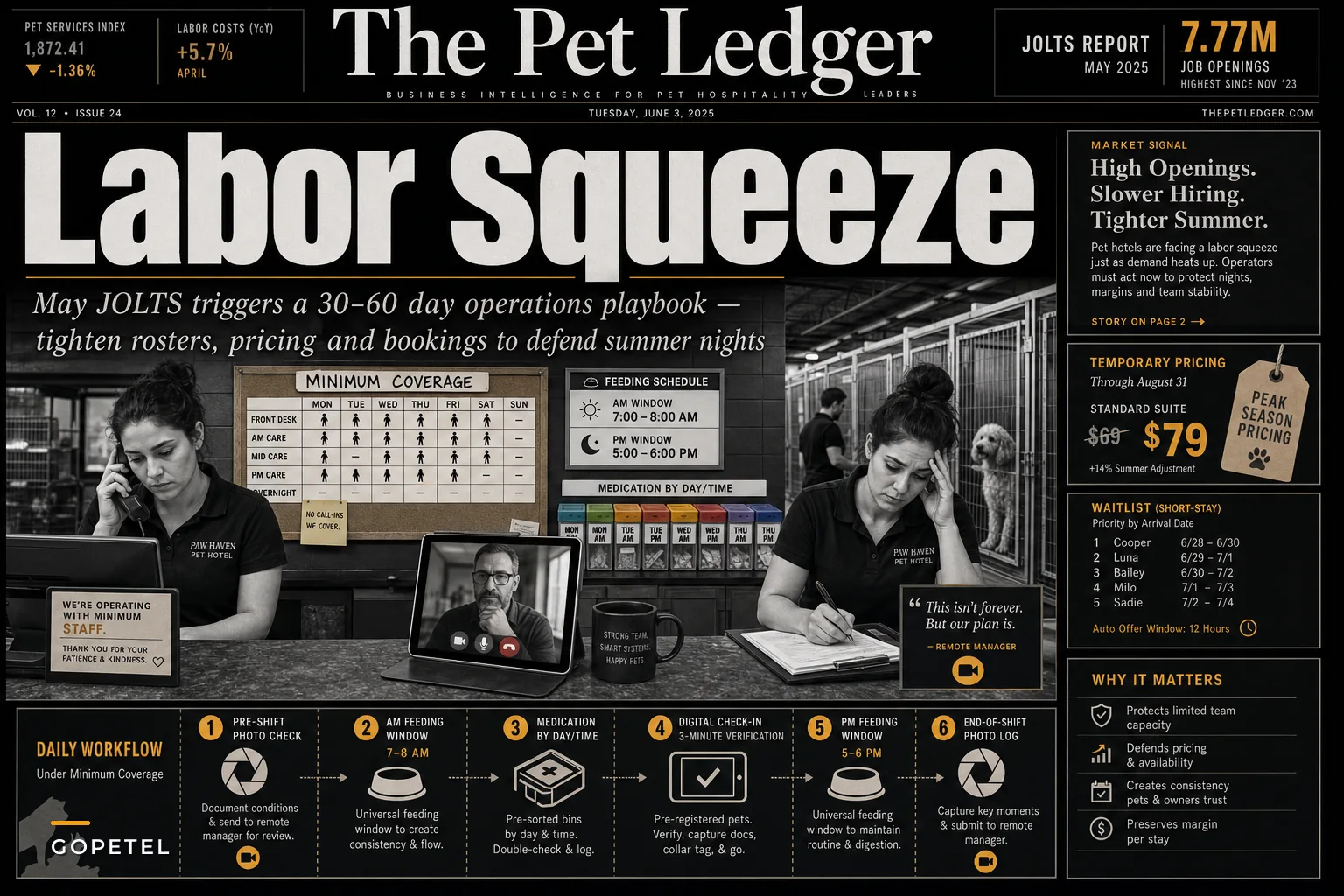
The latest jobs report dropped a reality check that every pet hotel operator needs to hear: job openings jumped to 7.59 million while actual hiring slowed down. That gap between open positions and actual hires means one thing for pet hotels heading into peak summer — the pet hotel staffing shortage just got more complicated.
The timing is brutal. Right when you need seasonal coverage for vacation boarding, the labor market decides to play hardball. More businesses chasing fewer willing workers, exactly when your occupancy should be pushing 85-90%.
The math doesn't forgive. A typical 40-kennel facility needs roughly 8-10 core staff plus 3-4 seasonal additions to handle summer volume. When those seasonal spots stay empty, you're either turning away bookings or burning out your core team on overtime — lost revenue either way, and a margin killer regardless of which path you pick.
What most operators miss is that this isn't actually a staffing problem. It's a capacity management problem wearing a staffing costume. The facilities holding margins through this squeeze aren't the ones finding magical hiring solutions. They're the ones who restructured their entire summer operation around the assumption that perfect staffing wasn't coming.
The hidden cost cascade that kills summer profits
When you can't fill that weekend shift supervisor role, the domino effect starts fast. Your facility manager covers the gap, pulling them off schedule optimization and customer service. Quality slips. Reviews soften. Rebooking rates drop from around 70% to maybe 55%.
Then overtime kicks in — not just the time-and-a-half labor cost, but the exhaustion factor. Tired staff make medication errors. They miss behavioral signs. They rush intake. One bite incident from an overtired handler missing aggression signals can run you $15,000 or more in vet bills, legal fees, and reputation damage that's harder to price.
The real killer is capacity throttling. Without proper coverage, you start blocking out kennels — not officially, you just "happen" to be fully booked earlier than usual. A 40-kennel facility running at 65% occupancy because of staffing gaps versus 85% with proper coverage loses somewhere in the range of $8,000–12,000 a month during peak season.
Meanwhile, competitors who locked in their summer roster back in March are running waitlists and premium pricing.
Tactical moves to protect occupancy without perfect staffing
Start with schedule restructuring — not around ideal coverage, but around minimum viable operations. Map your actual capacity at different staffing levels. At 6 staff instead of 9, maybe you can safely handle 28 kennels instead of 40. That's still better revenue than overtime burnout leading to callouts and dropping to 20 kennels.
Never miss a booking or detail again.
GoPetel simplifies pet hotel operations by managing every reservation and pet profile seamlessly.
- Centralized booking management
- Automated client notifications
- Staff and kennel scheduling
No credit card required
Most facilities try to maintain full services with skeleton crews. That's the wrong move. Strip your service menu to essentials during shortages. Basic boarding only. No grooming add-ons, no training sessions, no individual playtime upgrades. Yes, you lose some per-stay revenue, but you protect core occupancy and avoid the service failures that trigger refunds and bad reviews.
The aggressive move that actually works: implement peak-season minimum stays now. Not in July when you're already underwater — now. Three-night minimums for July–August bookings, five nights for holiday weeks. This cuts check-in/check-out burden by roughly 40% while keeping revenue intact. The customers who balk at minimum stays weren't your profit drivers anyway.
Announce peak-season minimum stays early and pair them with limited-time perks for repeat customers to minimize backlash.
Pricing needs adjustment too, but not across-the-board increases that spook regulars. Think strategic friction pricing instead. Single-night stays get a short-stay fee. Last-minute bookings under 72 hours get a surcharge that serves double duty — margin protection and demand management.
The pre-booking lockdown strategy
While everyone else scrambles for staff, lock in revenue through targeted pre-booking campaigns. Not generic "book early" emails — actual outreach to specific customer segments.
Pull your data from last summer. Anyone who booked five or more nights between June and August gets a personalized offer: lock in the same dates this year at last year's pricing, but they must book within 7 days and pay a 50% non-refundable deposit. You're trading a bit of margin for guaranteed occupancy and real cash flow.
For your top 20% of customers by lifetime value, go further. Offer summer passes — pre-purchased blocks of nights at a discount. Ten nights for the price of eight, usable June through August. Locks in revenue, improves cash position, reduces scheduling guesswork.
Create scarcity that's actually real. Something like: "Due to staffing challenges across the industry, we're limiting summer availability to existing customers first. New customers will be waitlisted." This protects capacity for your profitable regulars while creating urgency that moves fence-sitters to commit.
The deposit structure needs teeth too. Move to 50% non-refundable deposits for all summer bookings, with full payment required 72 hours before arrival. No exceptions. This eliminates the cascade of last-minute cancellations that destroy capacity planning when you're running lean.
Workflow automation that replaces missing hands
The facilities surviving this squeeze have eliminated every possible manual touchpoint from their operation. Not through expensive tech overhauls — through simple systematic changes, some supported by AI-powered operational software that handles scheduling, communications, and documentation without requiring someone to manually manage each piece.
Take feeding schedules. Instead of individualized feeding times based on owner preferences, two universal feeding windows: 7–8 AM and 5–6 PM. All dogs eat then. This cuts feeding labor significantly and removes the scheduling complexity that breaks down with new or inexperienced staff.
Medication administration gets similar treatment. Color-coded bins by day of the week, pre-sorted by your most experienced person during slower periods. New staff can't mess up "give everything in the Tuesday AM bin to the Tuesday dogs." Errors drop even with seasonal help.
Documentation moves fully digital with photo-based systems. Instead of written logs nobody reads, staff take a quick photo of each kennel at shift change — food bowls, water levels, dog positioning, all visible in seconds. Managers review remotely and catch issues before they escalate. This kind of predictable coverage system reduces chaos when you're running short-staffed.
The workflow below shows how this kind of streamlined daily operation holds up under reduced staffing:
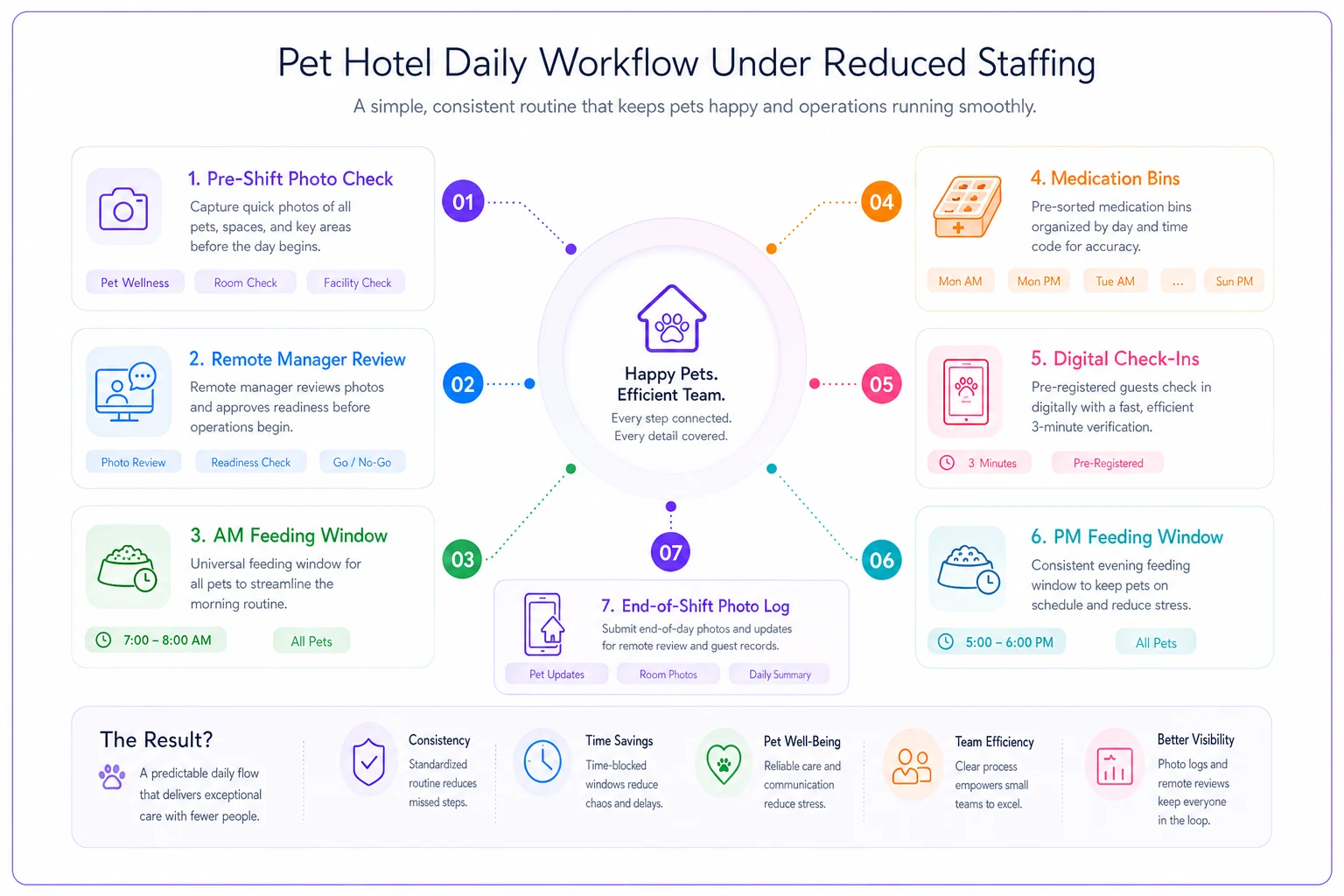
Check-in gets radically simplified. Pre-registration becomes mandatory. Customers upload vaccination records, complete forms, and sign waivers before arrival. Day-of check-in becomes a 3-minute verification instead of a 15-minute paperwork session. One person can handle 12 check-ins per hour instead of 4.
Strategic capacity trading with competitors
Something most operators don't do but probably should — formal capacity sharing agreements with nearby facilities. Not informal handshake deals, but structured operational partnerships.
Map three compatible facilities within 10 miles. Different price points are fine, actually preferable. Approach them with a specific proposal: guaranteed capacity swaps during shortage periods. You block kennels for them during your slow periods, they do the same during yours.
The key is making it systematic. Shared booking calendar visibility, standardized handoff procedures, pre-agreed payment splits. The customer doesn't care which specific facility houses their dog as long as the standard is maintained.
For holiday periods, go further. A consortium pricing agreement where all participating facilities raise rates by the same percentage, implement the same minimum stays, require the same deposits. This prevents the race-to-the-bottom pricing that happens when everyone panics about filling capacity simultaneously.
Some operators resist this, thinking they're helping competitors. During staffing shortages, though, your competition isn't the facility two miles away — it's Rover sitters and family pet-sitting arrangements. Professional facilities protecting each other protects the entire market segment.
The uncomfortable truth about who to serve (and who to let go)
When you can't serve everyone well, trying to serve everyone equally guarantees you'll serve everyone poorly. The facilities maintaining quality through staffing crunches make hard choices about their customer base.
Start with a customer audit. Stack rank by contribution margin — not just revenue, but revenue minus the true cost to serve. The customer with the aggressive dog requiring solo play time. The one with complicated feeding requirements and three medications. The one who always complains and demands credits. These are margin killers when you're fully staffed. During shortages, they become business destroyers.
Send them a polite letter. "Due to operational constraints, we're unable to accommodate pets requiring specialized care protocols after August 1st. We recommend [specific competitor]." Yes, you're firing customers. It's also how you survive with your team and reputation intact.
Your sweet spot becomes easy dogs from grateful, high-paying customers. Two-dog households with flexible schedules. Regular monthly boarders who treat you like partners. Corporate accounts with predictable volume. These customers get priority — booking access, rate locks, upgrade perks.
Below is a simple scoring framework worth building out:
| Customer Segment | Lifetime Value | Service Complexity | Complaint Frequency | Priority Tier |
|---|---|---|---|---|
| Monthly regulars, easy dogs | High | Low | Low | Tier 1 — protect |
| Vacation boarders, standard care | Medium–High | Medium | Low | Tier 2 — retain |
| Occasional users, no special needs | Medium | Low | Medium | Tier 3 — monitor |
| Complex care requirements | Variable | High | Medium–High | Tier 4 — price out |
| Chronic complainers | Low | High | High | Tier 5 — exit |
Build a scoring system: customer lifetime value, minus service complexity, minus complaint frequency. Anyone below the 50th percentile gets slowly priced out through targeted fee increases. Anyone in the top 20% gets basically whatever they need.
When to actually close reservations (and when to limit them strategically)
The biggest mistake operators make during staffing shortages is staying "technically open" when they should close strategically. Running at 50% capacity with stressed staff is worse than a planned closure.
Build planned closure periods into your summer schedule now. Every third Sunday, you're closed for deep cleaning. In reality, you're giving exhausted staff a guaranteed recovery day. The revenue loss from a handful of closed days is nothing compared to turnover from burnout.
You can also manage capacity constraints more deliberately. Your online booking shows full for certain periods, but phone calls from top customers find availability. This lets you prioritize high-margin bookings without the operational burden of true full capacity.
Automated waitlist systems — especially those built into AI-assisted operational platforms — can manage this flow without anyone manually tracking it. Customers join the waitlist, receive periodic updates, then get offered spots at adjusted pricing closer to their dates. You control the entire flow without it consuming staff time.
The stronger move is creating members-only booking windows. Your top customers get exclusive access to July–August dates in May. General availability opens in June to whatever's left. By the time staffing shortages hit in earnest, your best customers are locked in and capacity is optimized around what you can actually deliver.
Price elasticity testing when customers have fewer alternatives
Summer staffing shortages create natural price-testing conditions. Customers have fewer options, which opens space to learn actual willingness to pay. Random increases just create resentment. Systematic testing builds lasting margin improvements.
Split your customer base into rate cohorts. New customers see prices 15% higher than existing. Existing customers get segmented by booking frequency — monthly regulars see no increase, occasional users see a modest bump, once-a-year vacation boarders see a slightly larger one. Track conversion by cohort.
-
Standard — baseline boarding at current pricing
-
Enhanced — adds 25% with guaranteed playtime and photo updates
-
Premium — adds 45% with solo play and daily brushing
Most customers pick the middle tier. Margins improve meaningfully without it feeling like a straight price hike.
Test cancellation policy strictness by booking channel. Website bookings get standard terms. Phone bookings get a longer window with a personal explanation. Track realized revenue — bookings minus actual cancellations times average rate — and let the numbers tell you what works.
Rebuilding for September while surviving July
The operators who come out of summer stronger use the chaos as cover for fixing structural problems. While competitors scramble through crisis mode, you document everything.
Every shortage-driven workaround, every creative scheduling solution, every process simplification forced by necessity — these become your new standard procedures. That complicated seven-step check-in process you've been meaning to fix? Your skeleton crew just proved a three-step version works fine.
Start recruiting fall staff right now. Not for summer — that window is mostly closed. But posting positions starting September 15th gets you ahead of the school-year hiring cycle. College students, parents with kids returning to school, retirees who avoided summer heat. Different candidate pools with different availability and often better retention.
-
Labor cost per occupied kennel-night
-
Complaints per 100 stays
-
Overtime hours by role
-
Realized revenue per booking channel
Build your training program during summer operations. Record your best handler doing morning routines on their phone. Screenshot booking system workflows. Write one-page SOPs between customer calls. By September, you have a complete onboarding system built from actual operational pressure, not theoretical best practices.
Making it through peak season without losing your mind or your margin
The facilities that emerge stronger from staffing squeezes share one thing — they stopped waiting for things to normalize and started building for permanent volatility.
That means assuming 20% understaffing as a baseline. Building revenue models that work at 75% capacity. Creating customer experiences that don't require infinite customization. Developing systems that function with whoever shows up for their shift.
Which means killing some sacred cows. The "we treat every dog like our own" messaging that requires endless customization. The full-service mentality that has you offering grooming, training, daycare, and boarding from the same stressed team. The customer-is-always-right approach that lets difficult clients destroy staff morale.
Replace them with something more sustainable: professional, predictable care at scale. Boarding-focused expertise. Transparent policies consistently enforced. Less warm-fuzzy, more operationally honest — and honestly, more defensible when things get hard.
The upside of this model is that it actually scales. When staffing improves, you don't return to chaos — you expand capacity within the same systematic framework. When the next shortage hits, you throttle back smoothly instead of scrambling.
Nobody went into pet care dreaming of turning away dogs or firing difficult customers. But the current labor market doesn't care about that. It runs on math. And the math says operations built on perfect staffing assumptions will struggle, while those built on realistic constraints will capture disproportionate profit from competitors who couldn't adapt.
The question isn't whether you'll face staffing problems this summer. You will. The question is whether those problems define your business or end up refining it. That answer gets decided in the next couple of weeks, through the choices you make about scheduling, pricing, capacity, and who you actually serve.
Your July self will thank you for the hard calls your June self makes now.
Your July self will thank you for the hard calls your June self makes now.
Ready to optimize your pet hotel operations?
Join hundreds of pet hotels using GoPetel to save time, improve pet care, and increase booking reliability.