



Most pet hotel owners learn rostering the hard way. You start with a simple schedule—maybe three full-timers covering seven days—then suddenly you're scrambling to cover a sick call during spring break with 47 dogs checked in. The math gets complicated fast.
The facilities that thrive don't just schedule shifts. They understand the underlying math that drives coverage needs, labor costs, and staff burnout. They know how many staff-hours they need per occupied kennel, when cross-training actually pays off, and why their onboarding process determines whether new hires last three weeks or three years.
The difference between profitable operations and constant chaos usually comes down to three interconnected systems: your rostering math, your onboarding playbook, and your cross-training matrix. Get these right, and scheduling becomes predictable. Miss the connections between them, and you'll keep losing good staff while labor costs eat your margins.
Why traditional scheduling breaks down in pet hotels
Pet hotel staffing isn't like retail or restaurants. You can't send someone home early when it's slow—those 17 dogs still need evening feeding, medication, and overnight monitoring. You can't pull someone from another department when it gets busy—not everyone knows how to handle an aggressive German Shepherd or spot early signs of kennel cough.
The challenges compound quickly. Morning shifts need heavy coverage for feeding and cleaning. Afternoons thin out except during check-in/check-out windows. Overnight needs someone qualified but costs premium pay. Weekends and holidays—your busiest times—are when staff least want to work.
Then there's the specialization problem. Your morning cleaner might not know vaccination verification protocols. Your afternoon check-in specialist might not be comfortable administering medications. Your overnight person definitely can't handle a Sunday morning pickup rush alone.
Traditional approaches—copying last week's schedule, letting senior staff pick shifts, or just filling slots until covered—create cascading problems. You end up overstaffed during quiet Tuesday afternoons and understaffed during Saturday morning chaos. New hires get thrown into shifts they're not ready for. Experienced staff burn out from constantly covering gaps.
The rostering math that actually works
The foundation starts with understanding your true staffing ratios. Not the idealistic "one person per 20 dogs" you read online, but real numbers based on your specific facility layout, service mix, and operational flow.
Never miss a booking or detail again.
GoPetel simplifies pet hotel operations by managing every reservation and pet profile seamlessly.
- Centralized booking management
- Automated client notifications
- Staff and kennel scheduling
No credit card required
Here's the baseline most successful pet hotels actually work from:
Core Coverage Requirements:
-
1 staff per 15-18 dogs for basic boarding (feeding, cleaning, potty breaks)
-
1 staff per 10-12 dogs when daycare is mixed in
-
1 staff per 8-10 dogs during peak check-in/out windows
-
1 dedicated overnight per 30-40 dogs (depending on layout)
These ratios shift based on your reality. Single-story facilities with outdoor runs need fewer staff than multi-level buildings with interior kennels. Facilities offering grooming or training need buffer capacity. Medical boarding needs tighter ratios, full stop.
Task Time Standards:
-
Morning feeding
3-4 minutes per standard dog, 5-7 for special diets
-
Kennel cleaning
8-12 minutes per kennel (empty), 15-20 (occupied)
-
Medication administration
5-8 minutes per dog including documentation
-
Check-in process
12-15 minutes per dog with vaccination verification
-
Check-out process
8-10 minutes per dog with belongings
Now you can calculate actual coverage needs. Say you have 35 dogs on a Wednesday:
-
Morning feeding
35 dogs × 4 minutes = 140 minutes = 2.3 staff-hours
-
Kennel cleaning
35 kennels × 15 minutes = 525 minutes = 8.75 staff-hours
-
Medications (12 dogs)
12 × 6 minutes = 72 minutes = 1.2 staff-hours
-
Check-ins (8 expected)
8 × 13 minutes = 104 minutes = 1.7 staff-hours
-
Check-outs (6 expected)
6 × 9 minutes = 54 minutes = 0.9 staff-hours
Total task time: roughly 15 staff-hours needed throughout the day, before you account for supervision, breaks, or anything unexpected.
With this math, you know you need at least two people for the morning shift, can drop to one for midday, then need two again for afternoon pickups.
Building your 30-day onboarding playbook
New hires in pet hotels face an overwhelming amount to learn. Handling procedures, cleaning protocols to prevent disease spread, medication schedules, customer interaction, emergency responses—throwing it all at someone in week one pretty much guarantees failure.
The facilities with the lowest turnover follow a structured 30-day progression that builds competence in stages:
Here's a concise visual to show how the 30-day stages flow and hand off responsibilities.
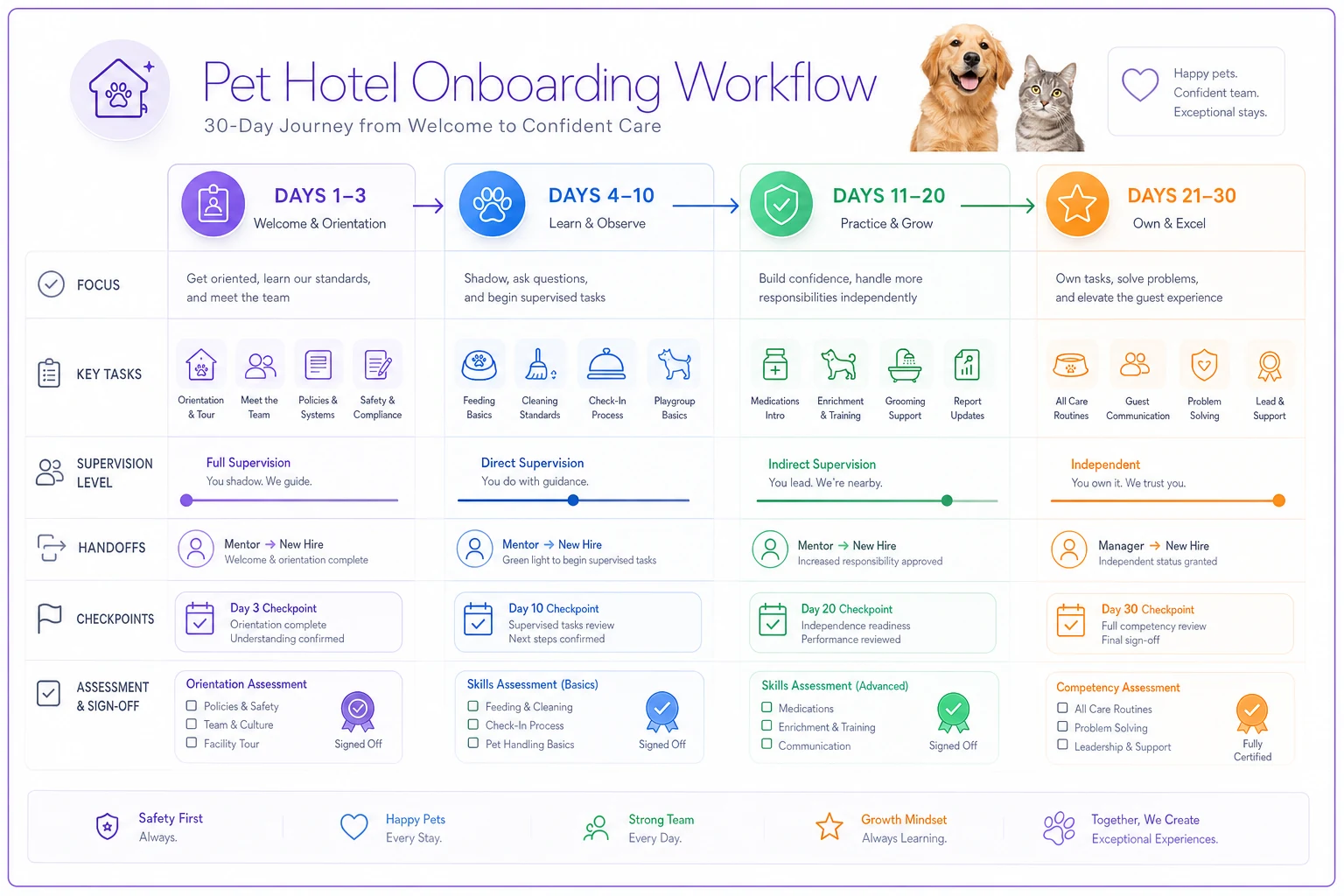
This graphic highlights the phased handoffs and assessment points so managers can visualize progression.
Days 1-3: Foundation and Observation
Start with safety and basic operations. New hires shadow experienced staff, focusing on:
-
Facility layout and emergency procedures
-
Basic dog handling and reading body language
-
Cleaning protocols and supply locations
-
Observation of check-in/check-out process
No direct dog handling yet—just learning the rhythm and requirements.
Days 4-10: Supervised Basic Tasks
Begin hands-on work with constant supervision:
-
Feeding assistance (preparing bowls, not entering kennels)
-
Cleaning empty kennels to standard
-
Laundry and dish sanitization
-
Basic record keeping
Introduce one specialty area based on their eventual role—medication logging for a future lead, or customer communication for front desk.
Days 11-20: Increasing Independence
Gradual release of supervision for mastered tasks:
-
Solo feeding rounds for easy dogs
-
Cleaning occupied kennels with backup nearby
-
Assisting with medications (observing administration, doing documentation)
-
Shadowing check-ins to learn verification processes
Start cross-training in a secondary area—if they're primarily kennel staff, introduce front desk basics.
Days 21-30: Competency Confirmation
Final assessments and role solidification:
-
Solo completion of primary responsibilities
-
Demonstration of emergency procedures
-
Check-off on specialized tasks for their role
-
Introduction to schedule flexibility needs
The key is specific benchmarks at each stage. Not just "knows how to clean kennels" but "completes standard kennel in under 15 minutes meeting all 12 checklist items."
The cross-training matrix that prevents coverage crises
Single-skilled staff create scheduling nightmares. When your only medication-certified person calls in sick, you're stuck. When your check-in expert takes vacation during busy season, service suffers.
Building systematic cross-training starts with mapping your actual skill requirements:
| Task Category | Skill Level 1 (Assist) | Skill Level 2 (Perform) | Skill Level 3 (Train) |
|---|---|---|---|
| Basic Cleaning | Supplies, protocols | Solo completion | Quality check others |
| Feeding | Prep, special diets | Distribution, monitoring | Troubleshoot issues |
| Medication | Documentation | Administration | Verify prescriptions |
| Check-in/out | Belongings, paperwork | Full process | Handle problems |
| Dog Handling | Calm dogs only | All temperaments | Aggressive/fearful |
| Customer Service | Basic questions | Booking, changes | Complaints, emergencies |
| Overnight | Emergency contact | Solo supervision | Medical emergencies |
Every staff member should reach Level 2 in at least three categories, Level 3 in their primary role. That creates coverage flexibility without expecting everyone to master everything.
Prioritize cross-training in medication administration and overnight supervision first to minimize high-risk coverage gaps.
The progression matters. Someone might spend six months at Level 1 medication assistance before attempting administration. Basic cleaning should reach Level 2 within two weeks. Map realistic timelines based on complexity and risk.
Track competency formally. Create sign-off sheets for each skill level. When Sarah demonstrates proper medication administration for five consecutive days without error, she gets signed off for Level 2. This isn't bureaucracy—it's protection against the "I thought they knew how to do that" disaster.
Shift templates that balance coverage and cost
Standard shift patterns in pet hotels often waste labor or leave gaps. The traditional 7-3, 3-11 hospital-style shifts don't match actual workflow needs. Neither does retail's varied daily scheduling.
Successful facilities build templates around task clustering:
Heavy Morning (6am-2pm): 2-3 staff
-
All feeding (6
30-8am)
-
All kennels cleaned (7am-12pm)
-
Medications round 1 (8am)
-
Late morning check-ins start (11am)
Midday Bridge (11am-7pm): 1-2 staff
-
Lunch potty breaks
-
Afternoon check-ins/outs (heavy 2-5pm)
-
Medications round 2 (2pm)
-
Dinner prep starts (4pm)
Evening Wind-down (2pm-10pm): 1-2 staff
-
Dinner feeding (5-6
30pm)
-
Final check-outs
-
Evening potty breaks
-
Medications round 3 (8pm)
-
Overnight prep
Overnight (10pm-6am): 1 staff
-
Hourly rounds
-
Emergency response
-
Early morning prep
-
Medication round 4 if needed (2am)
This creates natural overlaps during busy periods while avoiding excess coverage during quiet times. The 11am-7pm bridge captures both lunch breaks and afternoon rush. The 2pm-10pm shift handles dinner through close without early morning burnout.
Build multiple templates for different occupancy levels:
-
Under 40% occupancy
Minimum viable coverage
-
40-70% occupancy
Standard coverage
-
70-90% occupancy
Enhanced coverage
-
Over 90% occupancy
Full coverage
-
Holiday/surge periods
Maximum coverage
Each template should specify exact positions, not just headcount. "Two morning staff" becomes "one senior kennel tech plus one float." This prevents scheduling two new hires together or missing critical certifications.
Minimum coverage formulas that protect quality
There's always pressure to cut labor when occupancy drops. But going below minimum viable coverage creates compound problems—rushed work leads to mistakes, stress drives turnover, and service quality drops exactly when you need to impress the fewer customers you have.
Absolute Minimums by Occupancy:
-
1-10 dogs
1 person (may need on-call backup)
-
11-20 dogs
1.5 people (one full, one partial shift)
-
21-35 dogs
2 people minimum during peak hours
-
36-50 dogs
2.5 people (two full, one partial)
-
Over 50
3+ people during operations
These assume perfect conditions—no special needs dogs, no medications, no behavioral issues, standard check-in/out flow. Adjust upward based on:
-
Medical boarding
Add 0.5 staff per 10 medical dogs
-
Daycare integration
Add 1 staff when daycare is active
-
Grooming services
Add 1 dedicated groomer (don't pull from floor)
-
Extended check-in window
Add 1 during hotel-style anytime pickup
Never violate two-person minimums during operating hours, regardless of occupancy. Solo coverage creates real risk—what happens when someone gets bitten, has a medical emergency, or faces an aggressive dog? One incident can cost more than years of "excess" labor.
Cost-per-stay calculations that reveal true labor efficiency
Most pet hotels track labor as a percentage of revenue. That's useful for overall health but misses operational detail. Cost-per-stay calculations reveal whether your staffing model actually works.
Calculate Total Labor Cost per Stay:
-
Total weekly labor hours
280 hours
-
Average hourly rate (including taxes, workers comp)
$18.50
-
Weekly labor cost
$5,180
-
Weekly stays (dogs × nights)
245 stays
-
Labor cost per stay
$21.14
Now compare across different periods:
-
Low season (30% occupancy)
$31.20 per stay
-
Regular operations (65% occupancy)
$21.14 per stay
-
Peak season (90% occupancy)
$17.85 per stay
-
Holiday surge (95% with overtime)
$24.30 per stay
The pattern reveals your model's efficiency. If labor cost per stay increases linearly when occupancy drops, you're not adjusting staffing properly. If it spikes during high occupancy, you're hitting overtime penalties that better scheduling could avoid.
Labor Cost by Service:
-
Basic boarding
$18-22 per night
-
Luxury boarding
$22-28 per night (additional amenities)
-
Daycare addition
+$8-12 per day
-
Medication administration
+$4-6 per day
-
Special feeding
+$3-4 per meal
This math exposes underpriced services. If medication administration costs you $5 in labor but you charge $3, you're losing money on every pill given. If daycare adds $10 in labor but only $15 in revenue, the margin might not justify the complexity.
The 90-day reality check
Extending onboarding thinking to 90 days changes retention dramatically. Most facilities consider someone "trained" after a month, but real competence takes a full quarter.
Days 31-60: Role Ownership
-
Consistent primary shift assignment
-
Introduction to problem-solving scenarios
-
Cross-training in second area to Level 2
-
Inclusion in team meetings and scheduling decisions
Days 61-90: Team Integration
-
Feedback on process improvements
-
Mentoring newer hires
-
Coverage flexibility demonstrated
-
Performance review and raise consideration
The facilities that retain staff past 90 days typically see them stay over a year. Those who lose people in weeks 5-12 usually failed to provide enough support during the competence-building phase—people left not because the job was hard, but because they felt unsupported through the hard part.
Technology integration without losing the human element
Modern scheduling platforms can handle the mathematical complexity while you focus on the human side. AI-powered operational software can predict coverage needs based on historical patterns, flag when minimum coverage requirements aren't met, and surface cross-training gaps before they turn into actual problems.
The better systems integrate your booking data directly with scheduling—when occupancy projections shift, staffing recommendations adjust automatically. When someone calls in sick, the platform identifies qualified replacements based on skills, availability, and overtime implications.
That said, technology supports human judgment, it doesn't replace it. Your experienced manager knows that Jennifer handles difficult dogs better than her certification level suggests, or that putting Marcus and Tyler on the same shift creates friction. The math gives you the framework; experience provides the finesse.
Warning signs your model needs adjustment
Watch for these indicators that your current approach isn't sustainable:
Staffing Model Breakdown:
-
Overtime exceeding 10% of total labor hours
-
Turnover above 100% annually
-
Multiple no-call no-shows monthly
-
Staff refusing shift changes or extra hours
-
Customer complaints about rushed service
Coverage Quality Issues:
-
Feeding running past 9am regularly
-
Medications given late
-
Check-ins backing up to the parking lot
-
Cleaning incomplete at shift end
-
Overnight person handling morning tasks
Financial Stress Points:
-
Labor exceeding 45% of revenue consistently
-
Cost-per-stay varying more than 40% between periods
-
Premium pay (overtime, holidays) exceeding 15% of labor
-
Turning away bookings due to staffing, not space
When multiple warning signs appear at once, incremental adjustments won't fix it. You need systematic restructuring—redoing your templates, recalculating ratios, and possibly adjusting your service model to match staffing reality.
Making the math work in practice
The gap between theoretical models and daily reality is where most staffing plans break down. Your spreadsheet says you need 2.3 people for morning shift, but you can't schedule three-tenths of a person. Your cross-training matrix shows everyone at Level 2 in three skills, but half your staff started last month.
Successful implementation requires building in buffer capacity. If the math says you need 15 staff-hours for Wednesday, schedule 17. The excess isn't waste—it's insurance against the unexpected difficult check-in, the new dog who won't eat, or the kennel that needs deep cleaning after an accident.
Start changes gradually. Don't overhaul your entire scheduling system at once. Pick one element—standardizing shift templates, for example—and run it for a full month before adding complexity. Let staff adapt before introducing cross-training requirements or changing coverage formulas.
Document everything. When you find the right staffing level for 75% occupancy, write down exactly who worked what shifts. When a combination handles Saturday morning smoothly, capture the specific roles and timing. That documentation becomes your playbook for scaling.
Most importantly, involve your team in refinements. They know which transitions waste time, which task combinations create bottlenecks, and which shifts leave them drained versus manageable. Their input transforms theoretical models into practical systems.
The pet hotels that master staffing math don't just survive busy seasons and slow periods—they maintain consistent service quality while protecting margins and keeping good people. It takes upfront work to build the models, patience to refine them, and discipline to stick with them when it's tempting to just fill shifts however possible. But once you understand the math underlying your operations, scheduling transforms from daily chaos into predictable patterns that everyone—owners, staff, and dogs—can count on.
Ready to optimize your pet hotel operations?
Join hundreds of pet hotels using GoPetel to save time, improve pet care, and increase booking reliability.