



Tuesday morning felt like chaos. My phone started buzzing at 6 AM with calls from pet hotel owners asking if they could switch shift leads back to salary. By Thursday, the confusion had spread across every facility I work with. Everyone was scrambling to understand what just happened with the Department of Labor rules.
The short version: The Department of Labor just rolled back the overtime expansion, dropping the salary threshold from $844 per week back down to $684. If you had managers making between those numbers who you switched to hourly last July, you can technically flip them back to salary exempt status.
But hold on before you rush to reclassify everyone. The real impact goes way beyond just switching people between hourly and salary. This affects your entire operational structure.
The Hidden Mess This Creates
Most pet hotels have between 8 and 25 employees. When the threshold jumped to $844 weekly last year, many facilities had to convert assistant managers and shift leads to hourly. Now you can switch them back, but changing someone's classification twice in under a year creates problems that have nothing to do with legal compliance.
Your overnight supervisor who's been hourly since July has gotten used to clocking in, tracking hours, maybe picking up extra shifts during busy weekends for overtime pay. They've probably adjusted their budget around those overtime opportunities during holidays. Now you want to put them back on salary at maybe $36,000 a year? That conversation won't go well.
Three immediate problems crop up. First, you lose scheduling flexibility. When someone's salaried, you can't cut their hours during slow January weeks to save on labor costs — they get paid the same whether they work 35 hours or 50. Second, employees lose trust. Nobody wants their pay structure changed twice in twelve months. Third, your entire scheduling system breaks down.
Why Pet Hotels Get Classification Wrong
Pet boarding creates unique classification challenges because the work doesn't fit neatly into office job categories. Your kennel supervisor does administrative work — scheduling, inventory, customer issues — but also spends half their shift physically handling dogs, cleaning runs, and covering breaks. That blend makes the exempt/non-exempt decision murky even when the rules stay stable.
Never miss a booking or detail again.
GoPetel simplifies pet hotel operations by managing every reservation and pet profile seamlessly.
- Centralized booking management
- Automated client notifications
- Staff and kennel scheduling
No credit card required
One facility in Denver got hit with a $47,000 back-wage claim because they had a "kennel manager" on salary who spent 70% of her time doing direct dog care. The DOL investigator literally timed her activities throughout the day. If you're spending most of your time doing the same work as your hourly staff, that fancy title doesn't protect you from overtime requirements.
The investigation started from a single employee complaint during busy season. The manager had been working 65-hour weeks through the holidays, realized she would have made an extra $400 per week if she'd been hourly, and called the DOL hotline. One phone call turned into an audit of three years of timesheets.
Pet hotels face this problem more than other businesses because kennel supervisors regularly jump into direct care work. When three dogs start fighting in the play yard, your manager isn't delegating — they're breaking it up. When someone calls out sick during Saturday morning feeding, your manager covers those runs. That hands-on reality makes most kennel supervisor roles non-exempt regardless of the salary threshold.
The Scheduling Problem Nobody's Solving
Switching classifications breaks your coverage model. Pet hotels need consistent overnight and weekend coverage, and salary exempt employees were your solution for those awkward shifts. You could schedule your assistant manager for Tuesday through Saturday without worrying about overtime when they stayed late for a difficult pickup.
Now look at what happens when you flip-flop. Say you have an overnight supervisor making $38,000 annually (about $730 weekly). Last July, you switched them to hourly at $18.25 per hour. They started earning overtime for anything over 40 hours, which probably pushed their actual earnings up to around $41,000-$42,000 with typical pet hotel scheduling. Now you can switch them back to salary at their original $38,000.
You just asked someone to take a $3,000-4,000 pay cut.
During the months they were hourly, you probably adjusted your scheduling to minimize overtime. Maybe you hired a part-timer to cover their sixth day. Maybe you redistributed weekend duties. Your whole coverage model adapted to the hourly structure. Switching back doesn't just change their pay — it disrupts every schedule you've built since last summer.
The smart approach isn't to rush back to salary classifications. Use this moment to rebuild your staffing structure from scratch.
Building a Classification System That Won't Break Again
Start with job duties, not titles or pay. Write down what each role actually does hour by hour through a typical week. Monday 6am-7am: feeding and medications. 7am-8am: cleaning runs. 8am-9am: checking in overnight boarders. Document until you have a real picture of where time goes.
For each position, calculate the percentage of time spent on:
-
Direct animal care (feeding, cleaning, medicating, exercising)
-
Customer interaction (check-ins, tours, problem resolution)
-
Administrative work (scheduling, ordering, paperwork)
-
Training and supervising other employees
-
Strategic planning and business development
If direct animal care plus customer interaction exceeds 50%, that role is almost certainly non-exempt regardless of salary. The DOL doesn't care that you call them a manager — they care what they actually do all day.
Map out your true coverage needs:
-
5am-7am
Morning feeding crew
-
7am-3pm
Full day shift
-
3pm-11pm
Evening shift with pickup coverage
-
11pm-5am
Overnight monitoring
During peak season, you might need double coverage from 3pm-7pm for pickups. During slow season, you might run skeleton crews. Which roles provide flexible coverage versus fixed coverage?
Fixed coverage roles (must be there specific hours) work better as hourly. Flexible coverage roles (handle whatever comes up) might justify salary exempt status — but only if they're doing actual managerial work most of the time.
When documenting duties, track actual activities for at least two full weeks to avoid relying on idealized schedules.
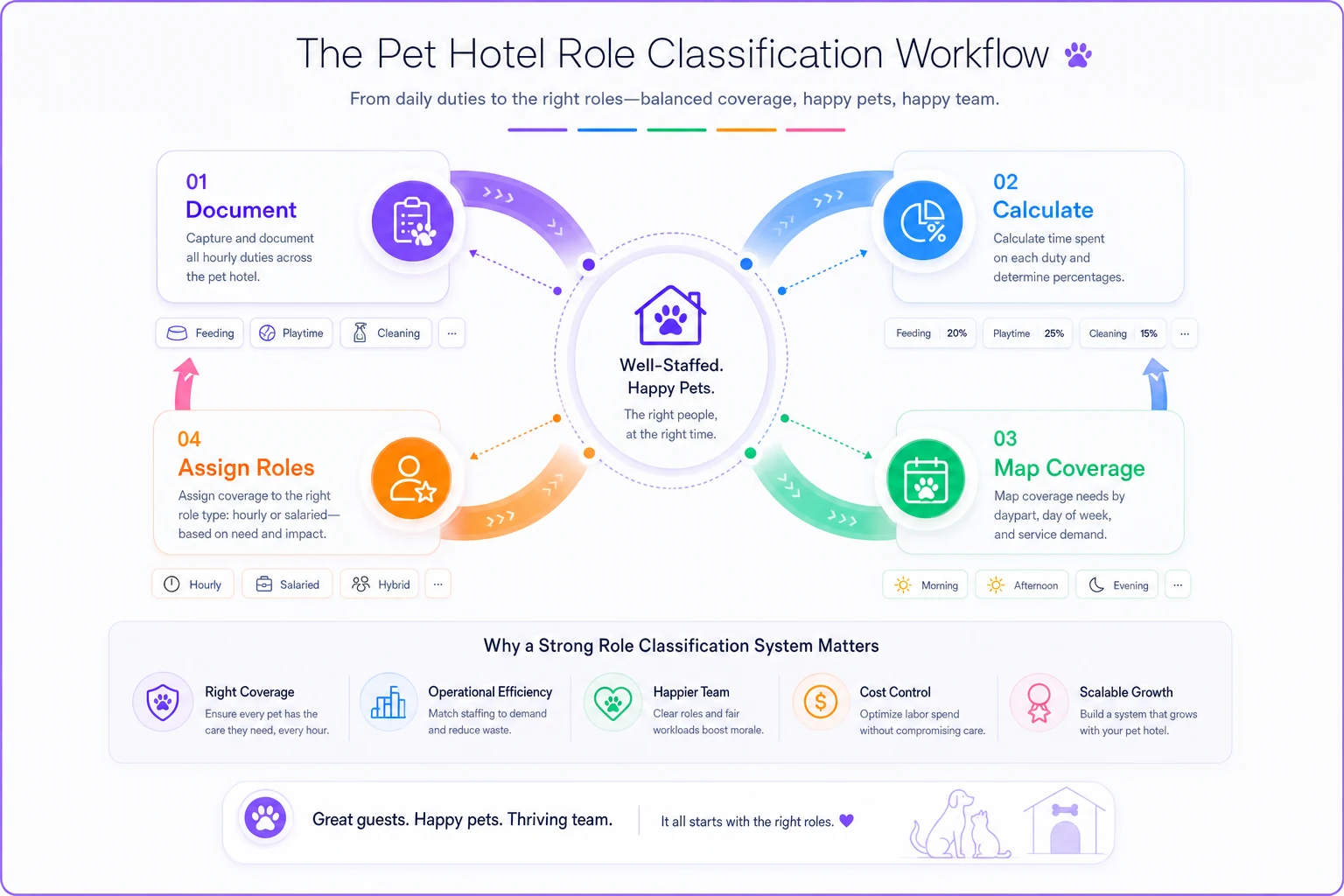
Use this simple workflow to keep decisions consistent across roles and seasons.
The Pricing Reality Check You've Been Avoiding
Every classification decision has a pricing consequence. When you switch someone from salary to hourly, your labor cost becomes variable. When three dogs need emergency vet runs on the same Saturday, your hourly manager's overtime kicks in. When you're full during spring break, everyone works extra hours. Your labor percentage swings from 35% during normal weeks to 48% during chaos.
The math is brutal but simple. Take your total annual labor cost (including payroll taxes, workers comp, everything) and divide by total capacity nights. If you have 40 runs available 365 nights, that's 14,600 capacity nights. If labor costs $380,000 all-in, that's $26 per night just for staffing. Add facilities, insurance, supplies, and profit — you should be charging at least $45-50 per night minimum. Most facilities are stuck at $35-40.
| Metric | Value |
|---|---|
| Capacity nights | 14,600 |
| Total annual labor cost | $380,000 |
| Labor cost per night | $26 |
| Recommended price per night | $45-50 |
| Most facilities price | $35-40 |
This classification rollback gives you a chance to fix both problems at once.
A Practical Decision Framework
Instead of asking "should I switch people back to salary?" ask these questions in order:
-
1. What percentage of time does this role spend on exempt activities? Less than 50%? Keep them hourly. No exceptions. The legal risk isn't worth it.
-
2. Can I afford to pay this role at least $47,000 annually? That's roughly $900 per week, well above both the old and new thresholds. At this level, classification challenges mostly disappear. If you can't afford this for true managers, you probably can't afford the legal risk of borderline classifications.
-
3. Does this role actually manage other employees? Not just "in charge when manager's gone" but real hiring, firing, scheduling, training authority. If they can't independently make staffing decisions, they're probably not exempt.
-
4. Would losing this person disrupt operations for more than a week? If yes, pay them properly as hourly with overtime or raise their salary above risk thresholds. If no, keep them hourly and cross-train coverage.
-
5. Can I raise prices to support proper classifications? If not, you have a business model problem, not a classification problem.
If not, you have a business model problem, not a classification problem.
The Compliance Checklist That Actually Matters
Immediate actions (this week):
-
Pull reports showing everyone currently between $684-844 weekly
-
Calculate their actual earnings including overtime for the past 3 months
-
Document current job duties with time percentages
-
Check state laws (California, New York, and others ignore federal thresholds)
Communication prep (early next week):
-
Draft two versions of staff communications — one for changes, one for no changes
-
Prepare individual meetings with affected employees
-
Create new job descriptions that match actual duties
-
Calculate the cost difference for each scenario
Decision documentation (by Friday):
-
Written rationale for each classification decision
-
Updated job descriptions signed by employees
-
New offer letters if making changes
-
Payroll system updates completed
Ongoing monitoring:
-
Weekly overtime reports
-
Monthly labor percentage analysis
-
Quarterly duties assessment
-
Annual market rate comparison
The latest HR analysis suggests most employers should focus on long-term compliance rather than reactive changes. For pet hotels, this means building classifications that can survive the next rule change, not just this one.
The Integration Problem Everyone Ignores
While you're deep in reclassification decisions, you're missing the bigger picture: this chaos exposes how fragmented your operations really are. Your scheduling lives in one system (or maybe just text messages), time tracking in another, payroll somewhere else, and customer bookings in yet another place. When rules change, you're manually cross-referencing four different sources to make one decision.
The classification mess becomes manageable when all your operational data lives in one place. AI-powered operational platforms designed for pet care can automatically track time allocation across different duty types. Instead of guessing whether your supervisor spends 40% or 60% of time on exempt duties, you'd have actual data. When someone clocks in, they indicate what type of work they're doing. The system builds a real picture of role responsibilities over time.
This same integration helps with the pricing problem. When you can see true labor cost per booking in real-time — including overtime impacts — you can adjust rates dynamically. Holiday surge pricing becomes mathematical rather than emotional. You know exactly when your labor percentage tips into unprofitability.
When regulations change again (and they will), you'll have historical data showing exactly how each role operates. No scrambling, no guessing, no emergency meetings. Just pull the reports and make informed decisions.
Making the Right Call for Your Kennel
Unless switching someone back to salary clearly benefits both you and the employee, don't do it. The trust you lose from changing people's pay structure twice isn't worth saving a few hundred dollars per month on overtime.
Use this moment to fix the underlying problems. Restructure roles so they clearly fall on one side or the other of exempt classification. Adjust your pricing to support proper wages. Build systems that track real work patterns rather than theoretical job descriptions.
The pet hotels that thrive through regulatory chaos build operations robust enough to handle change. They don't chase every rule modification — they create stable structures that work regardless of where thresholds land. They price services based on true costs, not competitor matching. They treat employees consistently rather than ping-ponging their classifications.
Most importantly, they recognize that staffing isn't just a compliance exercise — it's the core of delivering great pet care. When your team knows their role, understands their pay, and trusts the system, they focus on what matters: keeping pets safe, healthy, and happy.
The rollback isn't a chance to save money by switching people back to salary. It's an opportunity to build the staffing structure you should have had all along — one that survives any regulatory change while supporting both your team and your bottom line.
Ready to optimize your pet hotel operations?
Join hundreds of pet hotels using GoPetel to save time, improve pet care, and increase booking reliability.