

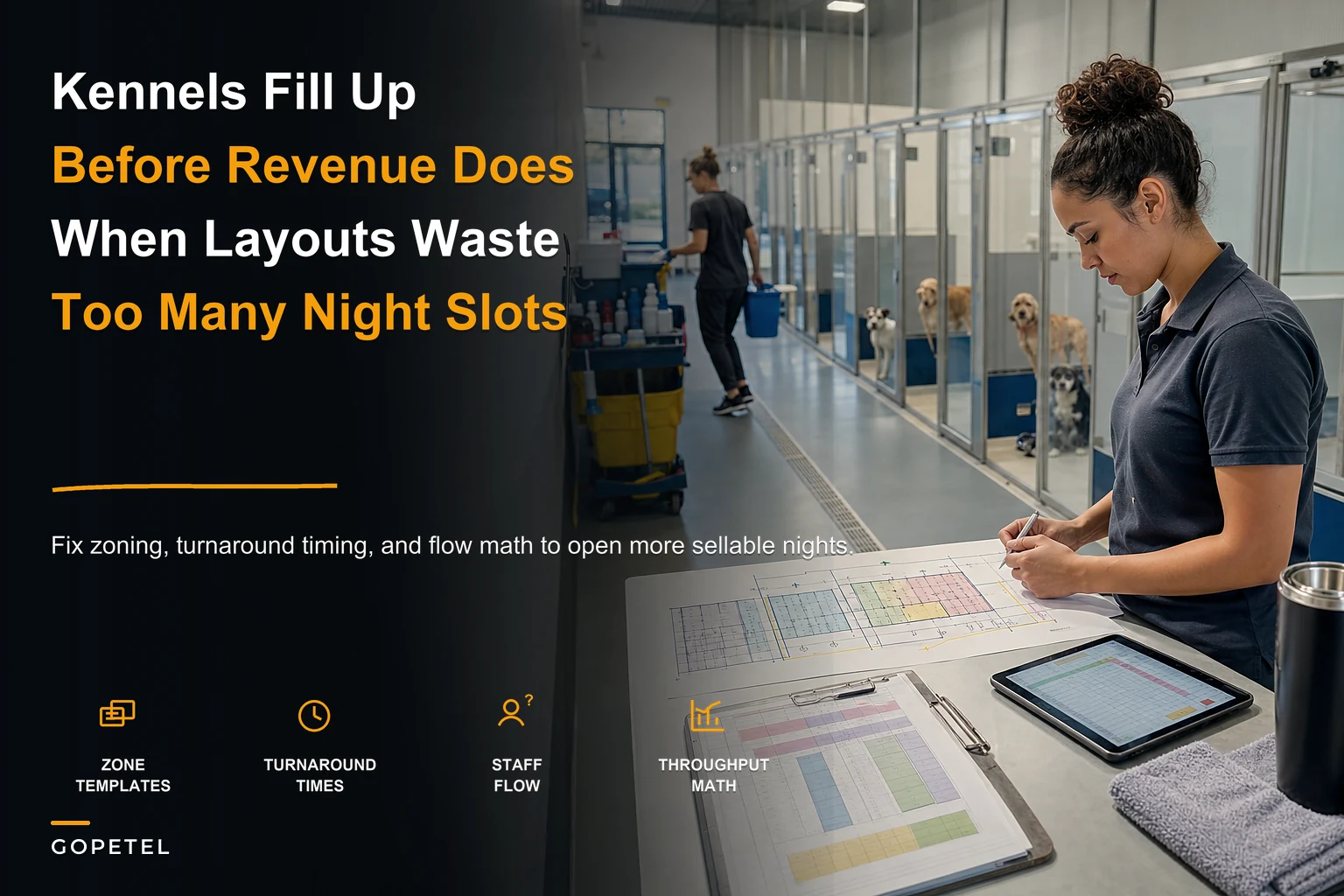

Watch a pet hotel during morning pickup rush and you'll see the real capacity killer. It's not the number of runs. It's the bottleneck at 9:47am when three dogs need grooming, two are waiting for meds, the luxury suite needs deep cleaning, and your staff is stuck waiting for the disinfectant cart that's trapped behind check-ins.
The math looks simple on paper — 42 runs means 42 dogs, right? But operational reality hits different. That corner run next to the food prep area? Can't use it during meal times. The three runs near the grooming station? Blocked every morning from 8-11. The isolation wing you built for sick pets? Empty 80% of the time but eating 15% of your square footage.
Most pet hotels lose 25-35% of their theoretical capacity to poor zoning and workflow conflicts. Not because they lack space, but because their layout creates operational traffic jams that compound throughout the day.
Why traditional kennel layouts fail at scale
The standard kennel blueprint — rows of runs with a central corridor — works fine when you're boarding 15 dogs. But somewhere around 30-35 dogs, everything starts breaking down. Staff collide in hallways. Cleaning takes forever because the utility closet is at the opposite end from half your runs. Dogs in adjacent runs feed off each other's anxiety because sight lines weren't considered.
Most facilities grow by adding runs wherever they fit. That back room becomes overflow boarding. The old grooming area becomes luxury suites. Each addition makes sense individually but creates workflow chaos collectively.
A facility starts with 20 runs in a simple grid. Business grows, they add 10 runs in the basement. Then convert office space to 5 luxury suites. Now staff is running three floors, cleaning supplies are scattered, and morning feeding takes an hour longer because half the time gets burned walking between zones.
The compounding effect is brutal. Each workflow conflict doesn't just waste time — it creates scheduling dependencies that ripple through your entire day. Can't clean the back runs until grooming is done. Can't start afternoon playtime until morning meds are distributed. Can't intake new arrivals because your quarantine area is being used for overflow boarding.
The zoning breakthrough that changes everything
Proper zoning isn't about organizing by dog size or temperament — it's about organizing by operational workflow. The facilities that maximize throughput divide their space based on task dependencies and cleaning cycles.
Never miss a booking or detail again.
GoPetel simplifies pet hotel operations by managing every reservation and pet profile seamlessly.
- Centralized booking management
- Automated client notifications
- Staff and kennel scheduling
No credit card required
Start with the turnaround math. Standard runs need 15-20 minutes for full cleaning and disinfection between dogs. Luxury suites need 35-40 minutes. But cleaning time isn't just about the physical cleaning. It's about staging, access to supplies, drying time, and avoiding cross-contamination paths.
The most efficient layout follows a three-zone system based on turnover speed. This isn't revolutionary thinking, but it works when you actually implement it correctly.
Zone A: Quick-turn runs (1-3 night stays)
Located nearest to supplies and drainage. These runs get the most turnover, so every extra step multiplies into hours of wasted labor. Keep them clustered, with direct access to cleaning stations. No luxury features that slow down cleaning.
Zone B: Extended stays (4+ nights)
These can be further from supplies since they turn over less frequently. Put your comfort features here — raised beds, windows, sound dampening. The cleaning complexity is worth it because you're not turning them daily.
Zone C: Special handling
Puppies, seniors, medical holds, new arrivals awaiting behavior assessment. These need isolation from general population but easy staff access for frequent monitoring. Put them where staff naturally travels, not in some forgotten corner that requires special trips.
The magic happens when you align these zones with your natural traffic patterns. Morning cleaning flows from Zone A to B to C. Feeding routes don't cross contamination paths. Your infection control protocols actually become feasible instead of theoretical because the layout supports them.
Here's a simple workflow diagram showing movement from Zone A to Zone C.
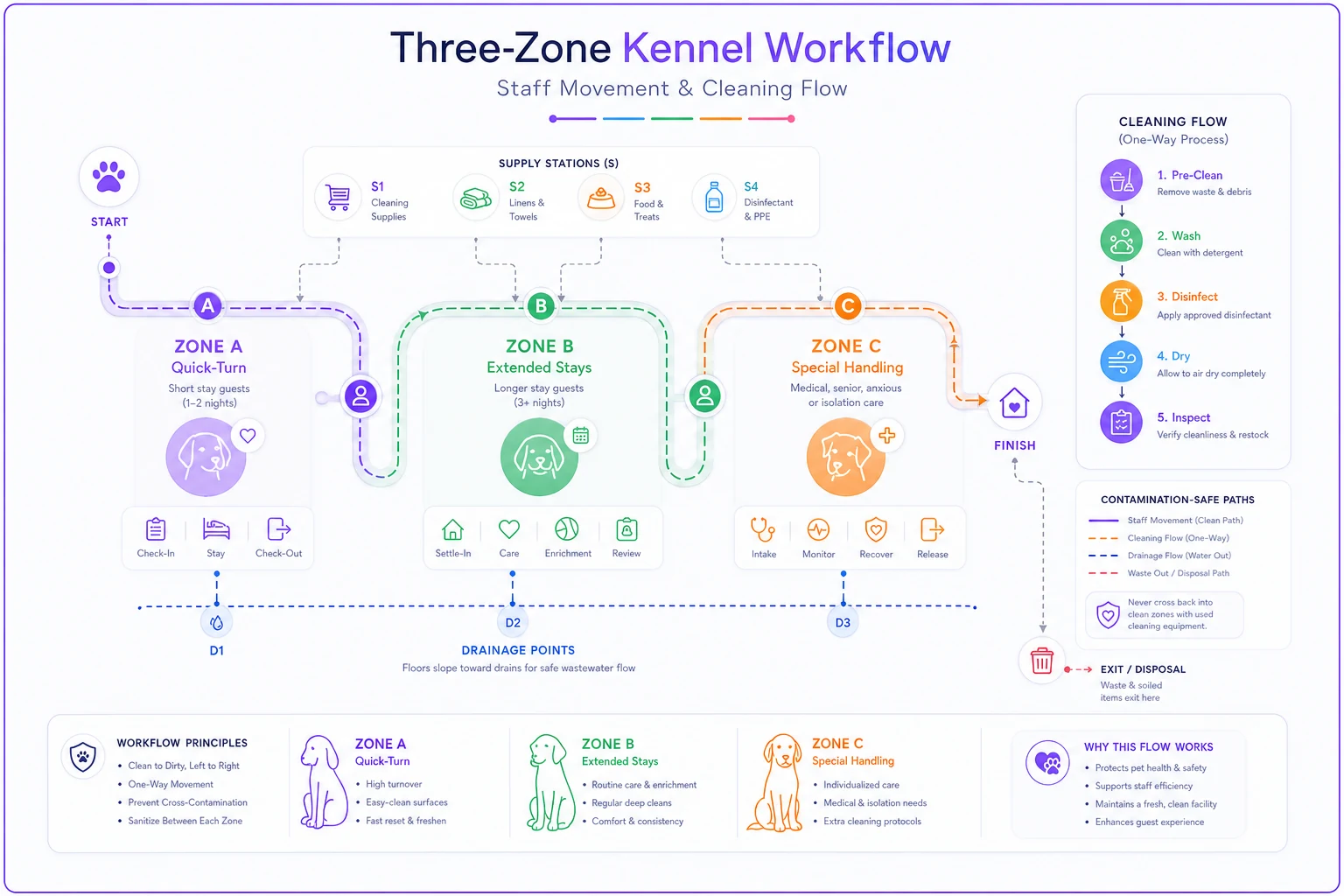
Use this diagram to orient staff during morning turnover.
Time-based scheduling that prevents pile-ups
Even perfect zoning fails if your scheduling creates conflicts. The solution? Understanding your operation's natural rhythm and building schedules that flow with it.
Map out your collision points first. When does grooming overlap with feeding? When do pickups conflict with cleaning? Where do staff literally run into each other? These aren't random — they're predictable patterns that repeat daily.
| Time Block | Focus Activity | Zone Priority | Staff Notes |
|---|---|---|---|
| 7:00-8:30am | Cleaning surge | Zone A turnovers | No grooming, minimal dog movement |
| 8:30-10:00am | Movement window | All zones | Grooming starts, playgroups form |
| 10:00-11:30am | Intake window | Reception + Zone C | New arrivals processed |
| 11:30am-1:00pm | Deep cleaning | Zone B focus | Lower intensity, thorough work |
We're not trying to do everything simultaneously. Clear operational windows where specific tasks dominate reduce friction and increase throughput.
Capacity math that reflects reality, not wishful thinking
Your real capacity isn't your run count. It's the minimum of several bottlenecks: cleaning speed, staff availability, intake processing rate, and special needs percentage.
The formula that actually works:
Effective Capacity = (Total Runs - Maintenance Buffer) × Turnover Efficiency × Staff Coverage Factor
Real numbers work out like this: Say you have 50 runs total. You need 3-4 runs always available for emergency intakes or isolation needs. That's 46 usable runs. Your turnover efficiency (how quickly you can clean and flip runs) is probably around 80% if you're good, 65% if you're average. Your staff coverage factor (accounting for breaks, multiple task requirements, no-shows) is roughly 0.85.
So: 46 × 0.80 × 0.85 = 31 runs of real capacity.
That's why your 50-run facility struggles at 35 dogs. You're not under capacity — you're at capacity given your operational constraints.
Facilities that understand this stop trying to fill every run. They price and book based on their effective capacity, which means higher revenue per dog and less operational stress.
Layout diagrams for common footprints
Most pet hotels fall into three footprint categories. Each has specific flow patterns that work and specific mistakes to avoid.
The Rectangle (most common)
Single building, 2,500-4,000 sq ft, one main corridor. The mistake everyone makes: putting high-turnover runs at the far end. Instead, create a U-flow where morning cleaning starts at the back and moves toward the front, pushing dirty materials toward the exit. Place your utility station at the midpoint, not the end. This cuts walking distance by 40%.
The L-Shape
Usually a converted building or addition. The corner becomes your operational hub — put utilities, food prep, and staff station there. Use the short arm for special needs and isolation. The long arm for general population. This prevents staff from walking the entire L repeatedly.
The Hub-and-Spoke
Multiple connected buildings or wings. Don't treat this as one facility. Each spoke needs semi-autonomous operation capability. Duplicate critical supplies in each wing. Staff should complete most tasks without returning to the hub. The hub becomes intake, administration, and specialized services only.
Your drainage matters more than your walls. Beautiful facilities fail because water flows uphill from the cleaning area, or drains backup when three zones clean simultaneously. Get your infrastructure right before worrying about aesthetics.
Converting theory to Monday morning reality
All these concepts mean nothing if your team can't execute them. The best zoning plan fails when staff shortcuts through the wrong zones. Perfect scheduling collapses when someone calls in sick.
Build flexibility into your system. Your Zone A might become Zone B during holidays when extended stays dominate. Your quick-turn schedule might slow down when you have multiple special-needs dogs. The framework should guide decisions, not dictate them.
Document everything as visual workflows. Not lengthy SOPs that no one reads — actual diagrams showing movement patterns, cleaning sequences, and timing.
-
Laminate them and post them where work happens.
-
When someone new starts, they should understand traffic flow within their first shift.
Training matters, but tools matter more. Color-coded cleaning supplies for each zone. Timer systems for turnover tracking. Visual indicators for run status. The easier you make it to follow the system, the more consistent your operations become.
Staff buy-in happens when they see the system actually works. Start with your most chaotic time period — usually morning turnover — and nail that first. Once they experience smoother operations during rush hour, they'll embrace the changes for the rest of the day.
The compound effect of proper throughput engineering
When you nail kennel capacity optimization, the entire business transforms. It's not just about fitting more dogs in — it's about creating predictable, scalable operations that don't break under pressure.
Your staff stops running around frantically. Cleaning happens in logical sequences instead of random scrambles. Dogs experience less stress because their environment is predictable and calm. Owners notice the organization and trust you more with their pets.
The revenue impact compounds too. Better throughput means you can handle peak periods without overtime chaos. Higher effective capacity means better revenue per square foot. Smoother operations mean fewer mistakes, fewer complaints, and more referrals.
Most importantly, you stop leaving money on the floor during peak season. While competitors turn away Christmas bookings because they're "full," you're operating at true capacity with room to spare. That's an extra $30k-50k annually for a typical 40-run facility, just from better space utilization.
Implementation isn't perfect on day one, but it improves every week as your team internalizes the patterns.
Your facility probably has 20-30% more capacity hiding in plain sight. Not in empty runs, but in the friction between your current layout and your daily operations. Fix the flow, and the capacity follows.
Ready to optimize your pet hotel operations?
Join hundreds of pet hotels using GoPetel to save time, improve pet care, and increase booking reliability.