


There's a specific kind of pain that shows up about six months after a pet hotel launches its first "premium" package. The math looked great on paper — bundle a few nights with a bath, some playtime, a couple photo updates, charge a nice round premium. Bookings come in. Everyone's happy.
Then peak season hits, and suddenly the front desk is fielding angry calls because a package promised two 30-minute play sessions a day and the staff physically can't deliver them when the facility is at 92% occupancy. The package didn't just sell a price. It sold a fulfillment obligation that quietly competes for the same labor minutes, the same yard slots, and the same grooming bay as everything else in the building.
That's the part most owners miss. A package isn't a marketing object — it's an operational contract. And when you design bundles without wiring them to your actual throughput limits, you don't create margin, you create a promise-generating machine that outruns your ability to deliver.
This is a systems article, not a pricing-tips list. The goal is to show how service definitions, fulfillment SLAs, throughput gating, and profitability math all have to connect — and what breaks when they don't.
Why packages drift away from capacity in the first place
The reason this happens across so many facilities isn't laziness. It's that the people designing packages are almost never the same people fulfilling them.
Packages usually get built in a spreadsheet by whoever handles pricing — an owner, a GM, sometimes a marketing consultant. They're thinking about attractiveness, competitor comparison, and average ticket. What they're not holding in their head is the reality that a "VIP Suite Stay" with a nightly enrichment session, a mid-stay bath, and daily photo/video updates consumes roughly:
-
2 handler play blocks (staff-minutes)
-
1 grooming bay slot (a scarce, non-substitutable resource)
-
media capture and editing time (which competes with the exact same rebooking driver you're trying to protect)
None of that lives in the pricing spreadsheet. So the package looks profitable at the SKU level and quietly destroys profitability at the facility level, because it steals capacity from higher-margin nights.
There's a pattern that shows up again and again: the more premium the package, the more it leans on your most constrained resources. Grooming bays, senior handlers, one-on-one time. So your best-sounding product is often the one most likely to blow up throughput. This is the same dynamic covered in the grooming capacity model and booking rules — add-ons and premium inclusions feel like free upside until they collide with a bottleneck resource that has hard daily limits.
The four layers a package actually has
If you want packages that scale, stop treating them as a name and a price. Every package is really four layers stacked on top of each other, and each layer needs its own definition.
Never miss a booking or detail again.
GoPetel simplifies pet hotel operations by managing every reservation and pet profile seamlessly.
- Centralized booking management
- Automated client notifications
- Staff and kennel scheduling
No credit card required
| Layer | What it defines | What breaks if it's vague |
|---|---|---|
| Service definition | Exactly what's included, in measurable units (minutes, sessions, items) | Staff improvise; two guests on the same tier get different experiences |
| Fulfillment SLA | When and how each inclusion must be delivered | "Daily photo" becomes "sometime, maybe," and clients notice |
| Throughput gating | How many of this package can be sold per day/week given constrained resources | You oversell your grooming bay and cascade delays through the whole building |
| Profitability logic | The true margin after resource cost, not just price minus food | You scale the package that loses you money at volume |
The mistake almost everyone makes is defining layer one and skipping two through four. You write "includes daily playtime" and stop there. But "daily playtime" without a duration, a delivery window, and a per-day sell limit isn't a spec — it's a liability with a friendly name.
A tight service definition reads more like: "2 × 20-minute solo yard sessions, delivered one AM (7–10) and one PM (3–6), logged with timestamp." Now it's fulfillable, measurable, and — critically — you can count how many the building can physically produce in a day.
What breaks at scale (and it's not what you think)
At low occupancy, sloppy packages hide. When you're at 40% capacity, slack is everywhere. Staff can absorb an extra bath, squeeze in a longer play session, catch up on photos during a slow afternoon. The package "works" because the building is carrying its inefficiency for free.
The failure mode is entirely a scale problem. Here's the sequence as occupancy climbs:
-
Occupancy passes ~75% and slack disappears. Every promised inclusion now competes directly for the same finite minutes.
-
Premium packages get prioritized (as they should — clients paid more), which means standard-tier service quietly degrades. Standard guests get shorter walks, later feedings, fewer updates.
-
Grooming becomes the choke point. If three package types all include a bath, and your grooming bay does maybe 8–10 baths a day, you've mathematically oversold before a single client complains.
-
Staff start triaging by whoever's loudest instead of by rule, which means fulfillment becomes personality-driven and inconsistent.
-
Refunds and comps climb. Now the "profitable" package is generating margin leakage through service-recovery credits that never showed up in the original pricing model.
The thing worth paying attention to: packages don't fail at the tier that's broken. They fail at the tier underneath it, because premium fulfillment cannibalizes standard fulfillment first. Complaints come from the wrong guests, and owners chase the wrong fix.
Throughput gating: the piece almost nobody builds
Gating is the mechanism that stops your booking system from selling more of a package than you can deliver. It's the difference between a package system and a package problem.
Real gating means each package is tied to the resources it consumes, and the booking flow checks availability against the constrained resource, not just the kennel. An open kennel doesn't mean you can honor a mid-stay groom that day.
-
Kennel availability — the obvious one, and the only one most systems actually check.
-
Bay/station gating — max baths, nail trims, or grooming inclusions available per day. When the bay is full, packages requiring it stop being bookable for those dates even if kennels are open.
-
Handler-minute gating — total available enrichment/one-on-one minutes per shift, minus what's already committed.
-
Media-capacity gating — if photo/video updates are a promised inclusion, someone has to shoot and send them; that's a real time budget, not a freebie.
Where facilities get burned: they gate on the resource that's visible (the kennel) and ignore the resource that's scarce (the bay, the senior handler). You end up with a building that looks fine on paper but has zero remaining capacity to fulfill its premium promises.
Gate on the scarcest resource (bay or senior handler) rather than the visible one (kennel) to avoid silent cannibalization.
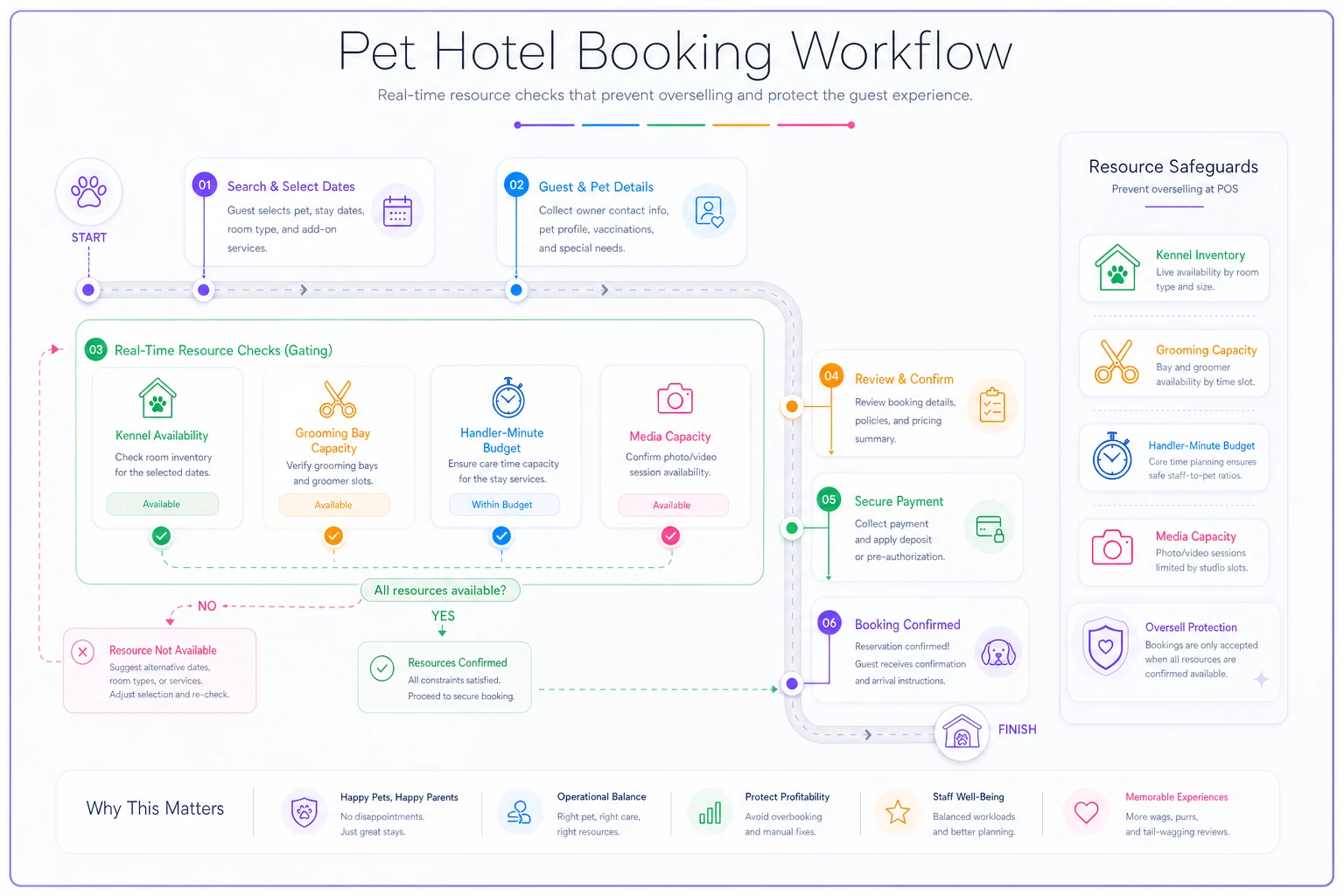
This diagram shows the gating checks in the booking flow and how a sale can be blocked when a constrained resource is exhausted.
Package-level profitability, done honestly
The profitability mistake in almost every pet hotel package: margin gets calculated as price minus obvious costs (food, bedding). But the real cost of a premium package is the opportunity cost of the constrained resource it consumes.
If your VIP package uses a grooming bay slot, and that same slot could've sold as a standalone groom for $65, then $65 is a real cost of that package — even though no cash left the building. Ignore that, and you'll happily scale a package that's technically less profitable than just selling the components separately.
Package margin = Price − direct consumables − (constrained-resource opportunity cost) − (fulfillment labor at loaded rate) − (expected service-recovery credits)
That last term matters more than people expect. If a package generates comps or partial refunds even 8% of the time during peak, that's a recurring cost that belongs in the model. A package that looks like a 55% margin at the SKU level can land closer to 30% once you load in opportunity cost and recovery.
The pattern worth internalizing: the packages that are easiest to sell are often the ones with the worst true margin, because ease-of-sale usually comes from stuffing them with scarce, desirable inclusions.
A real scenario
A mid-size facility — around 60 runs, single grooming bay — launched three tiers: Standard, Comfort, and Suite. The Suite tier included a mid-stay bath, two daily enrichment sessions, and daily photo updates. It sold well: roughly 18–22 Suite bookings a month at first, priced about $30/night above Standard.
The problem surfaced over the holidays. At high occupancy, the single grooming bay couldn't service the mid-stay baths for every Suite guest plus the standalone groom bookings also on the calendar. Staff started doing baths late or skipping enrichment sessions to catch up. Comp credits during that stretch ran somewhere around $1,400–$1,700 — money that came directly out of the tier's supposed premium.
-
The Suite tier's mid-stay bath got a hard daily cap tied to the bay (max 3 Suite baths/day), so the system stopped selling more than could be delivered.
-
Enrichment sessions were redefined with fixed durations and delivery windows so staff could schedule them instead of improvising.
-
Standalone groom slots and package-bath slots were pulled from the same capacity pool, so the calendar couldn't double-book the bay anymore.
Over the next peak period, comp credits on the tier dropped to roughly a third of what they'd been. And — this is the part owners underrate — standard-tier complaints fell too, because premium fulfillment stopped cannibalizing standard service. Occupancy didn't change much. Deliverability did.
An experiment playbook for launching a new package
Don't launch a package facility-wide on day one. Treat every new bundle as an experiment with a controlled blast radius. A launch sequence that actually protects throughput:
-
Define the four layers on paper first — service spec in measurable units, SLA windows, gating limits, honest margin. If you can't fill in gating and margin, the package isn't ready.
-
Set a hard sell cap for the pilot. Cap the new package at a low daily/weekly number regardless of demand. You're testing fulfillment, not demand.
-
Run it only through low-occupancy weeks first. Observe delivery quality before the building is stressed, then deliberately test it once during a busier stretch.
-
Track three signals on-time SLA fulfillment rate, comp/credit rate, and impact on adjacent tiers. If the tier below it degrades, the package is stealing capacity.
-
Kill or fix, don't drift. If SLA fulfillment falls below your threshold at higher occupancy, either add a gate, reduce an inclusion, or reprice. Don't leave it half-working.
The discipline that separates facilities that scale cleanly from ones that stall: they treat a package launch like a change to their operating system, not like adding a menu item.
A pre-launch checklist
Before any new package goes live, it should pass all of these:
-
[ ] Every inclusion is defined in measurable units (minutes, sessions, count)
-
[ ] Every inclusion has a delivery window, not just a frequency
-
[ ] Each inclusion is mapped to the specific resource it consumes
-
[ ] The most constrained resource has a daily sell cap
-
[ ] Booking flow checks constrained resources, not just kennel availability
-
[ ] True margin includes opportunity cost and expected recovery credits
-
[ ] The package has a pilot sell cap for launch
-
[ ] There's a defined SLA-fulfillment threshold that triggers a rework
If a package can't clear this list, it isn't a product yet — it's a promise you haven't stress-tested.
When rich packages actually make sense — and when they don't
When they make sense: you have genuine slack in your constrained resources, or you can gate tightly enough that premium fulfillment never eats into standard service. Facilities with two grooming bays and predictable mid-week occupancy have room to run richer tiers because the scarce resource isn't the binding constraint.
When it's a bad idea: a single grooming bay, tight handler staffing, and highly seasonal demand. That combination means premium inclusions will collide with your scarcest resource exactly when demand peaks — the worst possible time to fail a promise.
Who should probably not build a heavy tiered system yet: small facilities still running fulfillment by memory and goodwill rather than by logged, scheduled tasks. If you can't currently guarantee a simple stay is delivered consistently, layering three tiers of promises on top of that just multiplies the failure points. Get baseline fulfillment reliable first, then add tiers.
Where software quietly helps — and where it doesn't
None of this requires software to be true. The four layers, the gating logic, the honest margin math — those are operational decisions you make with a spreadsheet and some discipline. Plenty of facilities run tight package systems on manual capacity boards.
Where a management platform earns its keep is enforcement at the point of sale. The failure mode that keeps coming up — selling more of a package than the building can deliver — is precisely the kind of thing that's hard to hold in a human's head at 8am on a busy morning. A booking system that gates against constrained resources (the bay, the handler minutes) rather than just open kennels turns your gating rules from a policy nobody remembers into a rule the calendar enforces automatically. Same with SLA tracking: logging whether each promised session actually got delivered, on time, is tedious by hand and nearly automatic once it's wired into fulfillment workflows.
But the software is downstream of the thinking. A platform that gates against rules you never defined does nothing. Build the four layers first. The tooling just keeps you honest when the building gets busy.
The point worth keeping
Packages aren't a pricing lever you pull once. They're capacity contracts that compound. Every inclusion you promise is a claim on a finite resource, and the tiers that sound most impressive are usually the ones making the biggest claims on your scarcest resources — right when you can least afford it.
Design them the other way around. Start from what the building can actually produce at peak, gate the sale against your tightest constraint, price in the real opportunity cost, and launch each new bundle as a controlled experiment instead of a hopeful bet. Do that, and packages become what they should be: a way to raise average ticket without quietly mortgaging your throughput.
Packages aren't a pricing lever you pull once. They're capacity contracts that compound. Every inclusion you promise is a claim on a finite resource, and the tiers that sound most impressive are usually the ones making the biggest claims on your scarcest resources — right when you can least afford it.
Design them the other way around. Start from what the building can actually produce at peak, gate the sale against your tightest constraint, price in the real opportunity cost, and launch each new bundle as a controlled experiment instead of a hopeful bet. Do that, and packages become what they should be: a way to raise average ticket without quietly mortgaging your throughput.
Ready to optimize your pet hotel operations?
Join hundreds of pet hotels using GoPetel to save time, improve pet care, and increase booking reliability.