
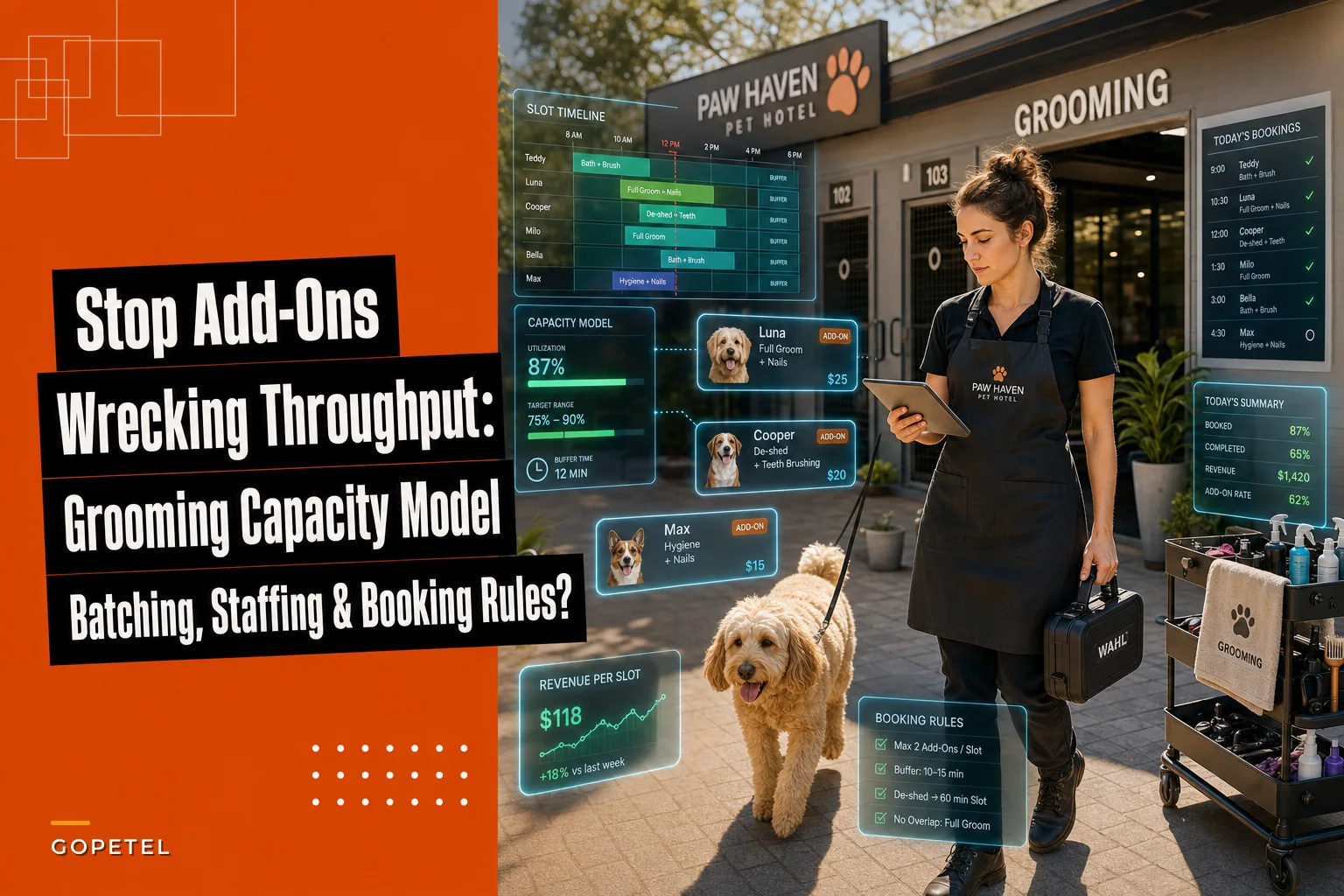

Your grooming department runs like clockwork until someone books a standard groom with three add-ons. Suddenly your 2PM slot bleeds into 3:30, the 3PM appointment starts late, and by 4PM you've got frustrated clients in the lobby while your groomer rushes through a matted doodle that genuinely needed the full 90 minutes.
The problem isn't the add-ons themselves. It's that most pet hotels treat grooming scheduling the same way they treat boarding — first come, first served, stack them in, figure it out when the day falls apart. Grooming doesn't work that way. Each service carries different time requirements, skill requirements, equipment needs, and margin structures. When clients can pile on services without any system pushing back, they're essentially reorganizing your production line through a booking form.
The batching nightmare that quietly kills grooming departments
Most pet hotels don't catch this until they're already buried in it. They start offering grooming because clients keep asking, price services individually, and the booking system happily accepts any combination at any time.
-
8am
Full groom (90 min)
-
9
30am: Bath only (45 min)
-
10
15am: Full groom + teeth + nails (120 min)
-
12
15pm: Walk-in nail trim (15 min)
-
12
30pm: Full groom for a matted dog (unknown time)
Every transition between service types requires equipment changes. Going from a full groom to a nail trim means clearing the table, switching tools, adjusting height settings. Large dog to small dog means reconfiguring restraints. Those transitions eat 10-15 minutes each and they're completely invisible in the booking system.
The matted dog problem makes everything worse. Your groomer quotes 90 minutes based on breed, starts working, discovers mats behind the ears and between the toes and under the collar. Now it's a 2.5-hour job. Every appointment after that shifts. The 2:30 pickup becomes 3:45. The 4PM gets rushed. Quality drops, clients complain, and your groomer is burned out by Thursday.
Meanwhile, you're actually losing money on the add-ons that caused the mess. That $12 teeth cleaning takes 20 minutes of skilled labor once you factor in setup, the service itself, and cleanup. At $18/hour, you're spending $6 in labor before supplies or overhead. You're breaking even at best while the schedule falls apart around it.
Revenue per slot vs. total services booked
The math most pet hotels miss: a grooming station generates maximum revenue when it runs at steady capacity with predictable service times. Not when it's cramming in the maximum number of services.
Never miss a booking or detail again.
GoPetel simplifies pet hotel operations by managing every reservation and pet profile seamlessly.
- Centralized booking management
- Automated client notifications
- Staff and kennel scheduling
No credit card required
Standard 90-minute full groom slot:
-
Service price
$75
-
Direct labor cost
$27 (90 min @ $18/hr)
-
Supplies
$8
-
Gross margin
$40
-
Hourly margin
$26.67
Same slot with add-ons:
-
Full groom
$75
-
Nail trim
$12
-
Teeth cleaning
$15
-
Total price
$102
-
Actual time required
130 minutes
-
Direct labor cost
$39
-
Supplies
$12
-
Gross margin
$51
-
Hourly margin
$23.54
You made an extra $11 in gross margin but dropped your hourly margin by over $3. And you pushed every subsequent appointment back 40 minutes, likely causing at least one cancellation or a rushed job at the end of the day.
The real issue? Add-ons cluster around the same dogs. The owner who wants teeth cleaning also wants nail grinding, ear cleaning, anal glands, and a specialty shampoo. A $75 groom becomes a $140 ticket but takes 3+ hours. You've given one client two appointment slots worth of time while charging roughly 1.8x the base price.
Building a capacity model that actually protects throughput
The fix starts with understanding your true service capacity — not the theoretical version. Most grooming scheduling fails because it assumes perfect efficiency. Real operations need buffer time, transition time, and complexity adjustments baked in from the start.
Before looking at specific numbers, it helps to map the flow from booking request to completed appointment.
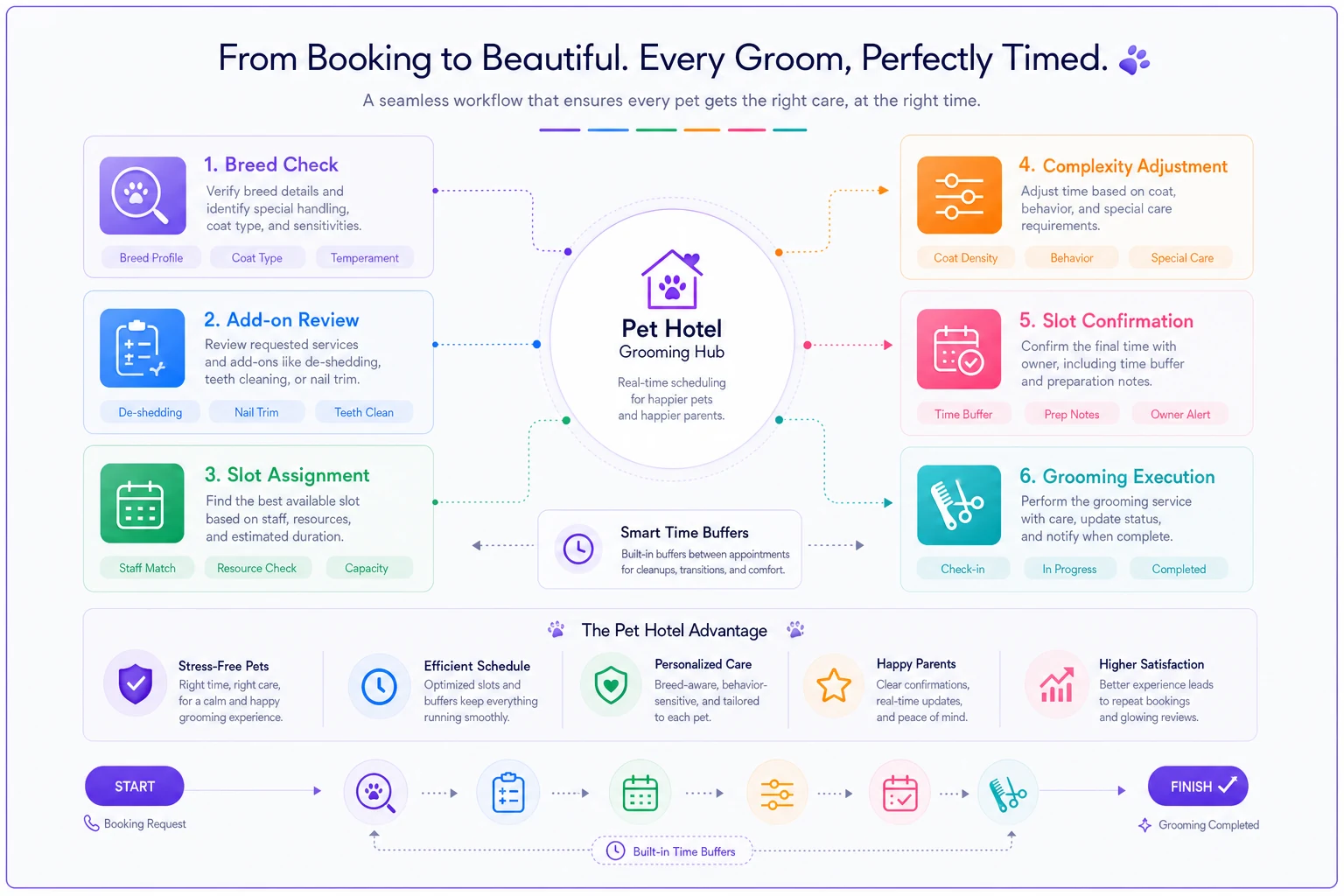
Every step — breed check, add-on review, slot assignment, complexity adjustment — should happen in sequence before a booking is confirmed.
| Service | Units |
|---|---|
| Bath only | 1 unit (45 min) |
| Basic groom | 2 units (90 min) |
| Full groom | 2 units (90 min) |
| De-matting groom | 3 units (135 min) |
Add-on Multipliers:
-
Nail trim only
0.5 units
-
Nail grinding
0.7 units
-
Teeth cleaning
0.5 units
-
Ear cleaning
0.3 units
-
Anal glands
0.3 units
-
Flea treatment
0.5 units
Complexity Multipliers:
-
Matted coat
1.5x
-
Aggressive behavior
1.3x
-
Senior dog
1.2x
-
First-time client
1.2x
-
Double-coated breed
1.3x
Daily Capacity Calculation:
-
Groomer available hours
8
-
Minus lunch/breaks
7
-
Minus transition time (15%)
5.95 hours
-
Converted to units
7.9 units
That means a groomer can realistically handle:
-
7 bath-only appointments, OR
-
3 full grooms + 1 bath, OR
-
2 de-matting grooms + 1 nail trim
Not 6-8 grooms like the theoretical model assumes.
Booking rules that preserve margins and sanity
Once you know your true capacity, you need rules that stop clients from unknowingly destroying it. These need to be built into your system — not left to someone's memory at the front desk during a busy phone call.
Rule 1: Service Bundling Requirements
-
Add-ons can only be booked alongside base services of equal or greater time units.
-
Nail trim alone
Requires a dedicated 30-min slot at premium price ($18, not $12)
-
Nail trim with groom
Standard add-on price ($12)
-
Three or more add-ons
Requires an extended appointment slot
Rule 2: Slot Protection
-
Morning slots (8am–12pm)
Full grooms only
-
Afternoon slots (12pm–3pm)
Mixed services
-
Late afternoon (3pm–close)
Bath-only and quick services
-
Never book de-matting after 2pm
Rule 3: Add-on Limits
-
Maximum 2 add-ons per base service
-
Exception
VIP package with a dedicated extended slot
-
Teeth + nails + glands = automatic upgrade to extended slot
Rule 4: Breed-Based Auto-Adjustments
-
Doodles, Portuguese Water Dogs
Auto-add 30 minutes
-
Huskies, German Shepherds
Auto-add de-shedding time
-
Bulldogs, Pugs
Auto-add wrinkle cleaning time
Rule 5: New Client Buffer
-
First appointment
Book in 1.5x time slot
-
Allows proper assessment
-
Prevents cascading delays
These rules aren't meant to be restrictive for the sake of it. They reflect what actually happens during the day when you remove the guardrails.
Cross-charging procedures for boarding-grooming combos
Pet hotels consistently lose margin when boarding clients add grooming without anyone accounting for the actual operational cost. A dog boarding for five nights who needs grooming on day three sounds simple. It rarely is.
That appointment means morning feeding happens early, the dog skips morning playgroup, someone needs to handle transport to grooming, there needs to be a holding area post-groom, the dog can't return to standard boarding until fully dry, and there might be kennel cleaning required if they soil during the stress of it all.
Grooming During Boarding Pricing:
-
Base grooming price
100%
-
Boarding coordination fee
$15
-
Early morning handling
$10 (if before 10am)
-
Priority scheduling fee
$10 (if a specific day is required)
Operational Requirements:
-
Grooming must be scheduled at booking — no day-of additions
-
Only available Tuesday–Thursday
-
Must be completed 24 hours before pickup
-
Requires a signed grooming waiver separate from boarding
Margin Protection Rules:
-
No grooming discounts for stays under 7 nights
-
10% discount only on 7+ night stays
-
Discount applies to grooming only, not add-ons
-
VIP boarding clients get priority scheduling, not discounts
The coordination fee covers the real labor cost of moving a dog between departments. The restrictions prevent things from unraveling during busy stretches. Most clients understand they're paying for complexity, not just the groom — and the ones who push back on that are usually the ones who cause the most disruption anyway.
Staffing multipliers that match reality
Standard grooming staffing ratios assume steady-state operations. Pet hotels don't have that. You've got boarding activity, seasonal spikes, and unpredictable complexity showing up without much warning.
-
High-margin mix (full grooms, regular clients) - 1 groomer per 6–7 units daily - 0.5 assistant per groomer - Can run at 85% capacity
-
Standard mix (variety of services) - 1 groomer per 5–6 units daily - 0.5 assistant per groomer - Should run at 75% capacity
-
Complex mix (heavy add-ons, new clients) - 1 groomer per 4–5 units daily - 1 assistant per groomer - Maximum 65% capacity
The assistant role gets overlooked constantly. They handle prep work, drying, cleanup between appointments, client calls, and transport from boarding. Without enough assistant coverage, your groomer spends roughly 30% of their time on tasks that don't require their skill level, and throughput tanks accordingly. That's not a staffing cost issue — it's a margin issue.
Margin thresholds and when to say no
Not every grooming dollar is worth earning. Some service combinations lose money outright while disrupting the appointments that are actually profitable.
Minimum Acceptable Margins:
-
Full groom
45% gross margin
-
Bath only
40% gross margin
-
Add-on services
35% gross margin
-
Standalone quick services
50% gross margin
Automatic Rejection Triggers:
-
Service combination exceeds 3.5 units
-
Estimated time exceeds 3 hours
-
Add-ons represent more than 40% of the total ticket
-
Requires equipment you don't stock
-
Client history shows consistent lateness
VIP Exception Criteria:
-
Client boards 20+ nights annually
-
Full-price services only
-
Always picks up on time
-
Dogs are well-maintained
A client wanting a full groom, de-matting, teeth, nails, and glands on their Great Pyrenees isn't a dream client — they're asking you to give half your grooming day to one dog. Unless the ticket hits $300 or more, you're better off booking two standard grooms and pointing that client toward somewhere better equipped for marathon appointments.
The technology layer that actually enforces discipline
Manual enforcement breaks down fast. Your front desk staff won't remember every breed multiplier mid-phone call. Your groomer won't push back on add-ons with the client standing right there. The booking person won't stop to calculate capacity units while trying to keep a conversation going.
This is where well-configured operational software earns its place. Not some AI scheduling system promising to optimize everything, but practical platforms that enforce your capacity model automatically — in the background, without relying on anyone to remember the rules.
-
Calculate true appointment duration based on all relevant factors
-
Block bookings that exceed slot capacity
-
Automatically apply breed and condition multipliers
-
Enforce add-on restrictions
-
Show real-time capacity in units, not just open time slots
-
Generate margin reports by service type
-
Flag unprofitable service combinations before they're confirmed
Platforms built for this kind of operational logic handle the math instantly. That's what prevents the booking mistakes that quietly drain grooming profitability over time — not better training, not more reminders, just rules enforced consistently by the software.
Converting grooming from cost center to profit center
Most pet hotels treat grooming as an amenity — something they offer because competitors do. Grooming can generate better margins than boarding when throughput is protected properly. That's not a bold claim, it's just what the math shows when the schedule stops falling apart every afternoon.
-
Price for complexity, not just service type A matted doodle requiring 3 hours shouldn't cost 20% more than a well-maintained poodle needing 90 minutes. It should cost 80–100% more. The pricing should reflect what you're actually consuming.
-
Book for margin, not volume Six high-margin full grooms generate more profit than twelve break-even quick services. Your booking system should fill profitable slots first, not just maximum slots.
-
Protect your groomers' time Every minute your groomer spends waiting on a late client, cleaning up chaos, or handling surprise add-ons is a minute they're not generating revenue. The capacity model exists to protect that time — which ultimately protects your margins.
The capacity model exists to protect that time — which ultimately protects your margins.
The cascade effect of proper capacity management
When grooming runs smoothly, the whole operation is calmer. Groomers stay longer because they're not constantly overwhelmed. The front desk handles fewer complaints. Boarding staff isn't juggling grooming logistics during morning routines.
More importantly, clients start trusting the grooming department. They book ahead because they know you'll be on time. They maintain regular schedules because the service is consistent. They pay your prices without friction because the experience backs it up.
The same discipline that makes holiday boarding profitable makes grooming profitable. It comes down to knowing your true capacity, protecting your margins, and being willing to say no to requests that quietly wreck your operation.
The pet hotels that do this well don't offer every service to every client at any time. They offer defined services, in protected time slots, with pricing that reflects operational reality. Their grooming departments run like grooming departments — not like chaotic add-on factories that happen to have a table and a blow dryer.
Your grooming schedule shouldn't be collapsing by 10am. It should be a production plan that protects throughput, maintains margins, and delivers consistent quality. The capacity model, booking rules, and margin thresholds are what hold that plan together. Without them, you'll keep watching the grooming department stay constantly booked and somehow never quite profitable.
Ready to optimize your pet hotel operations?
Join hundreds of pet hotels using GoPetel to save time, improve pet care, and increase booking reliability.