


Most pet hotel owners can tell you their occupancy rate off the top of their head. Ask them what percentage of their preauths silently expired last month, or how much they paid in merchant fees on refunded no-show deposits, and you get a blank stare. That gap is where a lot of money quietly leaks out.
This isn't about your booking calendar or your pricing tiers. It's about the mechanics of the money — how you authorize a card, when you actually capture it, what happens when a charge fails, and whether your daily numbers actually tie out at the end of the day. Get these wrong and you're not losing a dramatic amount all at once. You're losing $40 here, $115 there, a chargeback you didn't fight because nobody had the paperwork. It adds up to real money over a year, and worse, it makes your books untrustworthy.
Preauth vs capture: the confusion that costs you both ways
The most common payment mistake in boarding is treating a preauthorization and a capture like they're the same action at different times. They're not, and the difference has hard deadlines attached.
A preauth puts a temporary lock on a customer's available funds. It proves the card is valid and the money exists. But that hold expires — usually within 5 to 7 days depending on the card network and your processor. If you preauthorize a two-week boarding stay at drop-off and plan to capture it at pickup, there's a real chance the authorization is dead by the time the dog goes home. Now you're running the card cold, and if the balance shifted or the card got replaced, you're chasing money.
The opposite mistake is capturing too early. You take the full stay amount at booking, the client cancels within your allowed window, and now you're issuing a refund — and eating the processing fee on both the original charge and, depending on your processor agreement, not recovering that fee on the refund either. You paid to collect money you had to give back.
The pattern across boarding operations: short stays get over-captured (money taken early, then partially refunded for early pickups), and long stays get under-secured (preauths that expire before pickup). Both are fixable with a straightforward rule that ties the payment action to the stay length.
A payment sequence you can actually use
Use stay length to decide the sequence. This is the template most small hotels should start from:
| Stay type | At booking | At check-in | During stay | At check-out |
|---|---|---|---|---|
| Short (1–4 nights) | Deposit capture (e.g., 1 night) | Preauth remaining balance | — | Capture remaining balance |
| Medium (5–10 nights) | Deposit capture (1–2 nights) | Preauth balance | Re-preauth on day 5 if hold expiring | Capture actual balance |
| Long (11+ nights) | Deposit capture (2 nights) | Preauth ~50% | Capture midway, re-preauth remainder | Capture final balance |
| Peak/holiday | Non-refundable deposit capture | Preauth balance | Re-preauth as needed | Capture remaining |
The core principle: capture the deposit as real money up front so a cancellation or no-show doesn't leave you empty-handed, and preauth the rest so you're only capturing what the stay actually ended up costing — add-ons, extra nights, late pickups included.
For the deposit and no-show side of this — how much to hold, what's refundable, and how to enforce it without torching your reviews — we went deep on the policy mechanics in our no-show deposit, cancellation and enforcement guide. This article assumes those policies exist and focuses on the payment execution underneath them.
The re-preauth problem nobody plans for
The re-preauth step in that table is the one people skip, and it's the one that bites during long holiday stays.
Never miss a booking or detail again.
GoPetel simplifies pet hotel operations by managing every reservation and pet profile seamlessly.
- Centralized booking management
- Automated client notifications
- Staff and kennel scheduling
No credit card required
Say a client books 12 nights over the winter holidays at $65/night — a $780 stay. You preauth the full amount at check-in. Seven days later, that hold silently drops off. Nobody's watching, because the dog is happily boarding and check-out is still five days away. At pickup you run the capture and it declines — the client's card hit its limit on holiday shopping, or the hold releasing freed up funds they then spent.
Now you're at the counter with a happy owner, a dog on a leash, and no way to collect $780 without an awkward conversation. Most front-desk staff, under pressure, just let the client leave and deal with it later. Later usually means a partial recovery, if any.
The fix is a re-preauth checkpoint. For any stay longer than the hold window, flag a task to re-authorize the balance before the original hold expires. If the re-preauth fails while the pet is still in your care, you have leverage and time to sort it out — a much better position than at the door.
This is exactly the kind of deadline-driven task that gets forgotten on a busy afternoon. Workflow software that tracks each stay's authorization expiry and flags "re-preauth due tomorrow" turns a silent failure into a routine reminder. The hold expires and someone knows about it before it does — that's the whole job.
Use workflow software to flag re-preauth due dates so the task appears before a hold lapses.
Workflow software that tracks each stay's authorization expiry and flags "re-preauth due tomorrow" turns a silent failure into a routine reminder. The hold expires and someone knows about it before it does — that's the whole job.
Failure-handling: turning a decline into a recovery
A failed charge isn't a dead end. It's a sequence. The hotels that recover the most from declines are the ones that treat failure handling as a defined process rather than an improvised phone call.
-
Immediate soft retry (same day) Many declines are temporary — a daily limit, a fraud flag on an unfamiliar merchant. A single automatic retry a few hours later clears a meaningful chunk of them.
-
Notify the client (day 1) A short, non-accusatory message. "We weren't able to process the balance for Bella's stay — could you confirm your card or update it here?" A link to update the card beats asking them to read numbers over the phone.
-
Second retry after card update (or day 2) If they update the card, retry immediately. If not, one more attempt on the original card.
-
Escalation hold (day 3) No response, still failing? The account gets flagged. Future bookings require prepayment. That's your protection against repeat offenders.
-
Final notice + policy enforcement (day 5–7) Reference the signed authorization and your terms. This is where documentation matters.
The wording matters more than most owners expect. A decline message that reads like an accusation ("Your payment failed") gets ignored. One that assumes a simple mix-up ("Looks like the card on file needs updating") gets a response. Same information, very different recovery rate.
A note on dunning cadence
Don't hammer people. Sending a decline reminder every few hours feels aggressive and trains clients to tune you out. A soft retry, then messages spaced roughly a day apart, is the rhythm that recovers money without damaging the relationship. Automated retry sequences handle this well precisely because they don't over-send — they follow the schedule and stop when the balance clears.
Here's a simple workflow image to visualize the retry-and-recovery steps.
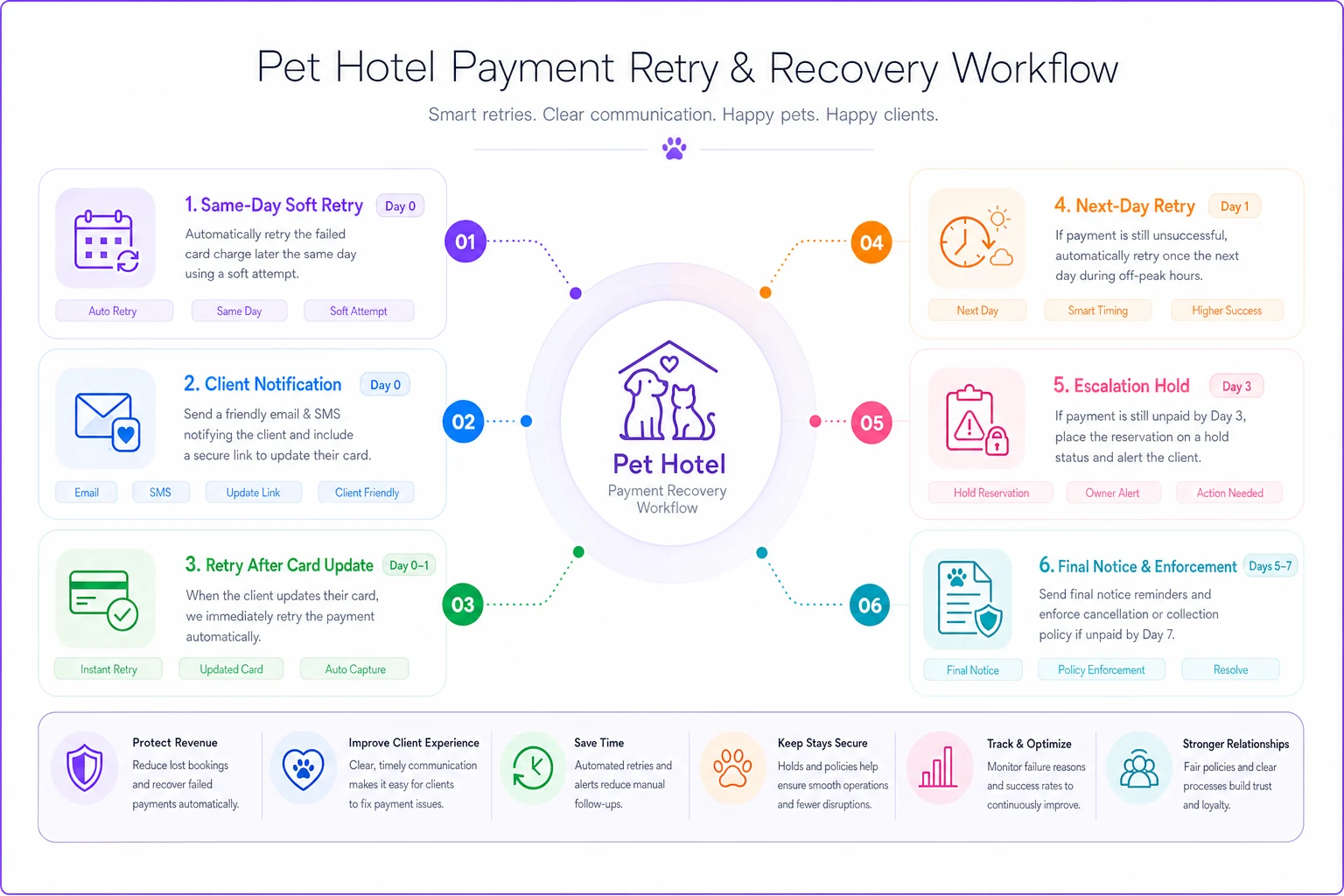
Use the visual to train staff on the retry schedule and communication stages so declines become recoverable processes, not improvised conversations.
Daily reconciliation: the checklist that catches what your gut misses
Reconciliation is the step almost every small hotel does badly, because it feels optional until the day the numbers don't add up. Your booking system says you earned $2,400 today, your card processor deposited $2,180, and nobody knows where the $220 went. It might be legitimate merchant fees. It might be a refund. It might be a capture that never went through. Without a daily check, you find out weeks later — if ever.
-
Match today's captures to today's completed stays. Every pickup should have a corresponding full capture. Any pickup without one is a chase-it-now item.
-
Check preauths against check-ins. Every dog that arrived should have an active authorization on file. Missing holds get created immediately.
-
Flag expiring preauths. Any hold expiring in the next 48 hours on an active stay → schedule re-preauth.
-
Reconcile deposits captured vs. bookings made. New bookings should show their deposit captured. A booking with no deposit is exposure.
-
Review declines and their stage. Where is each failed charge in the recovery sequence? Anything stuck moves to escalation.
-
Confirm refunds are legitimate. Every refund should tie to an approved cancellation. An unexplained refund is either an error or a problem.
-
Note the fee spread. Rough gap between what you charged and what settled. If it's wildly off from your normal merchant-fee percentage, dig in.
Run this at the same time every day, ideally end of shift:
That last point deserves its own section, because merchant-fee math is where the deposit and no-show side of your operation quietly changes shape.
Merchant-fee math on deposits and no-shows
When you charge a card, you pay a processing fee — roughly 2.9% plus around 30 cents per transaction, depending on your processor. That fee applies to deposits too. And when you refund a charge, many processor agreements do not return the original percentage fee. You paid to take the money and paid again, in lost fees, to give it back.
Layer that onto a busy cancellation policy. A typical example: you take $50 deposits, and in a given month you collect 60 deposits and refund 20 for legitimate early cancellations within your window.
-
60 deposits × ~$1.75 in fees each ≈ $105 in fees to collect them
-
On the 20 refunded ones, the collection fee (~$35 total) doesn't come back
That's roughly $35 gone on transactions that netted you nothing — small on its own, but it compounds when your policy is generous with refunds. The insight isn't "stop taking deposits." It's that a refundable deposit isn't free to you, and that should shape your cancellation window and whether certain periods use non-refundable deposits instead.
The enforcement angle flips the math in your favor. A retained no-show deposit isn't just recovered revenue — it's revenue on which you've already paid the fee, so every dollar you enforce keeps its full weight. Sloppy enforcement, where staff waive no-show charges to avoid conflict, means you paid the fee to collect a deposit and then handed it back for free. You lose twice.
A real scenario
A single-location hotel with around 30 kennels was running roughly 300–330 stays a month. They captured full payment at booking on nearly everything because it felt safer. Two things were happening. First, they were refunding a steady stream of early-pickup differences and cancellation deposits, eating processing fees each time. Second, on longer stays they occasionally re-ran expired cards at pickup and had a handful fail each month — a few hundred dollars that mostly went uncollected.
They switched to the deposit-plus-preauth sequence, added a re-preauth checkpoint for stays past the hold window, and started running the daily reconciliation checklist at end of shift. Nothing exotic.
Within about two months, the pickup-counter card failures basically stopped — the ones that did fail got caught mid-stay when there was still time to fix them. Monthly fee drag came down because they weren't over-capturing and refunding. Recovered balances that used to slip away were now $400–$600 a month back in the account. The bigger win was quieter: their daily deposit finally matched their books, so they actually trusted their own numbers again.
When this level of rigor makes sense — and when it doesn't
When it's worth it: If you run long stays, charge for add-ons that change the final total, or do meaningful holiday volume, the preauth/capture split and re-preauth discipline pay for themselves quickly. Same if you've ever stood at the counter unable to collect from a departing client.
When it's overkill: A tiny operation doing a handful of short, fixed-price stays a week with reliable regulars probably doesn't need multi-stage authorization sequences. Capturing a deposit and the balance at check-out is fine. Don't build machinery you don't need.
Who should not wing the reconciliation part: Anyone who takes deposits and issues refunds. That's where fee leakage and untracked refunds hide. Even the smallest hotel benefits from a five-minute daily check — the process above works whether you run 20 stays a week or 200.
The part that's easy to underestimate
None of this is complicated in theory. The problem is that every step — the re-preauth before a hold expires, the decline retry on the right day, the daily match of captures to pickups — depends on someone remembering to do it during a chaotic shift. That's exactly why these tasks fail. Not because owners don't understand them, but because there's a dog barking, a client at the counter, and a phone ringing when the reminder was supposed to fire.
The realistic fix is to stop relying on memory. Whether that's a rigid checklist taped by the register or a booking-and-payment platform that tracks authorization expiries and walks declines through the recovery sequence automatically, the goal is the same: take the payment decisions out of the moment and into a process that runs whether or not it's a busy Saturday.
Get the sequence right, watch the holds, run the daily check, and enforce what your policy already allows. The money was always there. This is just the operational plumbing that makes sure it actually lands in your account.
None of this is complicated in theory. The problem is that every step — the re-preauth before a hold expires, the decline retry on the right day, the daily match of captures to pickups — depends on someone remembering to do it during a chaotic shift. That's exactly why these tasks fail. Not because owners don't understand them, but because there's a dog barking, a client at the counter, and a phone ringing when the reminder was supposed to fire.
The realistic fix is to stop relying on memory. Whether that's a rigid checklist taped by the register or a booking-and-payment platform that tracks authorization expiries and walks declines through the recovery sequence automatically, the goal is the same: take the payment decisions out of the moment and into a process that runs whether or not it's a busy Saturday.
Ready to optimize your pet hotel operations?
Join hundreds of pet hotels using GoPetel to save time, improve pet care, and increase booking reliability.