

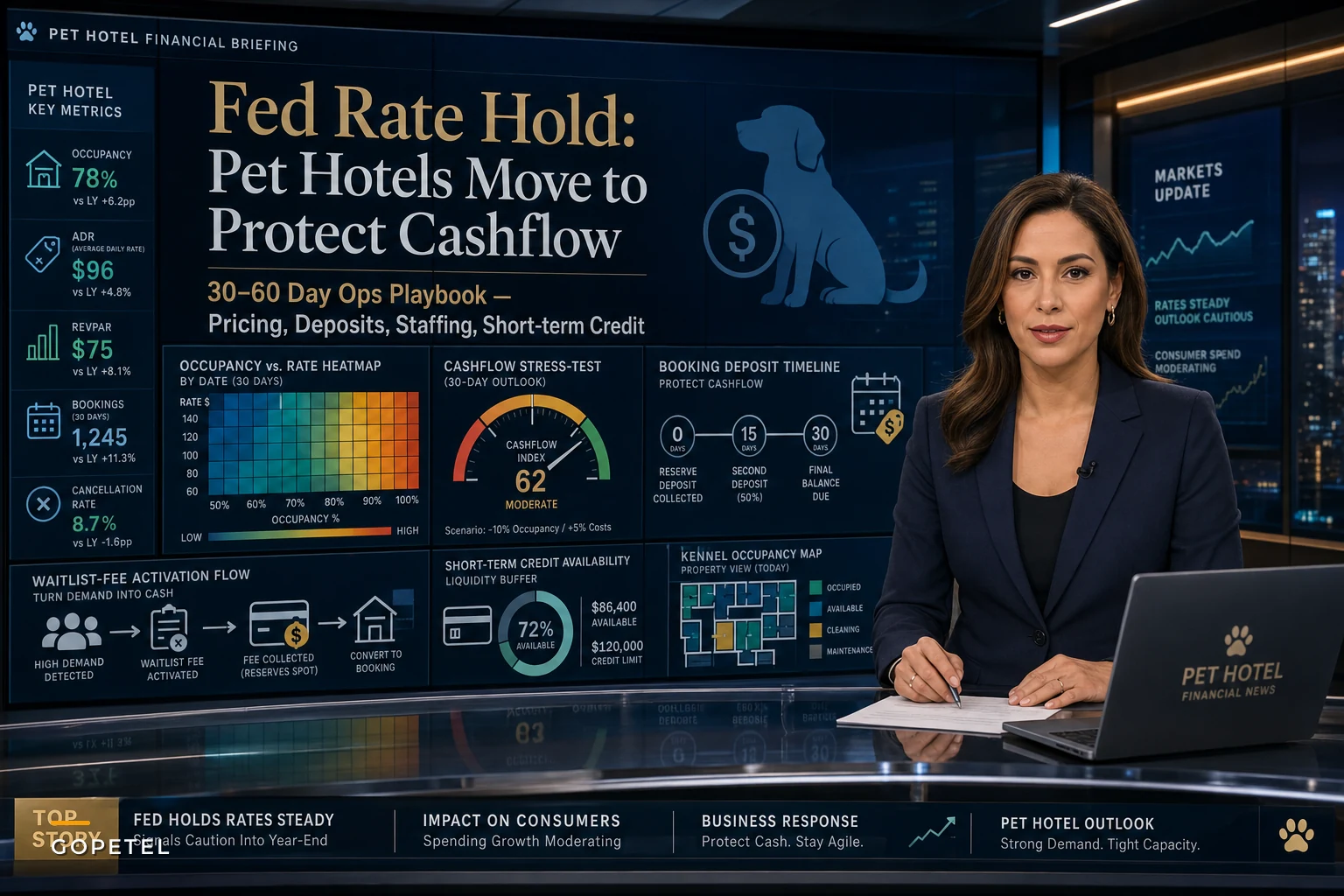

The Federal Reserve just held rates at 3.50-3.75%, but something unusual happened—three members actually voted to raise rates. That split vote signals rates will likely stay elevated through peak boarding season, maybe longer. For pet hotels already operating on thin margins, this isn't just another economic update. It's a direct hit to working capital costs right when you need flexibility most.
Most pet hotel operators run their facilities on some form of short-term credit—equipment financing for new kennels, lines of credit for payroll during slow months, working capital loans to bridge seasonal gaps. When the Fed keeps borrowing costs high, every one of those tools gets more expensive. A $50,000 equipment loan that would've cost around $2,800 in interest last year now runs closer to $3,900. That's real money gone from your operating budget.
And what makes this particularly rough for pet hotels is the double squeeze. Borrowing costs are up while customers pull back on discretionary spending. The same rate environment hitting your balance sheet is making your clients think twice about that two-week boarding stay or monthly grooming package.
The Hidden Cashflow Crunch
Pet hotels have a cashflow problem that gets worse when rates stay elevated. Unlike restaurants or retail that turn inventory daily, you're essentially a real estate business with a service overlay. Your biggest expense—facility costs—stays fixed whether you're at 40% or 90% occupancy, but revenue swings wildly based on seasonality, local travel patterns, and now, consumer pullback.
A pattern that shows up constantly: a pet hotel running 85% occupancy in July drops to 45% in September. Normal seasonal variance, except now you're paying 7-8% on your line of credit instead of 4-5% to cover the gap. On a $30,000 draw to cover payroll and expenses during the slow period, that's an extra $75-100 per month in interest alone. Multiply that across multiple slow periods and equipment loans and you're looking at thousands in additional annual costs.
The real problem is most operators don't adjust pricing or operations fast enough to compensate. They're still running on last year's numbers while this year's financing costs have jumped 30-40%.
Immediate Moves to Protect Your Margins
Repricing Without Losing Bookings
Never miss a booking or detail again.
GoPetel simplifies pet hotel operations by managing every reservation and pet profile seamlessly.
- Centralized booking management
- Automated client notifications
- Staff and kennel scheduling
No credit card required
The knee-jerk reaction is raising prices across the board. That's usually a mistake. What works better is surgical repricing based on demand elasticity. Your regular monthly boarders who trust you with their anxious rescue? They'll absorb a 5-7% increase without blinking. The occasional customer comparing you to three other facilities on Google? A $2 increase might send them elsewhere.
Start with add-on services. Grooming, extra walks, medication administration—these carry higher perceived value and lower price sensitivity. One facility raised their bath-and-brush add-on from $25 to $32 without losing a booking. That's a 28% increase on near-pure margin revenue.
Then implement dynamic pricing on peak days. Thursday through Sunday should cost 15-20% more than Monday through Wednesday—not just during holidays, but every week. Your weekend kennels are premium inventory. Price them accordingly.
Tightening Deposit and Cancellation Policies
When capital costs more, you need cash in hand faster. Most pet hotels still operate on outdated deposit structures—25% down for holiday bookings, nothing for regular stays. In this rate environment, that's leaving money on the table.
-
50% deposit on all bookings over 3 nights
-
100% prepayment for holiday periods (book in October, pay in full)
-
Non-refundable deposits for peak season (refundable as credit only)
-
Cancellation window moves from 72 hours to 7 days
One facility implemented this last month and pulled in $18,000 in deposits for Thanksgiving bookings—cash they can use now instead of borrowing at 8% to cover October payroll.
Supplier Payment Optimization
Counterintuitive, but worth understanding. While most operators stretch payables to preserve cash, you should be doing the opposite with select vendors. Food suppliers, cleaning products, anyone offering 2/10 net 30 terms—pay them early.
A 2% discount for paying in 10 days versus 30 equals a 36% annualized return. If you need to draw on a credit line at 8% to capture that 2% discount, you're still ahead by a wide margin. Just don't apply this logic blindly. Focus on vendors where you have leverage and volume. Your twice-weekly food supplier is a perfect candidate. An annual software subscription? Skip it.
Building a Surge-Resistant Booking System
According to NBC News, the Fed's concern about inflation means rates could go higher before they go lower. That means you need booking structures that capture revenue upfront and lock in margin before costs potentially climb further.
Package Restructuring for Upfront Revenue
Stop selling individual nights. Start selling packages requiring full prepayment. A "Summer Stay" package—10 nights for $450, usable anytime within 60 days—brings in immediate cash and locks in bookings. Price it at a slight discount to daily rates. Customers feel like they're saving, you get working capital without borrowing.
The psychology matters here too. When rates are elevated, consumers worry about their own finances. A prepaid package feels like locking in a price before things get more expensive. You're essentially using the same economic anxiety driving your costs to drive purchasing decisions in your favor.
Membership Programs That Generate Predictable Cash
Monthly memberships aren't just for gyms. A basic membership at $29/month that includes one free nail trim, 10% off boarding, and priority booking access creates predictable monthly cashflow. Even 50 members means $1,450 in guaranteed monthly revenue before anyone books a single night.
Structure it right and members actually board more frequently—they want to use their benefits. One facility launched this model about six months ago and now has around 120 members generating roughly $3,480 monthly in near-pure margin revenue. Nail trims cost maybe $3 in labor.
Waitlist Monetization
Your waitlist has value most operators ignore. Instead of just collecting names for holiday weekends, charge a $25 priority waitlist fee. If they get a spot, it applies to their stay. If not, they receive a $30 credit for a future booking.
That's an interest-free loan from customers who might not even end up staying. A facility with 200 dogs on their Thanksgiving waitlist could pull $5,000 in working capital from people who won't get a kennel.
The three strategies above—packages, memberships, and waitlist fees—follow a specific sequence for a reason. Packages convert one-time bookers into upfront payers. Memberships turn those payers into repeat customers. Waitlist monetization captures value even from demand you can't fulfill. Run them in that order.
Here's a simple workflow that visualizes the activation sequence.
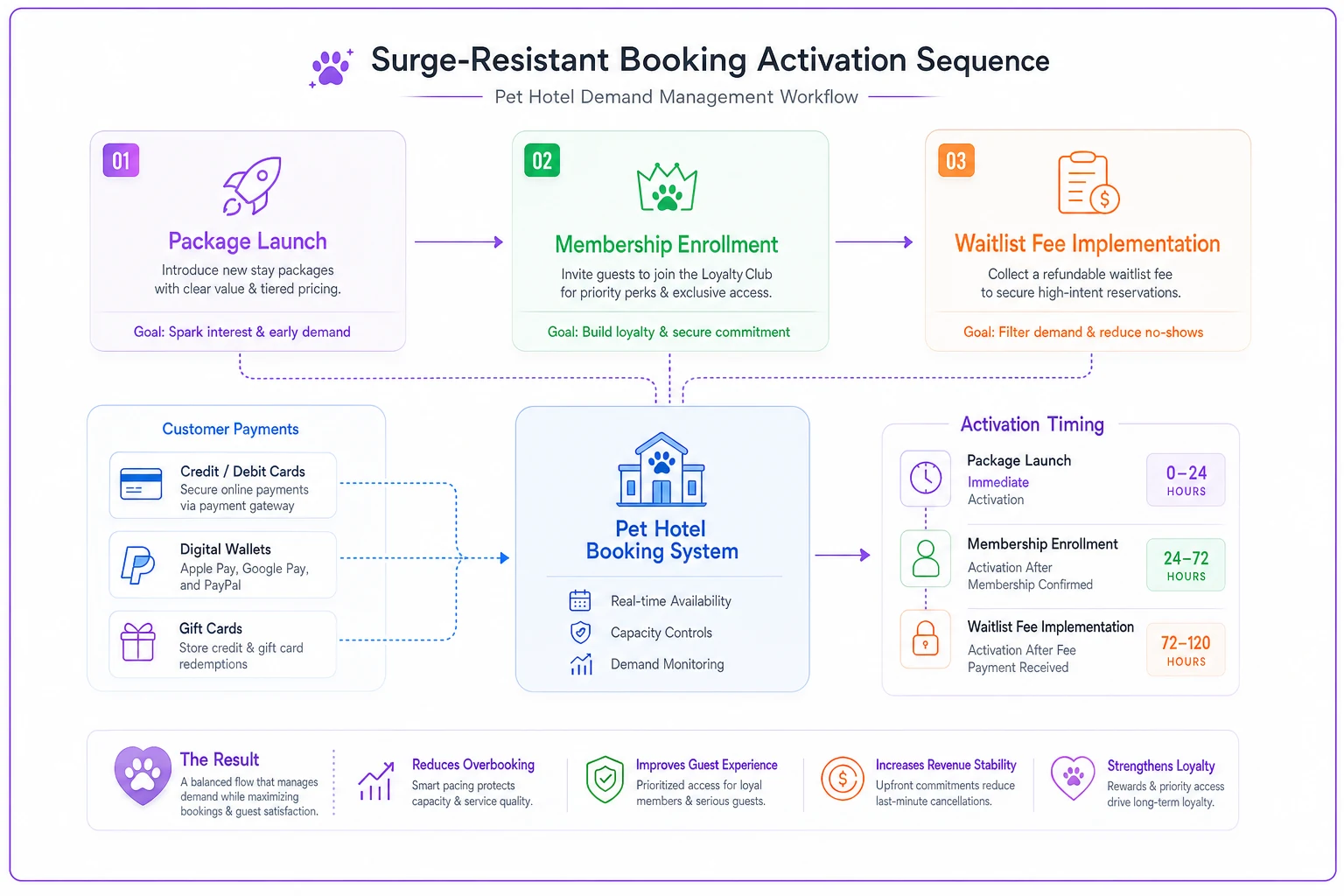
> WORKFLOW: Surge-Resistant Booking Activation Sequence > Package Launch → Membership Enrollment → Waitlist Fee Implementation
Operational Efficiency Becomes Survival
When borrowing costs more, every inefficiency literally costs you more. An employee who takes 45 minutes to clean a kennel instead of 25—at $15/hour—adds about $5 per kennel in excess labor. Across 30 kennels daily, that's $150/day, roughly $4,500/month disappearing into inefficiency.
Labor Scheduling Precision
Most facilities still schedule like it's 2019—fixed staff, fixed days, regardless of actual occupancy. That made sense when labor was your main variable cost. Now, with capital at 8%, every excess labor hour carries a real cost beyond the hourly rate.
Switch to demand-based scheduling. Tuesday at 40% occupancy needs two people, not four. Use split shifts during check-in and check-out rushes instead of full-day coverage across the board. One facility cut labor costs by around $2,800/month just by aligning staffing to actual demand rather than habit.
Inventory Turns and Cash Conversion
Pet hotels sit on a lot of inventory—food, cleaning supplies, retail products. When rates were near zero, holding three months of supplies made sense. Now that's dead capital costing you 8% annually.
| Inventory Category | Old Approach | Recommended Turn | Notes |
|---|---|---|---|
| Pet food (bulk) | 90-day stock | 45-day max | Switch to bi-weekly delivery |
| Cleaning supplies | Monthly bulk | 30-day rolling | Negotiate delivery frequency |
| Retail products | Quarterly order | 60-day turns | Cut slow movers entirely |
| Medical/emergency | As-needed | Keep buffer | Don't apply lean logic here |
Technology Stack Rationalization
The average pet hotel runs somewhere between 8 and 12 different software subscriptions—booking tools, payment processing, scheduling, marketing, and so on—each pulling $50-500 monthly. In a high-rate environment, consolidation isn't just a convenience play; it's a cashflow decision.
An operational platform that combines booking, scheduling, payment processing, and customer communication might cost $400/month versus $800 for separate tools. But the bigger savings comes from efficiency. Automated workflows reduce labor hours, and integrated systems mean fewer errors that need manual cleanup. AI-powered operational software handles a lot of this quietly in the background—not magic, just fewer dropped tasks and less time spent moving information between systems that don't talk to each other.
Consolidating your stack also gives you cleaner data on which services, time slots, and customer segments actually generate margin. That's information you need right now, not at the end of the quarter.
The Next 90 Days: Your Action Plan
Peak boarding season starts in about 11 weeks. Those three dissenting Fed votes suggest rates aren't dropping before then. Here's exactly what to do:
-
Week 1-2
Pricing Surgery
- Analyze your last 90 days of bookings by service type - Identify your top 20% of customers by revenue - Implement 5-15% increases on add-on services - Create premium pricing for Thursday-Sunday -
Week 3-4
Cashflow Acceleration
- Revise deposit policies for all future bookings - Launch prepaid package options for summer - Negotiate early payment discounts with suppliers - Start charging for waitlist positions -
Week 5-6
Operational Tightening
- Audit actual versus scheduled labor hours - Implement demand-based scheduling - Reduce inventory levels by 30-50% - Cut redundant software subscriptions -
Week 7-8
Peak Season Preparation
- Lock in staff for holiday periods (pay premiums if needed) - Presell Thanksgiving and Christmas packages - Secure inventory for peak periods at current prices - Open bookings under new pricing structure
Follow this sequence. The order matters because pricing changes take a few weeks to roll through your booking pipeline before you see the cashflow impact. If you start with operations first, you've tightened the cost side without fixing the revenue side yet.
Making Hard Decisions Now
Some operators reading this are thinking they can wait it out. Maybe the Fed drops rates in September. Maybe demand picks up. Maybe a competitor raises prices first and you follow.
Pet hotels operating at 8-12% margins can't absorb a 2-3% increase in capital costs without operational changes. That math just doesn't hold.
An owner I spoke with recently waited too long to adjust. By the time he implemented surge pricing and deposit requirements, he'd already burned through his line of credit covering off-season losses. He's now paying 12% on emergency financing just to make payroll. That's a bad position to be recovering from heading into peak season.
These operational improvements should've happened regardless of the Fed. Higher rates just make inefficiency more expensive and the consequences more immediate. Use this pressure to fix the broken processes you've been tolerating. Tighten operations, capture cash upfront, and price for what things actually cost today—not what they cost two years ago.
The facilities that get this right won't just survive the current rate environment. They'll come out with better margins and leaner operations when rates eventually drop. Your competition is hoping this blows over. Your financial operations playbook should assume it won't.
Peak season is coming regardless of what the Fed does next. The only question is whether you adapt now with a clear head or scramble later under pressure.
Ready to optimize your pet hotel operations?
Join hundreds of pet hotels using GoPetel to save time, improve pet care, and increase booking reliability.