


Most facilities don't get burned by reactive dogs because staff can't handle them. They get burned because the dog was booked, checked in, and placed before anyone knew what they were dealing with. The owner said "he's a little shy with strangers" on the phone, and forty minutes later a tech has a lunging 70-pound shepherd on a slip lead in a hallway full of other dogs at pickup time.
The intake process is where all of that gets decided. By the time a dog is snapping at a kennel door, you've already missed your window. So this covers the front door specifically — the pre-screen questions that actually surface risk, the assessment checklist your staff runs on arrival, the isolation and handling protocols that keep everyone safe, and the signage that keeps the wrong door from getting opened.
One narrow topic. The goal is a reactive dog intake protocol that reduces both liability and the daily operational friction these dogs create when they're handled on the fly.
Why the phone screen fails you
The standard failure isn't that owners lie. It's that they answer honestly and you still learn nothing useful.
Ask "Is your dog friendly?" and almost everyone says yes — and from their perspective, they're right. The dog is friendly to them, in their living room. That tells you almost nothing about how the dog behaves when a stranger reaches into a kennel run or another dog barks two feet away through a fence.
| Weak question | What it produces | Better question | What it surfaces |
|---|---|---|---|
| "Is your dog friendly?" | "Yes" | "How does he act when a stranger reaches over his head?" | Actual handling risk |
| "Does he get along with other dogs?" | "Mostly" | "Has he ever growled, snapped, or lunged at another dog? When?" | Trigger patterns |
| "Any behavior issues?" | "Not really" | "What does he do when he's nervous or overwhelmed?" | Stress response and warning signs |
| "Is he good with new people?" | "He warms up" | "Has he ever been muzzled, or has a vet or groomer refused to handle him?" | Prior professional flags |
That last one is the highest-signal question on the list. A dog that a vet clinic already handles with a muzzle is telling you exactly what you need to know, and owners usually volunteer it once you ask directly instead of asking "any issues?"
The pattern in facilities that get this wrong: the phone screen gets treated as a booking formality, so it's rushed, and whatever answers come through get typed into a free-text notes field nobody reads before check-in. The information exists. It just never reaches the person holding the leash.
The pre-screen questionnaire that actually flags risk
Keep it short. A ten-minute questionnaire nobody fills out is worse than a four-minute one everybody completes. Aim for the smallest set of questions that reliably separates a normal dog from one that needs a modified intake.
Never miss a booking or detail again.
GoPetel simplifies pet hotel operations by managing every reservation and pet profile seamlessly.
- Centralized booking management
- Automated client notifications
- Staff and kennel scheduling
No credit card required
Questions worth including:
-
Has your dog ever bitten a person or another dog? If yes — when, and what happened right before?
-
Has a vet, groomer, or previous boarding facility ever required a muzzle, sedation, or refused service?
-
How does your dog react to strangers approaching or reaching toward them?
-
How does your dog react to other dogs on leash? Through a fence?
-
What does your dog do when scared or overstimulated? (Hide, freeze, growl, bark, snap, redirect onto the handler?)
-
Are there specific triggers we should know about? (Men, hats, brooms, other dogs eating nearby, being cornered?)
-
Has your dog been on any behavioral medication?
-
What calms your dog down when they're worked up?
That last question does double duty. It gives you a de-escalation tool, and it quietly confirms the owner has actually seen the dog get worked up before — which is itself useful information.
Set a rule: if the owner answers yes to the bite history question or the muzzle/refusal question, the booking gets flagged and doesn't proceed as a standard stay. It routes to a manager for an assessment plan before the dog ever arrives. This isn't about turning dogs away — it's about making sure a known biter doesn't get handled by whoever happens to be on the floor that afternoon.
The arrival assessment: what to watch in the first five minutes
The questionnaire tells you what the owner knows. The arrival assessment tells you what's actually in front of you, because plenty of owners genuinely don't recognize their dog's stress signals.
This is a quick, structured observation your intake staff runs during check-in — not a formal temperament test, just deliberate watching while the paperwork happens.
The five-minute check:
-
Watch the approach. As the dog enters, does it move forward loosely or hang back stiff? A dog planted behind the owner's legs with a low tail is already giving you information.
-
Note the body, not the tail wag. Wagging means arousal, not friendliness. Look for a stiff body, closed mouth, hard stare, weight shifted back, whale eye (whites showing).
-
Test space, don't force it. Toss a treat rather than reaching in. A dog that won't take food in the lobby is over threshold — that's a red flag, not stubbornness.
-
Watch the leash handoff. How does the dog react when control shifts from owner to staff? Some dogs are fine with the owner and reactive the moment a stranger takes the lead.
-
Observe response to the environment. A dog barking and lunging at every sound or passing dog during check-in will do the same thing all night in the kennel. That's a placement and isolation decision, not a maybe.
A simple workflow visualization of this process:
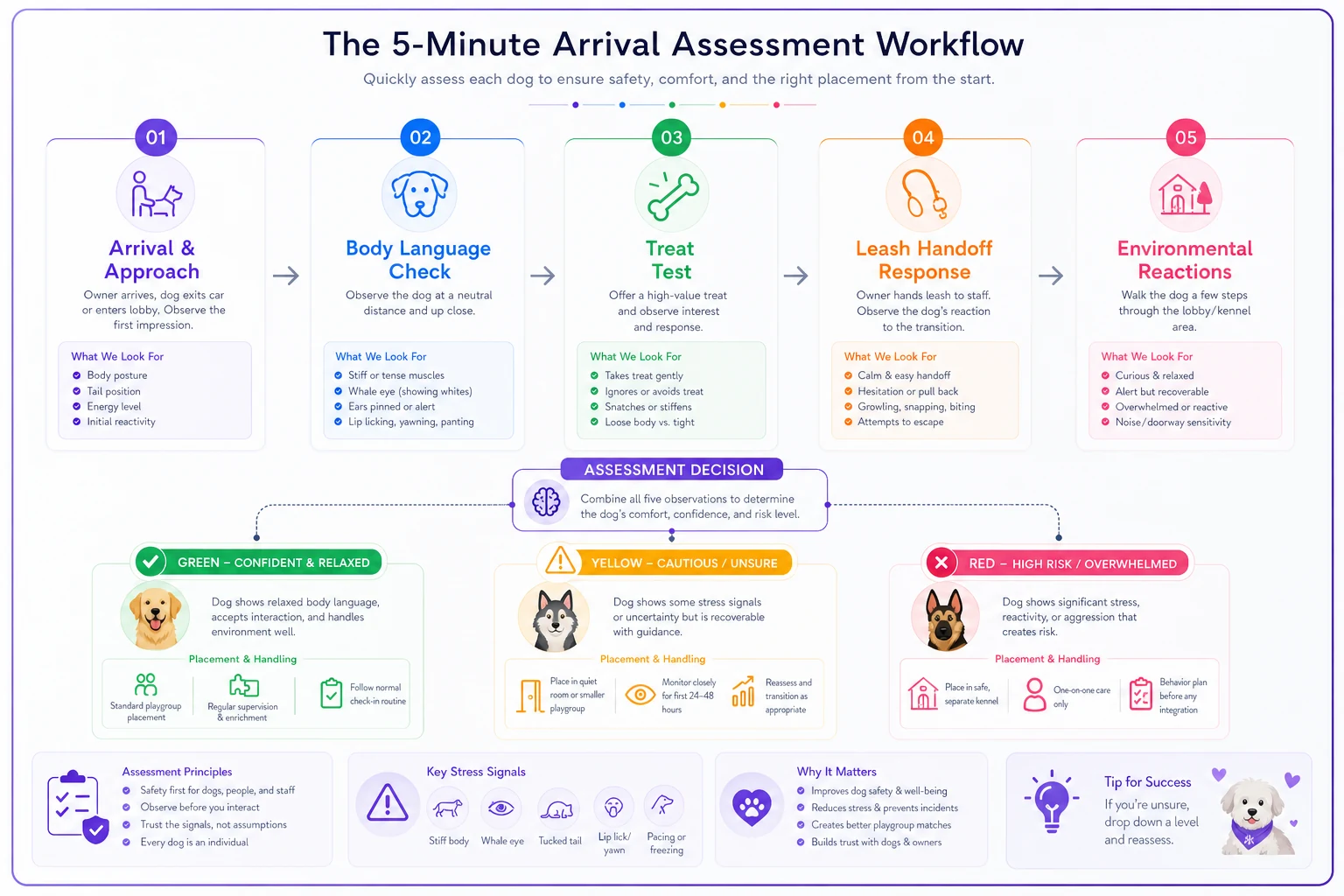
Give it a simple three-tier outcome so it's decision-ready:
-
Green — relaxed, takes treats, handles normally. Standard placement.
-
Yellow — nervous, stiff, slow to settle, but manageable. Modified handling, quieter placement, note in file.
-
Red — growling, snapping, refusing food, can't be handled by staff. Isolation protocol, two-person or muzzle handling, manager sign-off before the stay continues.
The mistake is treating this as pass/fail. A yellow dog isn't a problem dog — it's a dog you now know to place away from the busy corridor and assign to your calmer staffer. The point is matching handling to the animal, not screening dogs out.
Isolation and staff-use protocols
Once a dog is yellow or red, placement and handling stop being improvised. This is where most of the daily friction and most of the liability live, because a reactive dog handled inconsistently across three shifts is a dog whose stress just keeps compounding.
Placement. Reactive dogs shouldn't be in the highest-traffic runs, and if fence-fighting is a trigger, direct line of sight to other dogs is a problem. Visual barriers matter more than distance for a lot of these animals. A red-flagged dog placed where every passing handler triggers a lunge is one that never settles — and a run everyone dreads walking past.
Handling rules that get written down and posted, not passed by word of mouth:
-
Two-person handling for any red-flagged dog during moves, or a documented single-person protocol if that's your standard.
-
Muzzle requirement clearly noted, with the muzzle stored with the dog's file or on the run — not something staff are hunting for during the moment they need it.
-
Defined leash-out routes and times that avoid crossing paths with other dogs. Staggered potty breaks, not the group flow.
-
A named handler or shortlist. Rotating a reactive dog through every staffer resets its stress each shift. Consistency reduces incidents.
-
A clear "do not" list
no reaching over the head, no cornering, no face-to-face greetings, no group play — whatever this specific dog flagged.
Store the dog's muzzle with its file or on the run for quick access.
Feeding and cleaning. Resource guarding shows up at feeding and in the run during cleaning. The protocol should specify whether the dog eats undisturbed, whether the run gets cleaned with the dog secured elsewhere, and who's allowed to do it. This overlaps with your broader sanitation routines — the same consistency across shifts that drives a solid infection-control and compliance framework applies here too. Predictable, shift-to-shift consistency is what actually prevents the bad outcome.
None of this works if it lives in one manager's head. The reactive dog's plan has to travel with the dog and be visible to whoever's on shift at 6 a.m. and whoever closes at 10 p.m.
Signage and templates that prevent the wrong door from opening
Most reactive-dog incidents inside a facility come down to someone not knowing. A new weekend hire, a temp covering a shift, someone doing a fast round who opens a run they shouldn't.
Physical, standardized signage on the run closes that gap faster than any buried software note — though ideally you have both. Keep run signage visual and fast to read:
-
A consistent color-coded tag or card on every flagged run (yellow/red matching your assessment tiers).
-
Icons for specific rules
muzzle required, two-person handling, do-not-open-alone, no dog-to-dog contact.
-
The dog's name and one line on the primary trigger.
-
Feeding and leash-out instructions if they differ from standard.
Templates worth standardizing so this runs the same way every time:
-
The pre-screen questionnaire (used at booking).
-
The arrival assessment card with the green/yellow/red decision.
-
The run signage template tied to those same tiers.
-
A one-page handling protocol sheet that lives in or beside the dog's file.
-
An incident note format for anything that does happen, so it's documented consistently.
The reason to template all five: a reactive-dog protocol that depends on any one person remembering things falls apart the first time that person is off. The value is in the sameness. Everyone flags the same way, reads the same signs, and handles the dog the same across three shifts.
Where a management system actually helps
You don't strictly need software to run any of this — plenty of facilities do it on printed cards and a whiteboard. But the failure point is almost always the handoff: the phone screen answer never reaches the floor, or the flag lives in one system and the run signage in another and they slowly drift apart.
This is where a booking and operations platform earns its keep on this specific problem. When pre-screen answers automatically flag a booking, the assessment tier attaches to the dog's profile, and that flag surfaces on the kennel card, the daily task list, and the check-in screen — the information stops depending on memory. The dog can't get booked into a standard stay without the flag traveling with it. Staff see the handling rules at the run, not buried in a notes tab.
That consistency across shifts is the whole game. Not the technology itself, just making sure the right person knows the right thing at the right door.
A real scenario
A mid-size boarding facility — around 40 runs, steady mix of daycare and overnight — had two handling incidents in a single quarter, both with dogs whose owners had described them as "shy" on booking. Neither dog was formally reactive on paper. Both had bitten a vet before, which nobody at the facility knew because nobody had thought to ask directly.
They rebuilt the front door. Added the muzzle-history and bite-history questions to the pre-screen, made a "yes" answer route to a manager before confirmation, and added a five-minute arrival assessment card to check-in with the green/yellow/red tiers. Flagged runs got color-coded signage.
Over the following months, roughly one in seven incoming dogs got a yellow tag and a handful landed red — numbers that surprised the owner, who assumed reactive dogs were uncommon in their book. Handling incidents dropped to zero over that stretch. Just as telling, staff stopped dreading certain dogs, because the ones that needed careful handling arrived pre-flagged instead of surprising a tech mid-shift. The stress didn't disappear. The improvisation did.
The bottom line
Reactive dogs aren't some rare edge case you handle when one shows up. On any given week you're probably boarding several, and the difference between a smooth stay and a bite report is almost entirely made at intake — before the dog is ever behind a gate.
Ask behavioral questions instead of yes/no ones. Run a quick, structured assessment on arrival and commit to a tier. Write the handling and isolation rules down, post them on the run, and make sure they survive a shift change. Do that consistently and the reactive dog stops being the thing that derails someone's afternoon and becomes just another category you're actually set up to handle.
Ask behavioral questions instead of yes/no ones. Run a quick, structured assessment on arrival and commit to a tier. Write the handling and isolation rules down, post them on the run, and make sure they survive a shift change. Do that consistently and the reactive dog stops being the thing that derails someone's afternoon and becomes just another category you're actually set up to handle.
Ready to optimize your pet hotel operations?
Join hundreds of pet hotels using GoPetel to save time, improve pet care, and increase booking reliability.