



The September numbers from the Bureau of Economic Analysis landed with a wrinkle most operators didn't want to see heading into peak: PCE inflation ticked up 0.5% for the month while consumer spending kept climbing. The BEA's Personal Income and Outlays release confirmed both numbers, and Reuters' coverage framed it as inflation heating back up even as households keep opening their wallets.
For a pet hotel, that combination is deceptively tricky. Resilient spending feels like good news — people are still booking boarding, still paying for the deluxe suite, still adding the daily enrichment package. But the same report that says demand is holding also says your input costs are rising faster than you'd planned. The danger is running full occupancy over the holidays and finding out in January that your margin per night quietly shrank while you were too busy to notice.
This isn't about forecasting macroeconomics. It's about the fact that a mid-cycle cost bump plus steady demand creates a specific trap for seasonal, labor-heavy businesses — and pet hotels sit right in the center of that profile.
Why "demand is fine" is the wrong thing to feel relaxed about
The instinct when spending holds up is to lean into occupancy. Fill every run, upsell every stay, grab every holiday booking. That instinct is usually right — except when your cost base is moving underneath you at the same time.
When PCE inflation shows up as a broad 0.5% monthly move, it rarely hits your P&L evenly. For pet hotels, the pain concentrates in three places:
-
Energy — heating and cooling kennel space, laundry cycles, water. These are your most inflation-sensitive line items and they scale with occupancy, not against it.
-
Labor — a fully-booked holiday week means overtime, premium shift pay, and sometimes last-minute agency staff at a rate that destroys the economics of the nights they're covering.
-
Consumables — bedding, cleaning chemicals, food, waste disposal. Small per-unit, but you burn through them fastest exactly when you're busiest.
So the busier you get, the harder the cost bump hits. A 0.5% headline number can translate into something closer to 2–4% on your specific cost mix once you weight it toward the inputs a boarding facility actually consumes. Full occupancy amplifies the problem instead of absorbing it.
The quiet failure mode looks like this: a facility runs 90%+ through December, revenue looks great, and the owner assumes margin followed. Then the energy bill, the overtime line, and the restock invoices all land in the first two weeks of January and the "best month ever" turns out to have been a volume win and a margin loss at the same time.
The underlying problem: most pet hotels price for a year, not a quarter
This cost environment exposes something structural. A lot of boarding facilities set their rates once a year — usually in a quiet month — and then run those numbers through peak without revisiting them. That works fine when costs drift slowly. It breaks when costs move 0.5% in a single month and your busiest, most cost-intensive stretch is still ahead of you.
Never miss a booking or detail again.
GoPetel simplifies pet hotel operations by managing every reservation and pet profile seamlessly.
- Centralized booking management
- Automated client notifications
- Staff and kennel scheduling
No credit card required
The deeper issue is that peak-season pricing and peak-season costs are set at different times by different people. Rates get decided in spring. Staffing and supply costs get felt in December. Nobody reconciles the two until the accountant does, months later. By then every decision is locked.
What separates facilities that protect margin from ones that don't isn't better forecasting. It's a shorter loop between "costs moved" and "pricing and rostering responded." When that loop is tight, a mid-cycle inflation bump is an annoyance. When it's slow, it's a quiet drain on every one of your most profitable nights.
A fast re-pricing pass you can run this week
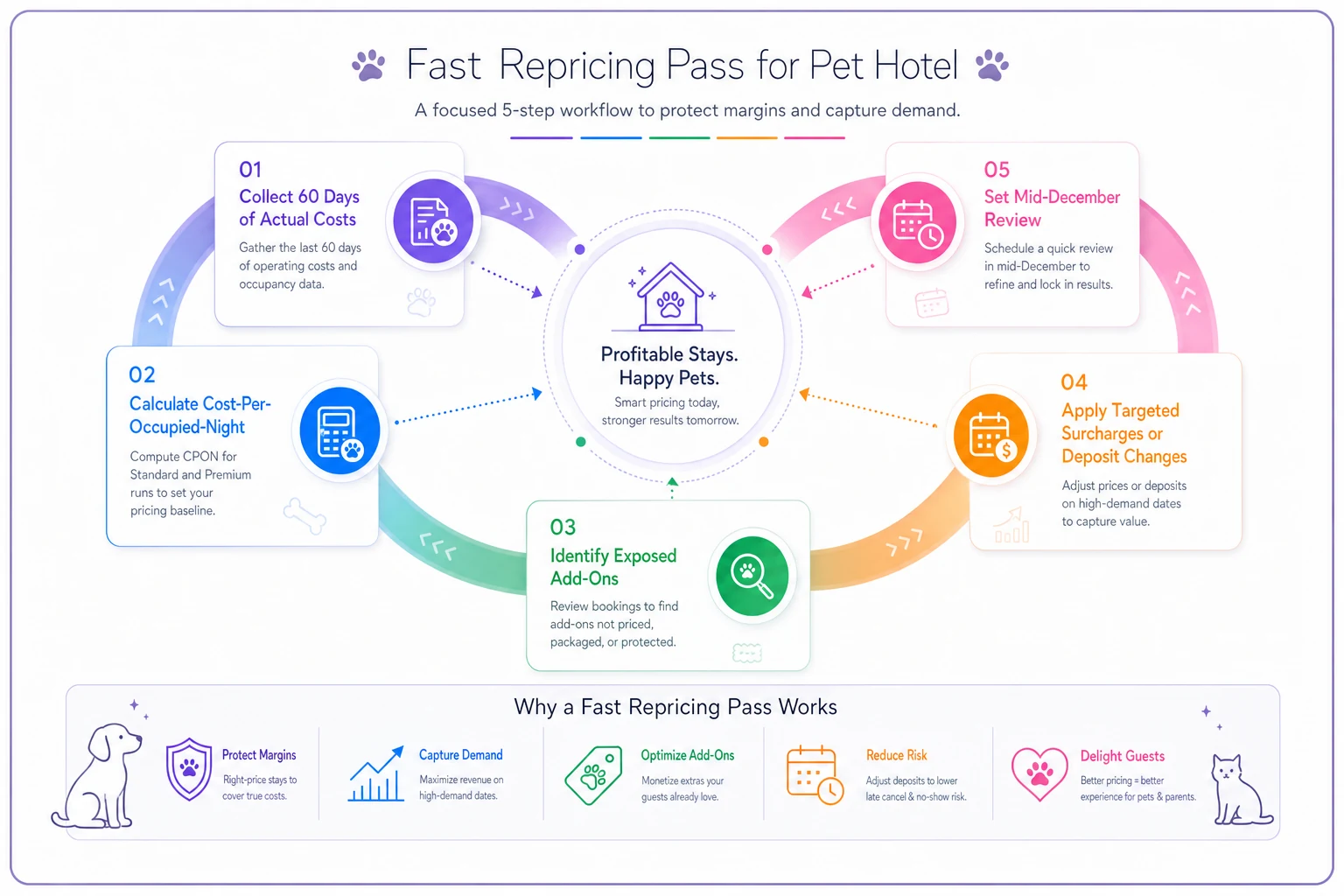
You don't need a full repricing overhaul before the holidays. You need a targeted pass on the stays and add-ons that are most exposed. Here's a sequence that takes an afternoon, not a quarter:
-
Pull your last 60 days of actual cost data — energy, labor hours (including OT), and consumable restocks. Not budgeted. Actual. This is your new baseline.
-
Recalculate cost-per-occupied-night for your standard run and your premium run separately. The gap between them tells you which product is actually absorbing the cost increase.
-
Identify your inflation-exposed add-ons. Anything that burns energy or extra labor — extended play sessions, extra walks, bath-before-pickup — may now be priced below true cost.
-
Apply a modest peak surcharge or adjust deposit structure on the highest-demand dates rather than a blanket rate hike. Demand is holding, so you have room to protect margin on the dates people need most without scaring off shoulder-season bookings.
-
Set a review date for mid-December so you can adjust once more before the final holiday wave if costs keep moving.
Start by scanning which two or three products moved from profitable to loss-making after you recalc cost-per-occupied-night — fix those first.
A quick workflow to run this pass:
The point isn't to raise everything. It's to find the two or three products where the cost move erased your margin and fix those specifically.
That said, actually running this pass requires decent data. If your cost history lives across three spreadsheets and a folder of supplier invoices, the afternoon estimate above becomes a week. That's one place where operational software with centralized cost tracking earns its keep — not because it makes better decisions for you, but because it makes the data available when you actually need it.
Rostering: where a cost bump turns into a labor-cost spike
Pricing is the visible lever. Rostering is where most of the damage actually happens, because overtime compounds. One understaffed holiday shift becomes mandatory OT, which becomes burnout, which becomes a callout, which becomes agency cover at 1.5–2x your normal rate.
Think of your labor cost per night not as a flat number but as a curve — one that spikes hard once you cross into overtime territory. The goal of good holiday rostering is to stay off the steep part of that curve as long as possible.
| Staffing approach | Cost behavior during peak | Margin risk |
|---|---|---|
| Fill gaps with OT on existing staff | Cheap at first, expensive fast past 40 hrs | High — compounds silently |
| Last-minute agency cover | Predictable but high per-hour | Medium — kills margin on covered nights |
| Pre-scheduled seasonal part-timers | Higher planning effort, lowest per-night cost | Low — if demand forecast holds |
| Cross-trained flex staff | Highest upfront training cost | Lowest — absorbs surges without premium pay |
The facilities that handle cost spikes best tend to over-invest in that bottom row before peak — cross-training a couple of people so a single callout doesn't force an expensive scramble. It feels like a cost in November. It's margin protection in December.
If your rostering still lives in a spreadsheet that nobody updates between when it's built and when the shift starts, the current inflation environment is a decent reason to tighten that up. A scheduling or workflow platform keeps your projected labor cost visible while you're building the roster, so you catch the OT creep before it's locked in rather than after payroll runs.
Cashflow: the part that bites in January
Peak revenue arrives on a delay — deposits now, balance at checkout, some corporate accounts on net-30. But peak costs arrive on time or early: you pay staff weekly, you restock before the rush, the energy meter runs in real time.
-
Tighten deposit timing on holiday bookings so more cash lands before you incur the staffing and supply costs to deliver those stays.
-
Pre-buy inflation-exposed consumables now, before the next monthly cost move, if you have the storage and the supplier won't move price again on you.
-
Flag corporate and net-30 accounts for early invoicing so their balances don't land in February when you need them in December.
-
Map your runway week-by-week through January, not month-by-month. Monthly averages hide the mid-January trough.
This connects directly to the cashflow and booking discipline worth reading in our earlier breakdown on tactical pricing and cashflow moves before peak season — the sequencing logic there holds whether the trigger is a rate decision or an inflation print. The trigger changes; the operational response rhymes.
A real scenario
A mid-size facility — roughly 40 runs, mostly dog boarding with a grooming add-on — went into last holiday season assuming its spring pricing would hold. It ran about 88% occupancy through the peak weeks and the owner expected a strong margin month.
What actually happened: energy costs ran about 9% over the prior year, and three callouts in the final stretch forced agency cover at nearly double the normal hourly rate. Revenue was up noticeably. But the per-night margin on the busiest week came in roughly 6–7 points lower than the quieter shoulder weeks before it. The volume was real; the profit wasn't where it should have been.
The fix for this season wasn't dramatic. They ran the fast repricing pass above, added a modest surcharge on the ten highest-demand dates, cross-trained two kennel staff so one callout didn't trigger agency cover, and moved deposit collection earlier. Nothing exotic — just closing the loop between rising costs and the decisions that respond to them. Early indications are that the surcharge dates alone recovered most of the margin gap without any drop in bookings, because demand on those dates was never price-sensitive to begin with.
When to act aggressively — and when not to
Not every facility should respond the same way to this.
Move aggressively on pricing and deposits if: you run high occupancy through peak, your cost mix is energy- and labor-heavy, and your current rates were set more than six months ago. You have the most exposure and the most room to adjust.
Be more cautious if: you operate in a price-sensitive local market, your shoulder-season occupancy is already soft, or you've raised rates recently. In that case, protect margin through cost-side moves — rostering discipline, pre-buying consumables, cutting underpriced add-ons — rather than broad rate hikes that could soften demand you can't afford to lose.
Who should not do a blanket rate increase: anyone whose booking calendar is already thin on weekdays. Raising everything to chase a cost bump can cost you more in lost shoulder nights than it recovers on peak nights. Target the exposed products instead.
The signal to watch isn't the headline inflation number. It's your own cost-per-occupied-night, tracked monthly instead of annually. The whole point of the September print is that it's a reminder to shorten that measurement loop before the busiest, most expensive weeks of your year — not to panic about the economy.
The real takeaway
A cost bump during steady demand is sneaky precisely because the top line still looks healthy. The facilities that get hurt are the ones that confuse a good revenue month for a good profit month and only find out the difference in January. The ones that stay protected are the ones with a short loop between a cost moving and pricing, rostering, and cashflow responding — close enough that a 0.5% monthly shift gets caught and adjusted for while the season is still in front of them, not after it's already priced in.
That's ultimately what this is about. Not macroeconomics, not inflation theory — just building the operational habit of measuring the right things often enough that a bad January doesn't come as a surprise.
Ready to optimize your pet hotel operations?
Join hundreds of pet hotels using GoPetel to save time, improve pet care, and increase booking reliability.