



Your pet hotel probably tracks occupancy. Maybe average stay length and seasonal patterns too. But what quietly kills profitability is when a client books once and disappears.
Why most pet hotels are quietly bleeding revenue after checkout
I pulled numbers from three pet hotels recently. One had 82% occupancy during peak season but only 31% of clients had booked more than once in the past year. Another filled every kennel over Christmas week, yet roughly two-thirds of those customers never came back. The third was running at around 54% occupancy year-round while spending north of $400 per new client through Google Ads.
The math gets ugly fast when you factor in acquisition costs. Most pet hotels spend somewhere in the range of $35–85 to get a new customer through the door. That first booking might generate $280 in revenue. But if they never return, you're just grinding through marketing budget to hold baseline occupancy. Meanwhile, the hotel down the street quietly builds a rebooking system that brings clients back four or five times a year without spending another dollar on acquisition.
Why rebooking fails: the operational black hole after checkout
Pet hotels treat checkout like a finish line. Client picks up Bella, pays the invoice, maybe gets a generic thank-you email three days later. Then nothing. No follow-up system. No lifecycle thinking. Just hoping they remember you before their next trip.
Never miss a booking or detail again.
GoPetel simplifies pet hotel operations by managing every reservation and pet profile seamlessly.
- Centralized booking management
- Automated client notifications
- Staff and kennel scheduling
No credit card required
The breakdown happens because retention isn't actually built into the operational flow. Intake efficiency, kennel management, daily care—all critical, all well-managed in most facilities. But post-stay operations get ignored. There's no systematic approach to turning a one-time booking into something resembling a relationship.
Think about what happens at most front desks after checkout. Staff hand over the dog, process payment, maybe say "see you next time" while already glancing at the next pickup in line. Any follow-up depends on whether someone remembers to send an email that afternoon. Rebooking is left entirely to the customer.
This compounds over time in ways that aren't obvious. A client who books twice yearly for five years generates somewhere around $2,800 in revenue. Lose them after one stay and you've lost most of that. Multiply across a few hundred clients and you're bleeding potential revenue without even realizing it.
Building the lifecycle map: from first booking to year-five retention
Pre-arrival phase (Day -7 to Day 0) Send confirmation and prep messages. Not just "your reservation is confirmed" but actual value—reminders about what to bring, tips for reducing separation anxiety, an introduction to their pet's assigned caregiver. This sets expectations and reduces friction on drop-off day.
Active stay phase (Day 1 to checkout) Daily updates if requested, photo sharing for first-time clients, immediate notification of any issues. The goal isn't just communication for its own sake—it's demonstrating the care level that justifies premium pricing and gives people a concrete reason to return.
Immediate post-stay (Day 0 to Day 7) This window matters most. Get the thank-you out within 24 hours, but make it specific. "Bella loved playing with Max during group time" beats generic appreciation every single time. Include a photo from their stay. Collect feedback while the experience is fresh.
Engagement window (Day 8 to Day 30) Most facilities go silent here. Good ones send care tips, seasonal reminders, or facility updates. Nothing salesy—just showing you exist beyond the transaction.
Rebooking trigger zone (Day 31 to Day 90) Based on their booking pattern, send targeted outreach. Weekend stay? Check in about upcoming weekend availability. Holiday booking? Send early-bird info for the next holiday season. Make rebooking easier than searching for alternatives.
Maintenance phase (Day 91 to Day 365) Quarterly touchpoints minimum. Facility improvements, new services, staff updates. Keep yourself top-of-mind without being pushy about it.
Annual cycle restart One year post-first-stay, look at their pattern. No rebookings? Run a win-back campaign. Multiple bookings? Move them to a VIP track with priority booking windows and small loyalty perks.
Below is a rough flow of how this lifecycle maps operationally—from first booking through to annual retention:
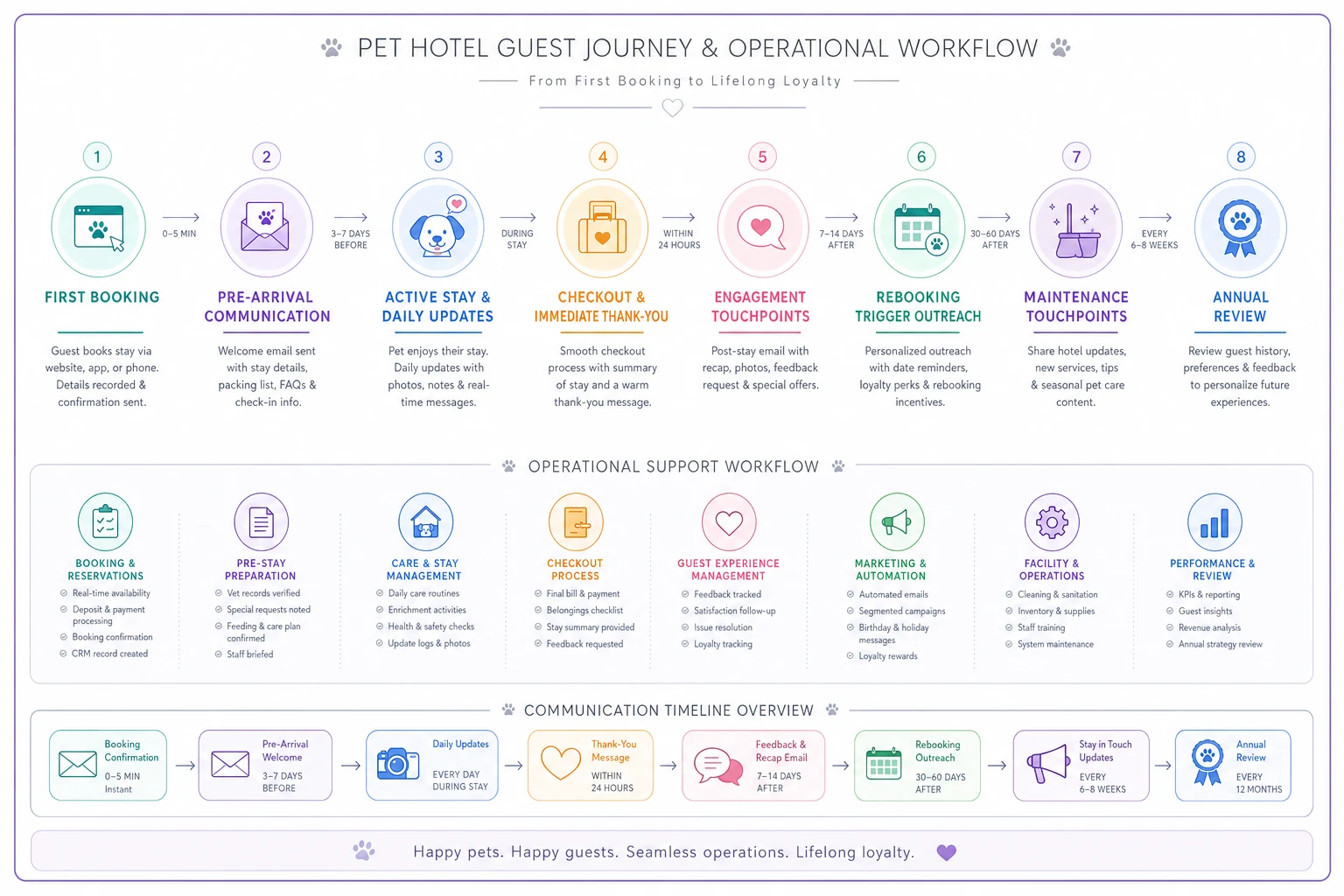
Each stage needs to be systematized. If even one phase is missing, you're leaving rebooking up to chance.
The message sequence that actually drives rebooking
Generic email blasts don't drive rebooking. Targeted sequences triggered by specific behaviors and timed to booking patterns actually do.
The immediate post-stay message sets everything up. Within 24 hours of pickup, send a note—even if templated—that references something specific about their pet's visit. Attach one good photo. Include a subtle rebooking nudge: "We've noted Bella's preferences for next time."
Day three brings the feedback request. Keep it short—three questions max. But include a rebooking incentive alongside the survey. "Complete this 2-minute form and lock in 10% off your next stay booked within 30 days." You get insights while creating a time-bound reason to rebook.
Day fourteen targets seasonal patterns. If they booked for July 4th, message them about Labor Day availability. Spring break clients get summer vacation reminders. Connect what they've already done to what's coming up.
Day thirty splits based on feedback scores. Happy clients get a refer-a-friend offer. Neutral responses trigger a personal call from management. Complaints—if handled well—often convert unhappy clients into loyalists. That's not theoretical; it's one of the more counterintuitive things I've watched play out repeatedly.
Day sixty adapts to engagement. Opened every email? Send VIP early access to holiday bookings. Never opened anything? Try SMS with a compelling offer. Still nothing? One final win-back attempt before marking them inactive.
The sequence above works as a numbered process for implementation:
-
Send personalized thank-you with photo within 24 hours of checkout
-
Deliver three-question feedback form on Day 3, include rebooking incentive
-
Trigger seasonal availability reminder on Day 14 based on booking type
-
Split messaging on Day 30 by feedback score — referral offer, manager call, or service recovery
-
Adapt Day 60 outreach by email engagement — VIP access, SMS offer, or final win-back
-
Shift to relationship messaging after third confirmed booking
Once someone books three or more times, the messaging shifts from selling to relationship maintenance. Facility updates, pet birthday messages, anniversary booking bonuses. The goal changes.
Consent forms and feedback loops that protect and improve
Every pet hotel thinks about liability, but few actually build protection into their retention system. Your consent and feedback forms should do three things at once: legal protection, service improvement, and rebooking support.
The intake consent form should go beyond basic waivers. Include communication preferences—do they want daily photos? Emergency-only contact? This shows operational sophistication while giving you data for personalized follow-up. Add optional fields about upcoming travel plans, how often they typically board, and what other facilities they've used. That information shapes your entire retention approach.
Build feedback collection into operations, not just post-stay emails. Tablet-based forms at pickup capture immediate reactions while memories are still fresh. Three core questions: overall satisfaction (1–10), likelihood to rebook (yes/maybe/no), and one open-ended improvement suggestion. Under 60 seconds.
Tie feedback to immediate action. Score 9–10? Trigger a referral request and loyalty program enrollment. Score 6–8? Manager reviews within 24 hours and responds personally. Score 1–5? Service recovery protocol launches—call within two hours, offer appropriate compensation, document the issue.
Monthly feedback analysis drives real operational improvements. Multiple comments about pickup wait times? Fix the bottleneck. Several mentions of a specific staff member? Figure out what they're doing differently and recognize them for it. Complaints about cleanliness? Address it before it shows up in a Google review.
Rebooking triggers beyond the obvious
Most pet hotels try to rebook everyone the same way—send a discount, hope they bite. Triggers that actually work match client behavior patterns and lifecycle stage.
The vacation pattern trigger Track booking intervals. Client books every June? Reach out in April with availability reminders and early-bird pricing. Don't wait for them to remember you exist.
The special date trigger Capture important dates during intake—pet's birthday, adoption anniversary, owner's annual work trip. Three weeks before these dates, send personalized rebooking suggestions. "Bella's birthday is coming up! Book a birthday package with extra playtime and a special treat."
The capacity optimization trigger When specific room types hit roughly 70% booked for upcoming dates, message past clients who stayed in those rooms. "Our suites for larger dogs are filling fast for Memorial Day weekend. Since Max loved his suite last visit, we wanted to give you first access."
The weather event trigger Hurricane forecast? Message all clients in evacuation zones about emergency boarding availability. Unexpected busy travel season? Remind corporate clients about last-minute options. These show you're thinking about their needs, not just your occupancy.
The social proof trigger After collecting a great review or a genuinely cute photo, share it with similar clients. "Check out how much fun Bailey (another Golden Retriever) had during yesterday's pool time! We'd love to see Bella back for summer swim sessions."
The win-back trigger No booking in six months? Run escalating win-back attempts. First, a simple "we miss you" note. Then a meaningful discount. Finally, a personal call to understand why they haven't returned. Each stage gives you real intelligence about where retention is breaking down.
Using a mix of these triggers—rather than sending the same campaign to everyone—is what separates a retention system that actually works from one that generates unsubscribes.
The revenue math of rebooking rates
Most pet hotels have no idea what a single percentage point improvement in rebooking rate actually means for revenue. These estimates assume 500 total unique clients annually, average 3-night stays at $70/night, and roughly $50 acquisition cost per new client—they're approximations, not guarantees, but directionally they're solid:
| Rebooking Rate | Annual Clients | Total Bookings | Revenue @ $70/night avg | Acquisition Cost | Net Revenue |
|---|---|---|---|---|---|
| 20% | 500 new | 600 | $126,000 | $25,000 | $101,000 |
| 30% | 429 new | 614 | $129,000 | $21,450 | $107,550 |
| 40% | 375 new | 625 | $131,250 | $18,750 | $112,500 |
| 50% | 333 new | 666 | $139,860 | $16,650 | $123,210 |
| 60% | 300 new | 720 | $151,200 | $15,000 | $136,200 |
Moving from 20% to 40% rebooking rate generates over $11,000 in additional net revenue without adding capacity or raising prices. Push to 60% and you're looking at $35,000+ in additional profit from the same facility, same staff, same overhead. Even if your numbers land 20% lower, the case still holds.
The compound effect accelerates over years. A client retained at 60% rebooking generates roughly $1,200–$1,300 in five-year lifetime value. At 20%? Somewhere around $280–$300. That's close to a 4x difference based purely on how well you handle retention operations.
Improving rebooking rate also costs less than new customer acquisition. A solid retention system might run $2,000–4,000 upfront and a few hundred monthly to manage—compare that to spending $25,000+ annually on Google Ads just to fill the gaps left by poor retention.
Building the retention dashboard that drives decisions
You can't improve what you don't measure. Most pet hotels track vanity metrics—total bookings, occupancy rate—while ignoring the retention KPIs that actually move revenue.
Start with cohort-based rebooking rates. Track what percentage of clients from each month return within 90 days, 180 days, and a full year. January clients often show different patterns than July clients. Understanding those differences shapes more targeted retention efforts.
Start with a single monthly cohort to validate a rebooking trigger before scaling complex segmentation.
Monitor message engagement throughout your sequence. Which emails get opened? Which ones drive actual bookings? If your day-14 message has an 8% open rate but your day-30 message hits 31%, something's working in that second message. Figure out what and replicate it.
Track rebooking revenue separately from new client revenue. When rebooking revenue grows from 20% to 45% of total, you've built a more sustainable business—less dependent on constant acquisition, more predictable month over month.
Measure feedback scores alongside rebooking behavior. Do 9–10 scores actually rebook more? What score threshold predicts churn? That correlation guides both service improvement and retention targeting.
Calculate customer lifetime value by acquisition channel. Referral clients might rebook at 70% while Google Ads clients rebook at 25%. That data reshapes where your marketing dollars should go. Most owners never look at this split—and it's often the most revealing number in the whole dashboard.
The consent and communication framework
Getting rebooking right requires proper consent management. You need permission to communicate, but aggressive opt-in requests just annoy people.
During online booking, default opt-in to stay updates only. Make marketing communications a separate, clear choice. "Would you like to receive special offers and rebooking reminders?" beats burying consent in terms and conditions.
At intake, verify preferences verbally. "I see you're opted in for stay updates—would you also like early access to holiday bookings and special promotions?" This increases marketing consent rates while showing you respect their preferences. Small thing, but it works.
Post-stay feedback requests don't require marketing consent—they're transactional communications about service delivery. But include a soft opt-in at the end: "Want first notice about availability and special rates? Join our VIP booking list."
Build preference centers, not just unsubscribe buttons. Let clients choose frequency (weekly, monthly, quarterly) and content type (promotions only, facility updates, pet care tips). Partial engagement beats total opt-out.
Honor preferences immediately and consistently. Client says monthly only? Don't send weekly "exceptions." Trust erodes fast when you abuse communication permissions. Document everything in your operational system—who opted in when, preference changes, full communication history. This protects against compliance issues while enabling actually personalized outreach.
Failed rebooking and what it teaches
Every lost client tells you something about an operational gap. The question is whether you're paying attention.
Track rebooking failure reasons systematically. When someone doesn't return, find out why. Send a brief survey around 90–120 days after their last stay: "We noticed you haven't booked recently—mind sharing why?" Give them real options: price, location, service issues, no travel needs, switched providers.
Price complaints often mask value perception problems. When clients say you cost too much, they're usually saying you didn't demonstrate enough value to justify the cost. That's an operational and communication problem, not a pricing problem. Cutting rates won't fix it.
Service issues need immediate review. One complaint might be a personality conflict. Three similar complaints point to something systematic. Don't wait for it to show up on Yelp before addressing it.
Competitive switches reveal positioning weaknesses. Clients leaving for a facility with grooming? Maybe consider adding that service. Switching to home-based sitters? Lean harder into professional oversight and safety protocols in your messaging.
The "no travel" response isn't a dead end—these clients will travel again. Keep them on a quarterly touchpoint schedule with facility updates and gentle reminders.
Technology and automation in retention operations
Manual retention management starts breaking down somewhere around 150–200 active clients. You need automation to scale personalized communication without burning out your staff.
Modern pet hotel management platforms should handle basic retention workflows automatically. Post-stay emails, rebooking reminders, birthday messages—these should trigger without daily input from your team. The system tracks booking patterns, calculates outreach timing, and personalizes content based on pet and owner data.
Automation doesn't have to mean impersonal. AI-powered operational platforms can reference specific pets by name, pull previous stay details, and adjust messaging based on client history. "Since Princess enjoyed our cat condos last March, we wanted to let you know about our new climbing tower installation" feels personal even when systematically generated.
The real value comes from behavioral triggers. System notices a regular client hasn't booked their usual summer stay? Automatic check-in message goes out. Feedback score drops below threshold? Management gets an alert for personal follow-up. Rebooking rate for a client cohort falls below target? The platform flags it for campaign adjustment.
Integration matters too. Your retention system should connect with booking, payment, and communication tools. When a client books, every part of the system updates. When they leave feedback, it flows into their profile. When capacity changes, relevant clients get notified automatically. That coordination eliminates the dropped balls that cost you bookings without anyone on your team realizing it's happening.
The compound effect of systematic retention
A few years from now, your pet hotel will be one of two types. Either you'll still be churning through new clients, spending heavily on acquisition, and wondering why occupancy feels unpredictable. Or you'll have built a system where 60–70% of revenue comes from repeat clients who book predictably and refer enthusiastically.
The difference isn't better facilities or lower prices. It's whether retention is actually built into your operations. Most hotels leave every post-checkout interaction to chance. The ones that systematize those touchpoints—even imperfectly—end up in a fundamentally different financial position.
Start simple. Map your current client lifecycle. Find the gaps—where do you go silent? Where do clients drift away? Build one message sequence. Track one new metric. Test one rebooking trigger. Small improvements compound into real change over time.
Every month without a proper retention system, you're losing clients who could have generated thousands in lifetime value. More importantly, you're missing the chance to build a business that runs on relationships rather than constant recruitment. The hotels that figure this out won't just survive—they'll dominate their local markets while spending less on marketing than competitors who never solved the retention problem.
Ready to optimize your pet hotel operations?
Join hundreds of pet hotels using GoPetel to save time, improve pet care, and increase booking reliability.