

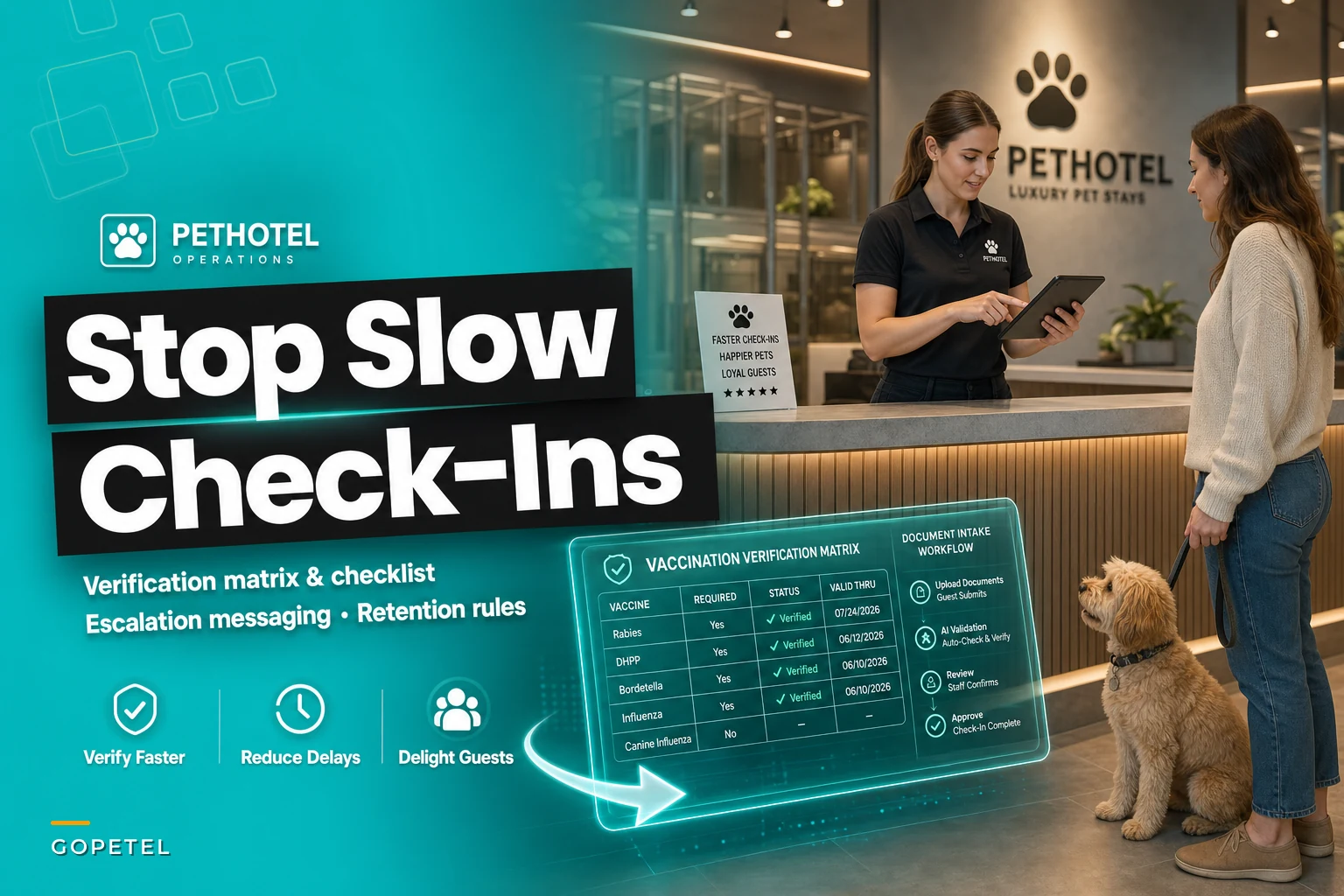

Your front desk staff spends twelve minutes on the phone with a vet clinic trying to confirm if "Rabies 3yr" on a blurry photo means the vaccine is actually valid through next month. Meanwhile, four dogs are waiting to check in, their owners getting increasingly frustrated. One of them will leave a one-star review. Another will drive to your competitor down the street.
But the real problem? The German Shepherd in kennel 14 whose Bordetella expired yesterday, and nobody caught it because the photo was stored in someone's email inbox.
The document verification breakdown happening right now
Most pet hotels handle vaccination records like they're running a detective agency. Staff squint at faded PDFs, decode handwritten vet notes, chase down missing records through three different communication channels, and somehow still miss the expired DHPP that puts your entire facility at risk. The operational chaos looks different at every facility, but the pattern stays consistent. A boarding facility with 85 runs averaging 70% occupancy processes around 1,800 check-ins annually. Each one requires verification of at least five vaccines. That's 9,000 individual vaccination checks per year, usually handled through:
-
Emailed photos that might show half the document
-
Portal screenshots that don't include expiration dates
-
Faxed records from 2019 that nobody updated
-
Text message photos taken at weird angles
-
Handwritten notes from mobile vets
Your staff develops workarounds. They create spreadsheets. They highlight things in different colors. They leave sticky notes on monitors. They remember that Bailey the Golden Retriever always has current vaccines but Madison the Maltese's owner consistently forgets Bordetella.
These manual systems work until they don't. Until someone new starts on a Saturday. Until your experienced manager takes vacation. Until you get sued because a dog contracted something preventable and the owner's attorney requests your verification documentation.
Why traditional verification creates compound risk
The vaccination verification problem compounds in ways that aren't immediately obvious. Every unclear document creates a decision point. Accept it and risk liability. Reject it and risk losing the booking. Call the vet and risk a 20-minute hold time during your busiest check-in period.
Never miss a booking or detail again.
GoPetel simplifies pet hotel operations by managing every reservation and pet profile seamlessly.
- Centralized booking management
- Automated client notifications
- Staff and kennel scheduling
No credit card required
Staff naturally develop different risk tolerances. Your morning person might accept a slightly blurry photo showing "Rabies" and "2027" while your afternoon person demands official letterhead. These inconsistencies create three distinct problems:
First, customer confusion. Regular clients learn which staff members are "easier" and time their drop-offs accordingly. New clients get different answers depending on who they talk to. Second, legal exposure varies by shift. The documents you accept Monday morning might be different from what you accept Friday evening. If something goes wrong, these inconsistencies become evidence of negligence. Third, operational bottlenecks cluster around cautious staff members. The person who actually follows protocol creates longer wait times, leading to pressure from both customers and management to "just make it work."
Building a functional verification system eliminates these judgment calls entirely.
Building an acceptable document matrix
A functional verification system starts with defining exactly what counts as acceptable documentation. Not guidelines or suggestions – specific, measurable criteria that eliminate interpretation.
| Document Type | Acceptable If | Not Acceptable If | Escalation Required |
|---|---|---|---|
| Vet clinic PDF | Shows clinic header, all required vaccines, clear dates | Missing any vaccine, dates cut off, unofficial format | Expired within 30 days |
| Portal screenshot | Full page visible, URL shown, dated within 7 days | Partial view, no URL, outdated screenshot | Different pet name shown |
| Photo of paper record | All text readable, full document visible, clinic info clear | Blurry text, partial document, no clinic identifier | Handwritten additions |
| Email from vet | Official clinic email, includes license number, lists all vaccines | Personal email, missing vaccines, no license number | Forward from owner |
| Faxed records | Clinic letterhead, received directly from vet, dated transmission | Forwarded fax, unclear transmission, outdated records | Records over 6 months old |
This matrix removes the guesswork. Staff no longer decide if something "looks official enough." They match the document against specific criteria.
But the matrix alone doesn't solve the problem. You need a workflow that handles exceptions without grinding operations to a halt.
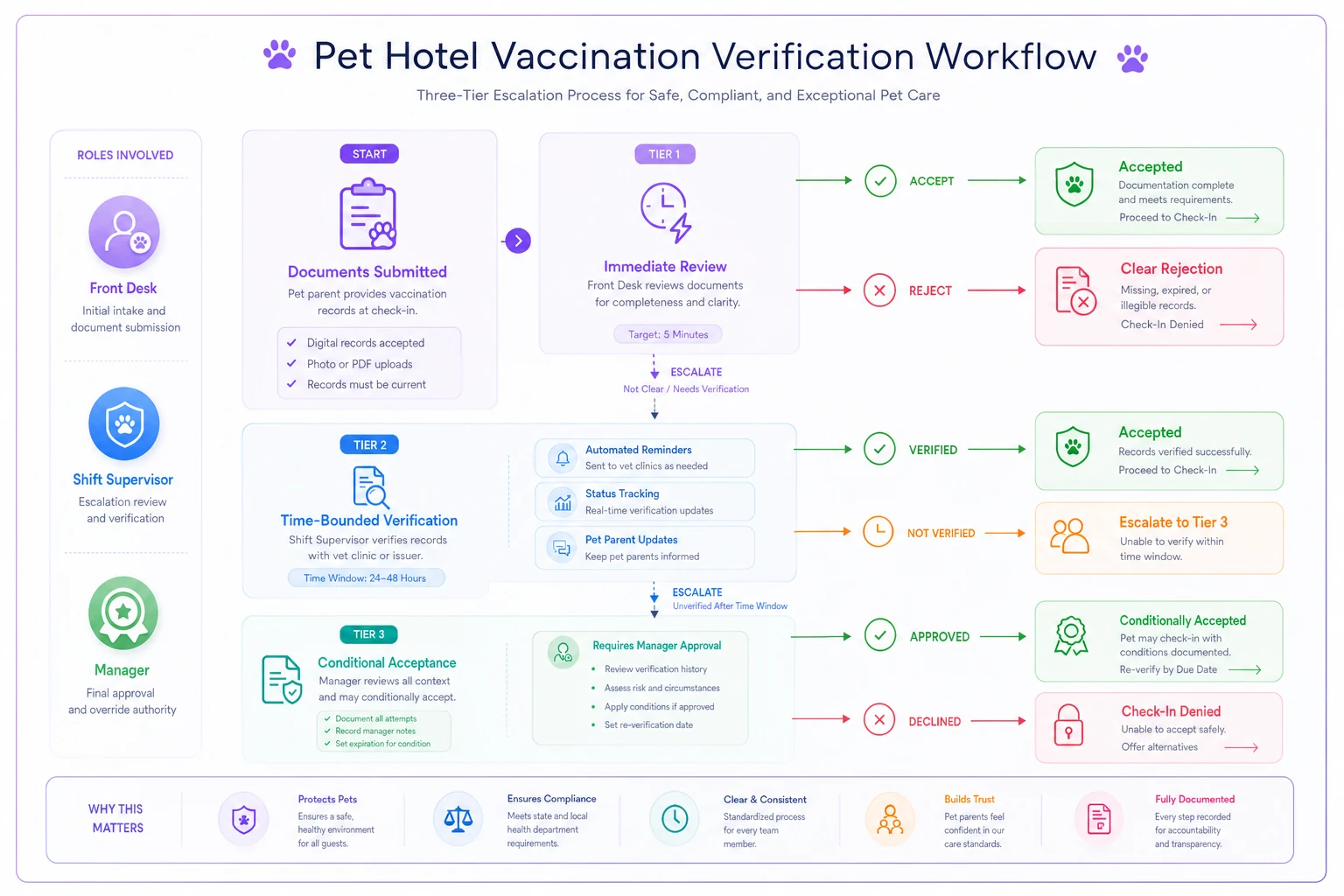
The three-tier escalation workflow
When documents don't meet your matrix criteria, most facilities either reject them outright (losing bookings) or accept them anyway (accepting liability). The solution sits between these extremes: a structured escalation process that maintains standards while preserving revenue.
Tier 1: Immediate acceptance or clear rejection Documents either clearly meet all criteria or obviously fail. No middle ground. No "let me ask someone." This handles roughly 70% of submissions.
Tier 2: Time-bounded verification Documents with minor issues get a specific verification window. Missing Bordetella date? Client has 24 hours to provide clarification. Blurry expiration? They can email a clearer photo by end of business. Set automatic reminders at 4 hours and 20 hours.
Tier 3: Conditional acceptance with documentation Some situations warrant accepting incomplete documentation with specific conditions. The owner signs an additional waiver. You document the exception reason. The pet stays in a designated area until verification completes.
Each tier has different authority levels. Front desk handles Tier 1. Shift supervisors manage Tier 2. Only managers approve Tier 3 exceptions.
This workflow prevents the common trap of making exceptions that become the new rule. Every deviation gets documented and tracked.
Here's a simple workflow diagram to visualize the escalation steps.
This workflow prevents the common trap of making exceptions that become the new rule. Every deviation gets documented and tracked.
Messaging templates that reduce friction
The difference between a smooth verification process and an adversarial one often comes down to communication tone. Your messages need to feel helpful, not bureaucratic.
Initial missing document message: "Hi Sarah, preparing for Max's stay tomorrow. We're missing his Bordetella record – could you snap a photo of it or forward the vet email? Any format works as long as we can see the date. Thanks!"
Escalation for expired vaccine: "Quick heads-up – Bella's DHPP expired on the 15th. If she's already been revaccinated, just send the updated record. If not, she'll need it before boarding. Your vet can usually squeeze in a quick vaccine visit. Let me know if you need local vet suggestions."
Final verification warning: "Max's reservation starts tomorrow at 2pm. Still need that Bordetella record to check him in. Without it, we'll have to cancel the reservation by 10am. Reply with a photo or let me know if you need to reschedule after his vet visit."
Notice what these messages don't do. They don't lecture about policy. They don't use veterinary jargon. They don't sound like legal documents. They acknowledge that people are busy and documentation is annoying.
The tone makes all the difference. Customers respond better to "we need this for Max's safety" than "policy requires documentation."
Digital storage rules that prevent legal disasters
Storing vaccination records seems simple until you need to produce them. Three years later. For a specific date range. For a dog named Bailey (but there were six dogs named Bailey that year).
Physical files don't scale. Email inboxes become archaeological digs. Shared drives turn into digital hoarding situations. You need structure that maintains accessibility while ensuring compliance.
Organize by check-in date, not by pet name. A folder for each month, subfolders for each day, files named with the pattern: [Date][PetName][OwnerLastName][Confirmation#] Example: 2024-03-15BaileyJohnsonBK3847
This structure lets you find any record within seconds. More importantly, it lets you prove what you verified on any specific date.
Keep records for three years minimum, five years if your state has longer liability windows. Delete nothing without documented reason. Storage is cheap. Legal defense is expensive.
Set quarterly verification audits. Pull ten random records. Confirm you have all required documentation. Check that your staff is following the matrix. Document any issues found and corrective actions taken.
These audits catch problems before they become lawsuits. They also show your insurance company that you're serious about risk management.
The compound benefits of systematic verification
When vaccination verification becomes systematic rather than situational, several things happen. Check-in times drop from 12 minutes to 4 minutes. Staff stress decreases because they're following a process, not making judgment calls. Customer complaints shift from "your policies are inconsistent" to "I forgot to get the record" – a crucial difference in accountability.
Legal risk concentrates in documented exceptions rather than spreading across every interaction. You can point to specific decisions, specific criteria, specific documentation. Your insurance company loves this. Your attorney loves this even more.
Revenue impact often surprises operators. A facility processing 150 check-ins monthly might lose 8-10 bookings to documentation issues using ad-hoc verification. With systematic verification and clear escalation, that number typically drops to 2-3. At $45 per night average, three nights per booking, that's roughly $1,200 monthly revenue recovered.
But the real value shows during an outbreak. When infection control becomes critical, your verification system becomes your first line of defense. You can immediately identify which pets had current vaccines, which had exceptions, which might have been exposed.
The documentation you maintain during normal operations becomes your legal shield during emergencies.
When manual verification hits its limit
Around 200 monthly check-ins, manual verification starts breaking down. Not because staff can't handle the volume, but because the exception rate creates too many decision points. Five percent of submissions having issues means 10 problems to solve. That's manageable. But it also means 10 opportunities for mistakes, 10 potential inconsistencies, 10 possible liability points.
This is where operational software with AI automation changes the equation. Not by replacing human judgment, but by handling the routine verification that consumes 80% of the effort. AI agents can read documents, extract dates, check expiration status, and flag issues for human review. They don't get tired at the end of a shift. They don't interpret guidelines differently. They don't forget to check for Bordetella.
The workflow stays the same. Documents come in, get verified against criteria, trigger escalations when needed. But instead of staff squinting at photos, the system reads them instantly. Instead of manually tracking follow-ups, automated reminders go out on schedule. Instead of searching through emails for that one record, everything is indexed and searchable.
A mid-size boarding facility with 300 monthly check-ins might spend 25 hours monthly on vaccination verification. With automated document processing, that drops to about 5 hours of handling exceptions and special cases. Staff can focus on customer service rather than paperwork.
The technology handles what technology does well – reading, organizing, tracking, remembering. Humans handle what humans do well – making judgment calls, communicating with customers, solving problems.
Implementation that actually works
Rolling out a new verification system during peak season guarantees failure. Starting with every document type simultaneously creates confusion. The facilities that successfully transform their verification process follow a specific sequence.
Start with your document matrix. Define it completely but implement it for new customers only. Let existing customers continue with old processes for 30 days while you train staff and refine criteria.
Add the escalation workflow once staff is comfortable with the matrix. Begin with Tier 1 decisions only. Add Tier 2 after two weeks. Tier 3 comes last, once patterns are clear.
Introduce messaging templates as optional tools first. Let staff modify them as needed. After a month, standardize the most effective versions.
Digital storage begins immediately but runs parallel to existing systems for 60 days. This overlap seems redundant but prevents any gaps during transition.
The full system takes about 90 days to implement completely. Rush it and staff reverts to old habits under pressure. Take too long and momentum dies.
During implementation, track your exception rates. If more than 15% of documents need escalation, your matrix criteria might be too strict. If less than 3% need escalation, you might be too lenient. The sweet spot sits around 8-10% – enough to maintain standards without overwhelming staff.
Verification as competitive advantage
Every pet hotel deals with vaccination documents. Most treat them as a necessary evil, a compliance burden that slows operations and frustrates customers. But systematic verification becomes something unexpected – a selling point.
Pet owners choosing between facilities notice the difference. The place that texts them three days before boarding with a friendly reminder about expiring vaccines. The facility that accepts documents through multiple channels without confusion. The boarding operation that handles their paperwork in minutes rather than making them wait while someone calls a vet clinic.
Your verification system tells customers how you'll handle their pet. Chaotic document handling suggests chaotic operations. Smooth verification implies professional care. In a business built on trust, these signals matter more than your marketing messages.
The legal protection and operational efficiency are requirements for scaling. But the customer experience improvement drives growth. When verification friction disappears, rebooking rates increase. When documentation is predictable, referrals multiply. The vaccination verification matrix isn't really about documents. It's about building operations that can handle complexity without creating chaos. Once you solve this workflow, other operational challenges become manageable. The same systematic approach applies to feeding schedules, medication administration, special needs handling.
Start with the matrix. Build the workflow. Watch how quickly verification shifts from your biggest operational headache to a smooth, predictable process that protects your business while delighting customers.
Ready to optimize your pet hotel operations?
Join hundreds of pet hotels using GoPetel to save time, improve pet care, and increase booking reliability.