

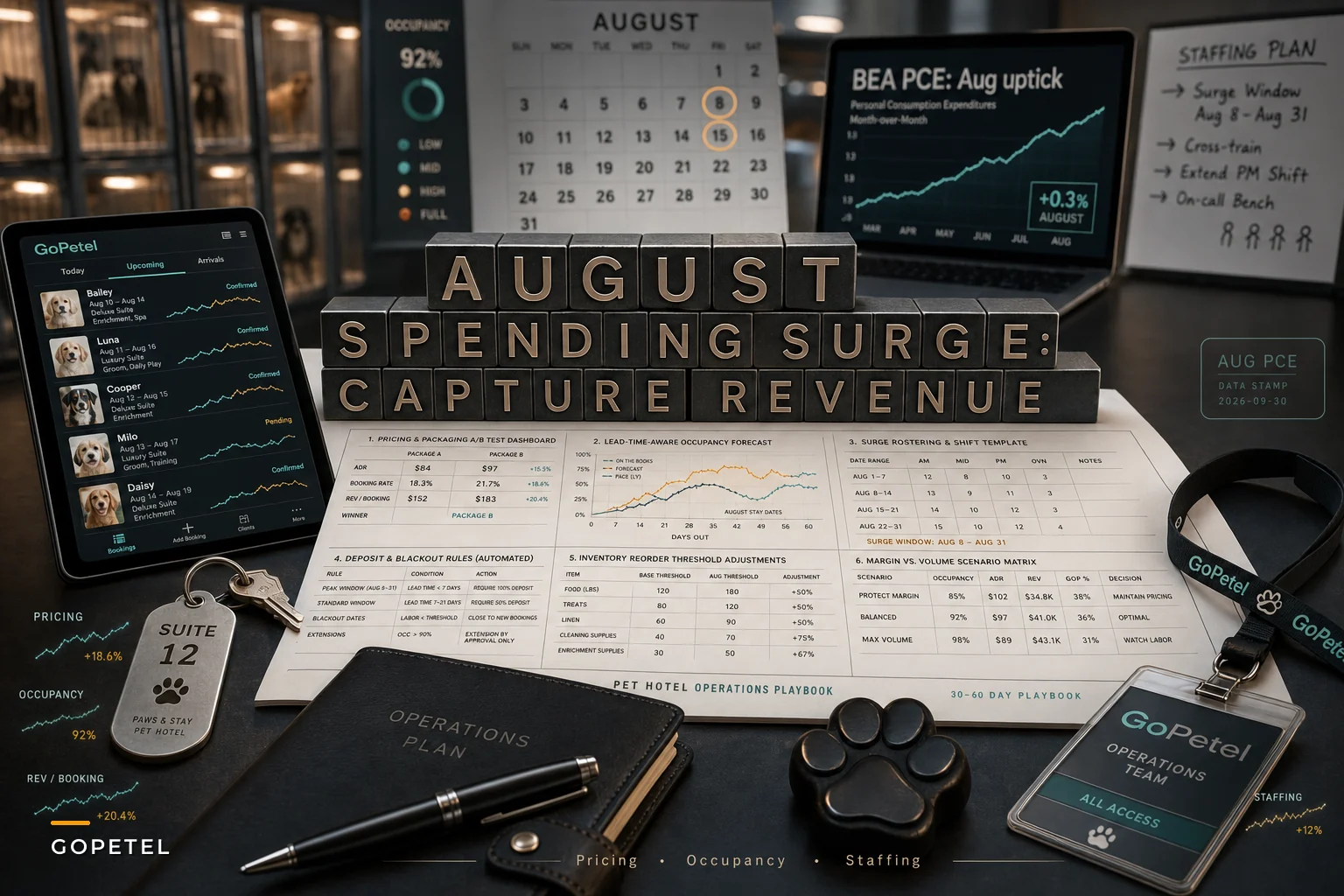

The August numbers caught a lot of people off guard. Consumer spending jumped 0.9% while the PCE price index only moved up 0.3% — meaning people are opening their wallets faster than prices are climbing. Reuters framed it as giving the Fed breathing room, but for anyone running a boarding facility, it reads differently: discretionary spending on pets is one of the first things to rise when households feel flush, and the fall/holiday booking window is right in front of you.
A demand surge is not automatically a revenue surge, though. Plenty of pet hotels will fill up in November and still end the quarter with thinner margins than last year — because they treated extra demand as a reason to say "yes" more often instead of a reason to get selective. That's the gap worth digging into.
What the spending surge actually changes for a boarding facility
When household spending rises like this heading into a peak booking season, three things happen at once, and they don't move at the same speed.
First, inquiry volume climbs before occupancy does. People start pricing out holiday boarding earlier, comparing two or three facilities, adding "maybe a grooming package too." You feel it in the inbox and on the phone before you feel it in the kennel count.
Second, add-on appetite rises faster than base-stay demand. This is the part most operators underuse. When someone feels comfortable financially, the $18 enrichment session or the $45 bath-and-brush exit groom stops feeling like an upsell and starts feeling normal. The base night is a commodity; the extras are where a surge actually shows up in your margin.
Third — and this is the trap — your cost base doesn't surge with you. Your kennel count is fixed. Your senior staff count is roughly fixed in the short term. So the question isn't "how do I capture more demand," it's "how do I capture the right demand without blowing throughput or burning out the three people who actually know how to run a holiday shift."
The official BEA release on personal income and outlays confirms the spending is real and broad. What it can't tell you is whether your specific facility is positioned to convert it. That's an operations question, not a macro one.
The underlying problem this exposes: most hotels price and staff for average weeks
There's a pattern that shows up constantly. A facility sets one nightly rate, maybe a modest holiday premium, and staffs from a rolling average. That works fine in a normal month. It falls apart the moment demand gets lumpy — which is exactly what a spending surge into peak season does.
Never miss a booking or detail again.
GoPetel simplifies pet hotel operations by managing every reservation and pet profile seamlessly.
- Centralized booking management
- Automated client notifications
- Staff and kennel scheduling
No credit card required
A surge doesn't raise demand evenly. It concentrates it. You'll see the Wednesday-before-Thanksgiving slot sell out while the preceding Monday sits half-empty. You'll get five requests for the same large-dog suite and zero for the economy runs. If your pricing and packaging treat every night and every kennel the same, you leave money on the high-demand slots and eat idle cost on the low-demand ones.
This is the same structural issue covered in the pricing, packaging and utilization playbook — the surge just makes the cost of ignoring it louder. A normal week forgives a flat rate. A surge punishes it.
Move 1: Run a 3-tier demand-day price, not a holiday flat premium
Stop thinking "holiday surcharge" and start thinking in day-classes. Tag every date in your next 90 days as one of three types and price accordingly.
| Day class | What it is | Pricing approach | Deposit rule |
|---|---|---|---|
| Peak | Sold-out-risk dates (holiday eves, long weekends) | Base + 20–30%, minimum-night requirement | 50% non-refundable |
| Shoulder | Days flanking peaks, strong but not capped | Base + 8–12% | Standard deposit |
| Soft | Mid-week, early-booking gaps | Base, or base minus a small early-bird incentive | Low or waived |
The point isn't the exact percentages — adjust those to your local market. The point is that a flat premium either underprices your sellout days or overprices your soft ones, and in a surge you'll do both at the same time. A tiered structure lets you capture the willingness-to-pay on the days people are desperate while still pulling bookings into the empty mid-week slots.
One thing operators miss here: put the minimum-night requirement on peak dates before you touch price. A two-night minimum on Thanksgiving eve protects you from the single-night booking that blocks a kennel you could have sold for three nights. That rule alone often does more for peak-week revenue than the price bump itself.
Put the minimum-night requirement on peak dates before you touch price.
That rule alone often does more for peak-week revenue than the price bump itself.
Move 2: Package the add-ons that are already surging — don't invent new ones
When discretionary spending rises, the temptation is to launch some elaborate new "premium experience" nobody's actually asked for. The faster money is in bundling what you already sell and what guests already decline out of decision fatigue.
A clean example: an exit-groom bundle. Guests picking up a dog after a five-night stay often want the dog to come home clean but don't think to ask. Pre-offer it at booking as a flat add-on and attach rate climbs noticeably — because you removed the decision from pickup day (when they're rushed) and moved it to booking day (when they're planning).
-
Arrival + daily enrichment pass — one price for the stay, two enrichment sessions a day, framed as "we'll keep them busy"
-
Exit groom + nail trim — attached at booking, scheduled for the last morning so it doesn't eat throughput mid-stay
-
Peace-of-mind pack — scheduled photo update + a short end-of-stay note, priced low, high perceived value, near-zero marginal cost
Keep the count small. Three bundles you can actually fulfill beat eight that confuse the booking flow and wreck your staff's day.
When this makes sense — and when it doesn't
Bundling add-ons works when your fulfillment capacity can absorb them on the days they'll land. It becomes a problem the moment the exit-groom bundle sells out your grooming slots and forces you to turn away a higher-margin base booking. Model the grooming and enrichment capacity against your peak-day occupancy before you promote anything. If the math says you can't deliver 20 exit grooms on the Sunday after a holiday week, cap the bundle on that date.
Move 3: Staff for the shape of the surge, not the size of it
The instinct during a demand spike is "add bodies." The sharper move is to add bodies at the right hours on the right days and leave the soft days lean.
A simple process to get there without over-hiring:
-
Pull your last two comparable peak periods and map occupancy by day, not by week.
-
Identify your three heaviest check-in/check-out days — these are your labor pressure points, not the nights themselves.
-
Layer staff against intake and turnaround spikes, not flat across the period. A holiday eve needs double coverage at the front desk from 7–11am and again at 4–7pm, and almost nobody midday.
-
Pre-book your flexible/part-time staff for peak days only, with soft days as backup, not default.
-
Protect your two most senior people — don't bury them in check-in paperwork when they should be running the floor. Put your newest hire on the predictable tasks.
The waste that shows up most during surges isn't understaffing. It's even staffing — same headcount Monday and Thanksgiving eve — which means you're overpaying on the quiet days and still slammed on the heavy ones.
A realistic scenario
Take a mid-size facility, around 40 runs, that normally runs a flat 15% holiday premium and staffs the same crew across the whole period.
Going into a surge season, they switch to three-tier day-class pricing, add a two-night minimum on their four hardest peak dates, and pre-offer the exit-groom bundle at booking instead of mentioning it at pickup.
What changed over the period wasn't dramatic on paper, but it added up. The two-night minimum on peak dates alone recovered several single-night gaps that used to block three-night bookings. Exit-groom attach rate roughly doubled because it moved to the booking screen. And by staffing against the check-in spikes instead of flat, they trimmed idle labor on the soft mid-week days. Net effect was a healthier margin on roughly the same occupancy — the surge turned into profit instead of just a busier, more stressful month.
No single lever did it. The combination did.
The coordination problem nobody budgets for
What quietly breaks during a surge isn't pricing or staffing — it's coordination. More bundles mean more fulfillment tasks. More day-class pricing means more rules to enforce. More deposits mean more reconciliation. When demand is high and everyone's moving fast, the thing that slips is the handoff between booking, floor, and billing.
This is where having your booking rules, deposit logic, and add-on fulfillment living in one system instead of scattered across a calendar, a spreadsheet, and someone's memory actually earns its keep. Not because software is magic — but because a surge multiplies the number of small decisions per day, and manual tracking is exactly what fails under volume.
A quick workflow view:
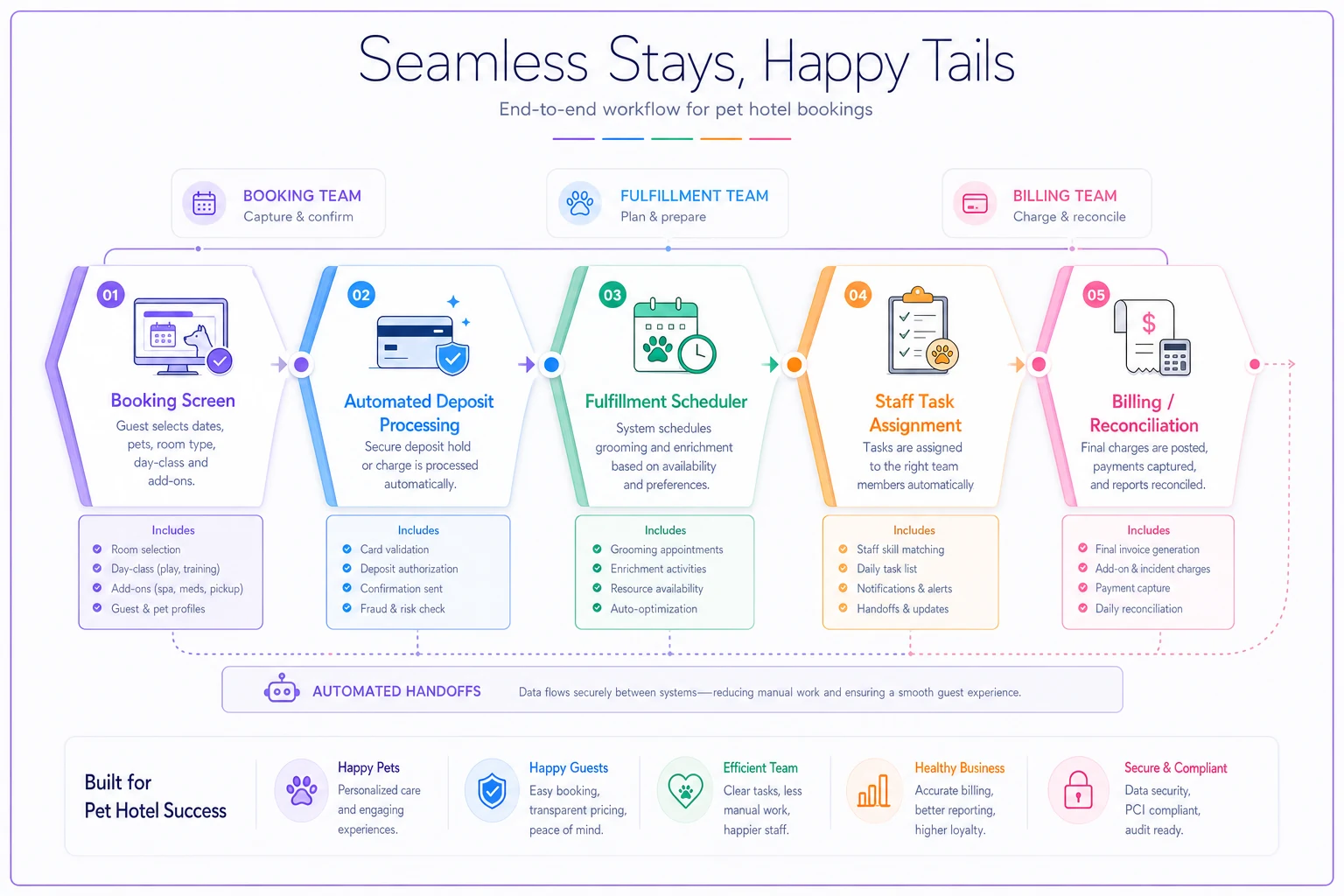
The goal is straightforward: when a peak-day booking comes in with an exit-groom bundle attached, the deposit rule, the grooming slot, and the staff task should all connect without a human manually threading them together. AI-powered operational software handles that kind of rule-based coordination well — not by replacing your team's judgment, but by making sure the right information lands in the right place automatically, so your staff isn't playing telephone across three different tools during your busiest week of the year.
That's the difference between a surge you absorb and one that runs you ragged.
A quick pre-surge checklist
Before the next heavy booking window hits, confirm you've got these in place:
-
[ ] Every date in the next 90 days tagged peak / shoulder / soft
-
[ ] Minimum-night rules set on your hardest 4–6 peak dates
-
[ ] Non-refundable deposit logic active on peak bookings
-
[ ] Three add-on bundles defined, capacity-checked, and live in the booking flow
-
[ ] Add-on capacity (grooming, enrichment) capped on your tightest days
-
[ ] Staff scheduled against check-in/check-out spikes, not flat across the period
-
[ ] Part-time/flex staff pre-booked for peak days, backup for soft days
-
[ ] Senior staff protected from intake paperwork during heavy shifts
-
[ ] Consumables reorder schedule bumped to cover the heaviest week
Before the next heavy booking window hits, confirm you've got these in place:
Who should skip most of this
If you're already running at 90%+ occupancy through peak on flat pricing, you don't have a demand problem — you have a capacity problem, and tiered pricing just helps you select which bookings to keep (take the three-nighters, drop the one-nighters). The bundling and staggered staffing still apply, but your lever is throughput, not demand capture.
If your facility is small enough that you personally touch every booking, don't over-engineer this. Two day-classes and one good exit-groom bundle will get you most of the upside without the overhead.
The takeaway
The spending data is a signal, not a strategy. Households are spending more into the exact window when pet owners plan holiday travel, and that demand is landing on facilities whether they're ready or not.
The ones who turn it into real margin won't be the ones who said yes to everything — they'll be the ones who priced their scarce days properly, packaged the extras people already wanted, and staffed for the shape of the week instead of its average. The surge is temporary. The pricing and packaging discipline you build during it is what carries into the next one.
The ones who turn it into real margin won't be the ones who said yes to everything — they'll be the ones who priced their scarce days properly, packaged the extras people already wanted, and staffed for the shape of the week instead of its average. The surge is temporary. The pricing and packaging discipline you build during it is what carries into the next one.
Ready to optimize your pet hotel operations?
Join hundreds of pet hotels using GoPetel to save time, improve pet care, and increase booking reliability.