

Most transport problems at pet hotels don't show up as dramatic crashes. They show up as a crate that slid six inches on a hard brake, a Shih Tzu that chewed through a loose seatbelt tether on a 40-minute run, or a van that smelled like the last dog's diarrhea when the next client's Golden got loaded in. These are the things that quietly turn into liability, cancelled contracts, and the kind of review that mentions "they didn't even strap my dog in."
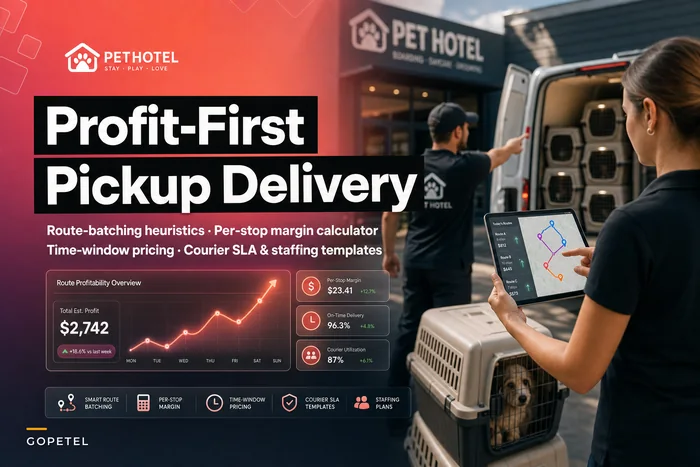
If you run pickup and delivery, you've probably already worked through the routing and margin side of things — and if not, the profit-first pickup & delivery playbook covers that angle well. This piece is narrower. It's about what happens inside the van once a pet is in your custody, and how to document it so that when a corporate account or an insurer asks "show me your transport SOP," you have something real to hand over.
The gap between "we transport pets" and "we have a transport SOP"
A lot of pet hotels offering transport are basically running a nice person with a van and some crates. It works right up until it doesn't.
The failure pattern is pretty consistent. A new driver gets hired during peak season, nobody has time to train them properly, so they ride along once and then they're solo the next week. There's no written restraint standard, so they do whatever feels right — which varies by driver, by dog size, by how late they're running. Cleaning between stops depends entirely on whether the driver thinks it looks dirty. And when something goes wrong, there's no incident form, so everything lives in a text message the owner half-remembers three weeks later.
This usually surfaces during a vendor audit. A corporate daycare contract or breeder-referral relationship asks for transport documentation, and you realize you have none. Or worse — it comes up after an incident, when your insurer asks for the securement log and you're scrambling.
The fix isn't complicated. It's just rarely written down.
Securement: the part everyone underthinks
The most common restraint mistake isn't using no restraint — it's using the wrong restraint for the pet and assuming it's fine because "it's attached to something."
Never miss a booking or detail again.
GoPetel simplifies pet hotel operations by managing every reservation and pet profile seamlessly.
- Centralized booking management
- Automated client notifications
- Staff and kennel scheduling
No credit card required
A seatbelt-clip harness rated for a 25 lb dog does almost nothing for a 70 lb dog that panics. A crate that isn't tied down becomes a projectile in a 20 mph fender bender. A cat carrier sitting loose on a seat will slide into the footwell on the first hard stop — which is exactly when the cat starts screaming and the driver gets distracted.
| Pet profile | Primary restraint | Secondary check | Common mistake to avoid |
|---|---|---|---|
| Small dog / cat (under ~20 lb) | Hard-sided crate, strapped to seat frame or floor anchor | Crate door latched + zip-tied on reactive animals | Carrier sitting loose on the seat |
| Medium dog (~20–50 lb) | Crash-tested harness clipped to seatbelt, OR secured crate | Harness fit: two fingers under straps, no chew access to tether | Oversized harness that slips over the head |
| Large dog (50 lb+) | Secured crate anchored at two points, OR barrier + crash harness | Crate anchored front and rear so it can't pivot | Harness-only in an open cargo area |
| Multiple pets, same household | Separate crates, spaced so they can't paw/bite through bars | Confirm temperament notes from file before co-loading | Loading two dogs loose together "because they're friends" |
| Reactive / flight-risk animal | Double containment: crate + closed van, slip-lead on before door opens | Driver confirms door sequence before every stop | Opening the crate before the van door is shut |
The reactive-animal row causes the worst outcomes. A flight-risk dog that bolts from a van in a parking lot is a genuine emergency, and it almost always happens because the loading sequence was sloppy. The rule that prevents it is boring but absolute: the van's exterior door is closed before any crate or lead comes off. No exceptions, even on a two-minute stop.
Per-stop timing heuristics (so safety doesn't get rushed away)
Safety SOPs fall apart when the schedule is too tight. If a driver is 40 minutes behind, the restraint check is the first thing that gets skipped. So timing isn't separate from safety — it is safety.
-
Arrival + client contact (2–3 min) Confirm the right pet, grab any notes the owner adds last-minute (meds, "she's been anxious today").
-
Pre-load check (1–2 min) Visual on the pet, slip-lead on if flight risk, confirm the assigned crate/harness from the file.
-
Secure + verify (2 min) Restraint applied, two-point anchor confirmed, door latch checked. This is the step that gets logged.
-
Buffer (2 min built in) For the dog that won't get in the crate, the owner who wants to chat, the cat that hides.
That's roughly 8–9 minutes of real budget per residential stop, not the 4 minutes a lot of routes get planned around. Routes planned at 4–5 minutes per stop tend to be the ones where securement logs show suspiciously identical timestamps — because the driver is backfilling them later rather than logging in real time. If your route math doesn't leave room for the secure-and-verify step, the SOP is decorative.
Shorter budgets work fine for facility-to-facility transfers where pets are already crated. Residential pickups need the buffer.
Vehicle cleaning and containment between runs
Cross-contamination in transport is an underrated infection vector. You spend real effort on kennel sanitation inside the building, then move three dogs through the same unwiped crate in one morning.
-
Between every pet Remove and replace soiled bedding/liners. Wipe crate interior if there was any mess. A diarrhea incident in transit is a stop-and-clean, not a "deal with it at the end."
-
End of route Full crate wipe-down with your standard disinfectant, correct contact time, floors and seat surfaces cleaned, waste bagged and removed from the vehicle.
-
Weekly deep clean Pull all crates, clean anchors and tie-down points (they collect hair and grime that weakens the strap grip), check harness wear.
-
Containment supplies always stocked Spare liners, waste bags, paper towels, disinfectant, spare slip-leads. A driver who runs out of liners mid-route will reuse a soiled crate.
The mistake that costs the most reputationally is the smell one. A van that reeks of the previous dog is the first thing a client notices, and it reads — fairly — as "they don't clean." A short checklist taped to the dashboard that the driver physically confirms before each run is more reliable than good intentions.
A short checklist taped to the dashboard that the driver physically confirms before each run is more reliable than good intentions.
A short checklist taped to the dashboard that the driver physically confirms before each run is more reliable than good intentions.
Driver competency: ride-alongs aren't a sign-off
"Watched someone do it once" is not competency verification. For a role where someone is solely responsible for live animals in a moving vehicle, you need an actual competency check before they go solo, and a re-check at least annually.
A real driver competency check should confirm the person can, without prompting:
-
- [ ] Correctly match and apply the restraint for a small, medium, large, and reactive pet
-
- [ ] Demonstrate the closed-door loading sequence for a flight-risk animal
-
- [ ] Anchor a crate at two points and verify it can't pivot or slide
-
- [ ] Complete a securement log entry accurately and in real time
-
- [ ] Describe what to do if a pet gets loose, has a seizure, overheats, or vomits in transit
-
- [ ] Handle a client who adds a last-minute instruction (meds, behavior change)
-
- [ ] Locate and use all containment supplies in the vehicle
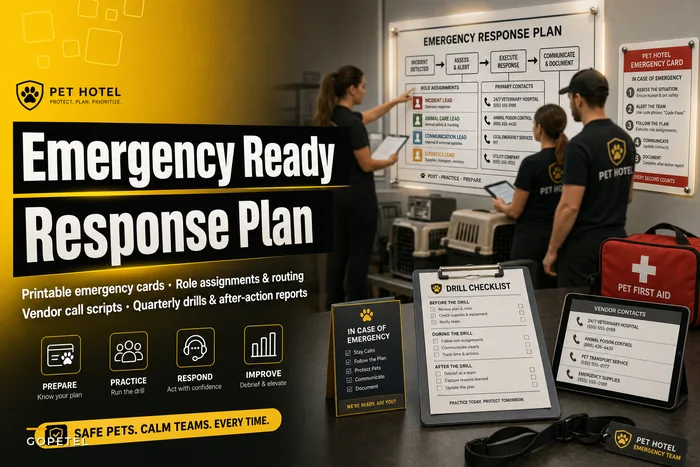
The emergency-response items on that list shouldn't live only in the driver's head. They should tie back to your facility-wide emergency response plan with vendor scripts so that a dog overheating in a van on a hot route triggers the same escalation path as one overheating in the building. A driver stranded roadside with a seizing dog and no idea which emergency vet to call is a failure of your SOP, not theirs.
The securement log and incident template (what auditors actually want)
This is the part that separates a hobby operation from one that can hold a corporate contract: the paper trail.
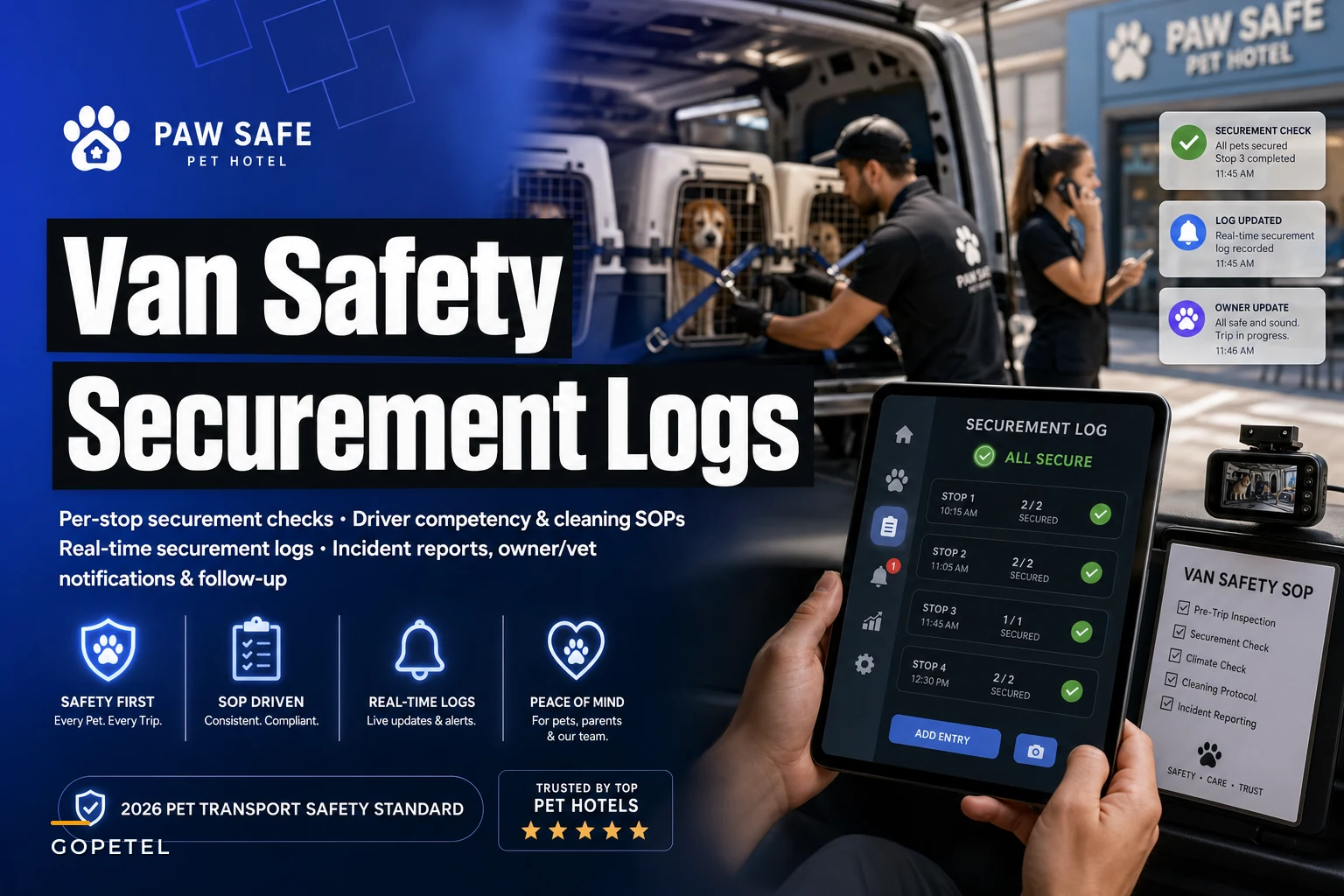
A securement log is a per-stop record. It doesn't need to be elaborate, but it needs to be completed in real time, and it needs these fields:
-
Date, route, driver
-
Pet name + client (or booking ID)
-
Restraint method applied (from the matrix)
-
Secure-check confirmed (initial or tap-to-confirm)
-
Load time / unload time
-
Any notes (behavior, mess, delay)
An incident report template is separate and only fires when something goes wrong. It should capture:
-
Date, time, location, driver
-
Pets involved and their condition before/after
-
What happened, in plain sequence
-
Immediate action taken
-
Who was notified (owner, vet, manager) and when
-
Restraint/containment status at time of incident
-
Photos if applicable
-
Follow-up / corrective action
Keep these two documents separate. The securement log proves your routine was followed. The incident report proves you responded when it wasn't enough. When a vendor audits you — or an insurer reviews a claim — having both is what makes your transport program look like a managed system instead of a liability.
Below is a simple workflow showing how a securement log entry and an incident report fit into the per-stop process.
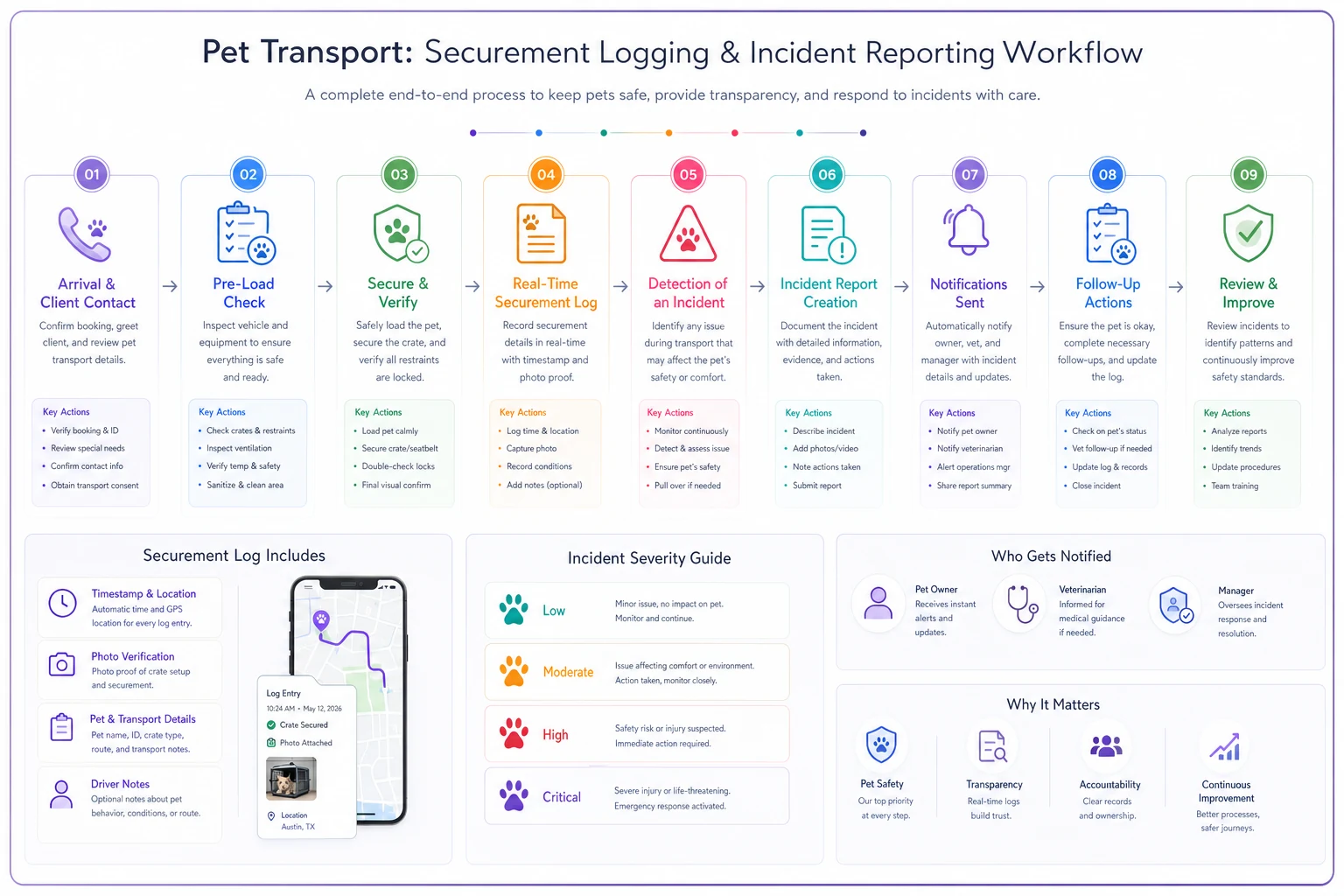
Where this gets painful is enforcement. Paper logs on a clipboard get filled in at the end of the day from memory, which defeats the purpose entirely. Operations that keep clean, defensible records tend to log securement on a phone or tablet at the point of action, timestamped automatically, so the record reflects what actually happened and when. Whether that's a transport module inside your booking platform or a simple mobile checklist, the principle is the same: real-time capture beats end-of-day reconstruction every time.
A realistic before/after
Consider a mid-sized pet hotel running two transport vans, somewhere around 30–40 pickups a day in peak months. Before formalizing any of this: no restraint standard, drivers using whatever harnesses were in the back, cleaning "as needed," and a glove-box notebook that was mostly blank. They lost a daycare referral contract when the partner asked for transport SOPs and got nothing back. There was also a minor incident — a crate slid during a stop and a dog got a cut paw — handled entirely over text, with no documentation.
After putting in the restraint matrix, an 8-minute per-stop budget, a dashboard cleaning checklist, a driver competency check, and a mobile securement log: the next vendor audit took about ten minutes to fulfill instead of being a dead end. Minor incidents still happened — transport is never zero-risk — but each one came with a complete report, photos, and a notification timeline, which their insurer specifically noted favorably.
The shift that mattered most wasn't tied to any single change. Transport went from the part of the business they hoped nobody asked about to the part they could actually show off.
When this level of SOP is worth it — and when it isn't
If you're transporting a handful of pets a week with one owner-driver who's been doing it for years, a full competency-check program is probably overkill. A restraint matrix and a basic log still make sense, but you don't need the full apparatus.
-
You hire drivers who aren't the owner
-
You hold any corporate, daycare-partner, or breeder-referral contracts that can audit you
-
You transport reactive, senior, or medically fragile animals
-
Your insurer's coverage assumes documented safety procedures
And the honest "don't bother" case: if you're considering transport mainly as a marketing checkbox and you can't staff the secure-and-verify step properly, don't offer it. A rushed, undocumented transport service carries more liability than it's worth. Better to refer out than to put a dog in a van you can't actually vouch for.
Transport safety isn't about buying better crates. It's about deciding — in advance and in writing — what "secured" means, and then making the schedule, the training, and the logs reflect that decision instead of hoping each driver figures it out on their own.
Ready to optimize your pet hotel operations?
Join hundreds of pet hotels using GoPetel to save time, improve pet care, and increase booking reliability.