

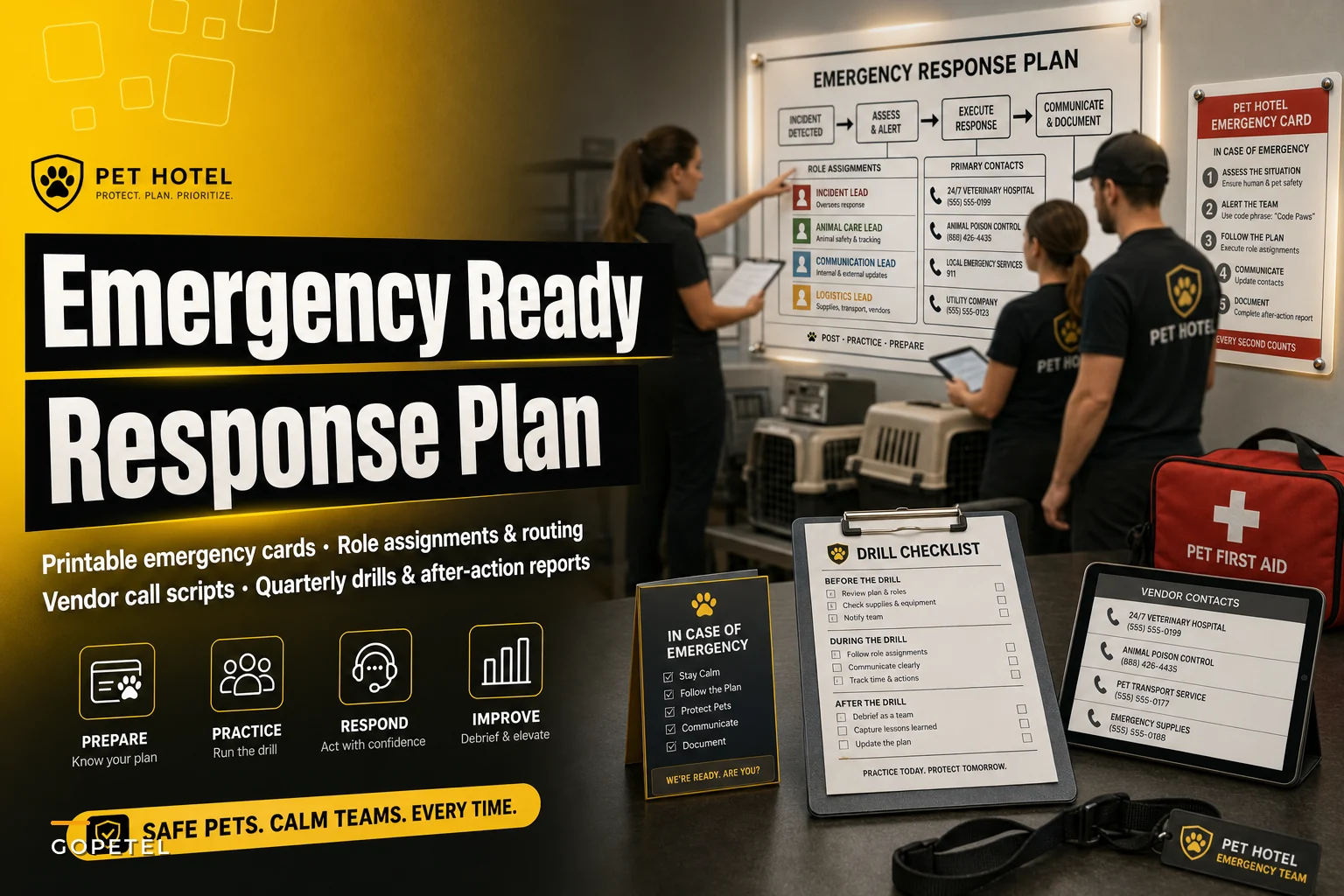

The scariest part of most pet emergencies at a boarding facility isn't the emergency itself. It's the twelve minutes of confusion that follow — the staff member frozen in the run, the manager who can't remember which vet takes overnight calls, the front desk pulling up an owner's file with a phone number that's been dead for six months. The dog collapses at 6:40 PM. The right vet gets called at 6:52 PM. Those twelve minutes are the whole ballgame.
A pet boarding emergency plan isn't a binder you write once and shove in a drawer. It's a physical, laminated, on-the-wall system that lets a nervous 19-year-old kennel tech do the right thing without having to think. Below is how to build that — the cards, the role assignments, the vendor scripts, and the drill cadence that keeps it all from going stale.
Before we get into templates, one thing worth saying plainly: most facilities have an emergency plan. It just lives in someone's head, or in a Google Doc nobody's opened since onboarding. That's not a plan. That's wishful thinking.
Where emergency response actually breaks down
Facilities don't fail their animals because staff don't care. They fail because of a handful of predictable friction points, and every single one of them is fixable with paper and rehearsal.
Here's what the breakdown typically looks like:
-
Nobody knows who's in charge in the moment. Two people both assume the other is calling the vet. Or worse, everyone converges on the dog and the phone never gets touched.
-
The critical numbers aren't where the emergency is. The after-hours vet line is saved in the manager's personal cell, which is in her jacket in the break room.
-
Owner contact info is stale or buried. The emergency contact field was filled out at intake eight months ago and never verified since.
-
Transport is an afterthought. You've got a dog that needs the ER, no crate ready, no car assigned, and nobody who knows the fastest route.
-
The incident never gets documented properly. Which becomes a real problem three weeks later when the insurer or the owner's lawyer asks for a timeline.
The pattern is almost always the same: the medical part goes okay because people have instincts, but the coordination part collapses. Two staff, one dog, zero structure.
The core tool: ready-to-print emergency cards
The single highest-leverage thing you can do is build laminated emergency cards and physically place them where emergencies happen — every kennel zone, the play yards, the grooming room, the front desk. Not one master binder. Multiple copies, everywhere.
Never miss a booking or detail again.
GoPetel simplifies pet hotel operations by managing every reservation and pet profile seamlessly.
- Centralized booking management
- Automated client notifications
- Staff and kennel scheduling
No credit card required
Each card should be dead simple. If someone has to read a paragraph during a crisis, the card failed. Think bold headers, short lines, big fonts.
-
Immediate action (secure other pets, don't move the animal unless X, apply pressure to bleeding, etc.)
-
Who calls whom — role-based, not name-based (more on this below)
-
The three numbers — primary vet, after-hours/ER vet, facility owner or manager
-
Transport trigger — what conditions mean "we're driving now" versus "we're calling first"
One design detail people miss: use the back of the card for the specific emergencies you're most likely to see. Heat stroke, seizure, bloat/GDV, choking, allergic reaction, fight injury. A one-line first-response reminder for each. When a dog bloats, the tech doesn't need a veterinary lecture — they need: "abdomen looks distended + retching without vomiting = ER NOW, call while driving."
If you're serious about heat-related incidents, they deserve their own dedicated protocol beyond a card line. Emergency cards should reference it, not replace it.
Role assignments: fix the "who's actually doing what" problem
Emergencies get chaotic because everyone converges on the animal and nobody handles logistics. The fix is assigning roles, not people — because you never know who's on shift when something goes wrong.
Whoever is physically closest to the emergency becomes the First Responder by default. Everything else flows from there.
| Role | Who takes it | Core responsibility |
|---|---|---|
| First Responder | Closest staff member | Stays with the animal, provides first aid, does NOT leave |
| Coordinator | Next available / shift lead | Makes the calls: vet, then owner. Runs the clock. |
| Runner/Driver | Anyone else on shift | Preps crate, brings car around, drives to ER |
| Floor Cover | Remaining staff | Secures and calms all other animals, keeps operations stable |
Below is a quick visual of the role flow during an emergency.
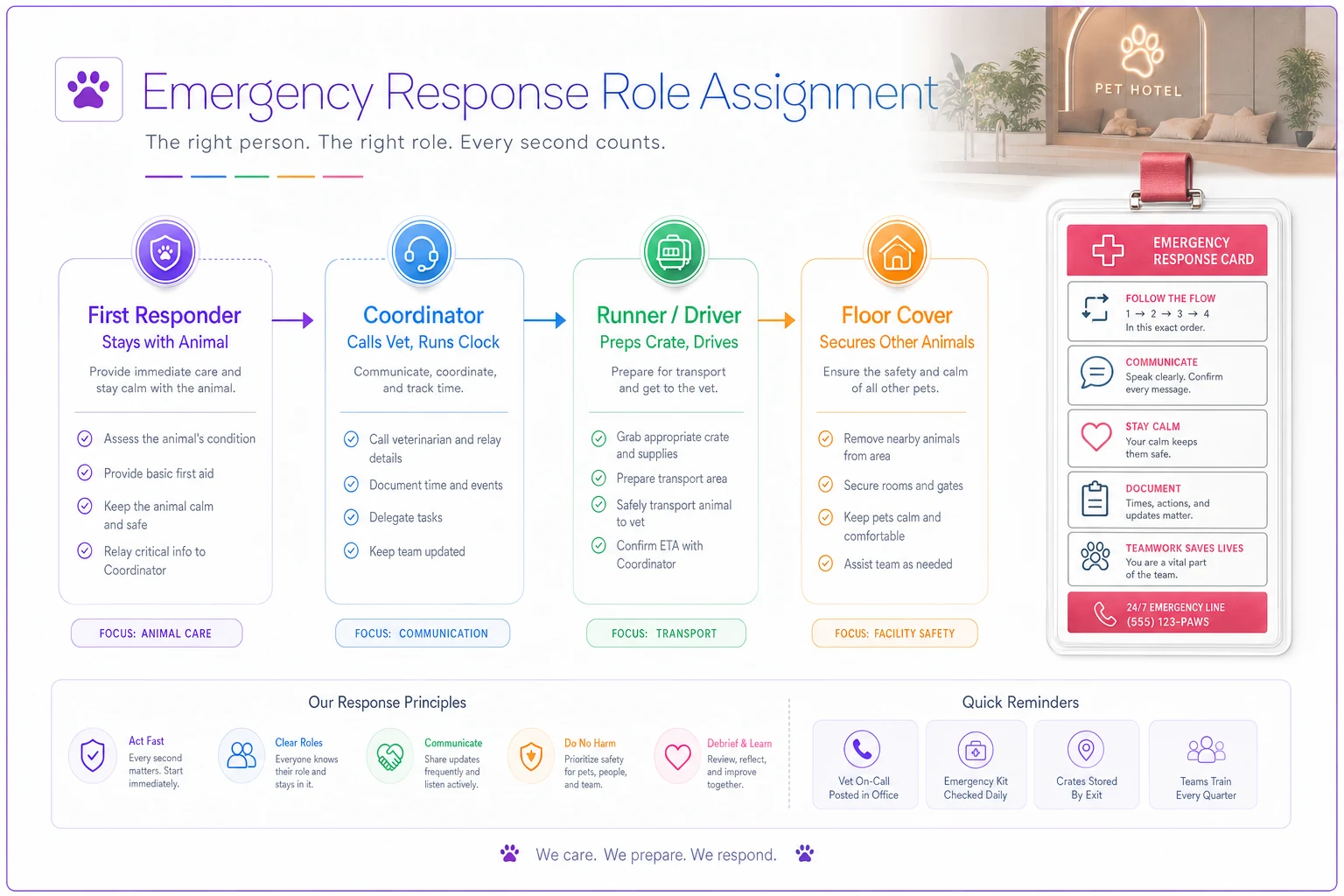
The key thing here: the First Responder never makes phone calls. That's the mistake baked into most informal plans — the person kneeling next to the animal is also supposed to call the vet, calm the owner down, and find the car keys. Split the animal care from the logistics and everything speeds up.
For a solo overnight shift — which a lot of facilities run — the plan looks different. One person can't be four roles. The card should say explicitly: stabilize, call the ER on speaker while prepping transport, call the owner from the car. Pretending a solo tech can follow the four-role model is a plan that sets them up to fail.
Call-steps: scripts so people don't freeze
People freeze on the phone during emergencies. They ramble, they forget the animal's weight, they leave out which facility they're calling from. A script fixes this.
Put the actual words on the card. Not "call the vet" — the sentence they should say.
Vet/ER call script: > "This is [Facility Name], a boarding facility. We have an emergency. [Species/breed], approximately [weight], showing [symptoms] for about [time]. Are you able to see us now, and should we start driving?"
Owner call script: > "This is [Name] from [Facility]. [Pet's name] had a medical emergency and we've taken action — we're [with the vet / driving to the ER at (clinic)]. [Pet] is [stable/being treated]. I'll call you back with an update in [X] minutes. What's the best number to reach you right now?"
That owner script matters more than most people realize. How you deliver the first thirty seconds of bad news determines whether that owner becomes an angry review or a loyal client who says "they handled it perfectly." Lead with the action you took, not the panic.
One more step people skip: who calls the owner second. The Coordinator calls the vet first, then the owner. Reverse that order and you'll have someone crying on the phone while the sick dog is still waiting.
Prearranged vet and transport partner templates
Don't wait for an emergency to establish a relationship with an ER clinic. Set it up in advance, in writing, so when you call at 6:40 PM on a Friday they already know who you are.
Build a simple partner template for each vet and transport relationship. What to nail down ahead of time:
-
After-hours and overnight contact numbers — and actually call to verify them quarterly, don't just assume they still work
-
Whether they accept walk-in emergencies from boarding facilities
-
Payment arrangement — do they bill the owner directly, or do you front it and reconcile?
-
Drive time and route from your facility (write the actual route on the card)
-
A named backup clinic in case the primary is at capacity
For transport, decide in advance which vehicle is the emergency vehicle, where the keys live, and which crates are the go-crates for small, medium, and large animals. A facility doing this right keeps a pre-loaded transport crate near the exit at all times — leash, muzzle, old towels, a copy of the incident form clipped to it. Zero prep time when it counts.
If you rely on courier or pickup partners for your regular operations, keep that completely separate from your emergency transport plan. Your normal logistics vendor is not a backup ER driver.
The after-action report: for the animal, the insurer, and you
This is where facilities lose real money and legal footing. The emergency gets handled, everyone's relieved, and then the documentation is... a text message thread and a fuzzy memory.
Every incident needs an after-action report (AAR) filled out the same day, while details are still fresh. This isn't bureaucracy — it's what protects you when an owner's insurer comes looking, or when your own carrier wants to know what happened. It also happens to feed directly into your broader infection-control and compliance framework, where incident documentation plays its own role.
-
Timeline — timestamps for onset, first response, vet contacted, transport departed, owner notified
-
What was observed — symptoms, condition of the animal, environment
-
Actions taken — by whom, in what order
-
Outcome — vet diagnosis, treatment, disposition
-
What we'd change — the honest section that makes the next emergency go better
That last section is the one everyone skips. It's also the one that actually earns its keep. If three separate seizure incidents show the same delay in reaching the ER, your AARs just told you to fix your vet partnership setup.
Keep these reports filed and retained. Your insurer and, in many states, your regulator will want them. Filling one out at 9 PM after a stressful night is nobody's idea of fun, but a half-page done that evening beats reconstructing a timeline from memory during a claim dispute six months later.
Quarterly drills: the part everyone hates and needs
A plan that's never rehearsed is a plan that fails under pressure. Staff turnover alone guarantees that within a year, a good chunk of your team has never actually run the emergency protocol. So you drill it — quarterly, minimum.
Drills don't have to be elaborate. A 20-minute tabletop scenario counts. "It's 7 PM, Bella in run 12 is having a seizure, go." Watch who does what. Time it. See where the freeze happens.
A simple quarterly drill cadence:
-
Q1 — Medical emergency (seizure, collapse, bloat). Focus on role assignment and call speed.
-
Q2 — Injury or fight. Focus on separating animals and treating wounds while securing the rest of the floor.
-
Q3 — Facility emergency (fire, power loss, HVAC failure). Focus on evacuation order and animal accountability.
-
Q4 — Full simulation with transport. Actually load a crate, actually start the car, actually place a mock call.
After every drill, fill out an AAR for the drill itself. Same template. This normalizes the paperwork so real incidents feel routine, and it surfaces the gaps — the expired vet number, the crate that doesn't fit the big dogs, the new hire who had no idea where the cards were posted.
Run a drill during a shift change to test handoffs between incoming and outgoing staff.
The first drill at most facilities is a mess. That's the point. Better to discover the chaos on a scheduled Tuesday afternoon than at 6:40 PM during the real thing.
When this level of structure makes sense — and when it's overkill
If you're boarding four dogs in a converted garage, the four-role model and quarterly drills are probably more than you need. A single well-designed card and a verified ER relationship covers you.
Once you're running multiple staff shifts, overnight coverage, or more than a couple dozen animals at capacity, the informal approach becomes a genuine liability. The moment you have staff who weren't there when you originally explained the plan, you need the plan on the wall.
Facilities that take medical or special-needs boarding should treat all of this as non-negotiable. The emergency likelihood is simply higher, and documentation expectations from insurers are stricter.
A quick real scenario
A mid-sized facility running around 40 kennels at peak had a bloat incident with a Great Dane on an evening shift. Before they'd built any of this out: an earlier emergency had cost them roughly 15 minutes just figuring out who was calling whom, and driving to the wrong ER — the first clinic was at capacity, they had no backup listed — cost even more time. The dog survived, barely.
They rebuilt around laminated cards, clear role assignments, a primary-and-backup ER with verified after-hours lines, and a pre-loaded transport crate. The next serious incident, a heat-related collapse the following summer: from onset to pulling out of the parking lot was under four minutes, the owner was called from the road, and the AAR was filed that night. Same kind of stressful situation, completely different execution. The owner rebooked. That's the real tell — handled well, an emergency can actually build trust.
Keeping it current without it becoming a chore
The quiet failure mode of any emergency plan is drift. Vet numbers change. Staff turn over. The plan you built in March is subtly wrong by October and nobody notices until it matters.
This is genuinely one of the places where centralizing your operational information helps — keeping owner emergency contacts verified at every booking, storing your vet and transport partner details somewhere your whole team can access, and building in a regular nudge to re-verify those after-hours numbers each quarter. Whether you do that in your booking platform or another shared system matters less than the discipline of actually reviewing it. The cards on the wall are only as good as the information printed on them.
Build the cards. Assign the roles. Write the scripts. Verify the numbers. Drill it four times a year and document every incident like you'll eventually have to defend it — because occasionally, you will. The goal isn't a perfect binder. It's that on the worst night of the year, a scared kid on the overnight shift knows exactly what to do, and does it.
Ready to optimize your pet hotel operations?
Join hundreds of pet hotels using GoPetel to save time, improve pet care, and increase booking reliability.