


Pet boarding check-in workflow bottlenecks don't announce themselves until they're costing you money. They hide behind well-meaning staff doing their best with a broken process. The average pet hotel loses 12–18 minutes per check-in to preventable coordination failures, document confusion, and physical layout problems that compound during peak drop-off windows.
Most facilities try fixing this with more staff. That's backwards. You need choreography, not bodies.
The hidden math of check-in chaos
A typical 40-kennel facility processes roughly 280 check-ins monthly. At 18 minutes average versus an achievable 8 minutes, you're burning 46 hours of labor just on intake inefficiency. That's before accounting for stressed pets, annoyed owners who might not rebook, and staff who quit because Monday mornings feel like war zones.
The real damage happens in compressed timeframes. Between 7:00-9:00 AM on Mondays, most facilities see 35% of their weekly check-ins. Your three-person front desk team suddenly needs to handle 20+ arrivals in two hours. Without proper choreography, each delay cascades. One missing vaccination record at 7:15 AM backs up your entire morning.
Physical space amplifies these problems. Watch your lobby during peak check-in. Dogs meeting for the first time, owners blocking doorways while filling forms, carriers stacked on counters because there's nowhere else to put them. Staff literally running into each other trying to escort pets to kennels while another employee needs the same hallway to bring a dog back for a concern the owner just remembered.
The coordination failures multiply when roles blur. Your most experienced person gets stuck verifying paperwork for a new client while two newer staff members stand idle, unsure if they should start the next check-in or wait. Meanwhile, a regular client who just needs a quick drop-off waits behind three first-timers requiring full orientations.
Document sequencing kills momentum
An owner arrives with Baxter. Your staff member starts the check-in software, realizes the rabies certificate expired last week, stops everything to call the vet (who doesn't open until 8:30), moves to paper forms while waiting, discovers the emergency contact changed, updates that in the system, remembers to ask about medications, writes those on a sticky note because the med log is in the back, then realizes they never got the pickup date confirmed.
Never miss a booking or detail again.
GoPetel simplifies pet hotel operations by managing every reservation and pet profile seamlessly.
- Centralized booking management
- Automated client notifications
- Staff and kennel scheduling
No credit card required
This document chaos stems from treating check-in as one blob instead of staged sequences. When paperwork appears randomly throughout the process, every interaction becomes a potential restart. The owner's already put Baxter's food on the counter, but now they need to dig through their email for vaccination proof. They step aside to search their phone, another client approaches the desk, and suddenly you're managing parallel half-completed check-ins.
Pre-arrival document staging changes this dynamic completely. Send automated texts 48 hours before arrival requesting specific documents in order: vaccination confirmations, medication schedules, feeding instructions, emergency contacts. Build the expectation that incomplete documentation means moving to the "resolution lane" — not holding up the express line.
Think about airline check-in evolution. They separated document verification from bag drop from security precisely because mixing stages creates compound delays. Your pet hotel needs the same separation, just adapted for living cargo that occasionally pees when nervous.
Physical layout determines flow physics
Most facilities inherited layouts designed for different operations — former vet clinics, retail spaces, warehouses. The check-in desk sits wherever it fit, not where it facilitates movement. This creates natural collision points where dogs meet face-to-face in doorways, owners squeeze past each other with carriers, and staff navigate obstacle courses just to escort pets.
Intake lanes fix this through deliberate separation. Create three distinct physical paths:
| Lane | Description | Target |
|---|---|---|
| Express lane | For established clients with complete digital pre-check-in. Straight path from door to quick-scan station to kennel hallway. No paperwork, no payment processing, just scan and go. | Target: 3 minutes total. |
| Standard lane | For clients needing normal verification and form completion. Angled approach that keeps them visible but not blocking express traffic. Built-in staging area where pets wait without seeing incoming dogs. | Target: 8-10 minutes. |
| Resolution lane | For problems requiring extended interaction — missing documents, behavioral assessments, first-time orientations. Completely separate area, ideally with its own entrance after initial triage. No time target — focus on thorough resolution without pressure. | No time target — focus on thorough resolution without pressure. |
The physics matter. Express lane needs straight-line visibility from parking to kennel access. Standard lane should angle away from entrance to prevent backup into doorway. Resolution lane must be physically separated enough that barking or extended discussions don't stress other waiting pets.
Measure staff walking distances during peak check-ins to identify the exact equipment and touchpoints to centralize near each lane.
One facility in Colorado rebuilt their intake after measuring movement patterns. They discovered staff walked an average 1,400 feet during each standard check-in — back to printer, over to filing, down to kennels, return to desk. Their new layout cut this to 200 feet by centralizing everything within arm's reach of each lane position. Check-in times dropped 40% from layout alone.
Role choreography beats multi-tasking
Monday morning, 7:45 AM. Sarah handles express lane, Tom runs standard, Maria floats for resolution and kennel escort. Except Tom sees his favorite regular and starts chatting while three standard clients wait. Sarah's express lane backs up because she's helping Tom with a computer issue. Maria's stuck in resolution with an aggressive dog assessment while nobody escorts completed check-ins to kennels.
Role blur kills efficiency. Each position needs rigid boundaries, at least during peak windows. This isn't about being unfriendly — it's about respecting everyone's time by maintaining flow.
Greeter/Triager (0-2 minutes): Stands at entrance, never at desk. Quick visual assessment: regular or new? Documents ready or not? Any visible behavioral concerns? Routes to appropriate lane. Never handles actual check-in.
Express Processor (2-3 minutes): Scans pre-uploaded documents, confirms identity, assigns kennel from pre-selected options. No small talk beyond greeting. No payment processing (auto-charge on file). No medication logging (pre-submitted). Just verify and release to escort.
Standard Processor (5-8 minutes): Handles typical check-ins with normal verification needs. Can process payments, update basic information, log standard medications. But cannot handle: new client orientations, behavioral assessments, missing vaccination resolution. Those go to resolution.
Escort Runner (continuous): Never stops moving between desk and kennels. Takes pets immediately after processing, no waiting for batches. Returns via different route to avoid crossing incoming traffic. Carries radio for kennel assignment changes.
Resolver (variable): Handles everything that would break flow. Missing documents, payment problems, behavioral concerns, special medical needs. Works from separate space where extended interaction won't create anxiety for waiting clients.
During non-peak times, roles can flex. But between 7-9 AM and 4-6 PM, choreography stays rigid. One facility tracked this: rigid roles during peak hours cut average check-in from 22 to 11 minutes while actually improving customer satisfaction scores — owners appreciated the efficiency even if interactions felt more transactional.
The compound effect of small delays
Watch what happens when one dog won't enter a kennel willingly. The escort runner spends five extra minutes coaxing. Meanwhile, three completed check-ins wait at the desk. The standard processor can't start the next client because the previous pet hasn't cleared the area. The waiting owner's dog gets anxious, starts barking. Other waiting dogs respond. Stress levels spike, making the reluctant dog even less willing to kennel.
Ten minutes later, you're still recovering from one scared beagle.
These cascades happen because most facilities treat problems as they arise instead of building overflow systems. When a pet won't kennel easily, protocol should instantly route them to a comfort kennel near the office, not fight it out in the main hallway while everything backs up. When paperwork's missing, the owner moves to resolution lane immediately, not "let me just check if maybe..."
-
Dog aggressive at check-in? Straight to isolation intake, different entrance
-
Payment declined? Resolution lane handles while pet proceeds to kennel
-
Medical concern noticed? Vet tech evaluation in separate area, check-in continues parallel
-
Forgot food? Standard protocol
house food today, owner can drop off later
The goal isn't perfection — it's preventing single problems from becoming system failures.
Technology coordination without overwhelming
Software can transform check-in, but most facilities implement it backwards. They digitize their existing broken process instead of rebuilding around capabilities. Your check-in system should pre-stage 80% of decisions before the owner arrives.
Pre-arrival sequences should automatically trigger:
-
72 hours out
Vaccination expiration check, missing document requests
-
48 hours out
Feeding and medication confirmation, special needs flagging
-
24 hours out
Check-in time selection, express lane qualification notice
-
Morning of
Reminder text with assigned lane and any pending items
But the software needs to reduce decision-making during actual check-in, not add digital steps to existing manual ones. If staff still need to click through six screens while an owner waits, you've just digitized delay.
The sweet spot combines pre-arrival digital staging with minimal interaction processing. QR code check-in for express lane — scan phone, confirm identity, assign kennel, done. Standard lane uses pre-populated forms where staff just verify rather than input. Resolution lane gets full access for complex situations.
One California facility cut check-in times 62% after implementing AI-powered intake management software that handled pre-arrival staging. But the key wasn't the technology — it was rebuilding their physical and role processes around what the software enabled. The platform knew each pet's history, preferences, and requirements before they arrived. Staff just had to execute, not investigate.
Measuring what moves the needle
Track three numbers religiously:
-
Door-to-kennel time by lane type
-
Percentage of check-ins requiring resolution lane
-
Peak hour throughput (check-ins completed 7-9 AM)
Everything else is vanity metrics. Don't track average satisfaction or staff productivity. Track whether your choreography actually accelerates throughput when it matters.
Weekly review should focus on pattern breaking. Which regular clients consistently end up in resolution? Why? Can you pre-solve their typical issues? Which staff members break role boundaries most often? Is it training or personality? Which physical bottlenecks repeat? Is it layout or process?
You'll discover your top 20% of clients cause 60% of delays — not because they're problems, but because their needs don't fit standard processes. Build custom protocols for these clients. If Mrs. Henderson always needs extra time discussing Fluffy's anxiety, pre-schedule her for slow periods. If Max the German Shepherd always needs two people for kennel entry, assign accordingly before arrival.
The real competitive advantage
Smooth check-in isn't just operational efficiency. It's marketing. Owners remember the chaos or the calm. They tell friends about the place where Monday morning drop-off takes five minutes versus the place where it's a 30-minute ordeal.
More importantly, confident check-in reduces liability. Stressed animals bite. Confused handoffs miss medical instructions. Chaotic lobbies create escape opportunities. Your infection control protocols mean nothing if sick pets spend 20 minutes in close contact during backed-up check-ins.
The business case is straightforward: Cut 10 minutes per check-in across 280 monthly instances. That's 46 hours of reclaimed labor — a full work week monthly. Redeploy those hours to revenue-generating services like grooming or training. Reduce stress-induced incidents that cause expensive vet bills or worse. Increase capacity to handle surge periods without adding staff.
But the real win is Monday morning at 8 AM when twenty dogs check in smoothly, owners leave confident, staff stay calm, and your facility hums instead of churns. That operational excellence becomes your reputation. In a business built on trust, nothing markets better than competence made visible.
Start with Monday morning
Don't rebuild everything at once. Start with Monday morning 7-9 AM — your highest-stress, highest-impact window. Map current reality: video record three Monday mornings, track every delay, collision, and restart. You'll spot patterns within minutes.
Then build one element:
-
Week 1
Implement triage at door
-
Week 2
Create express lane for prepared clients
-
Week 3
Add rigid role assignments during peak
-
Week 4
Launch 48-hour pre-arrival sequences
Measure door-to-kennel times throughout. You'll see immediate improvements from triage alone, bigger jumps from lane separation, and transformation once all elements coordinate.
Quick visualization of the day-of choreography map:
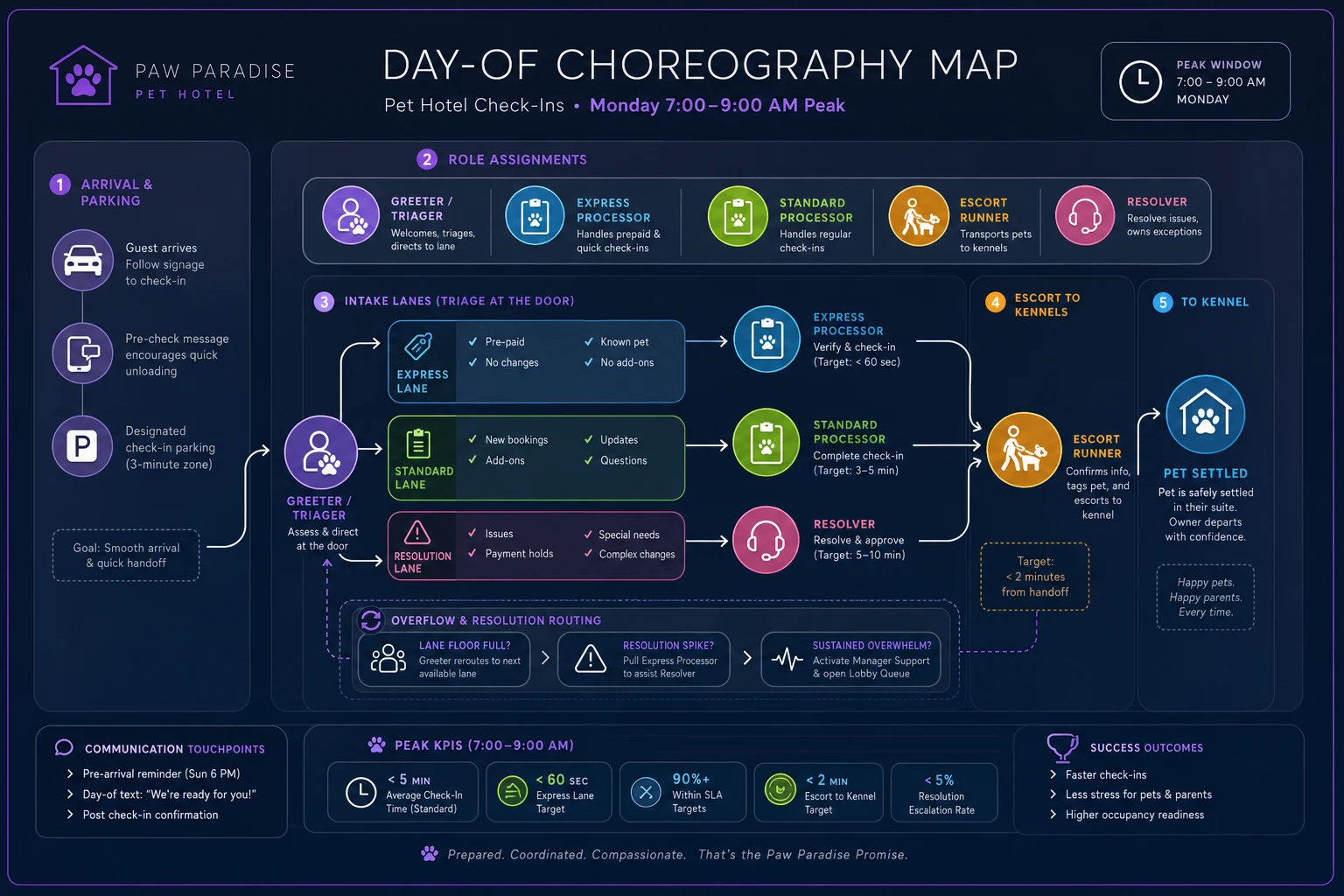
The choreography map isn't about perfection — it's about turning inevitable morning chaos into manageable flow. Every pet hotel faces the same Monday morning surge. The ones that thrive have learned to dance through it rather than fight it. Once your team experiences a properly choreographed morning, they'll never accept the old chaos again.
The difference between a 20-minute check-in and an 8-minute check-in isn't staff skill or customer cooperation. It's systematic design that assumes problems, routes around them, and keeps the line moving. Build that system once, and Monday mornings transform from your worst operational nightmare to your most predictable process.
Ready to optimize your pet hotel operations?
Join hundreds of pet hotels using GoPetel to save time, improve pet care, and increase booking reliability.