
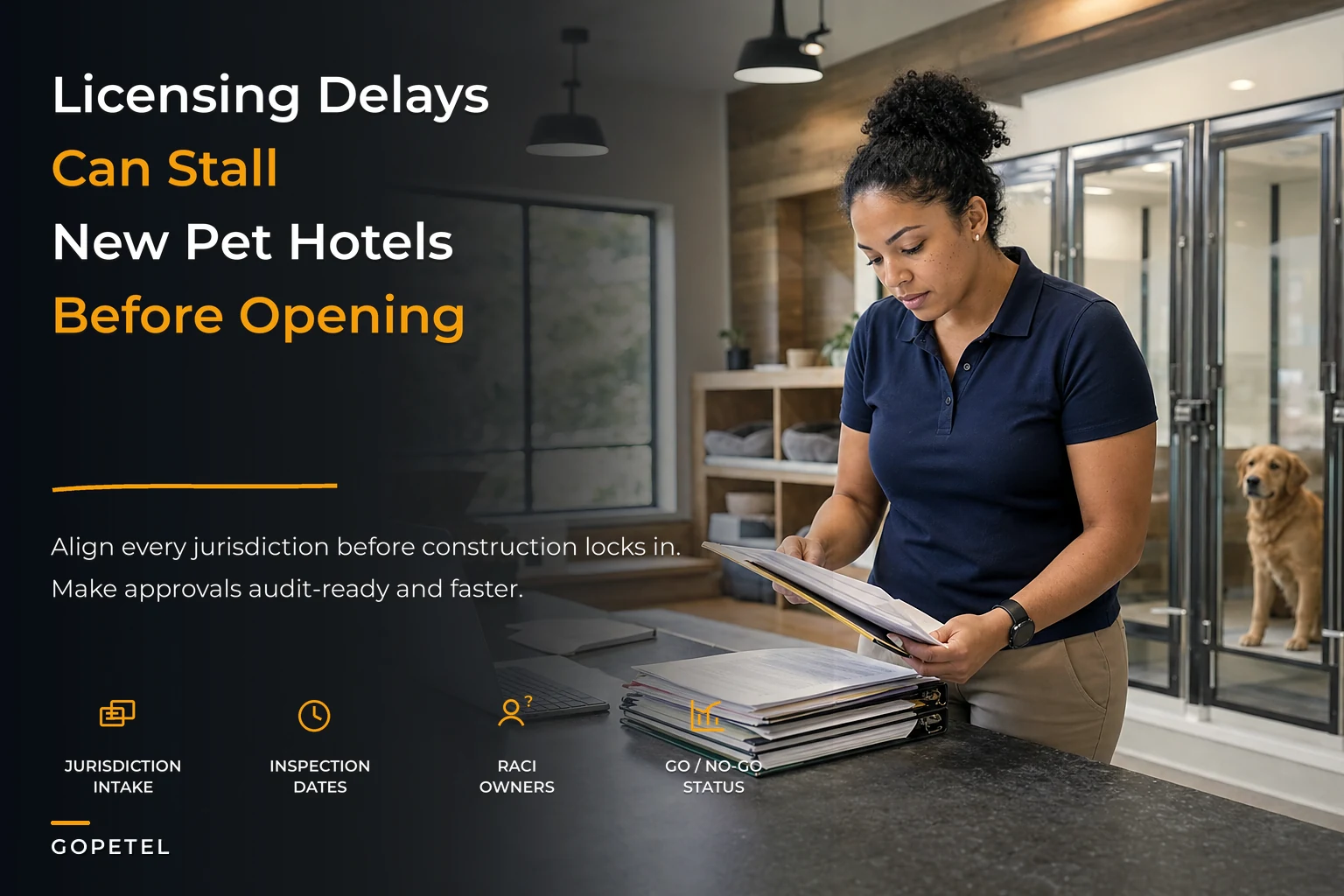

Every operator who's opened a second or third pet hotel eventually learns the same thing: the hard part isn't finding the building or hiring the staff. It's the paperwork tangle sitting between signing a lease and boarding your first dog. Zoning approvals, kennel license inspections, business registration, fire marshal sign-off, animal control permits, wastewater rules — sometimes a conditional use permit that goes in front of a planning commission that meets once a month.
And the ugly part: none of it is standardized. What passes in one county gets flagged in the next one over. A facility that's fully compliant in your home city might need a variance three miles away because a different municipality writes its kennel ordinance differently.
Most owners treat this as a one-off scramble every time. That works — barely — for the second location. It falls apart the moment you're running two or three openings at once, because licensing compliance isn't a checklist you complete once. It's a moving system that has to survive different jurisdictions, different inspectors, different timelines, and a rotating cast of vendors and attorneys who don't talk to each other.
This is a governance problem, not a paperwork problem. The operators who close new sites fast built a repeatable machine for it instead of reinventing the process each time.
Why licensing chaos looks the same across every expanding operator
When you dig into stalled openings, the delays almost never come from the government moving slowly. They come from the operator not being ready when the government is.
A typical pattern: lease gets signed in March with an optimistic July open date. The team assumes licensing is a "fill out some forms" task and doesn't touch it until the build-out is halfway done in May. Then they discover the property needs a conditional use permit, the planning commission's next available hearing is in August, and the fire marshal won't inspect until the sprinkler plan is stamped by an engineer they haven't hired yet. Now July is dead, and every week of delay is rent plus payroll for staff you already started onboarding.
The reason this repeats across operators is that licensing knowledge lives in one person's head — usually the owner or whoever handled the first opening. No template. Each jurisdiction's quirks get rediscovered from scratch. Nobody wrote down that the last county required proof of a vet-on-call contract before they'd issue the kennel permit, so you hit the same wall again.
The second failure is sequencing. Licensing tasks have brutal dependencies. You can't get the occupancy permit without the fire inspection. You can't get the fire inspection without the stamped plans. You can't get the kennel license in some places without the occupancy permit already in hand. Miss the order and you're not delayed by days — you're delayed by the next available meeting date, which might be a month out.
What breaks when you're opening more than one site at a time
A single opening is survivable on hustle. Two or three concurrent openings expose every weakness in how you manage this.
Never miss a booking or detail again.
GoPetel simplifies pet hotel operations by managing every reservation and pet profile seamlessly.
- Centralized booking management
- Automated client notifications
- Staff and kennel scheduling
No credit card required
-
Knowledge doesn't transfer. The person who learned the hard lessons on Site 1 is now buried in Site 2, and Site 3 is being run by someone who's never done it. Without documented jurisdiction intelligence, every site starts at zero.
-
Ownership gets blurry. When one opening is in flight, "the owner handles licensing" is fine. When three are running, nobody knows who's chasing the fire marshal for Site B versus who's filing the animal control application for Site C. Things fall through the gaps between people.
-
Vendors bottleneck. The same engineering firm, the same expediter, the same attorney gets pulled across all three projects. If you didn't book them early with clear scopes, they'll service whichever site screams loudest — and the quiet one slips.
-
Go/no-go decisions get emotional. You've already signed the lease. You've already told staff. So when a jurisdiction turns out to be a nightmare — a moratorium on new kennels, a neighbor showing up to every hearing to object — nobody wants to admit the site might not be viable. The sunk-cost trap keeps money flowing into a location that should've been killed at intake.
The fix for all of this is treating licensing as a governed, repeatable operation with four core artifacts: a jurisdiction intake template, a go/no-go checklist, a RACI for inspections, and a vendor/attorney checklist. Everything below covers those four pieces.
Artifact 1: The jurisdiction intake template
Before you sign anything — ideally before you fall in love with a building — run the jurisdiction through a standard intake. The whole point is to surface the expensive surprises while you can still walk away cheaply.
This template becomes your institutional memory. Fill one out per site, and after four or five openings you've got a library that tells you at a glance which counties are friendly and which ones will eat six months of your life.
Here's what the intake should capture:
| Intake field | What you're actually checking | Why it kills timelines if missed |
|---|---|---|
| Zoning classification | Is a boarding/kennel use permitted by right, or does it need a conditional use permit (CUP)? | A CUP adds a public hearing — often 6–12 weeks minimum |
| Kennel ordinance specifics | Setback rules, max animal counts, noise limits, outdoor run restrictions | Can force a layout redesign after you've committed to a floor plan |
| Occupancy & fire path | Occupancy classification, sprinkler requirements, egress rules | Stamped engineering plans can take weeks; drives the whole inspection chain |
| Animal control permits | Separate license? Vet-on-call contract required? Inspection needed? | Often a prerequisite the team forgets until the end |
| Wastewater / drainage | Grooming and cleaning runoff rules, grease/hair trap requirements | Retrofits are expensive and slow |
| Hearing calendar | When does the planning commission / zoning board meet? | Miss the cutoff and you wait a full cycle |
| Neighbor / objection risk | Any active moratoriums? Nearby residential? History of kennel opposition? | Organized objection can stall or kill a CUP entirely |
| Business registration path | State, county, city layers and their sequence | Simple but easy to sequence wrong |
The insight most operators miss: the intake isn't a form you fill out at a desk. Half these answers require a fifteen-minute phone call to the actual permitting office. Those calls are where you learn the unwritten rules — the "oh, we always want to see X before we'll even accept the application" stuff that never appears on the website.
Keeping these intake records versioned and searchable across sites matters more as you grow, which is the same discipline behind an SOP versioning playbook for multi-site operations — once you have more than one location, "which version is current and where does it live" becomes a real problem.
Artifact 2: The go/no-go checklist
The intake tells you what you're dealing with. The go/no-go decides whether you proceed, renegotiate, or walk. It exists specifically to fight the sunk-cost pull that keeps bad sites alive.
The rule: run go/no-go before the lease is fully executed, ideally with a due-diligence or feasibility contingency written into the lease so you can exit cleanly if the jurisdiction turns out to be hostile.
A single hard "no" on the critical items should stop the deal until it's resolved:
Critical (any single fail = stop and reassess):
-
Is a kennel/boarding use permitted, or is there a viable, time-boxed CUP path?
-
Is there an active moratorium or pending ordinance change affecting kennels?
-
Does the building physically support the required setbacks, drainage, and fire path without a redesign that blows the budget?
-
Can the required approvals realistically land inside the opening window, given hearing calendars?
Serious (two or more = renegotiate terms or timeline):
-
Does the site need a variance in addition to a CUP?
-
Is there known neighbor opposition or a residential adjacency likely to trigger objections?
-
Are wastewater/drainage retrofits required, and are they priced?
-
Is the vet-on-call or animal control prerequisite achievable before the target date?
Manageable (note and plan, don't stop):
-
Multi-layer business registration
-
Standard fire and occupancy inspections
-
Routine annual license renewals
The mistake operators make is treating go/no-go as a gut call in a meeting. Write it down. Score it. The value shows up on Site 3, when the person deciding wasn't in the room for Sites 1 and 2 and needs an objective bar to hold the line against a landlord pushing to close.
One practical addition: attach a rough dollar-and-days cost to each red flag. "CUP required" isn't scary in the abstract. "CUP required = +$9k in fees and expediter time, +10 weeks minimum" is a decision you can actually make.
Artifact 3: A RACI for inspections and approvals
Inspections are where concurrent openings die, because they involve the most handoffs and the most external parties. A RACI — Responsible, Accountable, Consulted, Informed — kills the "I thought you were handling that" gaps.
You don't need a fancy matrix. You need clarity on, for every major approval, who does the work, who owns the outcome, who gives input, and who just needs to know.
| Approval / inspection | Responsible (does it) | Accountable (owns it) | Consulted | Informed |
|---|---|---|---|---|
| Zoning / CUP application | Expediter or attorney | Project lead | Architect, owner | Ops manager |
| Stamped fire/sprinkler plans | Engineering vendor | Project lead | GC | Fire marshal |
| Fire inspection | GC | Project lead | Engineer | Owner, ops |
| Occupancy permit | GC | Project lead | Architect | Owner |
| Kennel / animal control license | Ops manager | Owner | Attorney (if needed) | Project lead |
| Wastewater / drainage sign-off | GC | Project lead | Engineer | Owner |
| Business registration (state/county/city) | Admin/bookkeeper | Owner | Attorney | Project lead |
Two things make this work in practice.
First, one Accountable per row, always. The most common breakdown is diffuse accountability — three people vaguely responsible for the fire inspection means zero people actually driving it. The Accountable person's job is to know the current status and the next blocking step at all times.
Second, map the dependency chain visually. Stamped plans → fire inspection → occupancy permit → kennel license is a chain where each link gates the next. If the Accountable owner can see that chain, they stop treating sequential tasks like parallel ones.
The workflow that ties it together
Here's how the four artifacts connect into one repeatable opening sequence:
-
Scout & intake. Before committing, run the jurisdiction intake template. Make the phone calls. Populate the record in your shared system.
-
Go/no-go gate. Score the site against the checklist. Green means proceed. Yellow means renegotiate lease terms or timeline. Red means walk or resolve the blocker first.
-
Vendor lock-in. The moment you clear go/no-go, book your expediter, engineer, attorney, and GC — before the lease dries. (Vendor checklist below.)
-
RACI activation. Assign the Accountable owner for each approval. Build the dependency chain with real dates pinned to hearing calendars.
-
Parallel execution. Push everything that can run in parallel — business registration, animal control application, plan drafting — while the critical inspection chain proceeds in sequence.
-
Weekly status review. Every Accountable owner reports current status and next blocking step. One dashboard, all sites.
-
Post-open debrief. Update the jurisdiction record with what you actually learned. This is what makes the next opening faster.
This diagram illustrates the sequence and how the artifacts feed each other.
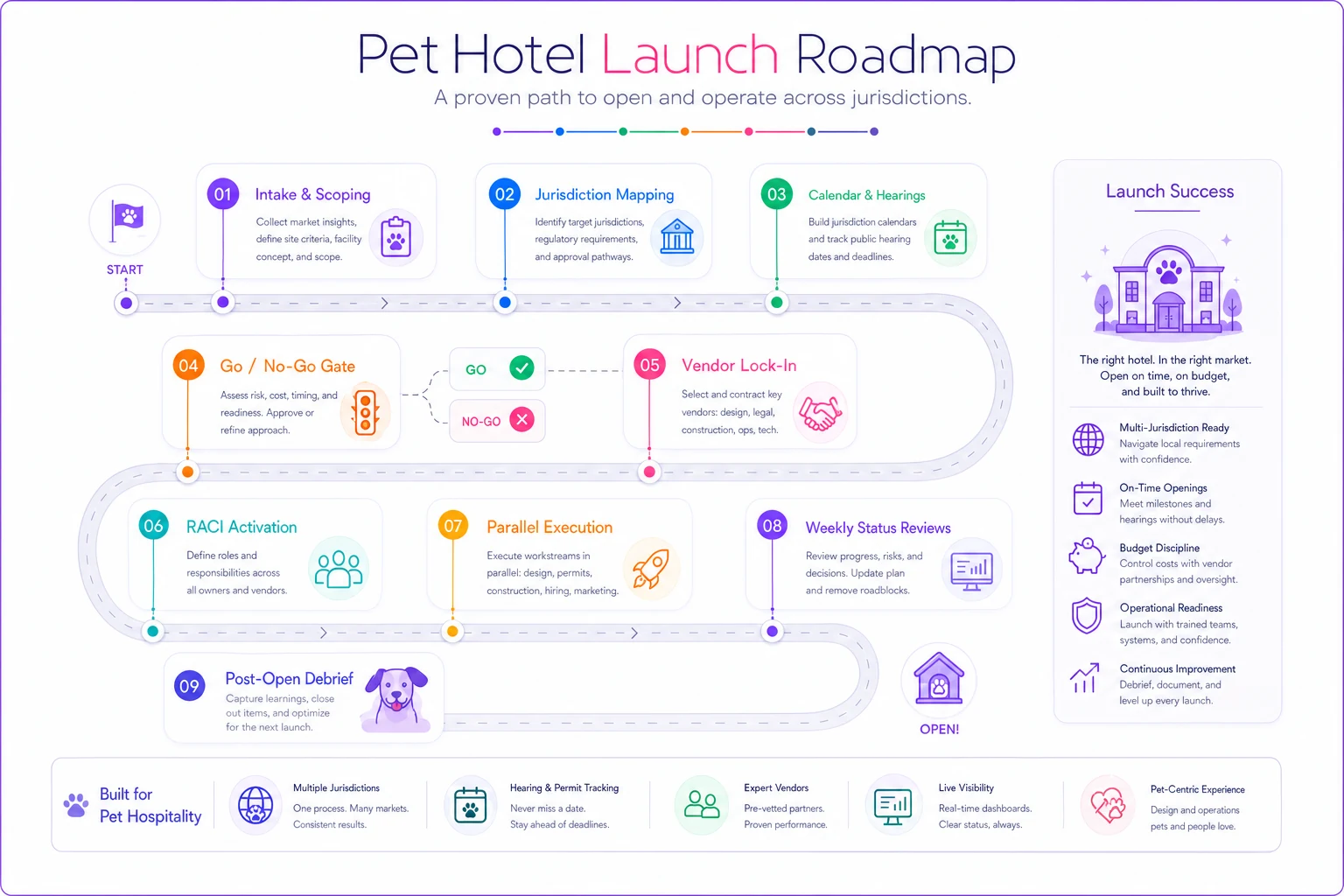
The step operators consistently skip is #7. The debrief is where the whole system compounds. Every closed opening should make the next one cheaper and faster because you've captured the jurisdiction's real quirks — not the version on the website, the version the permitting clerk told you on the phone.
Because these records contain lease terms, vendor contracts, and sometimes sensitive corporate documents, treat access to them the same way you'd treat client data — with defined roles and controlled access, the same discipline covered in keeping pet-hotel records out of legal danger. Not everyone on the team needs to see the lease or the attorney correspondence.
Artifact 4: The vendor and attorney checklist
The fastest openings share one trait: the operator locked in the right outside help before the clock started, with clear scopes. The slowest ones treated vendors as an afterthought and got serviced last.
-
Permit expediter / land-use consultant — Confirm they know your specific jurisdiction. A good expediter has walking-in relationships with the permitting office. Scope: application prep, submission, follow-up, hearing prep.
-
Land-use attorney — Only necessary for CUP hearings, variances, or objection risk. Confirm scope and fee structure — hourly vs. flat. Cap the exposure.
-
Civil/MEP engineer — For stamped fire, sprinkler, and drainage plans. Book early; stamped plans are almost always on the critical path.
-
General contractor familiar with animal-care build-outs — Kennel drainage, sound attenuation, and ventilation aren't standard commercial jobs. A GC who's done one before saves you from failed inspections.
-
Vet-on-call for the license prerequisite — Some jurisdictions require a signed vet contract before issuing the kennel license. Line it up early.
For each vendor, confirm: jurisdiction experience, clear written scope, fee structure, realistic timeline commitment, and — the one people forget — their availability against your target dates. A brilliant expediter who's booked solid for eight weeks doesn't help you.
Book engineers and expediters before the lease dries — their availability is often the real timeline risk.
The pattern worth internalizing: vendor delays are usually operator delays in disguise. The engineer isn't slow — you gave them the go-ahead three weeks late because go/no-go dragged. Front-load the vendor commitments and half your timeline risk disappears.
A real scenario: two openings, two very different outcomes
Consider a small operator running one successful location, expanding to two new sites in the same metro over the same year.
Site A they ran the old way. Signed the lease, assumed licensing was routine, started the build. Six weeks in, they discovered the parcel needed a conditional use permit. The planning commission's next opening was nine weeks out, and a neighboring homeowner showed up to object over noise. They scrambled to hire a land-use attorney mid-process. The site opened roughly four months behind target. Carrying costs — rent, early hires, financing — ran somewhere in the range of $30k–$40k in dead spend before the first dog checked in.
Site B they ran through the intake-and-gate system they'd just started building. The intake call flagged a required grease/hair trap for wastewater before the lease was signed, so they negotiated a build allowance from the landlord. The go/no-go came back green with one yellow flag. They locked the expediter and engineer the week the lease closed. The kennel license prerequisite — vet-on-call contract — was handled in week two instead of week twelve. Site B opened within about two weeks of target.
Same operator. Same city. The difference wasn't luck or a friendlier jurisdiction — Site B's jurisdiction was arguably stricter. The difference was that licensing was run as a governed pipeline instead of a scramble.
When this level of governance actually makes sense
When it's worth building the full system: You're planning three or more locations, or opening across multiple jurisdictions with different ordinances. The upfront work of building the templates pays back the second time you use them.
When it's overkill: You're a single-site operator with no expansion plans. You don't need a RACI for a one-time event. Run a solid checklist and hire a competent expediter — that's enough.
Who should not try to shortcut this: Anyone opening in a jurisdiction they've never worked in. The temptation is to assume "licensing is licensing" and reuse your home-market playbook. That assumption is exactly how you eat a four-month delay. New jurisdiction means a full intake, every time, no exceptions.
Where the software actually helps
None of this requires fancy tooling to start — the first version can live in a shared spreadsheet and a folder. But the coordination breaks down at scale precisely because it's spread across people, sites, and external vendors all moving at once.
That's where a workflow platform earns its keep: keeping jurisdiction intake records versioned and searchable so Site 3's team benefits from Site 1's hard lessons, holding the RACI so every approval has a named owner and a visible status, and surfacing the dependency chain so nobody treats a sequential inspection like a parallel task. AI-assisted operational tools can also flag the quiet risks — a site that's gone two weeks without a status update, an approval deadline about to collide with a hearing calendar, a vendor scope that was never confirmed in writing. The value isn't automation for its own sake; it's making sure nothing falls into the gap between people when three openings are in flight at once.
The operators who close new sites fast aren't smarter about permits. They stopped treating each opening as a one-off and built the intake, the gate, the RACI, and the vendor checklist into a system that gets faster every time they use it. That's the whole game: turn licensing from a scramble you survive into a pipeline you run.
The operators who close new sites fast aren't smarter about permits. They stopped treating each opening as a one-off and built the intake, the gate, the RACI, and the vendor checklist into a system that gets faster every time they use it. That's the whole game: turn licensing from a scramble you survive into a pipeline you run.
Ready to optimize your pet hotel operations?
Join hundreds of pet hotels using GoPetel to save time, improve pet care, and increase booking reliability.