

You built a profitable pet hotel. Maybe 40 kennels, running at 85% occupancy during peak months. Your staff knows the drill—morning feed routines, medication schedules, playtime rotations. Everything works because you're there, making micro-adjustments daily.
Then you open location two.
Suddenly your star employee at the original site starts doing things differently. The new location's manager interprets your cleaning protocols their own way. Customer complaints spike at one site while the other runs smoothly. You're driving between locations, putting out fires, wondering why everything that worked before stopped working.
The problem isn't your team. It's that you're trying to scale multi-location operations using single-site thinking. Your procedures exist in people's heads, in scattered documents, in "that's how we've always done it" tribal knowledge. What worked when you could walk the floor daily breaks down the moment you can't be everywhere at once.
Why pet hotel operations fragment differently than other businesses
Pet hotels face scaling challenges that restaurants or retail stores don't. A burger gets cooked the same way regardless of location. But pet care involves living animals with individual needs, behavioral quirks, and medical requirements. Your staff makes hundreds of judgment calls daily that can't be reduced to simple if-then instructions.
Take medication administration. At your original site, your senior staff member Sarah knows to give nervous dogs their meds wrapped in cheese first thing in the morning before the kennel gets noisy. She figured this out through experience. At your second location, the new team gives meds during midday rounds when half the dogs are barking, stress is high, and compliance drops to maybe 70%.
Both locations are technically following your SOP: "Administer prescribed medications according to schedule." But the outcomes diverge completely.
This variance compounds across every operational area. Feeding protocols, exercise routines, kennel cleaning sequences, emergency procedures—each develops local mutations based on who's implementing them and what shortcuts get discovered along the way.
One pet hotel chain I watched nearly implode because their third location started using a different dilution ratio for cleaning solutions to "save money." Six months later, they had a parvo outbreak that cost them around $47,000 in remediation, lost revenue, and reputation damage. The location manager thought they were being resourceful. Corporate thought everyone was following the standardized cleaning protocol. Nobody was tracking the variance until disaster struck.
The versioning problem nobody talks about
What really breaks multi-location pet hotel operations is procedure drift.
Never miss a booking or detail again.
GoPetel simplifies pet hotel operations by managing every reservation and pet profile seamlessly.
- Centralized booking management
- Automated client notifications
- Staff and kennel scheduling
No credit card required
Your SOPs aren't static documents. They evolve based on real-world feedback, regulatory changes, seasonal adjustments. But without versioning control, each location ends up running different iterations of your procedures.
Location A updates their intake process after a biting incident, adding a temperament screening step. Location B doesn't know about this change. Six weeks later, Location B has their own incident that could have been prevented.
Or worse—locations make contradictory changes. Site one extends checkout time to 6 PM to accommodate working customers. Site two keeps it at 4 PM to ensure proper end-of-day kennel counts. Now customers get different experiences, staff gets confused when covering shifts between locations, and your brand consistency evaporates.
Most operators try to solve this with quarterly meetings or email updates. Operational knowledge doesn't transfer through PowerPoints though. You need systematic versioning that tracks what changed, why it changed, who approved it, and which locations have actually implemented it.
Building your staged rollout framework
The smartest approach to scaling multi-location operations isn't launching all changes everywhere simultaneously. It's staged deployment with built-in learning loops.
Start with pilot programs at one location. Not your flagship—that's too risky. Not your worst performer—they have too many variables. Pick your middle performer, the steady location that represents your typical operational reality.
-
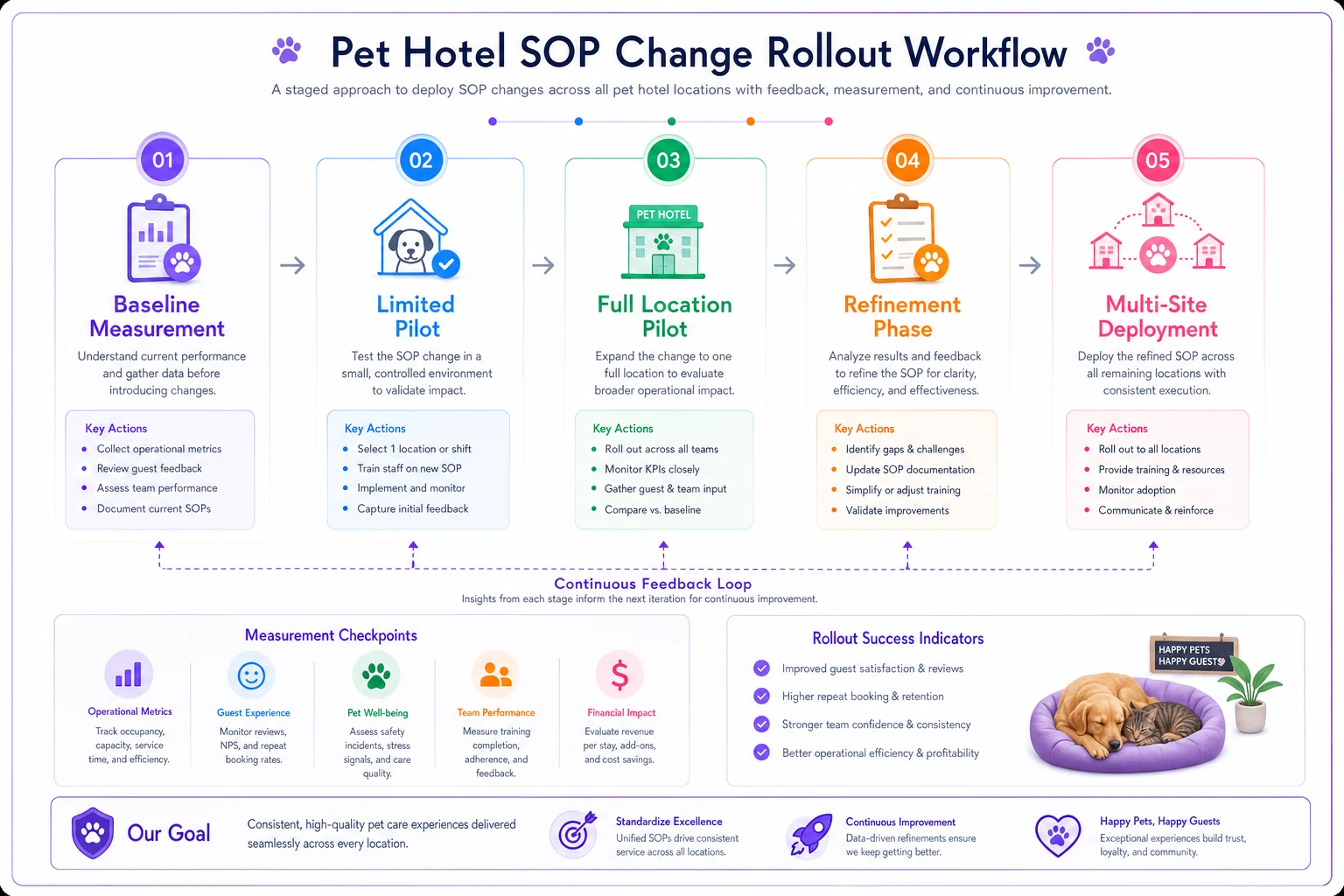
Weeks 1–2
Baseline measurement.
Document current performance metrics before any changes. Track everything—time per task, error rates, customer feedback scores. You need this data to prove whether changes actually improve operations. -
Weeks 3–4
Limited pilot.
Roll out the new procedure to one shift or one section of kennels. Maybe just the small dog area or just the morning crew. Contained testing reveals problems without disrupting the entire operation. -
Weeks 5–8
Full location pilot.
Expand to the entire pilot location. Watch for integration issues—how the new procedure interacts with existing workflows, where handoffs break down, which staff members struggle with adoption. -
Weeks 9–12
Refinement phase.
Adjust based on real-world friction. That beautiful SOP you wrote will probably need modifications once it hits practical reality. Maybe the new sanitization sequence takes 40 minutes instead of the planned 25. Better to discover this at one location than across your entire portfolio. -
Week 13+
Multi-site deployment.
Only after proving success and stability do you roll out to additional locations. Even then, go sequential, not simultaneous. Each new deployment teaches you something about local variance.
Here's a simple way to visualize the staged rollout and the feedback loops you need to build.
Only after proving success and stability do you roll out to additional locations. Even then, go sequential, not simultaneous. Each new deployment teaches you something about local variance.
Your change control system (before chaos hits)
Change control sounds corporate, but it's really just about preventing the situation where nobody knows which version of procedures they're supposed to follow.
Every SOP needs five components tracked:
Version number and date. Simple sequential numbering—v1.0, v1.1, v2.0. Major changes get whole number increases, minor adjustments get decimal increases.
Change summary. What specifically changed and why. "Added double-check step for aggressive dog kennels after March incident" tells staff the context, not just the rule.
Approval chain. Who reviewed and signed off. When the health inspector asks why you changed your sanitization protocol, you need documentation showing proper evaluation.
Implementation status by location. A simple tracker showing which sites have trained on and deployed each version. Location A might be on v2.1 while Location B is still implementing v2.0. That's manageable if you're tracking it. It's chaos if you're not.
Rollback triggers. Define what would cause you to revert to a previous version. If error rates spike 30% or customer complaints double, you need predetermined thresholds for admitting a change isn't working.
The RACI matrix that actually prevents territorial disasters
Multi-site operations create overlapping responsibilities that lead to either territorial battles or dangerous gaps where nobody takes ownership. A RACI matrix clarifies who does what, but most templates are too generic for pet hotel operations.
Here's what actually needs defining:
| Operational Area | Regional Manager | Location Manager | Shift Lead | Corporate |
|---|---|---|---|---|
| SOP modifications | Consulted | Responsible | Informed | Accountable |
| Incident response (minor) | Informed | Accountable | Responsible | Informed |
| Incident response (major) | Accountable | Responsible | Consulted | Informed |
| Pricing changes | Consulted | Informed | Informed | Accountable |
| Staff scheduling | Informed | Accountable | Responsible | Consulted |
| Inventory ordering | Consulted | Responsible | Informed | Accountable |
| Customer escalations | Responsible | Accountable | Consulted | Informed |
| Facility maintenance | Consulted | Accountable | Responsible | Informed |
| Marketing initiatives | Informed | Consulted | Informed | Accountable |
| Health inspections | Accountable | Responsible | Consulted | Informed |
The key distinction here: location managers need accountability for day-to-day operations, but corporate maintains accountability for anything touching brand standards or legal compliance.
This prevents situations like the location manager who decided to accept intact males without telling corporate, leading to three pregnancy scares and a lawsuit. They thought they were being entrepreneurial. A clear RACI would have flagged this as requiring corporate approval before it ever became a problem.
Local variance guardrails (not everything needs standardization)
Perfect standardization is a myth in pet care. Different locations serve different demographics, face different regulations, operate in different climates. The goal isn't identical operations—it's consistent quality with controlled variance.
Define three categories of procedures:
Non-negotiable standards. These cannot vary between locations. Medication administration protocols, emergency procedures, abuse reporting requirements. Violation means immediate retraining or termination.
Flexible implementation standards. The outcome is fixed but the method can vary. All dogs must receive 20 minutes of exercise twice daily, but Location A might use group play yards while Location B uses individual leash walks based on their facility layout.
Local optimization zones. Areas where locations have full autonomy within defined boundaries. Maybe Location A offers 6 AM early drop-off because they're near the airport. Location B doesn't need this service. That's fine as long as core hours remain consistent.
Document variance in a structured way—what specific variation is approved, why that location needs it, what metrics ensure quality standards are maintained, and a review date to reassess whether the variance is still warranted.
Without these guardrails, you get chaos. With too many restrictions, you get resentful managers who can't serve their local market effectively.
The pilot checklist that catches problems before they spread
Every operational change needs systematic piloting. This checklist prevents disasters:
Pre-pilot phase:
-
Current process documented with time and cost metrics
-
Specific problem identified with data backing
-
Proposed change written in clear SOP format
-
Success metrics defined
-
Failure thresholds set
-
Rollback plan prepared
Pilot launch:
-
Staff training completed with competency verification
-
Baseline metrics recorded for two weeks prior
-
Communication sent to affected stakeholders
-
Feedback mechanism established
-
Escalation path clarified if issues arise
During pilot:
-
Daily metric tracking against baseline
-
Weekly staff feedback sessions
-
Customer impact monitoring
-
Adjustment log maintained
-
Go/no-go checkpoint scheduled
Post-pilot evaluation:
-
Quantitative results compiled and analyzed
-
Qualitative feedback synthesized
-
Cost-benefit analysis completed
-
Scalability assessment completed
-
Final SOP version created with lessons learned incorporated
A pet hotel group skipped this process when rolling out a new cleaning protocol to reduce turnaround time. They went straight to all three locations. Two locations saw 15% faster turnover. The third had a 40% increase in returned pets due to inadequate sanitization between guests. Proper piloting would have caught the issue at one site instead of risking their entire reputation.
Technology coordination without the complexity trap
Scaling operations means your paper systems and spreadsheets break down. But the solution isn't always expensive enterprise software that nobody actually uses.
The core need is information synchronization. When Location A discovers a dog has a chicken allergy, Location B needs to know immediately if that dog ever boards there. When corporate updates vaccination requirements, all locations need the new protocol simultaneously.
Start with the basics: a centralized customer database accessible from all locations, a shared SOP repository with version control, incident reporting that feeds to a central system, and a basic operational metrics dashboard.
The mistake is trying to digitize everything at once. Pet hotels that spend $50k on comprehensive management systems often end up with staff bypassing them entirely with paper notes because the system is too cumbersome for daily operations.
Digitize medication tracking first—it's high-risk, high-frequency, and central to safety across sites.
Prioritize based on risk and frequency. Medication tracking? Critical and daily—digitize it first. Annual employee reviews? Keep them on paper until core operations are solid.
The best implementations maintain hybrid systems during scaling. Digital for anything involving customer safety, compliance, or multi-site coordination. Simpler tools for location-specific workflows that don't affect other sites. AI-powered operational software can help centralize pet records, flag procedure deviations, and surface cross-location patterns that manual review would miss—but only add those layers once your foundational systems are stable and your team is actually using what you've already built.
Communication rhythms that prevent dangerous silos
Multi-site operations fail when locations become islands. The morning shift at Location A doesn't know Location B solved the same problem they're struggling with. Corporate doesn't know Location C has been improvising procedures for weeks.
Daily: 5-minute stand-ups per location. Not across locations—that's too much coordination. Each site does their own, following the same format: safety issues, capacity status, any deviations from standard procedures. Document in a shared log that regional managers review.
Weekly: Ops sync between location managers. 30-minute video call. No agenda creep. Cover three things: what broke this week, what fix was implemented, what help is needed. This catches procedure drift before it becomes institutional.
Monthly: Incident review across all sites. Every incident at any location gets reviewed by all managers. Not to blame, but to learn. That dog fight at Location A might reveal a kennel design issue that Location B hasn't experienced yet but could.
Quarterly: SOP revision workshop. Bring key staff from each location together. Review what's actually happening versus what procedures say should happen. Update SOPs based on ground truth, not theoretical perfection.
The failure pattern is when corporate mandates these meetings without clear purpose. Staff shows up, shares nothing meaningful, checks the box. Each communication rhythm needs to solve a specific operational problem, or you cut it.
Scaling your training infrastructure
Your single site trains new staff through shadowing experienced employees. This breaks at multiple locations—you can't guarantee consistent knowledge transfer when you're not controlling who shadows whom.
Build training that scales by creating role-specific competency checklists. Not vague skills like "understands dog behavior" but specific, observable abilities: "Can identify three signs of bloat and execute emergency protocol within 2 minutes."
Develop location-agnostic training materials—videos, guides, quizzes that teach the standard way, with local variance covered in site-specific addendums. This prevents Location B from training completely different methods than Location A.
Implement buddy systems across sites. New Location B staff shadows at established Location A for core training, then returns for site-specific orientation. This builds network connections and prevents the isolation that causes procedure drift.
Track training completion centrally. When health inspectors audit, you need to prove all staff across all locations received required training. Scattered paperwork at each site becomes a compliance nightmare fast.
The more sophisticated approach uses tiered certification. Level 1 covers basics anyone at any location needs. Level 2 adds location-specific procedures. Level 3 qualifies for specialized roles. This creates clear advancement paths while maintaining standards across the board.
Measuring what matters across locations
Single-site metrics are straightforward. Multi-site metrics require more nuance to prevent gaming and ensure comparability.
Track both absolute and relative performance. Location A might have lower revenue than Location B, but if they're in different markets with different capacity, raw numbers mislead. Revenue per available kennel night normalizes for size differences and gives you something actually comparable.
-
Safety incident rate per 1,000 boarding nights
-
Staff turnover by role and location
-
Procedure compliance rate from audits
-
Customer lifetime value by acquisition location
-
Cost per boarding night (normalized for local wages and rent)
-
Cross-location rebooking rate (customers who use multiple sites)
Watch for metric divergence between locations. If Location A's cost per boarding night is 30% higher than Location B, investigate whether they're adding unauthorized services, have efficiency issues, or face legitimately higher operational costs that need addressing differently.
The financial reality of multi-site standardization
Standardizing operations costs more upfront than most operators budget for. The typical investment looks something like this:
-
SOP documentation and maintenance
40–60 hours initially, 5–10 hours monthly
-
Training development and updates
$15k–$25k first year
-
Technology infrastructure
$500–$1,500 per location monthly
-
Additional management layer
Regional manager at $55k–$70k annually
-
Compliance auditing
$2k–$5k per location annually
-
Change management consulting
$10k–$20k if bringing in external expertise
The payoff comes from reduced incidents and insurance claims (typically 20–30% decrease), higher customer retention from consistent experience (5–10% improvement), lower training costs once systems are established (30–40% reduction), and the ability to promote and transfer staff between locations.
Most importantly, standardization enables real scaling. Without it, each new location adds exponential complexity until the operation becomes unmanageable around four or five sites.
When staged rollout makes sense (and when to go all-in)
Not every change needs elaborate staged deployment. Reserve it for changes affecting customer safety or experience, expensive modifications requiring capital investment, process overhauls that disrupt established workflows, regulatory compliance updates with penalties attached, and technology deployments that can't easily be reversed.
Go straight to full deployment for minor clarifications to existing procedures, mandatory regulatory changes with fixed deadlines, emergency responses to immediate threats, simple tools or supplies that don't change workflows, and seasonal adjustments you've done before.
The judgment comes from risk assessment. Will failure at all locations simultaneously create an existential threat? Stage it. Will delayed implementation create more risk than rapid deployment? Go all-in.
Avoiding the franchise trap without losing control
Some pet hotel owners think franchising is the only way to scale. But you can maintain operational consistency without the franchise legal structure that limits your flexibility.
The key is separating ownership structure from operational standards. Whether locations are corporate-owned, partnership ventures, or management contracts, the operational playbook stays consistent.
Build your operations manual as if you were franchising, even if you're not. This forces the discipline of documenting everything, creating training systems, and establishing audit protocols. You get the operational benefits of franchising without the legal constraints.
This approach also makes eventual exit cleaner. Buyers pay premium prices for businesses with documented, scalable operations. A pet hotel chain with proven multi-site SOPs and performance data commands roughly 5–7x EBITDA versus 3–4x for single locations or undocumented operations.
The reality check most operators need
Scaling to multiple locations isn't just about replicating what works. It's about building systems that maintain quality while allowing necessary local adaptation.
Your first location succeeded because of your daily presence and instant adjustments. Your second and third locations will succeed through systematic operations that don't require you on-site every day.
This transition is genuinely hard for founders who built their business on personal relationships and hands-on management. You have to trust systems more than instincts, data more than gut feelings, documented procedures more than tribal knowledge.
The pet hotels that successfully scale beyond three or four locations share common traits: obsessive documentation of procedures, clear version control and change management, regular cross-location communication, balanced standardization with local flexibility, and investment in training and technology before they think they actually need it.
Those that fail try to run multiple locations like one big location, hoping proximity or technology will overcome the fundamental coordination challenges of distributed operations.
Building your implementation roadmap
Don't try implementing everything at once. Here's a practical sequence:
-
Months 1–2
Document current state.
Capture what's actually happening at your existing location(s). Not what should happen—ground truth. This becomes your baseline. -
Months 3–4
Create version 1.0 SOPs.
Transform your documentation into standardized procedures. Keep them simple. Perfection comes through iteration, not initial design. -
Months 5–6
Implement at original location.
Even your first site needs to follow the standardized SOPs. This reveals gaps and impracticalities before you spread problems to new locations. -
Months 7–8
Establish measurement systems.
Build the dashboards and tracking mechanisms to monitor compliance and performance across locations. You can't manage what you can't measure. -
Months 9–10
Train second location.
Whether opening new or standardizing existing, bring your second site into the system. This tests your training infrastructure and reveals multi-site coordination issues you didn't anticipate. -
Months 11–12
Refine and systematize.
Based on lessons learned, update your SOPs, training, and systems. Now you have a proven playbook for locations three, four, and beyond.
Don't try implementing everything at once. Here's a practical sequence:
The difference between a successful single pet hotel and a thriving multi-location business isn't capital or marketing or luck. It's operational systems that maintain quality without requiring your constant presence.
Most pet hotel owners hit an invisible ceiling around two or three locations where complexity overwhelms their management capacity. They blame staff, location differences, market conditions. Really, they're trying to scale without the infrastructure to support it.
Building that infrastructure isn't complicated, but it requires discipline. Document procedures, version your SOPs, establish clear ownership through RACI, pilot changes systematically, allow controlled local variance, and measure consistently across locations.
The pet hotels doing well with five, ten, even twenty-plus locations didn't get there through heroic management. They got there through boring, systematic operational excellence that scales predictably.
If you're thinking about the demand side of that growth—how to manage surge capacity and staffing across multiple sites as you scale—this breakdown on surge staffing for peak periods is worth reading before you need it rather than during the chaos.
Build the infrastructure before you need it, or scramble to create it while your multi-site operation burns around you. The operators who've made it to real scale already know which path leads somewhere worth going.
Ready to optimize your pet hotel operations?
Join hundreds of pet hotels using GoPetel to save time, improve pet care, and increase booking reliability.