

Most pet hotel HVAC maintenance plans are built around the calendar, not the building. Someone sets a "quarterly filter change" rule when the facility opens at 40% occupancy, then three years later the place is running at 85% through summer and holidays — and nobody has touched the service schedule. The air handler is now moving twice the dander, hair, ammonia, and moisture it was originally spec'd for. Filters that used to last 90 days are clogging in 30.
That gap between how the building was set up and how it's actually running is where most health incidents and surprise downtime come from. A coil freezes mid-July. A dryer motor dies the Friday before Thanksgiving. Kennel cough spreads through a wing because the air handler was recirculating instead of exchanging. None of that is bad luck — it's a maintenance cadence that stopped matching occupancy months ago.
This playbook ties your service intervals to how full the building is, not to a date on a wall calendar. You'll get 30- and 90-day checklists, an occupancy-tied service cadence, vendor SLA language that holds up when you actually need it, an emergency-replacement plan for the equipment that can shut you down, and a straight CAPEX-vs-repair framework with math your manager can run in five minutes.
Why calendar-based schedules quietly fail in a boarding environment
A standard office building cycles maybe 5–10 air changes per hour and deals with people who shower before they show up. A boarding facility at capacity is a completely different load: constant shedding, urine and feces off-gassing ammonia, wet dogs, laundry running all day, and bodies producing heat and humidity in enclosed runs.
Equipment doesn't degrade on a timeline. It degrades on workload. So when you tie maintenance to the calendar, two things happen:
-
Low season you're over-servicing. Changing filters that still had 40% of their life left, paying for PM visits the building didn't need.
-
High season you're dangerously under-servicing. The exact weeks you're fullest — holidays, summer, spring break — are when filters load fastest, coils foul quickest, and dryers run hardest. That's precisely when the calendar tells you nothing is due.
The first real HVAC failure at these facilities almost always lands during a peak. Not because peaks are cursed, but because the system was already running at the edge and occupancy pushed it over. The fix isn't more maintenance everywhere — it's maintenance that scales with how hard the building is actually working.
The occupancy-tied service cadence
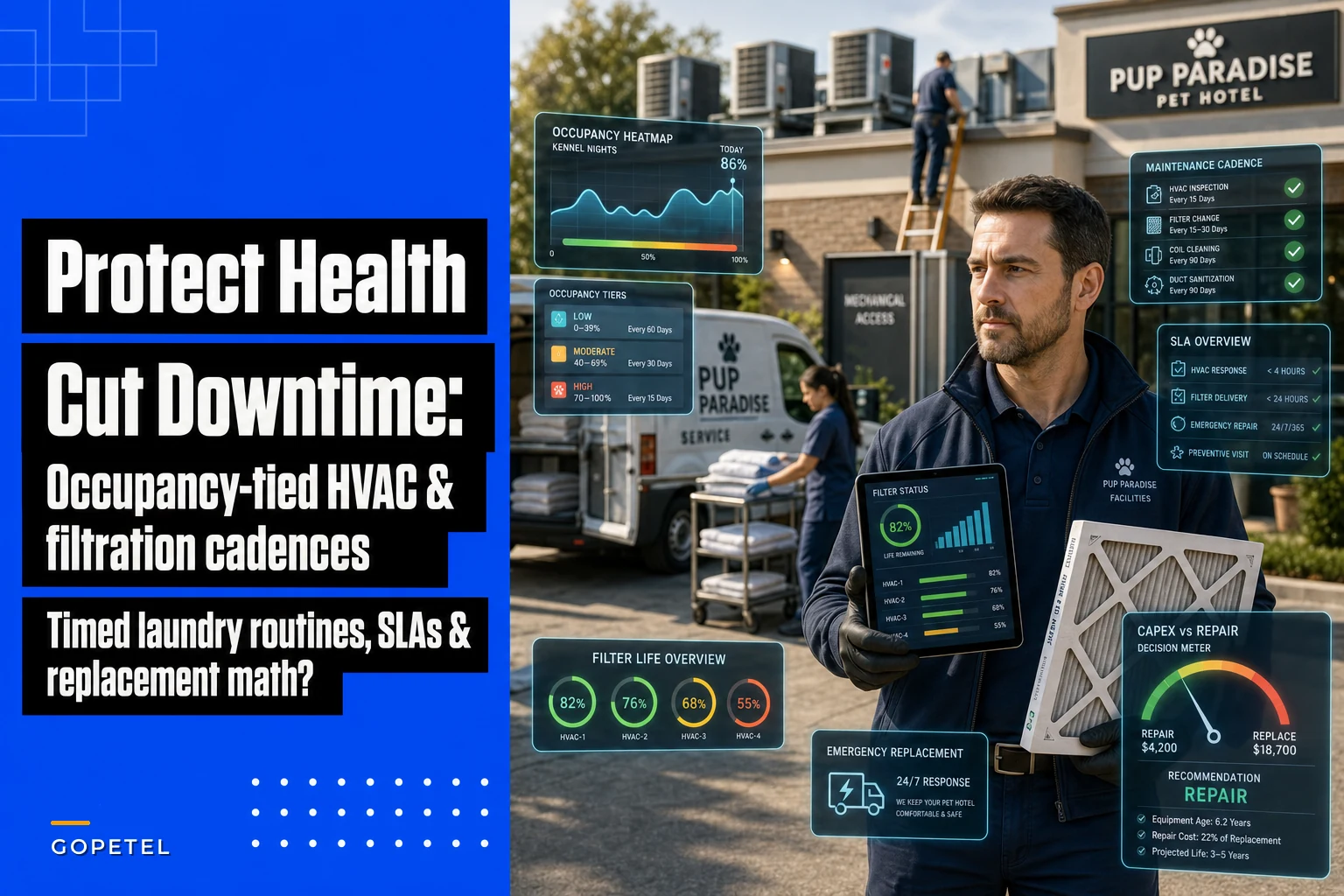
The core idea: pick your service intervals based on a rolling occupancy band, not a fixed date. Track your average occupancy over the trailing 30 days, then slot into one of three tiers.
Never miss a booking or detail again.
GoPetel simplifies pet hotel operations by managing every reservation and pet profile seamlessly.
- Centralized booking management
- Automated client notifications
- Staff and kennel scheduling
No credit card required
| Occupancy band (trailing 30-day avg) | Filter change interval | Coil/condensate check | Full HVAC PM | Dryer vent + lint deep clean |
|---|---|---|---|---|
| Under 50% | Every 75–90 days | Quarterly | 2x/year | Every 60 days |
| 50–75% | Every 45–60 days | Every 6 weeks | 3x/year | Every 30–45 days |
| Over 75% | Every 25–35 days | Monthly | 4x/year | Every 2–3 weeks |
A few things worth noticing. The high band isn't just "do it more often" — the dryer vent interval tightens dramatically because dryer fires and airflow loss scale directly with runtime, and a full facility runs laundry almost continuously. Lint buildup in a commercial dryer vent at 85% occupancy is a genuinely different risk profile than at 45%.
You also don't need fancy sensors to run this. Your booking software already knows your occupancy. The trick is making someone look at the trailing average on the first of every month and set the next month's cadence tier. That one habit prevents most peak-season failures.
Assign one person to check the trailing 30-day occupancy average on the first of each month to keep the cadence accurate.
If you want a more precise version, add a filter pressure-drop reading. A cheap manometer across the filter bank tells you actual loading instead of guessing by days. When pressure drop crosses the manufacturer's threshold, change regardless of what the tier says. The tier is your default; the gauge is your override.
A quick workflow for the occupancy-tied cadence:
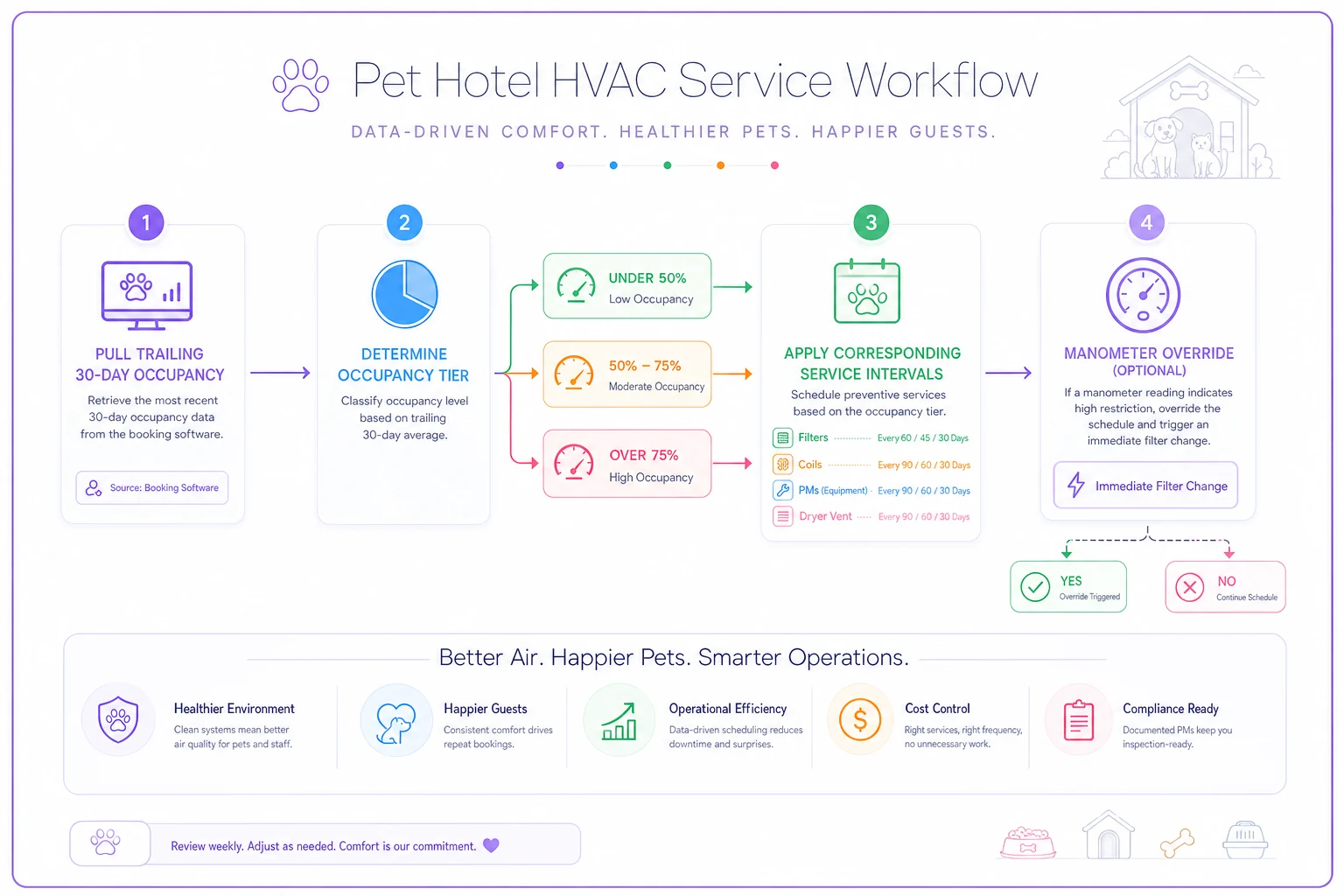
The trick is making someone look at the trailing average on the first of every month and set the next month's cadence tier. That one habit prevents most peak-season failures.
The 30-day checklist (run this every month, no exceptions)
This is the short list that catches problems before they become closures. It should take a lead staffer or manager under 30 minutes.
-
Check and read filter loading — visual inspection plus pressure drop if you have a gauge. Change per your current occupancy tier.
-
Inspect the condensate drain line — a clogged condensate pan in a humid kennel is a flood and a mold source. Pour the pan, confirm it drains, check for standing water.
-
Verify temperature and humidity in each zone — walk the kennels with a cheap hygrometer. Humidity creeping above ~60% in a boarding wing is a respiratory and odor warning sign long before anyone complains.
-
Clear and inspect dryer lint traps and the vent termination — not just the removable screen; check the exterior vent flap for lint buildup and airflow.
-
Confirm fresh-air intake is actually open — dampers get set to "recirculate" during a cold snap to save heat and never get flipped back. Recirculating air in a full kennel is how airborne illness travels.
-
Spot-check airflow at the runs farthest from the air handler — the end of the duct run is where ventilation dies first. If the back kennels feel stuffy, that's your early signal.
The fresh-air damper point deserves extra attention. Ventilation and air exchange are the backbone of keeping respiratory illness from spreading, and it connects directly to your broader infection-control framework. HVAC isn't separate from disease control in a boarding facility — it is disease control.
The 90-day deep checklist
Quarterly is where you bring in the vendor or do the heavier work that staff can't:
-
Coil cleaning (evaporator and condenser). Dander and hair blanket coils far faster in a pet facility than anywhere else. A fouled coil drops efficiency, raises your electric bill, and eventually freezes up. In a consistently high-occupancy facility, quarterly may already be too slow — move to monthly checks if you're consistently above 75%.
-
Full condensate system flush and pan treatment. Clear the line, treat the pan to prevent biofilm, confirm the safety float switch works.
-
Belt, bearing, and motor inspection on air handlers and dryers. Listen and feel for early signs — a dryer bearing that's starting to go has a distinct sound weeks before it fails.
-
Dryer vent professional cleaning if you're in the high tier. Commercial dryer vents at full runtime accumulate lint fast enough to create both a fire risk and a drying-time problem that backs up your whole laundry operation.
-
Refrigerant and electrical check. Pressures, connections, amperage draw. This is where a tech catches the compressor that's about to go.
-
Re-baseline your occupancy tier. Look at the last 90 days, confirm your cadence tier still matches reality, adjust the next quarter accordingly.
The laundry side gets ignored in most of these plans, and it shouldn't. Laundry downtime is sneaky — when the dryer dies and bedding can't cycle, kennels can't turn over and your throughput collapses even if your HVAC is running fine. A dead dryer during a holiday peak can effectively take runs offline because you have nothing clean to put down.
Vendor SLA templates that hold up when you need them
Here's the failure pattern: the dryer or the compressor dies Friday night before a holiday weekend, you call your HVAC vendor, and you get voicemail until Tuesday. The "relationship" you thought you had means nothing because nothing was in writing.
| Severity | Definition | Required response | Required resolution target |
|---|---|---|---|
| Critical | No heating/cooling in occupied zones, or total laundry failure during peak | On-site within 4 hours | Temporary fix or loaner same day |
| Urgent | Partial failure, one zone down, reduced capacity | On-site within 24 hours | Repair within 48 hours |
| Routine | PM visits, non-urgent repairs | Scheduled within 5 business days | Per visit scope |
A few clauses worth insisting on:
-
A named peak-season window where response times are guaranteed (your holidays, not theirs).
-
Parts stocking or sourcing commitment — the vendor keeps common failure parts on the truck or can source within a defined window. "Waiting on a part" is the excuse that turns a two-day repair into two weeks.
-
A loaner or temporary-cooling provision for critical failures. Spot coolers and portable units exist. A vendor who can drop one off keeps you open.
-
Priority status for an annual retainer. Paying a modest retainer to jump the queue is almost always worth it versus being just another call during a heat wave when every commercial building in town is calling.
If you can't find a vendor who'll agree to real response times, that itself is useful information. It means you need a second vendor on backup, and your emergency-replacement plan needs to be tighter.
The emergency-replacement playbook
Facilities that recover fast from equipment failures are the ones who decided in advance what they'd do. Panic decisions at 9pm on a Friday are expensive.
For the primary air handler / rooftop unit:
-
Who to call, in order (primary vendor, backup vendor, emergency HVAC service)
-
Where the spot coolers / portable units come from (rental company number, delivery time, cost)
-
Which zones get priority if you can only cool part of the building (medical/senior dogs first)
-
The threshold at which you stop taking new check-ins or relocate animals
For the commercial dryer:
-
Backup laundry plan (second dryer, laundromat runs, linen service on call)
-
How many runs you can keep turning with reduced laundry capacity
-
The bedding-inventory buffer that buys you a day (more on that below)
The single most underrated emergency lever is a bedding buffer. If you normally run with just enough bedding to cycle through one wash-dry loop, a dead dryer stops you cold. Carrying an extra day's worth of clean bedding — even cheap backup sets — turns a catastrophic dryer failure into an inconvenience. It's a few hundred dollars of linens against potentially closing wings.
The other quiet lever is a relationship with a spot-cooler rental company before you need one. Have the account set up, know the delivery window, know the cost. During an extreme-heat event everyone's calling for the same units, and the facility with a standing account gets served first.
CAPEX vs. repair: the threshold and the ROI math
This is the decision managers freeze on. The compressor quote comes in at $2,800, the unit is 11 years old, and nobody knows whether to fix it or replace it. Here's a rule you can actually apply.
The 50% rule, adjusted for age and downtime risk:
If the repair cost is more than 50% of replacement cost and the unit is past 60% of its expected life, replace it. If either condition is true but not both, it's a judgment call weighted by how critical the unit is and how reliable it's been recently.
The number managers consistently miss is the cost of the downtime the old unit creates. A unit limping along isn't just a repair bill — it's efficiency loss, repeat failures, and real revenue risk during your busiest weeks.
Run the math like this:
-
Replacement cost of the new unit, installed. Call it $9,000.
-
Annual efficiency savings from new vs. old. A failing 11-year-old unit running fouled coils might be 25–30% less efficient. If your HVAC electric cost for that unit runs roughly $4,000/year, that's around $1,000–$1,200 saved annually.
-
Avoided repair spend. If the old unit has been running $1,500–$2,000/year in repairs, the new unit under warranty is essentially zero.
-
Downtime risk value. A peak-season failure that takes a handful of runs offline for two days could mean $1,500–$3,000 in lost nights plus refund and reputation costs. Assign even a 30% annual probability to an aging unit and that's real money on the table.
Add it up: roughly $1,100 efficiency + $1,750 avoided repairs + ~$700 risk-weighted downtime ≈ $3,500/year of value from replacing. Against a $9,000 unit, payback lands around 2.5–3 years — well inside the 12–15 year life of new equipment. Replace it.
Flip it: a 4-year-old unit with a $900 repair. Well under 50% of replacement cost, barely a quarter through its life, efficiency still good. Fix it and move on. The math isn't close.
Keep a running log of repair spend per unit. The moment a single unit crosses roughly 40–50% of its replacement cost in cumulative repairs over 24 months, it goes on the replacement list for next budget cycle — before it fails on you during a holiday.
When this playbook makes sense — and when it's overkill
It makes sense when: you run meaningful occupancy swings between seasons, you've had at least one HVAC or laundry scare, or you're above around 25–30 runs where a single zone failure meaningfully hits revenue. The occupancy-tied cadence pays for itself fastest in facilities that swing from 45% in shoulder months to 85%+ at peak.
It's probably overkill when: you're a small, steady-occupancy operation with one simple HVAC zone and a single residential-grade dryer. In that case, just run the high-tier 30-day checklist year-round — the occupancy tiering doesn't buy you much if occupancy barely moves.
Who should not try to do this entirely in-house: if you don't have a trusted HVAC vendor relationship yet, don't start by writing SLAs. Start by finding and vetting vendors. The best maintenance schedule in the world falls apart without someone reliable to execute the 90-day deep work.
A quick real-world picture
A mid-size facility — around 38 runs, swinging from the mid-40s off-season to the high 80s over summer and holidays — had been changing filters every 90 days flat and doing one annual HVAC PM each spring. Two summers in a row they hit a coil freeze during a heat wave, lost a cooling zone for the better part of a day, and had to relocate dogs and comp a few stays.
They switched to the occupancy-tiered cadence, tightened the dryer vent intervals, added a one-day bedding buffer, and set up a standing spot-cooler account. The following summer, filters were changing roughly monthly during peak instead of quarterly. The coils stayed clean enough that there was no freeze. When the older of their two units did throw a fault, the SLA got a tech on-site within hours instead of the usual multi-day wait. No zone went fully offline.
The extra filter and PM spend ran maybe a few hundred dollars more across the year — against what had previously been thousands in comped stays and emergency service rates.
Nothing dramatic. Just a building being serviced at the rate it was actually working.
Pulling it together
Pet hotel HVAC maintenance breaks down in a predictable way: the schedule gets set once, the building gets busier, and nobody reconnects the two. Everything in this playbook exists to close that gap — tie the cadence to occupancy, run the short checklist monthly without fail, put real teeth in your vendor SLAs, decide your emergency moves before you need them, and run honest CAPEX math instead of defaulting to the cheapest short-term repair.
The air handling, filtration, and laundry systems aren't background infrastructure in a boarding facility — they're frontline health and throughput equipment. Treat them that way and you keep animals healthier, keep more nights sellable through peak, and stop losing weekends to failures you could have seen coming.
For the broader picture of how ventilation ties into disease prevention and how utility systems connect to cost and compliance, it's worth reading alongside your chemical-waste and sustainability operations playbook, since the two overlap more than most operators expect.
Ready to optimize your pet hotel operations?
Join hundreds of pet hotels using GoPetel to save time, improve pet care, and increase booking reliability.