

A dog goes home after a five-night stay. Two days later the owner texts: "Where's Max's Ruffwear harness? He came in with it." Your staff doesn't remember. The intake notes say "leash + collar." Nobody logged a harness. Now it's your word against theirs, and the harness retails for about $90. You either eat the cost to keep the client happy, or you push back and risk a one-star review that costs you far more than $90.
This is the lost-and-found problem almost every pet hotel underestimates. It feels small — a lost toy here, a missing blanket there — but across a year it quietly adds up to a few thousand dollars in goodwill refunds, replacement purchases, staff time spent arguing over who packed what, and the occasional small-claims threat. The fix isn't "be more careful." Careful doesn't survive a 40-dog holiday week. The fix is a documented chain of custody: photographic intake and return, tagging, storage rules, and a disposition timeline that removes the guessing.
Why "we're careful" fails every peak season
The failure almost never happens on a slow Tuesday. It happens when you're running near capacity and three check-ins stack up at once. Items go into a bin, the kennel card gets a quick scribble, and the person who received the dog isn't the person who packs it up at discharge. That handoff gap is where custody disappears.
In real operations, the pet hotel lost and found workflow breaks down in a few predictable spots:
-
Intake is verbal, not visual. "Blue blanket, chew toy, meds in a baggie" gets written fast and interpreted loosely. Was the blanket navy or teal? Was there one toy or two?
-
Belongings and the pet get separated. The dog goes to a kennel; the bag goes to a shelf, a cubby, or occasionally the wrong run. There's no physical link between them.
-
Discharge is rushed. Owners arrive at pickup wanting to leave. Staff grabs what's nearby and hands it over. Missing items aren't noticed until the client is home.
-
No expiration rule. Unclaimed items pile up for months. Eventually someone tosses the whole bin, including something a client was coming back for.
Take the intake photo before the owner leaves so color and condition are indisputable.
The pattern underneath all of these is the same: nobody can prove what came in. Without proof, every dispute defaults to the customer's memory — and customers remember generously.
The real cost, counted honestly
It's easy to dismiss individual incidents because each one seems cheap. Add them up over a year and it looks different.
Never miss a booking or detail again.
GoPetel simplifies pet hotel operations by managing every reservation and pet profile seamlessly.
- Centralized booking management
- Automated client notifications
- Staff and kennel scheduling
No credit card required
A mid-size facility running around 30 kennels might see 8–15 belonging disputes a month during busy stretches, fewer in slow months. Call it roughly 90–120 a year. If you settle most of them with a refund, a replacement, or a free night to smooth things over, the average cost per incident lands somewhere between $25 and $70 once you factor in staff time. That's a quiet $3k–$6k annual leak — before you count the reviews.
| Dispute type | Typical frequency | Direct cost range | Hidden cost |
|---|---|---|---|
| Missing toy/chew | Common | $10–$30 | Minor annoyance |
| Missing blanket/bedding | Common | $20–$60 | Emotional ("it was his comfort item") |
| Missing collar/harness/leash | Occasional | $25–$120 | High — gear is expensive |
| Missing/mixed-up medication | Rare | Varies | Serious — safety + liability |
| Wrong item returned to wrong dog | Occasional | $0 direct | Trust damage, cross-contamination worry |
The medication row is where a lost-and-found issue becomes a liability issue. Returning the wrong meds, or losing a dose schedule, isn't a goodwill problem — it's a health risk. That's where custody documentation overlaps with your incident and waiver paperwork, and it's worth tightening both together.
The chain-of-custody workflow, step by step
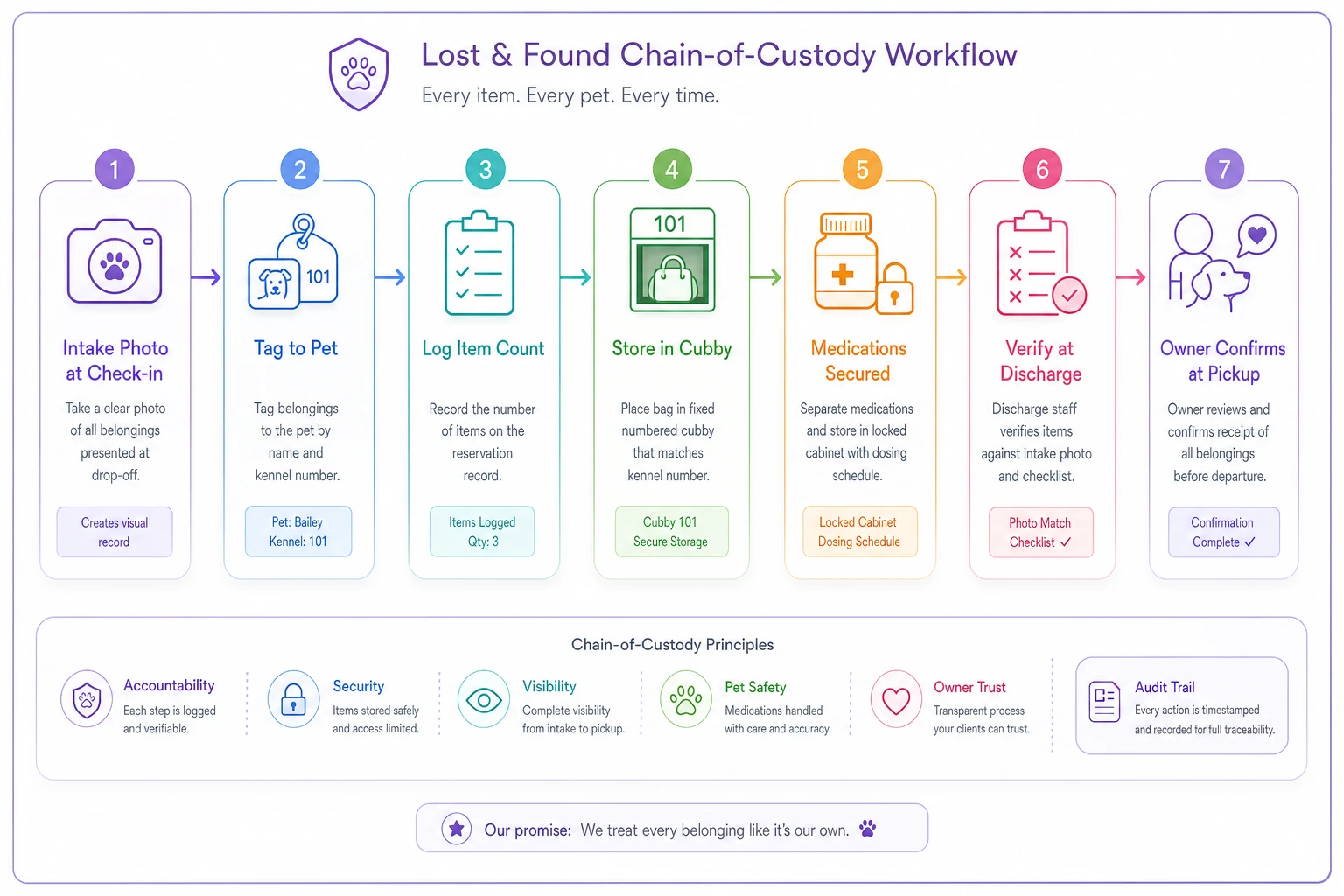
Chain of custody means every item has a documented trail from the moment it enters your building to the moment it leaves. Here's what that looks like in an actual busy kennel, not a theoretical one.
-
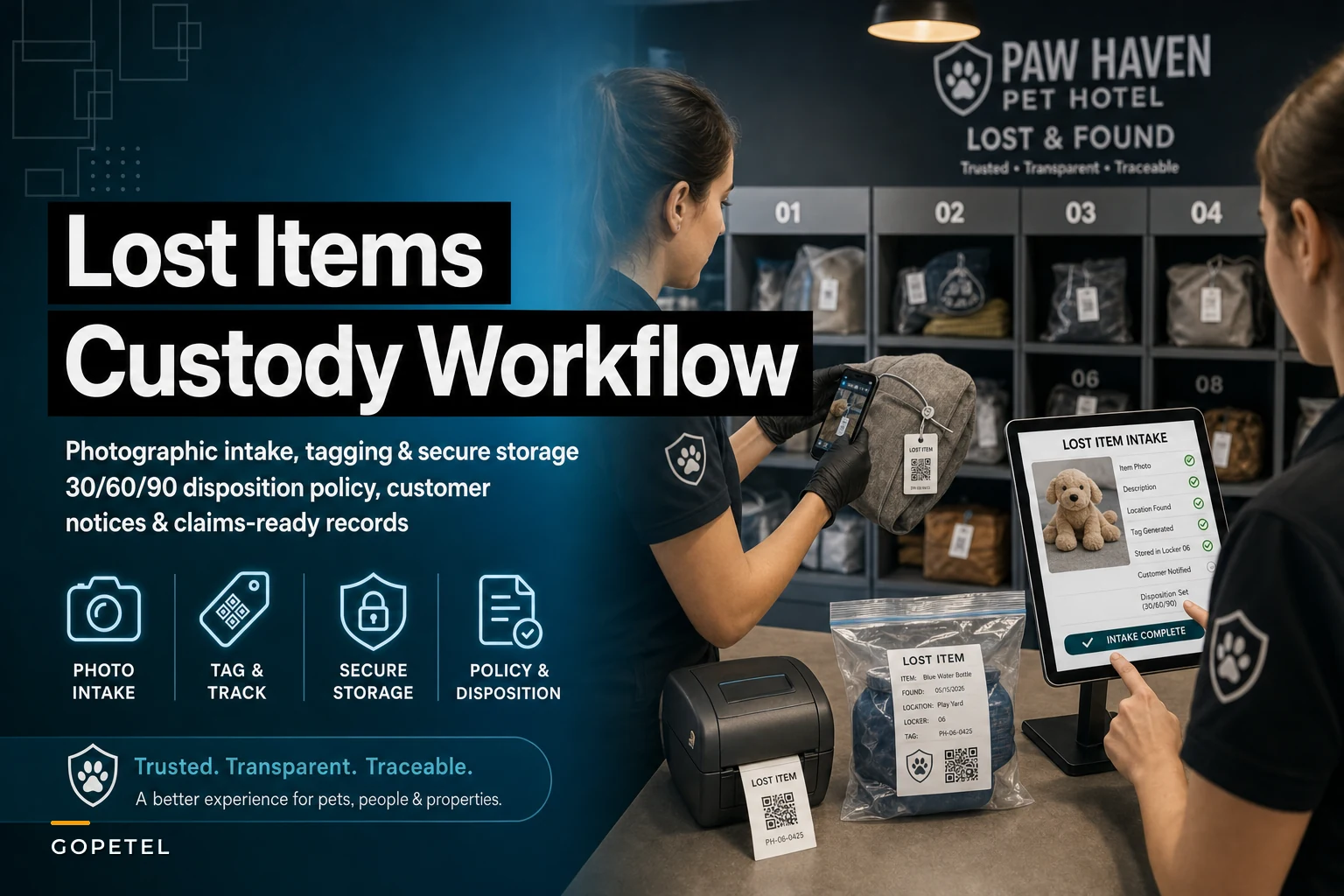
Photograph everything at intake. Before the owner leaves, lay out all belongings on a clean surface and take one or two photos. Capture the blanket, the toys, the collar, the food container, the meds. One photo is worth more than a paragraph of notes because it settles color, quantity, and condition instantly.
-
Tag the belongings to the pet. Every item — or the bag holding them — gets a tag with the pet's name, the owner's last name, and the kennel/run number. Use waterproof tags or a labeled bag. The goal is that anyone who finds the bag can reunite it without asking around.
-
Record a quick item list tied to the reservation. Even with photos, keep a short count: "1 blanket (gray), 2 toys, 1 harness (orange), meds: 1 bottle + schedule." The count is what you verify against at discharge.
-
Store belongings by a fixed rule, not by convenience. Bags go in a numbered cubby matching the kennel, or travel with the pet's kennel card — but always the same way, every time. Inconsistent storage is where items vanish.
-
Separate and lock medications. Meds never go in the general belongings bin. They live in a labeled medication area with the pet's name and dosing schedule. This ties directly into your medical handling and protects you if a client later questions what was administered.
-
Verify at discharge against the intake photo. Before handing anything over, the discharging staff member pulls up the intake photo and the item list, confirms each item, and checks it off. If something's missing, you find out now — while the client is standing there — not two days later over text.
-
Get a return confirmation. The owner confirms they received their belongings at pickup. A signature, a checkbox, or a quick "confirmed at pickup" note. This single step kills the majority of "you lost it" disputes, because you have their acknowledgment on record.
The whole thing adds maybe 60–90 seconds at intake and 30 seconds at discharge. That's the trade-off: a couple of minutes per stay to eliminate the argument entirely.
The 30/60/90 disposition policy for unclaimed items
The other half of the problem is what happens to stuff nobody picks up. Without a rule, forgotten blankets and toys accumulate until someone clears the shelf — and inevitably tosses something a client wanted.
A simple, written disposition timeline solves this and gives you a defensible answer when someone shows up looking for a toy from three months ago.
-
Day 0–30 (Hold & notify) Item is stored, tagged, and the owner is notified it was left behind. First notice goes out within 48 hours of discharge.
-
Day 31–60 (Second notice) A second reminder goes out. State clearly that unclaimed items will be donated or discarded after 90 days.
-
Day 61–90 (Final notice) A final notice with a hard date. "If not retrieved by [date], the item will be donated."
-
Day 90+ (Disposition) Item is donated, discarded, or — for valuable items — held longer at your discretion. Log the disposition with a date and who handled it.
Post this policy where clients can see it and include it in your intake paperwork. Once you've given written notice with a deadline, you've acted in good faith. A client can't reasonably claim you "threw away their property" when you notified them three times over 90 days.
Customer-notice templates
First notice (within 48 hours):
> Hi [Name], Max left behind 1 gray blanket and 1 orange harness after his stay. We're holding these for you. You can pick them up anytime during business hours. Per our policy, unclaimed items are held for 90 days. Thanks!
Final notice (day ~75):
> Hi [Name], a reminder that we're still holding Max's belongings (1 gray blanket, 1 orange harness). Per our lost-and-found policy, items not retrieved by [date] will be donated. Please let us know if you'd like us to hold them longer.
A quick note on tone: "per our policy" does real work in these messages. It signals that you have a policy, that it was communicated, and that you're following it — without being defensive about any of it.
Documenting for a small-claims threat
Most belonging disputes never reach small claims — but the ones that do are won or lost on documentation. If an owner files over a "lost" $120 harness, here's what makes your case airtight:
-
The intake photo, timestamped, showing exactly what arrived (and whether that harness was even in the frame).
-
The tagged item list from the reservation.
-
The discharge verification showing items checked off against the photo.
-
The return confirmation — the owner's signature or acknowledgment at pickup.
-
Your posted lost-and-found and disposition policy, which the client agreed to at intake.
A realistic example of how this plays out: an owner claims a designer collar never came back and demands $140. You pull the intake photo. The collar in the photo is a plain nylon one, not the designer piece they're describing — and the discharge checklist shows it was returned and confirmed. The dispute ends in one email. No photo, and you're writing a $140 check and hoping they don't leave a review.
This documentation discipline is the same muscle that protects you in bigger situations. The same habits that keep belonging disputes clean also strengthen your broader liability paper trail — the kind covered in building an incident-reporting, e-sign and retention workflow, and the readiness you need when a genuine emergency hits. Belongings custody is the low-stakes version of a skill you want sharp for the high-stakes moments.
A real scenario
A suburban pet hotel with about 25 runs was losing time and goodwill to belonging complaints — roughly a dozen a month at peak, averaging maybe $40 each to resolve between replacements and comped services. Staff dreaded discharge because half the arguments happened right there at the counter.
They changed three things: a photo at every intake, numbered cubbies matching kennel numbers, and a discharge check against the photo with a pickup confirmation. No fancy system at first — just a shared phone album and a laminated checklist.
Within two months, disputes dropped to two or three a month, and most of those were resolved on the spot by pulling up the intake photo. The owner estimated they recovered somewhere around $300–$400 a month in avoided refunds and replacements. The harder-to-measure win: staff stopped bracing for a fight at every pickup. The photos did the arguing for them.
Where software quietly helps
You can run this with a phone camera, labeled bags, and a checklist — plenty of facilities do. The friction shows up at scale. When you're doing 40 intakes in a holiday week, keeping photos tied to the right reservation, triggering the 48-hour notice automatically, and firing the 30/60/90 reminders by hand gets missed.
An AI-powered operations platform earns its keep here by attaching intake photos directly to the booking, prompting staff through the discharge checklist so nothing gets handed over unverified, and automatically sending the custody notices on schedule. The documentation gets created as a byproduct of the normal workflow instead of being a separate chore someone forgets during the rush.
The point isn't the software. It's that the proof exists without anyone having to remember to create it.
When this level of rigor is worth it — and when it isn't
If you're a tiny operation boarding three or four dogs a week for regulars who've known you for years, full photographic custody is probably overkill. A labeled bag and a text at pickup covers you.
The rigor becomes worth it the moment you hit enough volume that the intake person and the discharge person are often different people, or once you've eaten more than a couple of belonging refunds. That handoff gap between different staff members is the real trigger — not the number of kennels. If one person checks everyone in and out, your risk is low. The day you add a second shift, build the chain of custody before you need it.
Bottom line
Lost-and-found disputes feel too small to systematize until you total up a year of refunds, replacements, awkward pickups, and the occasional ugly review. The facilities that stop bleeding here aren't the careful ones — they're the ones who made custody provable. A photo at intake, a tag linking belongings to the pet, a discharge check, a pickup confirmation, and a clear 30/60/90 policy. None of it is complicated. It just has to happen every single time, especially the weeks you're too busy to think. That consistency is the whole game.
Ready to optimize your pet hotel operations?
Join hundreds of pet hotels using GoPetel to save time, improve pet care, and increase booking reliability.