

A pet hotel owner in Austin showed me their incident binder three months ago. Handwritten notes on printer paper, some signed, most not. Waivers stuffed in a filing cabinet from 2019. When their insurance company asked for documentation after a dog fight led to a $14,000 vet bill claim, they spent four days scrambling through boxes trying to piece together what happened.
The insurance company denied coverage. The incident report was filled out six days after the event, the waiver was missing a liability clause, and they couldn't prove they'd followed their own escalation procedures. That single gap in their pet boarding incident reporting workflow cost them the full settlement plus legal fees.
This happens constantly. Most pet hotels piece together incident management as problems arise. A bite happens, you create a form. Insurance asks for records, you buy a scanner. A lawsuit threat comes in, you suddenly care about retention schedules. But playing catch-up with documentation when you're already facing liability is like installing smoke detectors while the building burns.
The four-layer documentation system that actually protects you
Running incident management correctly means building overlapping protection before you need it. Not just having forms — having the right forms, signed the right way, stored the right duration, with clear escalation paths that staff actually follow.
Start with understanding what you're protecting against. Insurance companies don't just want to see that an incident was documented. They want proof you had systems in place beforehand, that staff followed established procedures, that owners were properly notified, and that you maintained consistent documentation standards across all incidents. Lawyers look for the same things, plus they hunt for gaps in your waiver language and inconsistencies in how different incidents were handled.
Your documentation system needs four interlocking pieces working together:
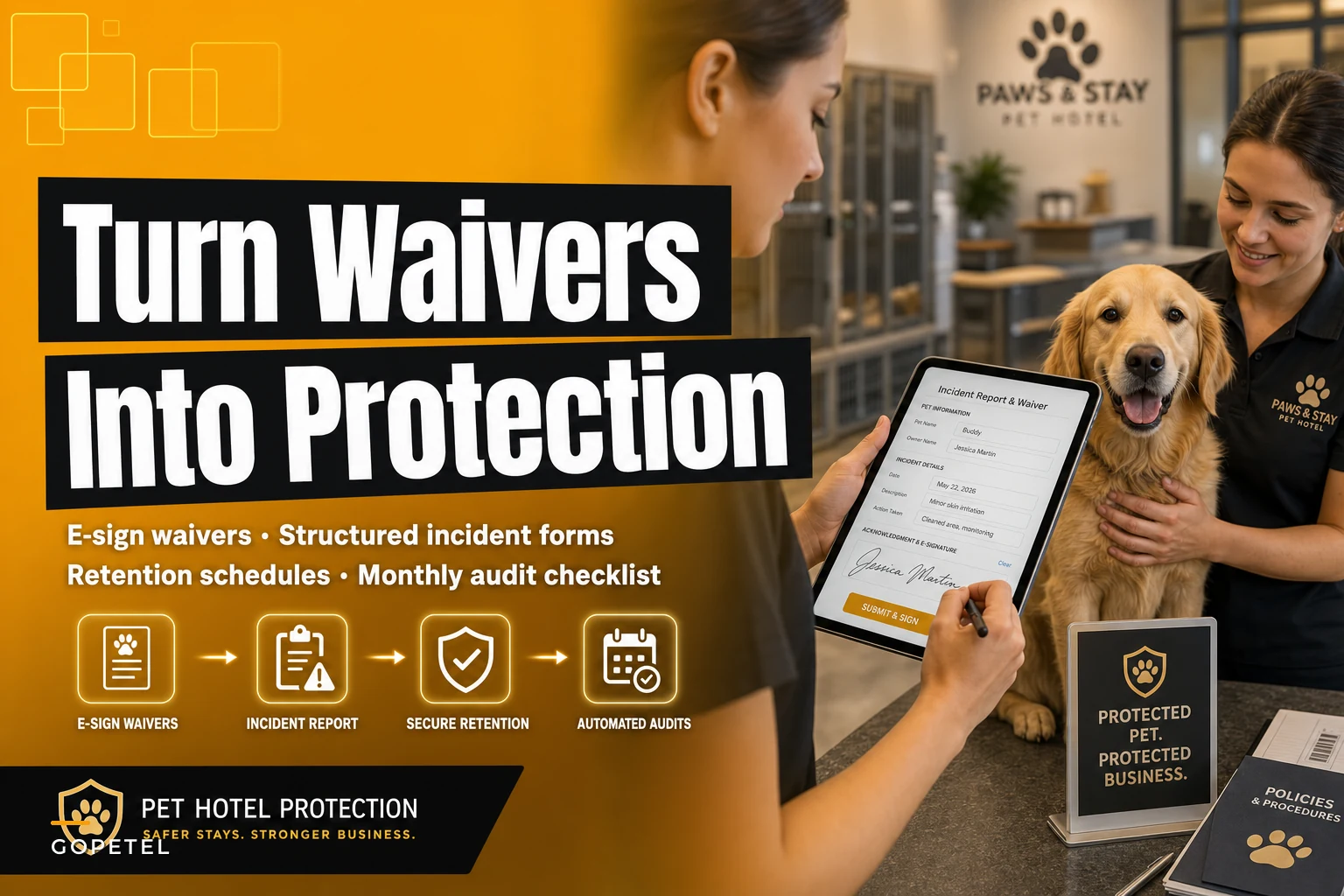
Digital waivers with specific incident language. Not generic liability waivers — incident-specific acknowledgments that spell out exact risks. Separate clauses for dog aggression, property damage, medical emergencies, and escape incidents. Each risk category needs its own acknowledgment because courts treat broad waivers as less enforceable than specific ones.
Structured incident capture forms. These can't be blank templates where staff write narratives. You need checkbox sections for incident type, severity level, immediate actions taken, witnesses present, and timestamp fields for each action. Narrative sections should be guided with specific prompts, not open-ended "describe what happened" boxes.
Retention and audit schedules. Not everything needs to be kept forever, but some things do. Incident reports involving injury need different retention than property damage reports. Your state's statute of limitations drives minimum retention, but insurance requirements often exceed those minimums.
Escalation trees with notification triggers. Who gets notified for what severity of incident, and when? A Level 1 property damage incident might only need shift supervisor notification, while a Level 3 bite requires immediate owner contact, vet referral, and insurance notification within 24 hours.
Here's a simple visual of how the four layers work together.
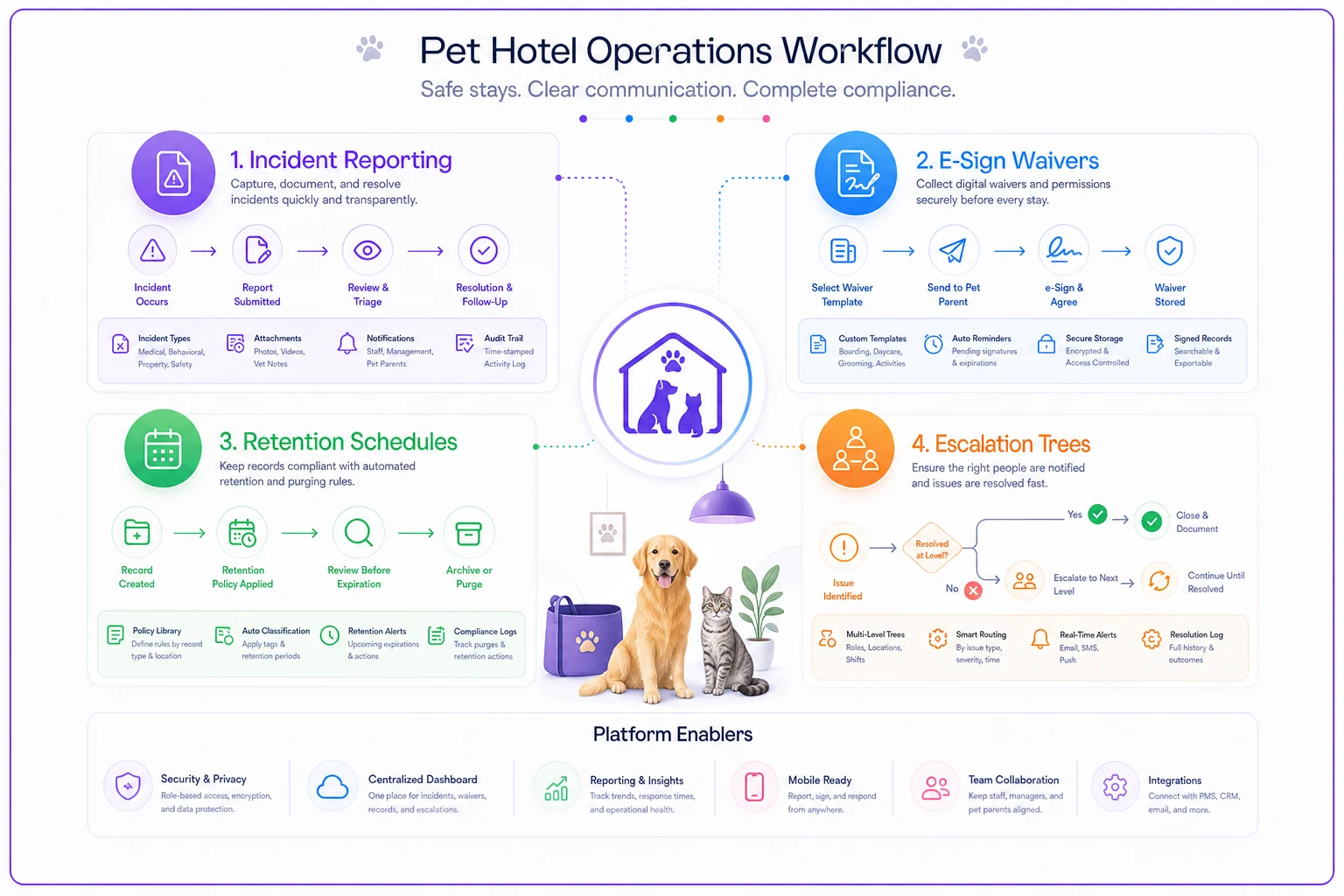
This diagram shows how waivers, incident capture, retention, and escalation interlock to provide layered protection.
Building waivers that courts and insurers actually respect
Generic pet boarding waivers downloaded from the internet won't protect you when it matters. Courts look at whether the waiver specifically addressed the risk that caused the incident. If your waiver talks vaguely about "pet interactions" but a dog escapes and causes a car accident, that generic language probably won't shield you.
Never miss a booking or detail again.
GoPetel simplifies pet hotel operations by managing every reservation and pet profile seamlessly.
- Centralized booking management
- Automated client notifications
- Staff and kennel scheduling
No credit card required
Here's what belongs in enforceable waivers:
Enumerated risk acknowledgments. Don't write "pets may interact." Write "I understand my pet may be bitten, scratched, or injured by other animals during group play, individual play, or through kennel barriers." List specific scenarios: fence fighting, resource guarding, play escalation, stress-induced aggression.
Medical decision authority. Spell out exactly what medical decisions staff can make without owner contact. Can you transport to emergency vet? Authorize stabilization treatment? Set dollar limits for emergency care? This prevents the "you should have called me first" disputes after emergency treatment.
Property damage responsibility. Dogs destroy things. Beds, toys, kennel doors, drywall. Your waiver needs clear language about owner responsibility for their pet's property damage, including damage to your facility and other pets' belongings.
Communication preferences and requirements. How will incidents be communicated? Establish that email notification meets your obligation unless they specifically request phone calls. Include language that failure to provide current contact information waives their right to immediate notification.
The e-sign component matters more than most operators realize. Courts have upheld e-signatures, but only when you can prove the signer's identity and intent. This means:
-
Capture IP addresses and timestamps
-
Require email verification before signing
-
Include "I agree" checkboxes for each major section
-
Generate unique document IDs for each signed waiver
-
Send immediate email confirmations with full copies
Store these digitally with backup systems. Physical waiver storage fails when you need it most. Water damage, misfiling, illegible signatures — these kill your protection when incidents escalate to legal action.
Incident forms that capture what lawyers actually need
Watch how most pet hotels document incidents: a staff member grabs a blank form, writes a paragraph about what happened, gets it signed by whoever's around. This creates massive gaps that lawyers exploit.
Professional incident documentation requires structured capture that guides staff through critical elements. Your incident form architecture should force completeness without creating complexity that staff skip under pressure.
Section 1: Incident Classification
Start with checkboxes, not narratives. Incident type (bite, escape, property damage, medical event, other). Severity level (1-5 scale with clear definitions). Location (specific area of facility). Time discovered versus estimated time occurred.
Section 2: Involved Parties
Every pet involved, not just the obvious ones. A dog fight might have two primary dogs but three others who were present and agitated. Document all of them. Include staff present, even if not directly involved. List any human injuries separately with their own detail section.
Section 3: Immediate Response
Checkbox list of standard responses: Separated animals, examined for injuries, contacted owner, administered first aid, called vet, took photographs. Include timestamp fields for each action. This proves you followed protocols, not just that an incident occurred.
Section 4: Detailed Narrative
Only after capturing structured data should staff write narratives. Provide prompts: What was happening immediately before? What triggered the incident? How did it resolve? What could have prevented it? These prompts extract useful information instead of rambling stories.
Section 5: Follow-up Requirements
Built-in tracking for required actions. Owner notification (timestamp and method). Vet referral provided (yes/no). Insurance notification required (yes/no with 24-hour deadline flag). Additional monitoring requirements for involved pets.
Digital forms beat paper every time for incident management. They timestamp automatically, can't be altered after submission, trigger immediate notifications, and create searchable records. The key is requiring completion before staff clock out. An incident form filled out three days later is nearly worthless for liability protection.
The retention schedule that satisfies insurers without hoarding forever
Pet hotels typically fall into two camps with document retention: keeping everything forever in boxes, or throwing everything away after a year. Neither approach works when you need documentation for defense.
| Retention Schedule |
|---|
| Incident Reports With Injury: 7 years minimum |
| Incident Reports Without Injury: 3 years |
| Waivers: Active plus 3 years |
| Medical Incident Documentation: 7 years |
| Video Footage: 60 days for routine, 2 years for incidents |
Build your retention schedule into operations, not hope someone remembers to review files annually. Digital systems can auto-archive or delete based on document type and date. Physical documents need quarterly review cycles with clear destruction logs.
The flip side of retention is proper destruction. Don't just throw old documents in the trash. Shred physical documents and permanently delete digital files. Document destruction dates and methods. This prevents someone claiming you destroyed evidence if an old incident resurfaces.
Monthly audits that catch gaps before lawyers do
Documentation systems degrade without regular audits. Staff get lazy with forms, waivers don't get updated for new risks, escalation procedures drift from written standards. Monthly audits catch these gaps while they're fixable.
Your audit workflow should check four areas:
Completeness Audit
Pull 10 random client files. Does each have a current signed waiver? Are all sections complete? For any clients with incident history, are all reports present and fully filled out? Track completion percentage and require 95% minimum.
Timeliness Audit
Review all incidents from the past month. How long between incident and documentation? Between incident and owner notification? Between incident and insurance notification if required? Late documentation is nearly as bad as no documentation for liability defense.
Escalation Compliance
Did Level 3 incidents trigger proper notifications? Were supervisors contacted for Level 2+ events? Did insurance get notified within 24 hours for injury incidents? Your escalation tree is worthless if nobody follows it.
Waiver Currency
Waivers need updates when laws change, new services launch, or incidents reveal gaps. Review your standard waiver quarterly. When did you last update injury language? Do you have escape-specific acknowledgments after that trending door-darting incident type? Are your medical authority limits still appropriate?
Automate the 10-file pull process to maintain audit consistency.
Track audit results monthly and address gaps immediately. If staff consistently file reports late, that's a training issue. If certain incident types lack proper forms, create them now. If waivers have outdated language, update and re-sign with all active clients.
The escalation tree that ensures consistent response
Incident response can't depend on who's working that shift. Every incident needs the same escalation based on type and severity, not staff judgment in the moment.
Map out your escalation tree with clear triggers:
Level 1: Minor property damage, mild behavioral issues
-
Document within 2 hours
-
Notify shift supervisor before end of shift
-
Owner notification at pickup (or within 48 hours)
-
No insurance notification required
Level 2: Moderate injury (no vet required), significant property damage, escape recovered immediately
-
Document within 1 hour
-
Notify manager immediately
-
Owner notification within 4 hours
-
Insurance notification if damage exceeds $500
Level 3: Injury requiring vet care, escape with recovery delay, human injury
-
Document immediately (before any other action except medical care)
-
Notify owner and manager immediately
-
Insurance notification within 24 hours
-
Preserve all video footage
Level 4: Severe injury, hospitalization, escape without recovery
-
All Level 3 requirements plus
-
Legal counsel notification within 2 hours
-
Written statements from all witnesses within 24 hours
-
Complete facility video preservation
Print this escalation tree and post it everywhere staff congregate. Include it in training. Quiz staff monthly on proper escalation. The biggest liability gaps come from inconsistent response, not the incidents themselves.
Build notification templates for each level. Staff under stress write poor communications. Give them templates: "Your pet [name] was involved in a Level 2 incident at [time]. No medical attention was required, but we observed [specific injury/issue]. We've separated them and are monitoring closely. Please call us at [number] to discuss."
When automated documentation and workflow tools make sense
Manual documentation systems work until they don't. As you grow past 30-40 dogs per day, paper forms and filing cabinets become liability traps. Staff skip steps, forms get misfiled, retention schedules get forgotten.
AI-powered operational software transforms incident management from reactive scrambling to systematic protection. Instead of hoping staff remember to complete forms, digital workflows enforce completion before they can clock out. Instead of manually tracking retention schedules, documents auto-archive based on type and date. Instead of wondering if escalation happened properly, automated notifications trigger based on incident classification.
The real value isn't just digitization — it's workflow enforcement. When a Level 3 incident gets logged, the system immediately notifies managers, generates owner notification drafts, sets insurance notification deadlines, and preserves relevant video. Staff can't skip steps because the system won't let them.
Modern platforms also solve the searchability problem. When a lawyer requests "all incidents involving Dog X over the past three years," you run a search instead of digging through boxes. When insurance wants to see your escalation compliance rate, you generate a report instead of manually reviewing records.
The biggest impact comes from pattern recognition that manual systems miss. AI automation can flag when specific dogs have multiple Level 2 incidents trending toward Level 3. When certain play groups generate more incidents. When specific staff members consistently have documentation gaps. These insights let you prevent incidents, not just document them better.
The difference between documentation theater and actual protection
Plenty of pet hotels have forms, waivers, and filing systems. They check the boxes, feel protected, then get destroyed when a real claim hits because their documentation was theater, not protection.
Real protection requires integration across all four layers. Your waivers must specifically address the risks your incident forms document. Your retention schedule must align with your escalation triggers. Your monthly audits must verify all pieces work together.
Consider this scenario:
A 75-pound lab named Duke has stayed with you monthly for two years. During afternoon playgroup, he redirects onto a smaller dog after a tennis ball dispute, causing puncture wounds requiring emergency vet care. The smaller dog's owner threatens to sue for the $3,200 vet bill plus "emotional distress."
With proper documentation systems:
-
Your waiver specifically mentions resource guarding and redirection risks
-
Duke's file shows two previous Level 1 resource guarding incidents, properly escalated
-
The Level 3 incident report was filed within 30 minutes, with photos
-
Owner notification happened within 1 hour via phone and email
-
Insurance was notified within 4 hours with full documentation
-
Video footage was immediately preserved showing the smaller dog initiated the resource competition
Without proper systems:
-
Your generic waiver mentions "dog interactions" but not resource guarding
-
Duke's previous incidents weren't documented because "they weren't serious"
-
The incident report was written three days later from memory
-
Owner notification was verbal only, no documentation
-
Insurance wasn't notified for a week
-
Video was already overwritten
Insurance denies coverage due to late notification and poor documentation. You pay the vet bill out of pocket. The emotional distress claim proceeds because you can't prove what actually happened.
Beyond compliance: building trust through transparency
Strong documentation systems do more than protect against liability — they build client trust. Pet owners choosing boarding facilities increasingly expect professional operations, not casual pet-sitting. When they see structured incident reporting, clear escalation procedures, and comprehensive waivers, they recognize operational maturity.
Some facilities worry that detailed waivers and incident procedures scare clients away. The opposite is true. Dog owners understand their pets aren't perfect. They want to know you have systems to handle problems professionally. Being upfront about risks and your management approach attracts clients who value transparency over empty promises of "nothing will ever happen."
Use your documentation standards as a selling point. During tours, mention your escalation procedures. Show sample incident reports (redacted). Explain your staff training on proper documentation. This positions you as the professional option, worth the premium pricing you should be charging.
The pet boarding incident reporting workflow you build today determines whether you survive the inevitable incidents tomorrow. Every pet hotel faces incidents — bites, escapes, medical emergencies. The difference between devastating liability and manageable insured events comes down to documentation systems built before you need them.
Start with your waivers. Update them with specific risk language. Move to e-signatures with proper verification. Build structured incident forms that capture what lawyers and insurers actually need. Create retention schedules that balance protection with practicality. Establish monthly audits that catch gaps while they're fixable. Map clear escalation trees that remove staff judgment from critical moments.
Most importantly, integrate these pieces into a single workflow. Your vaccination verification systems and infection control frameworks mean nothing if incident documentation fails when you need it most. Protection comes from systems, not good intentions. The Austin facility I mentioned? They rebuilt their entire documentation workflow after that $14,000 lesson. New e-sign waivers with enumerated risks. Digital incident forms with mandatory completion. Automated retention schedules. Clear escalation procedures posted everywhere. Six months later, another incident occurred — insurance covered everything because the documentation was bulletproof. You can build these systems manually with enough discipline, or use operational software that enforces workflows automatically. Either way, build them now. Because when that first serious incident hits, it's too late to wish you had better documentation.
Ready to optimize your pet hotel operations?
Join hundreds of pet hotels using GoPetel to save time, improve pet care, and increase booking reliability.