


Most membership programs at pet hotels start as a good idea and turn into an operational headache about four months in. The math looked clean on a spreadsheet: sell 40 "Unlimited Daycare" passes at $180/month, that's roughly $7k in recurring revenue, done. Then Thanksgiving hits, the members show up expecting the boarding they were promised, and your actual paying-per-night customers get bumped or turned away. Now you've traded high-margin holiday nights for flat monthly fees. That's the trap.
The problem isn't the membership itself. It's that most passes get sold before anyone designs the operational rules that govern them — booking priority, capacity caps, blackout windows, and how the revenue actually gets recognized. Get those four wrong and a membership program doesn't add predictable revenue. It quietly eats your best nights.
The three ways a membership silently breaks your booking flow
1. Members displace higher-value bookings. A daycare member paying $180/month who visits 12 times is worth $15/visit. A walk-in paying $42/day is worth almost triple. When your booking system treats both as just "a booking" with no priority logic, the member's recurring visit blocks a slot a full-price customer would've paid for. During slow weeks this doesn't matter. During peak weeks it's a direct margin leak.
2. No blackout windows means members expect your scarcest inventory. If you sold "unlimited" without carving out holidays, you've made an implicit promise. Members feel entitled to Christmas week — the exact nights you should be selling at surge pricing. When you tell them no, they churn and leave a bad review. When you say yes, you lose the surge revenue.
3. Fulfillment isn't tracked, so you can't tell profitable members from unprofitable ones. A membership is a liability until it's fulfilled. If you're not tracking usage against the cap, you have members burning 20 daycare days a month on a plan priced for 10, and others using two. You're subsidizing your heaviest users with your lightest ones, and you can't see it happening.
Each of these traces back to the same root: memberships were sold as a marketing product, not designed as an operational one.
Booking-priority rules: decide who wins the last kennel
The single most important design decision is what happens when demand exceeds capacity. Someone has to lose the last slot. Deciding in advance — and encoding it as a rule — is the whole game.
Never miss a booking or detail again.
GoPetel simplifies pet hotel operations by managing every reservation and pet profile seamlessly.
- Centralized booking management
- Automated client notifications
- Staff and kennel scheduling
No credit card required
| Booking type | Priority tier | Can book during blackout? | Counts against cap? |
|---|---|---|---|
| Full-price boarding (non-member) | 1 (highest) | Yes | N/A |
| Member with confirmed advance reservation | 2 | Only with paid upgrade | Yes |
| Member same-day/walk-up | 3 | No | Yes |
| Free-trial / promo pass | 4 (lowest) | No | Yes |
The logic that trips people up: members should get convenience priority, not capacity priority. A member gets early access to book — say, a 14-day window vs. 7 for the public — but does not get to displace a full-price booking when you're at capacity. Early access rewards loyalty without costing you your best inventory.
A practical rule of thumb: reserve a fixed percentage of your peak-period capacity for full-price bookings only. If you have 30 boarding suites, cap member boarding at 18 during any high-demand week. The remaining 12 stay open for full-rate customers right up until day-of. Members can still book — they just compete for the 18, not the 30.
This ties closely to how you think about utilization and pricing overall. If you haven't built out the underlying packaging logic yet, membership priority rules will feel arbitrary. It's worth working through pricing and utilization systems first so priority tiers actually map to margin.
Caps: the difference between "unlimited" and "unlimited-ish"
"Unlimited" is a marketing word that creates operational debt. The facilities that run memberships profitably almost never sell true unlimited. They sell soft caps dressed up as generous.
-
Hard visit cap. 12 daycare days/month, hard stop. Simple to enforce, easy for staff to understand. Downside: members hate hitting the wall.
-
Soft cap with overage. 12 included days, additional days at a discounted member rate ($22 vs. $42 walk-in). Usually the sweet spot — it feels generous, and heavy users become incremental revenue instead of a loss.
-
Rolling weekly cap. Max 3 visits/week rather than a monthly total. Underrated, because it smooths demand. A monthly cap lets someone dump all 12 visits into the two weeks around a holiday. A weekly cap prevents the bunching that wrecks your staffing.
The mistake almost everyone makes: setting the cap based on what sounds good in the ad instead of your actual cost per visit. Run the number. If a daycare day costs you roughly $9–$12 in labor and consumables, and you're charging $180/month, your break-even is around 15–18 visits before that member is unprofitable. Set the cap comfortably under that, and price overages so they stay above cost.
Blackout windows: protect your surge inventory in writing
This is the section people skip and regret. Blackout windows are the dates where membership benefits are suspended and everyone pays surge rates — holidays, long weekends, local event weeks.
Define blackouts as specific dates at sign-up, not as a vague clause. "Membership excludes peak holidays" is unenforceable and generates arguments at the front desk. "Membership benefits are suspended Nov 22–29, Dec 20–Jan 2, and the week of July 4th" is something your staff can point to without apologizing.
Offer a paid blackout upgrade instead of a flat no. A member who wants Christmas boarding pays the surge rate minus a small member discount, and their normal monthly benefit doesn't apply. You keep the high-margin holiday night, the member feels taken care of, and nobody's inventory got given away for a flat monthly fee.
A realistic example of what this protects: a 25-suite facility with 30 members. Without blackouts, if even 10 members claim holiday boarding at their flat rate, you've converted maybe $2,000–$2,500 of surge-rate nights into essentially $0 marginal revenue, because those nights were already "paid for" by the membership fee. Blackout windows recover that directly.
The revenue-recognition checklist nobody wants to do
Membership money hits your account before the service is delivered, which means it's not really earned yet. If you book it all as revenue on day one, your P&L lies to you — it looks like a great month, then you're delivering services against cash you already spent.
-
[ ] Is the monthly fee recognized as revenue as visits are fulfilled, or spread evenly across the month? (Pick one and be consistent.)
-
[ ] Do you track unused visits as a liability, and do they expire or roll over? (Rollover is a growing liability — cap it.)
-
[ ] Is there a breakage estimate — the percentage of paid-for visits members never use? (Real profit, but only if you can see it.)
-
[ ] Are overage charges tracked separately from base membership revenue?
-
[ ] When a member churns mid-month, what happens to the unfulfilled portion — refund, forfeit, or prorate? Written down?
-
[ ] Can you produce a per-member margin number — fee collected minus cost of visits actually delivered?
That last one is the whole point. If you can't produce per-member margin, you're flying blind on whether the program helps or hurts. The facilities that get this right treat each member almost like a mini account with its own utilization and P&L — the same discipline you'd apply to tracking client value and rebooking behavior across your whole customer base.
Fulfillment templates: making the rules run without front-desk arguments
Rules only work if the front desk can execute them under pressure. The goal is that a new staff member on a busy Saturday can enforce every rule above without calling you. That takes a defined workflow, not tribal knowledge.
Use your booking software to enforce caps and blackout rules at the point of booking to avoid manual errors.
-
At booking System checks membership status → checks if requested date falls in a blackout window → checks remaining cap for the period.
-
If blackout Member is shown the surge rate with member discount applied; membership benefit is automatically excluded.
-
If over cap Member is shown the overage rate; visit is flagged as billable overage, not an included visit.
-
If within cap and non-blackout Booking confirmed, remaining cap decremented, visit logged for revenue recognition.
-
At fulfillment (check-in) Visit marked delivered → moves from liability to recognized revenue.
-
Monthly Unused visits calculated, breakage recorded, per-member margin generated.
This flow visualizes the fulfillment steps above.
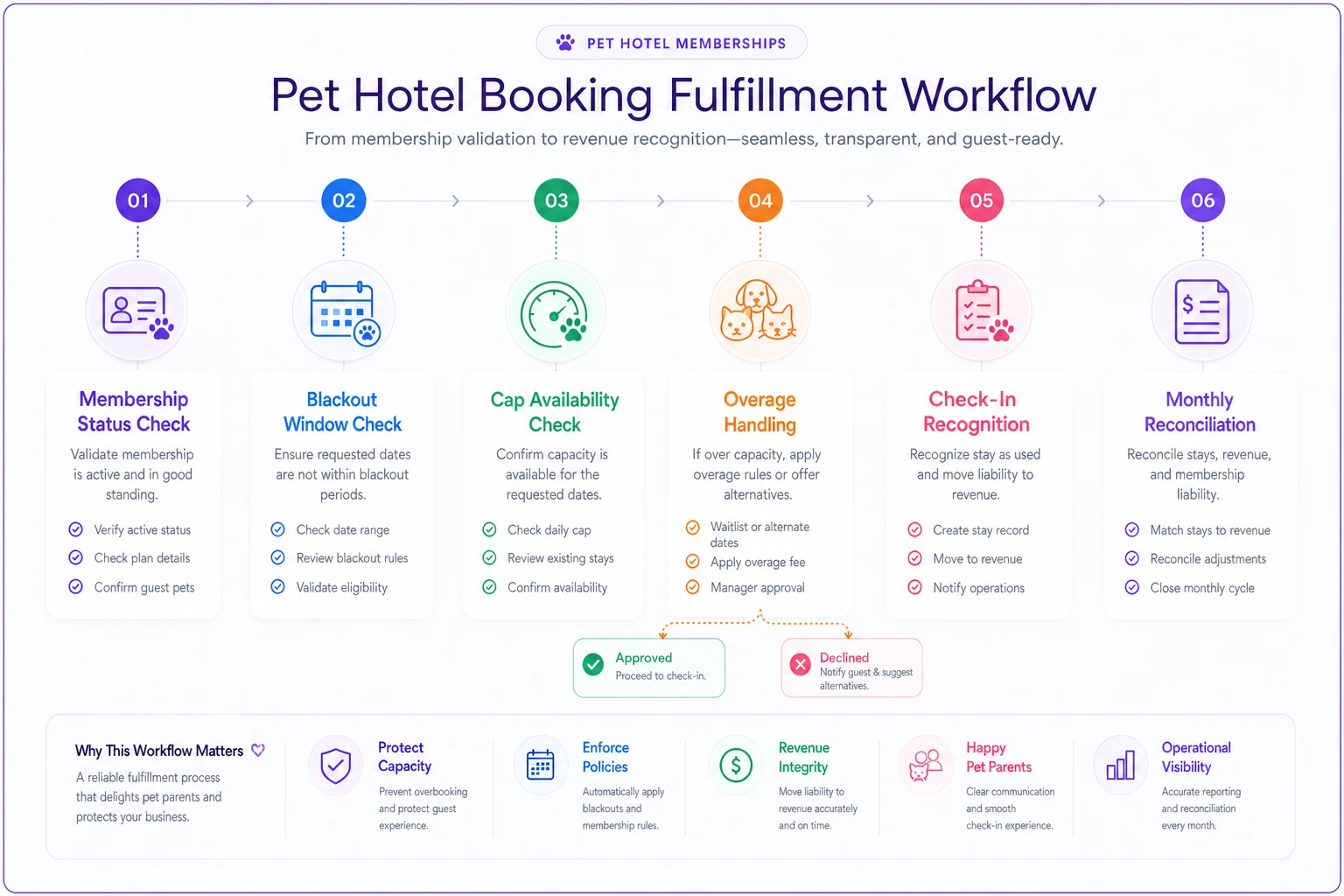
Every step in that flow is a decision your staff currently makes ad hoc — and inconsistently. When it's a defined sequence, enforcement stops being a personality thing (some staff cave, some don't) and becomes a process thing.
This is also where booking software earns its keep. Manually checking caps and blackout dates against a paper calendar is where the whole system falls apart — someone forgets to decrement a visit, a member sneaks a blackout booking, the liability tracking drifts. A platform that enforces priority tiers, caps, and blackout rules at the point of booking — and automatically moves visits from liability to recognized revenue at check-in — removes the human error without adding front-desk friction. But the software only matters after you've designed the rules. Automating a badly designed membership just breaks things faster.
A real scenario: 30-member daycare program, before and after
A mid-size facility — around 22 suites plus a daycare floor — launched a daycare membership at $165/month, sold as "unlimited weekday daycare." Within a couple months they'd sold about 35 memberships, roughly $5,700/month in recurring revenue. Looked great.
The problem showed up on the operations side. A handful of heavy users were dropping off dogs 18–20 times a month. The daycare floor was hitting capacity by mid-morning on Tuesdays and Wednesdays, turning away drop-in customers paying $38/day. And because there were no blackout rules, members expected daycare during the holiday stretches when the team was already stretched thin on boarding.
They reworked it: switched from "unlimited" to 12 included days with overage at $24, added a rolling weekly cap of 4 visits, and defined blackout dates for the two major holiday windows. They also reserved a portion of daily daycare capacity for drop-ins only.
Over the next quarter, base membership revenue stayed roughly flat, but overage charges added somewhere in the $600–$900/month range. Drop-in daycare recovered because the floor wasn't maxed by members alone. And — maybe most useful — they could finally see which members were actually profitable. Two were quietly costing more in labor than they paid; those got moved toward a plan that fit. Nothing dramatic happened to the top line, but the margin quality of the whole program improved, and peak days stopped feeling like a fire drill.
When a membership program actually makes sense (and when it doesn't)
When it makes sense: You have predictable slow periods you want to fill, a base of repeat local daycare customers, and enough booking discipline to enforce caps and blackouts. Memberships work well for smoothing weekday daycare demand and locking in loyalty.
When it's a bad idea: If your facility runs near capacity most of the year, a membership just discounts inventory you'd sell at full price anyway. High-occupancy facilities almost always benefit more from pricing and packaging refinements than from memberships.
Who should not do this yet: Anyone who can't currently track per-service cost and utilization. If you don't know what a daycare day costs you or where your capacity ceiling is, you can't set a meaningful cap or break-even — and a membership guessed wrong compounds monthly.
The bottom line on pet hotel membership operations
A membership isn't a product you sell. It's a set of operational promises you have to fund out of your capacity. The programs that add predictable revenue are the ones where booking priority, caps, blackout windows, and revenue recognition were designed before the first pass got sold. The ones that break operations are almost always the ones that launched on a nice-sounding "unlimited" offer with no rules underneath it.
Start with the four controls, write them into your booking flow so the front desk can enforce them without you, and track per-member margin so you can see which members help and which quietly drain you. Do that, and memberships stop being a gamble on your best nights and start being the steady revenue layer you meant them to be.
Start with the four controls, write them into your booking flow so the front desk can enforce them without you, and track per-member margin so you can see which members help and which quietly drain you. Do that, and memberships stop being a gamble on your best nights and start being the steady revenue layer you meant them to be.
Ready to optimize your pet hotel operations?
Join hundreds of pet hotels using GoPetel to save time, improve pet care, and increase booking reliability.