

The scary thing about a diet mix-up isn't that it happens during chaos. It happens on a calm Tuesday morning when a staffer scoops from the wrong bin because two labels looked almost identical. Nobody notices. The dog goes home three days later with diarrhea, the owner calls angry, and now you're reconstructing which meal went wrong from a fridge with no paper trail.
Boarding kitchens rarely fail dramatically. They fail in small, invisible ways—a shared scoop, a bag left open, a handwritten note that got smudged. With more owners feeding prescription diets, raw, home-cooked, and allergen-restricted meals, the margin for error keeps shrinking. A solid pet hotel allergen SOP isn't paperwork for its own sake; it's what stands between you and a refund, a bad review, or a vet bill you're suddenly responsible for.
This post is narrow on purpose. We're only talking about the kitchen: how diets get mapped at intake, how meals get assembled, how food gets labeled and stored, and how you audit it. Not health screening, not medication—those live elsewhere.
The five ways diets actually get crossed
Before fixing anything, it helps to name the specific failure points. Cross-contamination almost never comes from one big mistake. It comes from one of these five, usually repeating quietly until something goes wrong.
| Failure point | What it looks like in practice | Why it slips through |
|---|---|---|
| Vague intake info | "He's allergic to chicken, I think" written on a form | No structured diet mapping at booking |
| Shared equipment | One scoop used across three bins | Speed pressure during morning feed |
| Ambiguous labels | Two beige bags, both "Max," different rooms | No standard tag template |
| Storage co-location | Raw diet stored above dry kibble | No segregation rule |
| No verification step | Bowl handed off with no second check | Assembly done solo, no audit |
Worth noticing: four of those five have nothing to do with the food itself. They're information and handling problems. A dog with a beef allergy doesn't get sick because beef is dangerous—he gets sick because the beef bin's scoop touched his bowl. Fixing cross-contamination is mostly about controlling handoffs, not ingredients.
A solid intake and handling flow closes those handoffs so the food itself never has to be blamed.
Start where the mistake starts: intake diet-mapping
Most kitchen errors are actually intake errors that surface later. When an owner says "she has a sensitive stomach," that phrase has to survive a booking system, a shift change, and three different staffers before it becomes an actual bowl of food. If it enters your system as a free-text note, it will not survive.
Never miss a booking or detail again.
GoPetel simplifies pet hotel operations by managing every reservation and pet profile seamlessly.
- Centralized booking management
- Automated client notifications
- Staff and kennel scheduling
No credit card required
-
Diet type (dry / wet / raw / home-cooked / prescription)
-
Brand and exact product (down to the formula—"Adult Chicken" vs "Adult Salmon" matters)
-
Portion (weight or volume, per feed, not per day)
-
Feed schedule (times, not "twice a day")
-
Restrictions (specific proteins/ingredients, flagged separately from preferences)
-
Owner-provided vs facility-provided food
That last one causes more silent errors than people expect. When an owner brings pre-portioned bags but the intake form doesn't clearly say "owner food only, do not substitute," a staffer runs out and helpfully tops up with house kibble. For an allergy dog, that's the whole incident right there.
A quick related note: your intake structure for diet should sit alongside your health document intake, since the two often reference each other—prescription diets, vet-recommended restrictions. If your document flow is still loose, the vaccination verification matrix and document-intake workflow approach applies almost identically to diet documentation. Same principle: structured capture instead of free text.
Meal-assembly workflow: the part everyone rushes
Morning feed is the highest-risk window in the entire kitchen. You've got 20–40 bowls to build, dogs barking, staff hurrying, and every shortcut you've quietly tolerated shows up at once.
A meal-assembly sequence that holds up under pressure looks like this—built so speed doesn't force cross-contamination:
-
Print or pull the feed sheet first. Every bowl gets built against a written diet card, never from memory.
-
Build allergy and prescription diets first, before anything else touches the counter. Clean surface, clean scoop, dedicated. Do these while the workspace is still uncontaminated.
-
One scoop per bin, no exceptions. Scoops live inside their bin, not in a shared cup. This single rule prevents more contamination than anything else on this list.
-
Label the bowl as you build it, not after. The label goes on before the food, not from a stack you sort later.
-
Assemble standard diets last, in whatever batch order is efficient.
-
Second-check station. One person confirms each labeled bowl against the feed sheet before it leaves the kitchen.
The reason allergy diets go first isn't fussiness. In a rushed kitchen, contamination accumulates—kibble dust, wet food splatter—all building up on the counter over the session. Restricted diets built first get the cleanest surface of the day.
The scoop rule deserves its own emphasis. A shared scoop moving between a chicken formula and a novel-protein formula leaves no visible trace, just trace protein. For a genuinely allergic dog, trace is enough. Scoops that physically live in the bin remove the decision entirely, and removing decisions during a rush is how you remove errors.
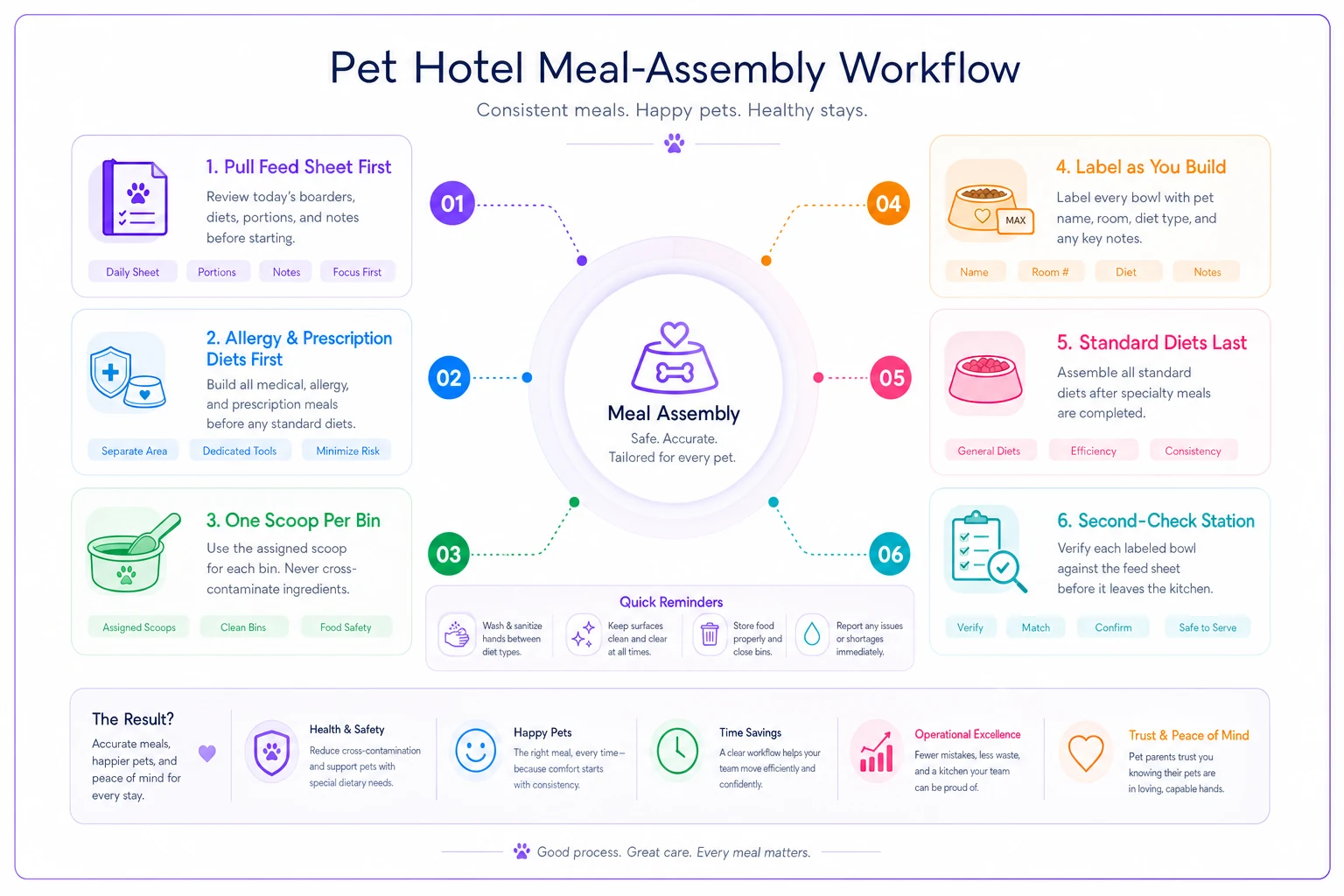
Use this visual as a quick reference during staff training.
Labeling and tag templates that don't get confused
The classic label failure is two dogs named Max. Or "Bella" and "Bela." Or a beige bag that could belong to any of four dogs. Names alone are not identifiers.
-
Pet name + run/kennel number (the number is the real identifier)
-
Owner last name
-
Diet type and portion
-
Allergy flag in a fixed color (red tape or red label—same color, every time, no creativity)
-
Owner-food indicator (a simple "OWNER FOOD" stamp)
-
Feed times
The color rule matters more than it sounds. When allergy dogs always get the same visual flag, a staffer scanning the fridge sees the risk without reading a word. Inconsistent color-coding—red one week, a highlighter circle the next—destroys the benefit, because the eye stops trusting it. Pick one allergy color and treat it as fixed.
For owner-provided food, label the container even if the owner already did. Their handwriting fades, bags tear, and their "Max" doesn't reference your kennel number. Re-label into your own system at intake so everything in the kitchen speaks the same language.
One pattern worth flagging: facilities that print labels have far fewer mix-ups than those handwriting them, but the real win isn't legibility. A printed label forces the information to come from the structured intake record rather than someone's memory of a conversation. The label becomes a receipt of the diet map, not a guess.
Storage segregation rules
Storage is where slow, silent contamination lives. A meal built perfectly can still be compromised by how food sits between feeds.
-
Raw diets always below cooked/dry, in sealed containers, on the bottom shelf. Drips go down, never up onto someone else's kibble.
-
Allergy-restricted foods get a dedicated zone, not just a dedicated container. A labeled shelf section, physically separated.
-
Owner food never mixes with house stock. Separate bin or shelf, clearly bounded.
-
Open bags get sealed and dated, always. An open bag is both a contamination path and a spoilage risk.
-
No decanting allergy diets into shared containers. Keep them in their original packaging so the formula is never in question.
The mistake that comes up most often isn't dirty storage—it's convenient storage. Someone stacks a raw container on top because there's space, or slides an allergy bag next to a similar-looking one because they're both "the salmon ones." Storage decisions made for convenience during a busy shift are exactly the decisions that cause problems three days later.
A related discipline: cross-contamination in the kitchen sits right next to broader facility hygiene. If you've already built out sanitation and handling standards from an infection-control and compliance framework, your kitchen SOP should plug into it rather than live as a separate island—same cleaning cadence, same accountability.
The audit checklist that catches problems before owners do
An SOP nobody checks is just a wish. The point of an audit isn't to catch staff—it's to catch drift, because kitchen discipline erodes gradually. The scoop stays in the bin for two weeks, then someone's in a hurry, then suddenly it's normal again.
Daily (end of morning feed):
-
Every allergy/prescription bowl matched feed sheet before leaving kitchen
-
All scoops returned to correct bins
-
Counters wiped between raw and dry handling
-
Open bags sealed and dated
-
Allergy zone contains only allergy diets
Weekly:
-
All labels legible and current (no fading, no old guests)
-
Raw stored below dry, no exceptions found
-
Owner food properly segregated and labeled to house standard
-
Expired/spoiled food removed
-
Feed sheets match current intake records (catch diet changes)
The weekly "feed sheets match intake records" check is the one people skip and the one that matters most. Diets change mid-stay—an owner calls, a vet updates a prescription—and if that change doesn't flow from the booking record to the kitchen sheet, you're feeding an outdated diet correctly, which is still wrong.
A real scenario: the two-beige-bags problem
A mid-size boarding facility—around 45 runs, feeding roughly 30–35 dogs on a busy weekend—kept getting minor "upset stomach" complaints, maybe two or three a month. Nothing catastrophic, but enough that a couple of regulars stopped rebooking. The owner assumed it was stress-related GI upset, which is common enough to hide the real cause for months.
When they actually mapped the kitchen, the problem was almost boring. Diets were captured as free-text booking notes. Meals were built from memory during a rushed morning feed. Scoops lived in a shared cup by the sink. And two dogs on limited-ingredient diets had similar beige bags stored right next to each other.
The fix wasn't expensive. Structured diet fields at intake, printed labels tied to those fields, one scoop per bin, allergy diets built first, and a two-minute second-check before bowls left the kitchen. Getting staff used to it took about a week.
Over the next couple of months, the "upset stomach" complaints dropped to nearly none—they had one, and it turned out to be genuine travel stress. More telling: two of the limited-ingredient-diet owners, the exact profile most likely to churn, started booking regularly again. Those are high-value, repeat clients precisely because their needs are hard to meet. Getting the kitchen right retained them.
Where structured systems quietly help
None of this requires software to work. Paper feed sheets and disciplined habits get you most of the way there. But the failure point in almost every kitchen is the gap between what was captured at booking and what actually reached the bowl. That handoff is where free-text notes die.
This is the one place an operational platform earns its keep: when the diet map entered at intake automatically becomes the printed label, the feed sheet, and the audit record, there's no re-typing, no memory, no smudged note. A diet change made by an owner updates the kitchen sheet the same day instead of living in someone's inbox. The value isn't automation for its own sake—it's that the same structured record follows the food from booking to bowl, so the information can't quietly degrade between shifts.
That's the whole game with cross-contamination: keep the diet information intact and unambiguous from the moment it's captured to the moment the dog eats. Every rule above—structured intake, dedicated scoops, consistent labels, segregated storage, real audits—exists to protect that one chain from breaking.
Bringing it together
Diet cross-contamination isn't a food-safety mystery. It's a series of small handling and information failures that each look harmless on their own. A dog gets the wrong meal because a label was ambiguous, a scoop was shared, or a note got lost between the front desk and the kitchen.
Build the kitchen so the safe path is the easy path—allergy diets first, one scoop per bin, allergy flags in one fixed color, raw below dry, and a quick check before bowls leave. Then audit lightly but consistently so the standards don't drift. Do that, and the angry calls, the refunds, and the quietly-churning special-diet clients mostly disappear—which, given that those are often your most loyal customers, is worth far more than the effort it takes.
Diet cross-contamination isn't a food-safety mystery. It's a series of small handling and information failures that each look harmless on their own. A dog gets the wrong meal because a label was ambiguous, a scoop was shared, or a note got lost between the front desk and the kitchen.
Build the kitchen so the safe path is the easy path—allergy diets first, one scoop per bin, allergy flags in one fixed color, raw below dry, and a quick check before bowls leave. Then audit lightly but consistently so the standards don't drift. Do that, and the angry calls, the refunds, and the quietly-churning special-diet clients mostly disappear—which, given that those are often your most loyal customers, is worth far more than the effort it takes.
Ready to optimize your pet hotel operations?
Join hundreds of pet hotels using GoPetel to save time, improve pet care, and increase booking reliability.