

Most pet hotels handle special‑needs animals by accident. A blind senior dog comes in, someone at the front desk feels bad, and they take the booking. Then the actual stay happens — and nobody documented that the dog panics when handled from the left side, that it needs eye drops twice a day, or that it can't do stairs. The kennel tech on shift figures it out the hard way. That's not a policy. That's improvisation dressed up as compassion.
The strange thing is that special‑needs boarding is one of the few genuinely underserved segments left in this business. Owners of deaf dogs, tripod cats, diabetic seniors, dogs with severe anxiety, mobility‑impaired animals — they call around and hear "we're not equipped for that" over and over. The demand is real and the competition is thin. But it stays untapped because the operational and legal exposure feels scary, and honestly, it should feel scary if you're doing it without a system.
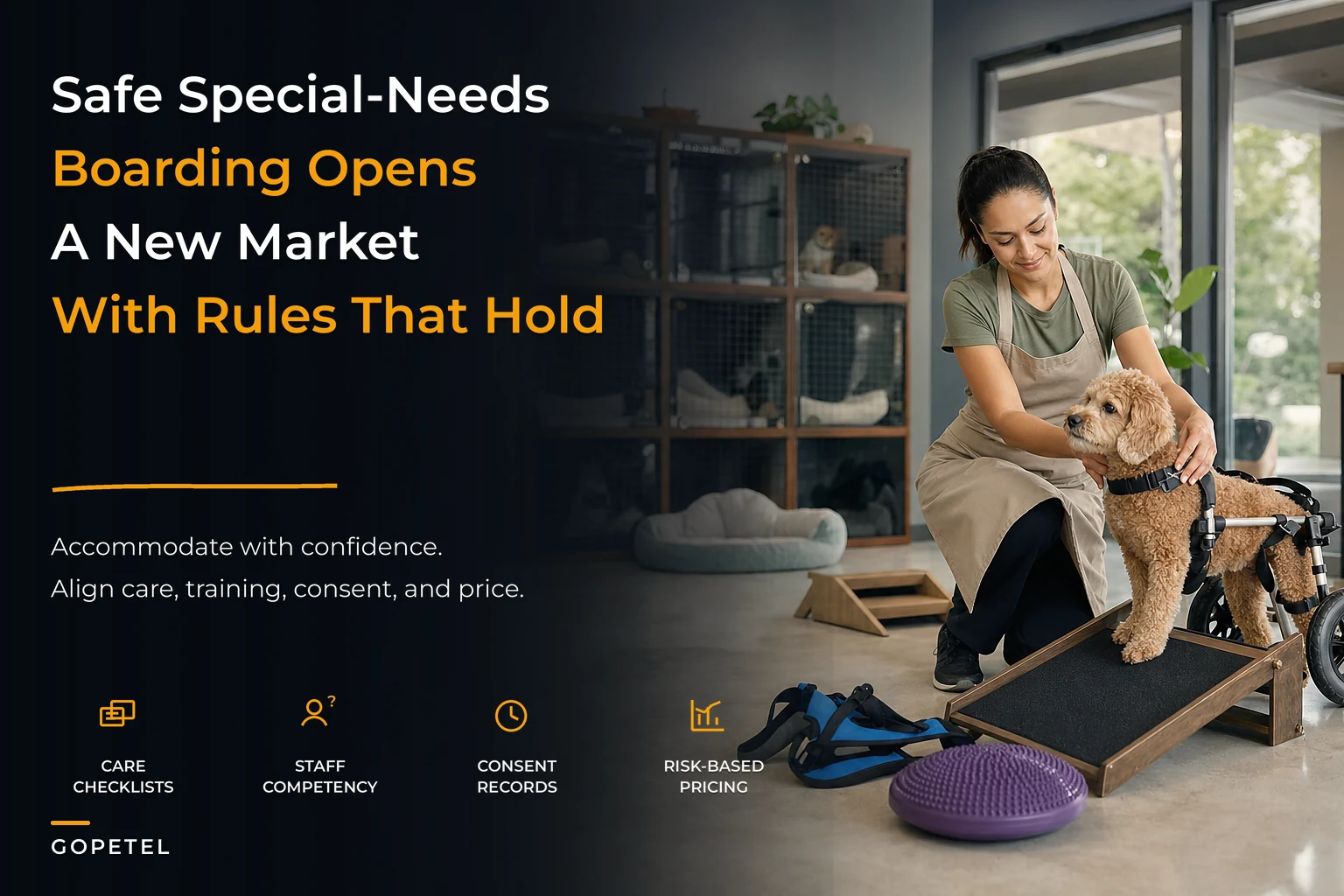
This article is about building that system. Not a warm feeling about helping animals — the actual accommodation checklists, facility roadmap, staff competency modules, and consent/pricing templates that let you open this market without exposing yourself to lawsuits and burned‑out staff. A solid pet boarding accessibility policy isn't a document you write once and forget. It's the connective tissue between intake, facility, staffing, and pricing.
Why this breaks the moment you say "yes" without infrastructure
The failure pattern is almost always the same, and it's not about bad intentions.
A facility takes a special‑needs case on goodwill. Nobody prices it differently, so the extra 40 minutes a day of handling comes out of the same labor budget as a healthy Labrador. Nobody writes down the specifics, so the knowledge lives in one employee's head — and that employee is off on the day something goes wrong. Nobody set expectations with the owner, so when the tripod dog scrapes its remaining rear leg on a kennel gate, the owner is furious and the facility has no signed acknowledgment that mobility issues carry inherent risk.
Scale that up. One special‑needs guest a month is manageable through heroics. Six a month, across a rotating staff of part‑timers, is a coordination nightmare. What breaks first is usually knowledge transfer — care details don't survive shift changes. What breaks next is labor math — you're eating unpriced time. What breaks last, and worst, is liability, because your consent paperwork was built for a standard boarder and says nothing about pre‑existing conditions, medication risks, or the realistic limits of what your facility can actually prevent.
The businesses that get burned aren't the ones that refuse special‑needs animals. They're the ones that say yes casually and treat it exactly like a normal stay.
The four pillars that actually make this safe
Think of the whole thing as four connected systems. Weakness in any one of them undermines the others. Great paperwork with untrained staff fails. Trained staff with no consent template fails.
Never miss a booking or detail again.
GoPetel simplifies pet hotel operations by managing every reservation and pet profile seamlessly.
- Centralized booking management
- Automated client notifications
- Staff and kennel scheduling
No credit card required
| Pillar | What it controls | What breaks without it |
|---|---|---|
| Accommodation checklist | Whether you can actually meet the animal's needs | You accept cases you can't safely handle |
| Facility adaptation | The physical environment matching the need | Injuries from an environment built for able animals |
| Staff competency | Consistent care across every shift | Care quality depends on who's working |
| Consent & pricing | Legal protection + profitability | Unpriced labor, angry owners, lawsuit exposure |
The rest of this article walks through each pillar and, more importantly, how they hand off to each other.
Pillar 1: The accommodation checklist (your intake gate)
This is the decision layer. Before you accept any special‑needs booking, you run the animal's situation through a structured checklist that answers one blunt question: Can we actually do this safely, or are we about to accept a case we're not equipped for?
The checklist should force real answers, not vibes. A workable intake checklist covers:
-
Mobility status — can the animal walk unassisted, needs a sling, wheelchair, cannot navigate stairs or slick floors
-
Sensory status — deaf, blind, partially sighted, and the specific handling adjustments each requires
-
Medical load — daily medications, injections, monitoring (diabetics, seizure dogs, post‑surgical), and escalation triggers
-
Behavioral flags tied to the condition — does the disability create fear‑based reactivity, resource guarding around mobility aids, panic when handled a certain way
-
Feeding and elimination needs — hand‑feeding, elevated bowls, more frequent potty breaks, incontinence management
-
Owner‑provided equipment — what they bring, what they expect you to supply, and who's liable if equipment fails
-
Honest capability check — do you have the space, the trained staff on every shift, and the facility features to meet all of the above
The part most facilities miss: the checklist has to have a "no" branch. If a diabetic dog needs insulin at 6 a.m. and 6 p.m. but your facility isn't staffed until 7:15, the correct answer is to decline or refer out — not to accept and hope someone remembers. Medication‑heavy stays are their own operational discipline, and if you're taking those on, the workflows in our guide on medical‑boarding SOPs for chronic care and vet‑escalation trees should be running before you accept a single case.
This checklist connects directly to intake documentation. Everything you learn here becomes the source data for the consent form and the care plan — which is why sloppy intake poisons every pillar downstream.
Pillar 2: The facility adaptation roadmap
You don't need to retrofit your whole building. You need to know which accommodations you can offer today, which you can add cheaply, and which you should honestly never claim to offer.
The mistake is binary thinking — "we're accessible" or "we're not." Reality is a gradient. A typical facility can serve mobility‑impaired and sensory‑impaired animals with modest changes long before it's equipped for post‑surgical recovery cases.
-
Low‑cost / immediate — non‑slip runner mats on hard floors, removing raised thresholds a wheelchair can't clear, designating quiet ground‑floor kennels away from the loud runs for anxiety and sensory cases, elevated feeders, gate padding.
-
Moderate / scheduled — a dedicated low‑stimulation zone with sound dampening, ramps replacing steps to outdoor areas, kennels with easier‑access latches, better drainage in kennels used for incontinent seniors.
-
Capital / decision‑required — a climate‑controlled recovery suite, walk‑in tubs for animals that can't step over a lip, backup‑power‑backed monitoring for critical medical cases.
Your facility tier determines your accommodation checklist's yes/no thresholds. You can't offer what you can't physically support. The roadmap isn't a wish list — it defines what you're allowed to say yes to. Every time you complete a moderate‑tier change, you can expand the checklist's acceptance criteria. That's how you grow this segment deliberately instead of overpromising.
One thing worth noting: the low‑stimulation zone almost always ends up serving far more than special‑needs animals. Nervous first‑time boarders, small dogs intimidated by the main runs, cats — it becomes a premium micro‑product on its own. The accessibility investment tends to pay for itself across the general population before the special‑needs revenue really kicks in.
Pillar 3: Staff competency modules
Documentation doesn't handle animals. People do. And the single most common point of failure in special‑needs boarding is care quality swinging wildly depending on who's on shift.
The fix is competency modules — short, specific, sign‑off‑required training tied to categories of need. Not a generic "we care about all animals" orientation. Concrete skills:
-
Handling and safely lifting mobility‑impaired animals (sling use, supporting a tripod, wheelchair fitting)
-
Approaching and communicating with deaf or blind animals without startling them into a defensive bite
-
Recognizing distress signs specific to the condition — a diabetic crashing looks different from ordinary lethargy
-
Basic medication administration protocols and, critically, when to escalate
-
De‑escalation for fear‑based reactivity tied to the disability rather than outright aggression
There's a pattern worth naming: facilities train the enthusiastic senior tech, that person becomes the "special‑needs person," and then care collapses on their days off. Competency has to be distributed. A reasonable rule — no special‑needs animal is accepted for a date range unless at least two qualified staff cover every shift in that window. That single rule prevents most of the "nobody knew" incidents.
Require two qualified staff to cover every shift for any special‑needs booking to avoid single‑point failures.
Tie competency to scheduling. A care plan requiring a certified handler is useless if the roster puts an uncertified part‑timer on Saturday morning. This is where facility, staffing, and intake all have to talk to each other — the booking needs to carry a competency requirement, and the schedule needs to reflect it.
Pillar 4: Consent and pricing templates
This is where facilities either protect themselves or expose themselves, and it's the pillar most likely to be treated as an afterthought.
Your standard boarding waiver does not cover special‑needs risk. A tripod dog will always carry more injury risk than a four‑legged one. A blind dog may walk into things. A diabetic can crash despite perfect care. Your consent document has to acknowledge these realities specifically and get the owner's informed, signed agreement — including an accurate condition disclosure from them, which shifts responsibility appropriately when an owner hides a known behavioral problem.
-
Detailed owner disclosure of the condition, history, and known triggers (signed as accurate)
-
Explicit acknowledgment of inherent, unavoidable risks tied to the specific condition
-
Medication authorization with dosing, timing, and a clear escalation‑and‑contact chain
-
Emergency vet authorization and a spending‑limit decision made before the crisis
-
The precise scope of care the facility is and is not providing
-
Equipment liability terms for owner‑supplied gear
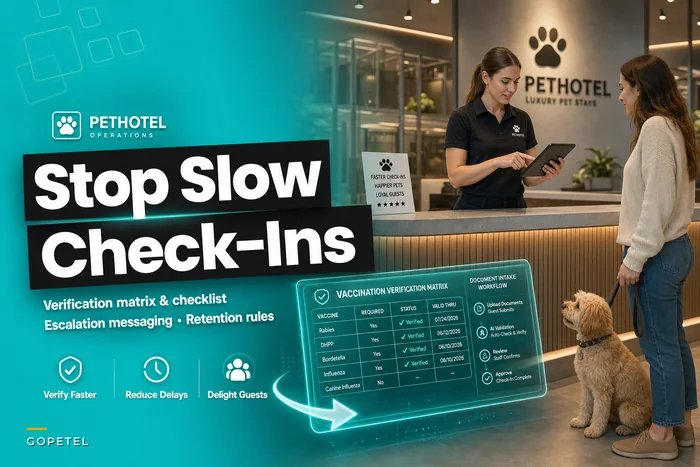
For anything involving medications or vaccination‑sensitive immune‑compromised animals, the intake and verification discipline in our vaccination verification matrix and document‑intake workflow should be wired into this consent step so nothing gets accepted on a verbal promise.
Now pricing. Special‑needs care is real labor, and pricing it like a standard stay is how facilities quietly lose money on the exact segment they thought was a growth opportunity. A clean model is a base boarding rate plus a care‑level surcharge that maps to actual labor minutes:
| Care level | Typical extra handling/day | Suggested surcharge approach |
|---|---|---|
| Light (sensory only, minor mobility) | ~15–20 min | Small flat daily add‑on |
| Moderate (meds 2x/day, feeding assistance) | ~30–45 min | Mid daily add‑on |
| Intensive (injections, monitoring, high mobility support) | ~60+ min | Higher daily add‑on + possible one‑time care‑plan fee |
The number that matters is your loaded labor cost per minute. If a moderate case adds roughly 35 extra minutes a day and your fully‑loaded handling cost runs somewhere around $0.50–$0.70 a minute, that's close to $18–$24 of daily cost before you've made a cent of margin. Facilities that skip this math end up subsidizing their most demanding guests with revenue from their easiest ones.
A real scenario
A mid‑sized suburban facility — around 40 runs, mostly standard boarding — kept getting calls for senior and special‑needs dogs and turning most away. When they did say yes, it was ad hoc, and they'd had two minor injury incidents in a year that ended in refunds and one lost regular client.
They built the four pillars over about a quarter. Non‑slip mats and a quiet ground‑floor zone first. Two staff trained and signed off on mobility and sensory handling. A special‑needs consent template with real disclosure language. A care‑level surcharge structure.
Within a few months they were running six to nine special‑needs stays a month at moderate‑to‑intensive surcharges — a few hundred extra dollars a week initially, trending up as word spread among vet clinics who started referring cases they trusted. The bigger win was reputational. The low‑stimulation zone became a selling point for anxious dogs generally, and injury incidents on special‑needs stays dropped to zero because handling was standardized instead of improvised.
Not a revenue explosion — a stable new line with far less exposure than the old ad‑hoc approach.
When this makes sense — and when it doesn't
When it's a good move: you already have stable core operations, at least a couple of staff you can invest in training, and consistent inbound demand you're currently declining. Local vet clinics referring cases is a strong signal the market is there.
When it's a bad idea: if your standard boarding operation is already chaotic — turnover problems, thin staffing, no reliable intake documentation — bolting special‑needs care on top will amplify every existing weakness. Fix the foundation first.
Who should not do this: a facility that can't guarantee trained coverage on every shift, or one unwilling to build proper consent documentation. Half‑measures here are worse than declining, because you're taking on the liability without any of the protections.
How the pieces coordinate as you grow
Intake checklist → Care plan + consent form → Competency requirement → Schedule constraint → Pricing applied
At one or two cases a month, you can almost hold this together with a shared note and a good memory. That stops working fast. Once you're running several concurrent special‑needs stays, the four pillars need to actually talk to each other: intake feeds the consent form and the care plan, the care plan sets the competency requirement, the competency requirement constrains the schedule, and the care level sets the price.
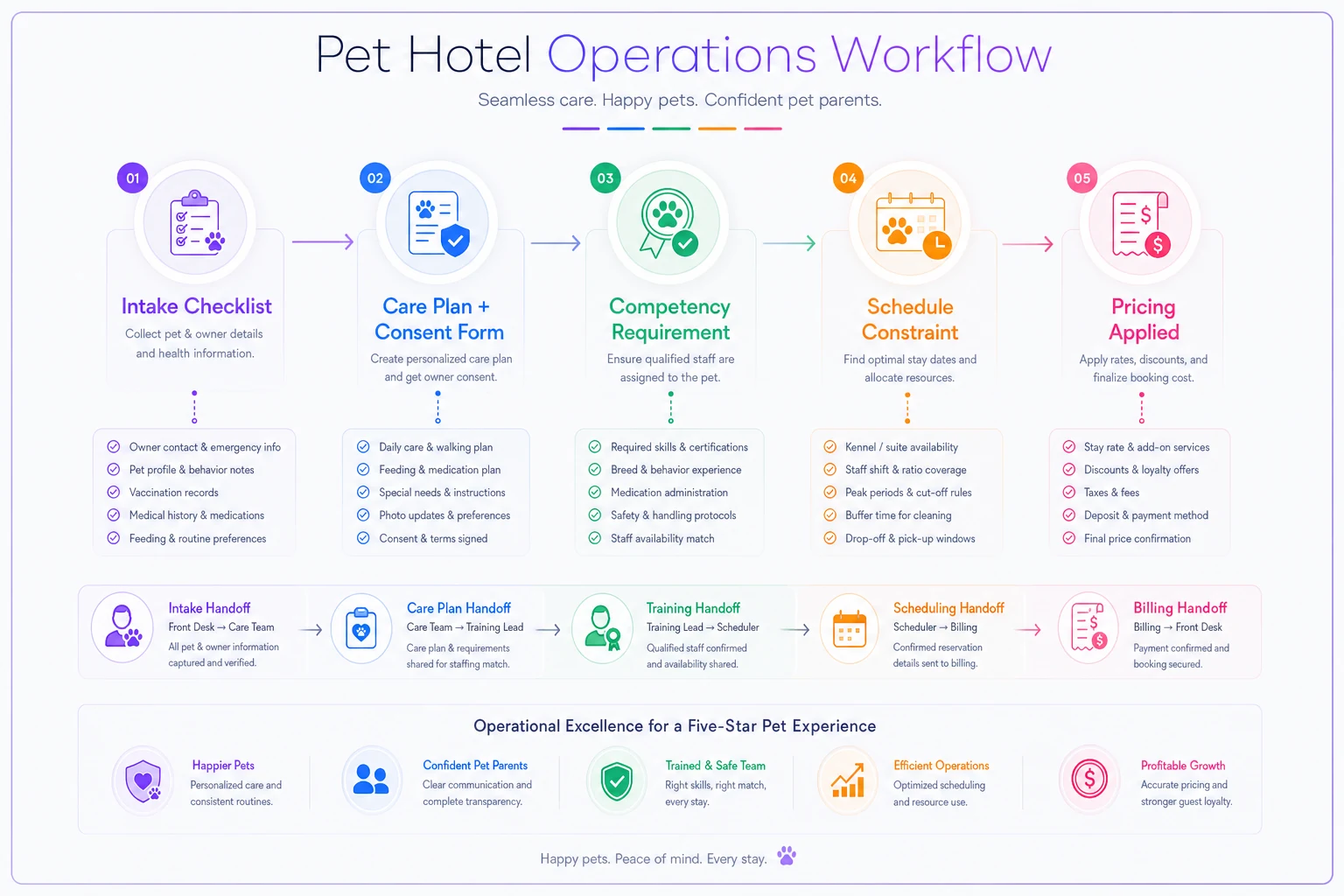
This diagram shows the handoffs between intake, care planning, competency, scheduling, and pricing.
When those handoffs live in someone's head or scattered across spreadsheets, things fall through. A medication gets missed, an uncertified tech gets scheduled, a surcharge doesn't get applied. These aren't dramatic failures — they're quiet, slow ones that add up over weeks until you've got an injury incident, a furious owner, and no documentation showing you did anything right.
This is where a central operations platform earns its place. The booking carries the care‑level flag, the roster surfaces the competency requirement, the consent and med schedule live on the animal's record where every shift can see them, and pricing applies consistently. Not because the software is magic — because it removes the "nobody knew" gap that causes almost every failure in this segment. The coordination problem is operational, not motivational. Most facilities that struggle with special‑needs care aren't failing because staff don't care. They're failing because the information isn't flowing between systems that were never designed to connect.
Bringing it together
Special‑needs boarding isn't dangerous because the animals are hard. It's dangerous when facilities treat a specialized service like a standard one. Build the accommodation checklist so you only accept what you can handle. Build the facility roadmap so your "yes" list grows deliberately. Build competency so care doesn't depend on who's working. Build consent and pricing so you're protected and profitable.
Do that, and you've turned the segment everyone else declines into a defensible, referral‑driven revenue line — with less risk than the improvised version most facilities are already running by accident.
Do that, and you've turned the segment everyone else declines into a defensible, referral‑driven revenue line — with less risk than the improvised version most facilities are already running by accident.
Ready to optimize your pet hotel operations?
Join hundreds of pet hotels using GoPetel to save time, improve pet care, and increase booking reliability.