

Medical boarding terrifies most pet hotel operators. Not because they don't care about sick animals, but because one medication error could mean a dead dog, a lawsuit, and your business shuttered. So they turn away diabetic dogs, cats with kidney disease, post-surgery recoveries — all the high-margin stays that veterinary clinics can't handle but desperately need somewhere to send.
The fear makes sense. Regular boarding runs on muscle memory and basic routines. Medical boarding demands precision documentation, staff competencies you probably haven't trained for, and decision trees that don't exist anywhere in your current operations manual.
Except the math doesn't support the fear. A standard boarding night might net $12–18 profit after labor and overhead. A medical boarding night? You're looking at $35–55 for the same kennel space. Dogs requiring subcutaneous fluids, insulin shots, or post-surgical monitoring typically stay 5–12 nights at a stretch, not the usual weekend visits. Their owners are less price-sensitive and more schedule-flexible. Medical boarders become some of your most loyal clients because finding reliable medical boarding is nearly impossible in most markets. The gap between "too risky" and "highly profitable" comes down to systematic controls. Not heroic staff members who happen to know veterinary medicine. Not hoping nothing goes wrong. Repeatable systems that turn medical boarding from a liability nightmare into your highest-margin service line.
The MAR system that keeps you legal and protected
Medication Administration Records aren't optional paperwork — they're your proof that medications happened on time, every time. Without proper MARs, you're one missed insulin dose away from explaining to a judge why your staff couldn't follow basic medical protocols.
The problem starts at intake. Most facilities that attempt medical boarding collect medications in ziplock bags with handwritten notes. "Give Fluffy one pill twice daily." That's not a medical protocol — that's a suggestion. Your MAR system needs to capture:
-
The exact medication name and dosage (not "heart pills" but "Enalapril 5mg")
-
Administration times tied to your facility's schedule, not "morning and evening"
-
The administration method — oral, topical, injection site rotation for insulin
-
Special requirements like "with food" or "30 minutes before meals"
-
Who can administer (some meds require specific training)
-
What happens if a dose is refused or vomited
A functional MAR template contains:
-
Medication Grid Layout
-
Pet name and kennel number at the top
-
Each medication gets its own row
-
Columns for each administration time across your operating hours
-
Initial boxes for who gave it
-
Refusal/incident codes (R for refused, V for vomited, L for late)
-
Running tally of remaining medication
The tracking matters more than people realize. When an owner drops off 28 pills for a 7-day stay requiring twice-daily administration, that pill count becomes your accountability system. You should end with exactly 14 pills returned. Any deviation needs documentation.
The real protection comes from the administration log itself. Each dose gets initialed by the staff member who gave it, creating a chain of custody that holds up if things go sideways. When something goes wrong — and occasionally it will — you need to prove your facility followed protocols. "Sarah gave the 8am dose, Michael gave the 2pm dose" backed by signatures beats "we're pretty sure someone gave it" every single time.
Electronic MARs through operational software make this tighter. Timestamps can't be faked, medication schedules trigger alerts to assigned staff, and you can track patterns like which employees consistently run late on medication rounds. The data helps you catch problems before they become lawsuits.
Building competency matrices that actually protect you
Letting untrained staff handle medical tasks isn't just risky — in some states, it's illegal. But you can't afford veterinary technicians on staff around the clock either. The solution is properly documented competency training that satisfies both legal requirements and operational reality.
Never miss a booking or detail again.
GoPetel simplifies pet hotel operations by managing every reservation and pet profile seamlessly.
- Centralized booking management
- Automated client notifications
- Staff and kennel scheduling
No credit card required
Your competency matrix needs three distinct levels:
Level 1: Basic Medication Administration
-
Can give oral medications (pills, liquids)
-
Can apply topical treatments
-
Can document in MAR system
-
Requires
4 hours training, witnessed administration of 20 doses, written test
Level 2: Injectable Medications
-
Everything from Level 1
-
Can give subcutaneous injections (insulin, fluids)
-
Can identify injection site problems
-
Can recognize adverse reactions
-
Requires
8 hours training, 50 supervised injections, vet tech sign-off
Level 3: Complex Medical Care
-
Everything from Level 2
-
Can manage feeding tubes
-
Can perform wound care and bandage changes
-
Can recognize emergency symptoms requiring immediate vet attention
-
Requires
16 hours training, veterinary supervision period, annual recertification
The training documentation matters as much as the training itself. Each employee needs a signed competency form in their file showing exactly what they're authorized to do. When state inspectors show up — and if you're doing medical boarding, they will — you need to prove that the person giving insulin injections on Tuesday night was properly trained and authorized.
What kills most medical boarding programs over time is competency drift. Someone gets trained, does great for three months, then makes a critical error because they haven't given an injection in six weeks. Your system needs maintenance requirements built in. If someone hasn't performed a Level 2 task in 30 days, they need a supervised refresher before working solo again.
The staffing math gets tricky too. You need at least two Level 2 staff per shift to handle medical boarders, accounting for breaks and emergencies. That means training 6–8 employees to that level to ensure coverage. The investment seems steep until you remember that each medical boarder pays roughly 2.5x your standard rate.
Intake medical plans that eliminate the guessing
The deadliest moment in medical boarding happens at drop-off. Overwhelmed owners dump medications on your counter while rattling off instructions, your front desk scrambles to write everything down, and critical details get lost in translation. By the time the evening shift arrives, nobody's sure if the gabapentin was "as needed for anxiety" or "twice daily for pain management."
Your intake process needs to force clarity through structured medical plan forms — not generic forms downloaded online, but actual operational documents that match how your facility runs.
The medical plan form must capture:
Primary Veterinary Contact:
-
Clinic name and direct phone
-
Authorizing veterinarian (full name and license number, not just "Dr. Smith")
-
After-hours protocol — can you call the emergency line or only during business hours?
-
What requires vet notification vs. what you handle internally
Condition Documentation:
-
Specific diagnosis, not "sick"
-
How long they've had the condition
-
Stability indicators — is this managed or actively being treated?
-
Previous boarding experiences with this condition
-
Warning signs specific to this pet
Medication Scheduling Grid:
-
Each medication listed separately
-
Exact times (not "twice daily" but "7am and 7pm")
-
Can you adjust times by 30 minutes if needed?
-
What happens if they refuse? Skip, force, or call owner?
-
Food requirements for each medication
Monitoring Requirements:
-
What needs daily documentation (appetite, urination frequency, energy level)
-
Specific observations ("watch for head tilt" not "monitor for problems")
-
Photo/video requirements for owner updates
-
Weight checks if relevant
The form should take 15–20 minutes to complete properly. That seems like a lot until you realize that ambiguity in medical instructions costs hours of staff confusion, worried phone calls, and real liability exposure. The owner signs it acknowledging that you'll follow these specific instructions — not whatever they might remember telling someone at drop-off.
Some facilities try to handle this verbally or with simple medication logs. That breaks down the moment you have two dogs on insulin with different injection protocols, or when the owner insists they said "every 8 hours" but your notes say "twice daily." The signed, detailed medical plan becomes your operational bible and your legal protection simultaneously.
Decision trees that tell you exactly when to call the vet
The scariest part of medical boarding isn't giving medications — it's deciding when something's wrong enough to require veterinary intervention. Wait too long and you're explaining why you didn't act on obvious symptoms. Call too often and you're burning through owner goodwill and vet clinic patience.
Standard boarding uses simple rules: dog won't eat for 24 hours, call owner. Medical boarding needs multi-path decision trees that account for conditions, medications, and baseline behaviors.
A practical decision tree workflow for an insulin-dependent diabetic dog looks like this:
-
Glucose Crisis Path — Dog appears lethargic or wobbly → Check blood glucose if trained, otherwise assume hypoglycemia → Give honey or karo syrup to gums → Call vet immediately → Document time, symptoms, intervention, and response → Do NOT give insulin until vet approves
-
Food Refusal Path — Dog refuses breakfast → Wait 30 minutes, offer different food → Still refusing, check for other symptoms (lethargy, vomiting) → No other symptoms: give 50% normal insulin dose, document and monitor → Other symptoms present: skip insulin, call vet within 2 hours
-
Vomiting Path — Single vomit episode → Monitor for 2 hours → Multiple episodes or contains blood: call vet immediately → If insulin was given before vomiting: call vet within 1 hour → Document time, appearance, and subsequent behavior
The decision tree needs clear ownership too. Who makes the call to contact the vet — the shift lead, the medical boarding coordinator, or any Level 2 staff? What if it's 2am? The tree should specify that overnight staff can make emergency vet calls without manager approval for specific symptoms.
The real value is removing emotional decision-making from high-pressure moments. When you're staring at a dog that seems "off" but not critically ill, the decision tree tells you exactly what to document and when to escalate. "Decreased appetite, normal energy, no vomiting" might mean wait and monitor for a healthy dog but requires immediate vet consultation for a diabetic. These trees also protect you from over-cautious staff calling the vet for every minor issue — the vet gets documentation showing you followed reasonable protocols before calling, and they're more likely to provide guidance when they know you're not crying wolf.
Here's a simple visual workflow to follow for diabetic dogs.
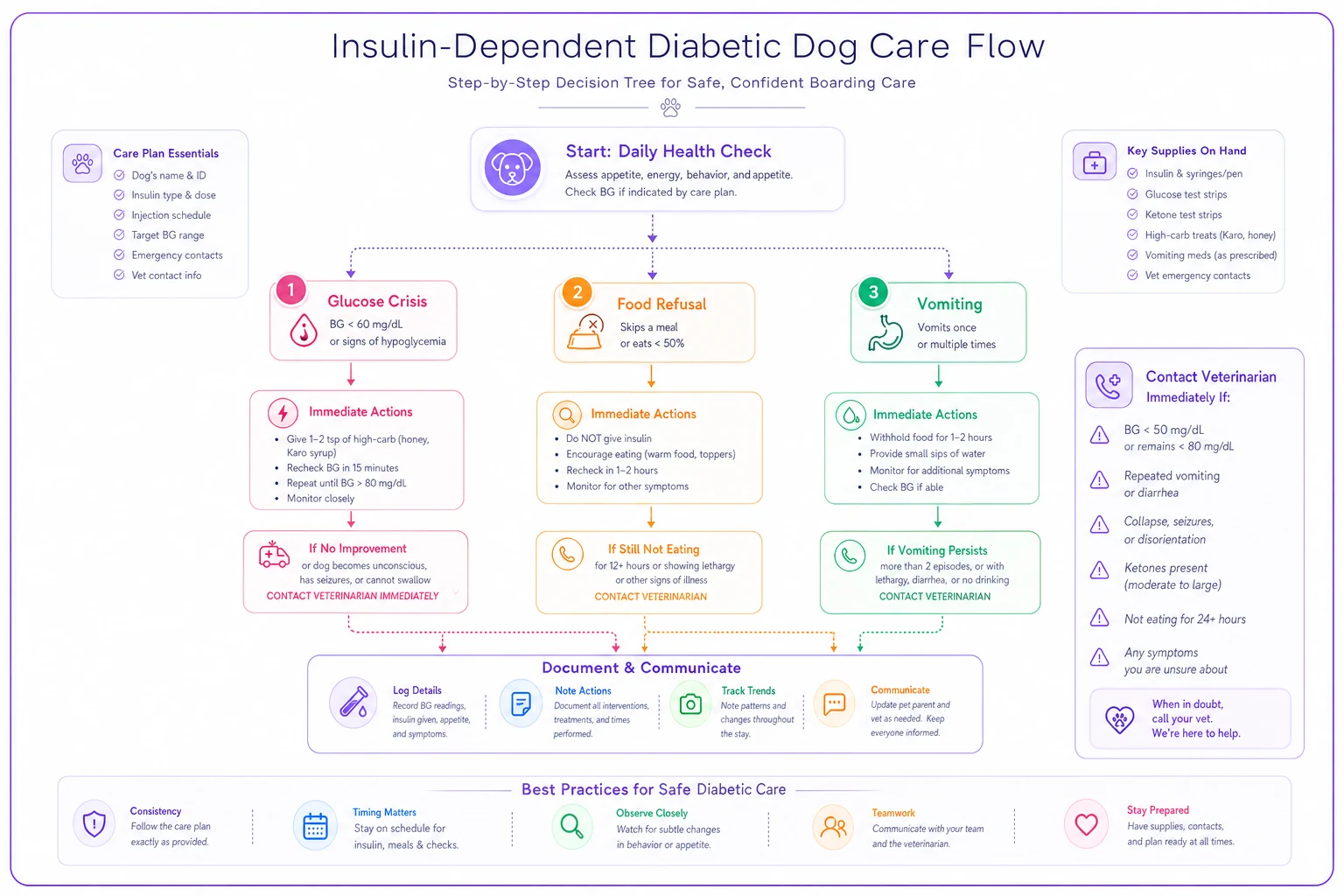
The visual helps staff quickly trace the correct path during a high-stress incident and shows when to document, treat, and escalate.
The pricing math that makes medical boarding worth the risk
Medical boarding pricing breaks every rule about competitive rates and market positioning. Owners needing medical boarding aren't shopping around — they're desperate for anyone competent who'll take their sick pet. Your competition isn't other boarding facilities; it's veterinary hospitals charging $150–250 per night.
Base pricing should start at 2x your standard boarding rate, then add:
Medication administration fees:
-
Oral medications
$3–5 per administration
-
Topical treatments
$3–5 per application
-
Injectable medications
$15–25 per injection
-
Complex care (feeding tubes, etc.)
$30–50 per session
Monitoring fees:
-
Basic observation log
Included in base price
-
Detailed behavior documentation
$10/day
-
Blood glucose monitoring
$15 per check
-
Weight/vitals tracking
$5/day
Supply charges:
-
Needle disposal
$2/day for injectable meds
-
Special feeding supplies
$5/day
-
Bandage materials
Actual cost plus 50%
A diabetic dog requiring twice-daily insulin, glucose monitoring, and special feeding might break down like this:
| Service | Daily Cost |
|---|---|
| Base medical boarding | $90/night (vs. $40 standard) |
| Insulin injections (2 x $15) | $30/day |
| Glucose monitoring | $15/day |
| Special feeding protocol | $5/day |
| Total | $140/night |
That same dog at an emergency veterinary hospital would cost $200–300/night with less individual attention. You're the affordable option while making three times your normal margin.
Don't apologize for medical boarding prices or offer discounts to ease clients in. These owners understand their pet requires specialized care. Confidence in your pricing actually builds trust — it signals that you know what you're doing. Discount pricing tends to attract owners trying to avoid veterinary hospitals, often with incomplete medical histories and pets that aren't stable enough to board safely.
Building SOPs that scale beyond one great employee
The biggest operational failure in medical boarding is when everything depends on that one amazing employee who "just knows" how to handle medical pets. When they quit, get sick, or go on vacation, your entire program collapses.
Real medical boarding SOPs need to function regardless of who's working. Documented procedures for every predictable scenario:
Morning Medical Rounds SOP:
-
Print MAR sheets for all medical boarders (6
30am)
-
Check overnight notes for any incidents or concerns
-
Prepare medication cart with all morning meds
-
Begin rounds at 7
00am sharp, starting with diabetic dogs (consistent timing matters)
-
For each pet
observe before entering kennel, document any concerns
-
Administer medications per MAR, initial immediately
-
Note any refusals or difficulties
-
Complete rounds by 8
00am
-
Enter all documentation into system by 8
15am
-
Report any concerns to manager by 8
20am
Medical Emergency Response SOP:
-
Staff member discovering emergency alerts entire facility with emergency code
-
Level 2 or higher staff responds immediately
-
Assess ABC (airway, breathing, circulation)
-
Call veterinarian while another staff member retrieves medical file
-
Follow vet instructions exactly, document everything
-
If transport needed, two staff members go (one drives, one monitors)
-
Contact owner only after pet is stable or en route to vet
-
Complete incident report within 2 hours
These SOPs need regular testing. Run surprise drills where you simulate a diabetic crisis or medication error. Time how long it takes staff to recognize the problem, make decisions, and execute. The debrief shows you where things break down under actual pressure.
The real test is turnover resilience. Can a new employee handle medical boarding after following your training and SOPs for 30 days? If not, your documentation has gaps. The SOPs should be clear enough that competent staff can execute them without years of experience or natural medical intuition.
Why paper MARs will eventually sink you
Paper medication logs feel simple and foolproof until you're reconstructing a medication error from illegible initials and coffee-stained forms. The morning shift swears they gave the medication. Evening shift says the box was already initialed when they arrived. The paper MAR can't tell you who's right.
Digital systems solve the ambiguity problem through timestamp precision. When medications get marked as given, the system records who, when, and from which device. You can see that Sarah marked the 8am insulin as given at 8:07am from the medical room iPad. If Michael tries to mark it again at 8:30am, the system warns him it's already been administered.
The bigger value is pattern recognition. Digital systems track medication compliance rates across your staff. You'll notice that Thursday evening shifts run consistently late on medication rounds, or that newer employees forget to document refused medications. These patterns let you fix systemic problems before they cause medical emergencies.
The automation features in modern operational platforms matter here too. Set alerts for time-sensitive medications. If nobody's marked the 2pm insulin as given by 2:15pm, the system sends escalating notifications — first to the assigned staff member, then to the shift lead, then to the manager. No more hoping someone remembers.
Legal protection improves dramatically as well. When a client claims you missed their dog's medication, you have timestamped logs showing exact administration times. When state inspectors audit your medical boarding protocols, you can generate compliance reports showing on-time administration rates across your entire program.
Integration with your general operations keeps medical boarding from becoming its own island. The same platform tracking your infection control protocols can manage your medical SOPs, making sure a dog recovering from surgery doesn't accidentally get placed in a kennel pending deep cleaning, or that staff handling medical boarding dishes follow stricter sanitization requirements.
Turning veterinary relationships into referral engines
Most pet hotels treat veterinarians as emergency contacts. Medical boarding flips that relationship into your most valuable marketing channel. Veterinary clinics desperately need reliable medical boarding partners — they have post-surgical dogs needing observation but not hospitalization, diabetic cats whose owners travel for work, senior pets with complex medication schedules that standard boarding can't handle.
Building these referral relationships requires more than dropping off donuts and business cards. You need to prove operational competence through documentation. Create a veterinary partnership packet that includes:
-
Your staff competency matrix showing who's trained for what
-
Sample MARs and medical intake forms
-
Your decision trees for when you contact them
-
Actual case studies of successful medical boards (with owner permission)
-
Your insurance coverage for medical care
-
Response time guarantees for their referrals
Schedule quarterly meetings with key veterinary clinics to review protocols. Show them you're improving systems based on their feedback. When they suggest adding blood pressure monitoring to your capabilities, actually investigate the training and equipment needed. These clinics want partners who take medical boarding seriously — not someone who just says the right things at the pitch meeting.
The referral math gets compelling quickly. A single veterinary clinic might send 3–5 medical boarding clients per month. At an average of 7 nights per stay and $140/night, that's roughly $3,000–5,000 in monthly revenue per referring clinic. Build relationships with four clinics and you're looking at a meaningful revenue stream from medical boarding alone.
The trust compounds over time too. When a vet confidently tells a worried owner "We work with [Your Facility] for all our medical boarding needs — they're excellent with diabetic dogs," that owner arrives pre-sold on your capabilities and pricing. No price shopping, no comparing you to standard boarding. They just want to know their sick pet is in good hands.
Knowing when medical boarding will hurt more than help
Not every pet hotel should offer medical boarding. If your regular operations are still shaky — if you're still working out basic feeding schedules and cleaning protocols — adding medical complexity will create problems across your entire operation. Medical boarding amplifies existing weaknesses.
You're probably not ready if:
-
Staff turnover exceeds 40% annually (you can't maintain competencies)
-
Your standard boarding already has frequent medication errors
-
You don't have reliable veterinary relationships established
-
Your insurance specifically excludes medical care
-
You can't guarantee minimum staffing levels
-
Your facility lacks proper medication storage (locked, temperature-controlled)
-
You're in a state with restrictive veterinary practice laws
The market might not support it either. Rural areas with one veterinary clinic often lack the demand to justify the infrastructure investment. If the nearest emergency vet is 90+ minutes away, you can't safely handle true medical emergencies. Urban markets with multiple specialty veterinary hospitals usually have enough volume to make a dedicated medical boarding program worthwhile.
Your current client base gives you clues. Survey existing customers about their pets' health conditions and medication needs. If fewer than 10% have pets requiring daily medication, medical boarding might not generate enough volume to justify the training investment. But if 30% mention avoiding travel because of their pet's medical needs, you're sitting on untapped demand.
The competitive landscape matters too. If three other facilities in your area already offer medical boarding with established veterinary relationships, you're fighting uphill. But if nobody's doing it well, you can own the entire local market within 18 months.
Making the medical boarding decision
Medical boarding isn't charity work for sick pets — it's the highest-margin service most pet hotels never dare to offer. The operational complexity is real but manageable through systematic controls. The same facility running standard boarding at 15% margins can run medical boarding at 35–40% margins using the same kennels, mostly the same staff, and documented protocols that remove the guesswork.
The fear of medical boarding keeps most operators away, which is exactly why the opportunity exists. While competitors race to the bottom on standard boarding prices, you can build a program that veterinarians trust and pet owners desperately need. The infrastructure investment — training, documentation, systems — typically pays back within 4–6 months once you're running at even modest medical boarding capacity.
Start small if needed. Begin with simple oral medications only. Master that for three months, then add injectable medications, then complex care. Each level builds your staff's capabilities and your reputation with veterinary clinics. Within a year, you can run a full medical boarding program that generates more profit than adding 20 additional kennels.
The operational software managing your standard boarding can handle medical protocols too. The same systems tracking cleaning schedules and managing photo updates can monitor medication administration and document medical observations. You don't need separate platforms or complex veterinary software — just operational tools configured properly for medical boarding requirements.
The market needs what you could offer. Veterinary hospitals are overwhelmed. Pet owners with sick pets have nowhere reliable to turn. The gap between fear and profit is just documented systems, trained staff, and the confidence to charge what medical boarding is actually worth.
Medical boarding isn't charity work for sick pets — it's the highest-margin service most pet hotels never dare to offer. The operational complexity is real but manageable through systematic controls. The same facility running standard boarding at 15% margins can run medical boarding at 35–40% margins using the same kennels, mostly the same staff, and documented protocols that remove the guesswork.
Start small if needed. Begin with simple oral medications only. Master that for three months, then add injectable medications, then complex care. Each level builds your staff's capabilities and your reputation with veterinary clinics. Within a year, you can run a full medical boarding program that generates more profit than adding 20 additional kennels.
Ready to optimize your pet hotel operations?
Join hundreds of pet hotels using GoPetel to save time, improve pet care, and increase booking reliability.