

Most pet hotels obsess over the indoor stuff—kennel sanitation, HVAC, laundry cycles—and treat the outdoor play yards like they take care of themselves. They don't. Yards are where dogs run full speed, where fence gaps develop, where mud freezes into ankle-turning ruts, and where most of the "my dog came home limping" conversations actually start.
The uncomfortable part: outdoor injuries are the ones that turn into insurance claims. A dog that tears a nail on a cracked slab or jumps a sagging fence line isn't just a vet bill—it's a liability conversation, a reputation risk, and sometimes a premium hike at renewal. The yard is the highest-risk, lowest-inspected part of most facilities.
This isn't a general "take care of your property" piece. It's specifically about one thing: a seasonal inspection cadence tied to how busy you are and what the weather is doing, plus the simple paperwork that makes it stick. That's the whole scope of pet hotel outdoor area maintenance covered here.
Why yard inspections fail even at good facilities
The failure almost never looks like neglect. It looks like a yard that seems fine.
In real operations, this usually happens because inspections are event-driven instead of scheduled. Someone notices a problem, fixes it, and moves on. Nobody is walking the yard on a fixed rhythm looking for the stuff that develops slowly—the fence post loosening a millimeter per week, the drainage starting to pool, the rubber matting curling at the seam.
The other issue is that occupancy and weather both change the risk, and almost nobody adjusts inspection frequency for either. A yard pulling 40 dog-hours a week in February behaves nothing like the same yard pulling 200+ during July or the holidays. More traffic means more wear, more digging, more chewing on fence lines, more surface compaction. If your inspection schedule is the same in a slow March as it is during peak summer, you're under-checking exactly when things break fastest.
Weather does the same thing from the other direction. Freeze-thaw cycles crack concrete and heave pavers. Heavy rain washes out footing and exposes buried hazards. Extreme heat degrades rubber and plastic faster than most people expect. The yard doesn't age at a constant rate—it ages in bursts tied to the calendar.
The core idea: cadence tied to occupancy AND weather
The whole system rests on one rule: your inspection frequency should rise with both occupancy and weather stress. Pick whichever factor is higher.
Never miss a booking or detail again.
GoPetel simplifies pet hotel operations by managing every reservation and pet profile seamlessly.
- Centralized booking management
- Automated client notifications
- Staff and kennel scheduling
No credit card required
| Condition | Occupancy level | Weather factor | Full yard inspection |
|---|---|---|---|
| Baseline | Under 50% | Mild/stable | Weekly |
| Busy | 50–80% | Mild/stable | Twice weekly |
| Peak | Over 80% | Mild/stable | Daily (quick) + weekly (full) |
| Weather event | Any | Freeze-thaw, heavy rain, heatwave, high wind | Add one inspection within 24h of the event |
| Post-event | Any | After storm/freeze passes | Full inspection before yard reopens |
The "quick" daily check during peak is not a 30-minute audit. It's a 5-minute walk with eyes on the high-failure spots: fence base, gate latches, standing water, visible surface damage, and anything chewed or dug overnight. The weekly full inspection is the thorough one.
Here's a simple workflow showing how inspection frequency adjusts with occupancy and weather.
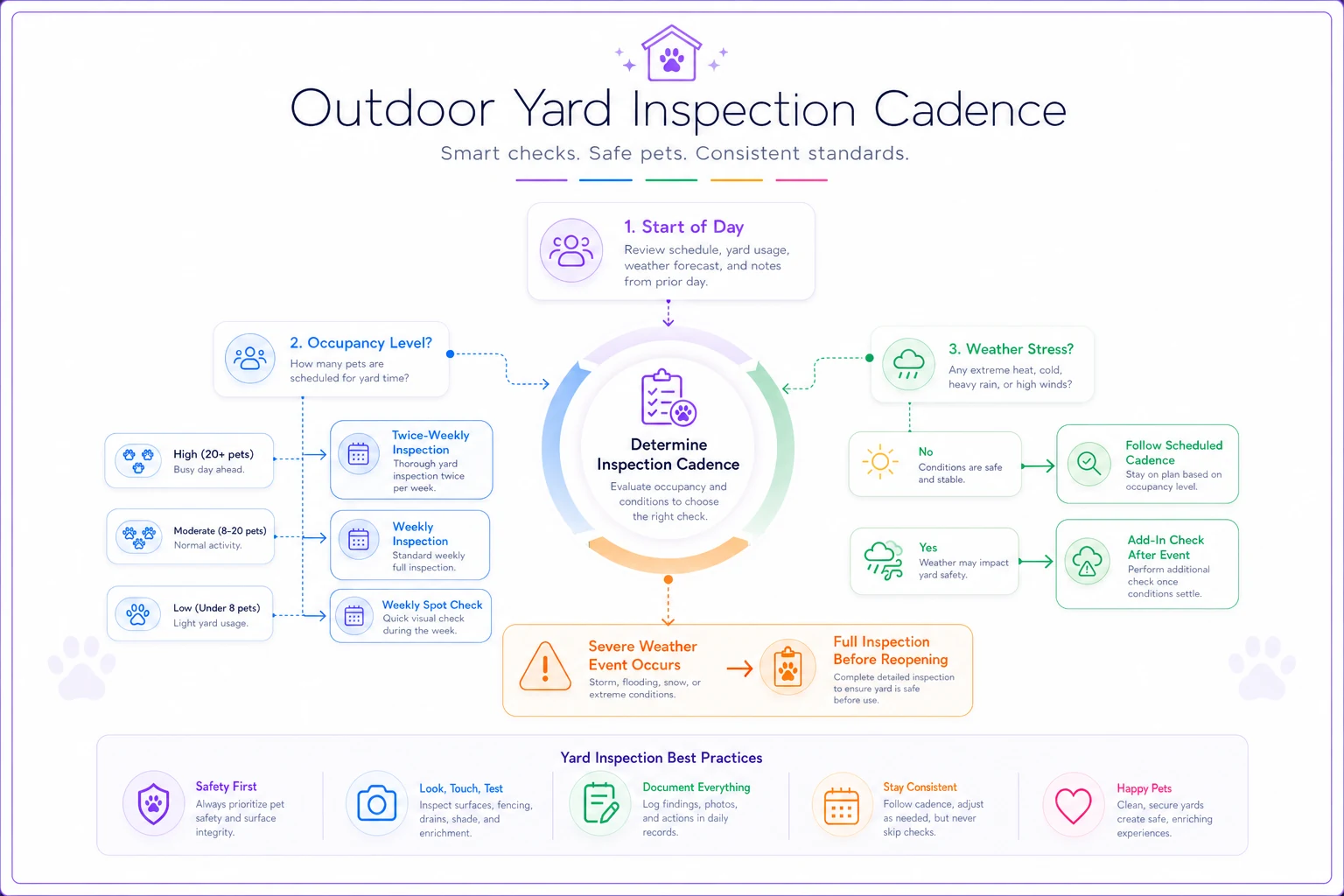
The point isn't to inspect constantly—it's to inspect more when things break fastest, and to have a clear trigger (a weather event) that overrides the normal schedule.
The repair checklist that actually catches things
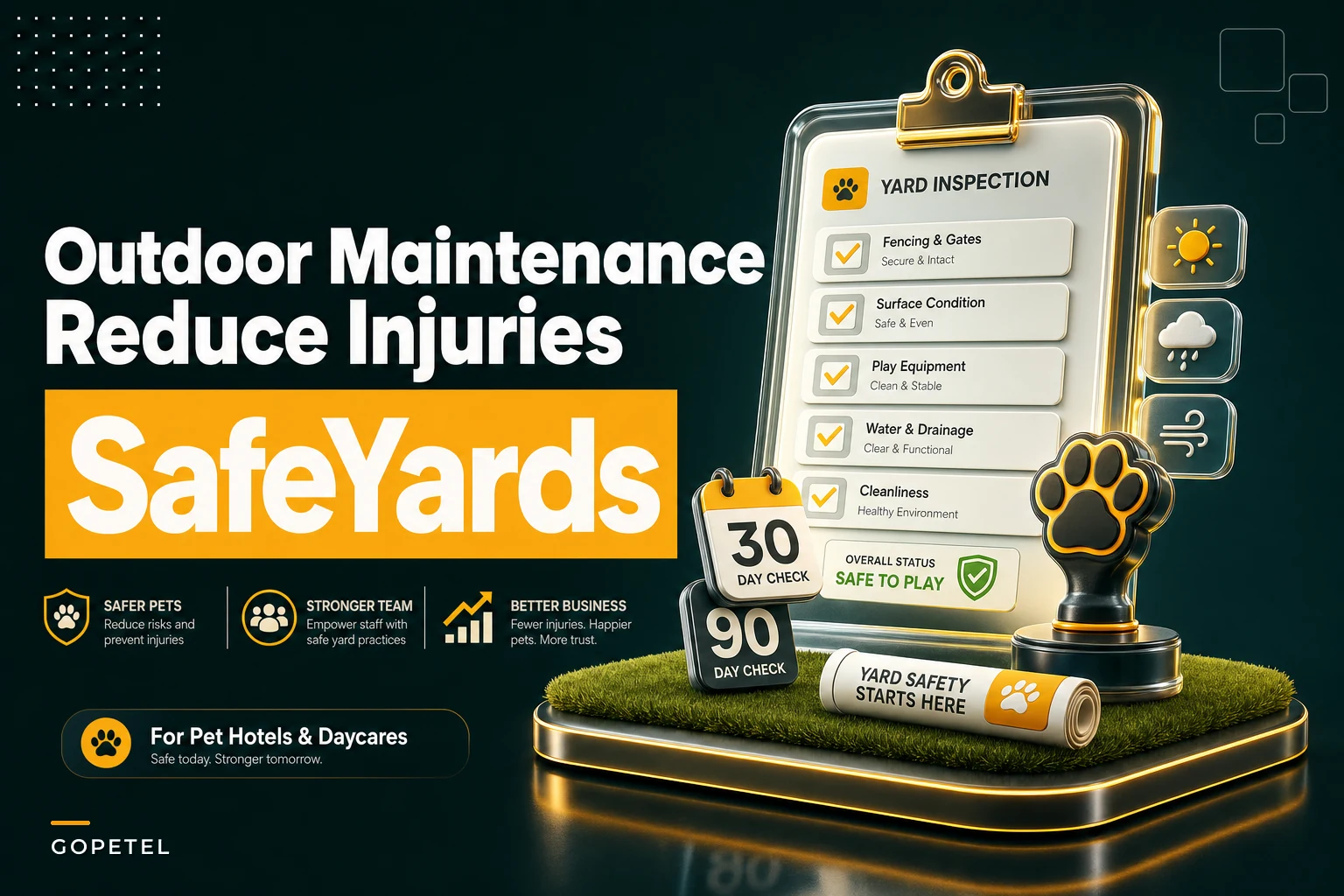
A checklist only works if it's specific enough that a tired closing-shift employee can run it without judgment calls. Vague items like "check fencing" get skipped because nobody knows what done looks like. Break it into observable yes/no conditions.
-
Fence line base Any gaps, digging, or soil erosion under the fence? Any loose or detached boards/panels?
-
Fence height integrity Any sag, lean, or section a determined jumper could clear?
-
Gate latches Do all gates self-close and latch fully on first swing? Any play in the hinges?
-
Surface condition Cracks wider than a finger, raised edges, trip points, exposed concrete rebar?
-
Footing/traction Slick spots, worn turf, mud pits, pooling water that won't drain within an hour of rain?
-
Rubber/mat seams Curling, lifting edges, or chewed sections that create a trip or ingestion hazard?
-
Shade and shelter Secure and intact? Any broken structure a dog could run into?
-
Water stations Clean, functional, no sharp edges from wear?
-
Foreign objects Rocks, sticks, construction debris, chewed toy fragments, anything that migrated in?
-
Plant hazards Any toxic plants growing through or near the fence, mushrooms after rain?
-
Chemical runoff Any treated areas or drainage issues that could pool treated water where dogs drink or lie?
That last item matters more than people think. If you use any cleaners, de-icers, or weed treatments near play areas, the storage and runoff rules are just as important as the inspection itself. Worth cross-referencing your chemical-waste and sustainability operations playbook so yard treatments don't quietly become a drinking-water problem.
Keep the checklist to observable yes/no items so a closing shift can finish it in a few minutes without judgement calls.
One thing most owners miss: mud and standing water cause more injuries than dramatic failures. Everyone imagines the fence collapse. The actual claim is usually a dog pulling a muscle on slick ground or a handler slipping while breaking up play. Drainage belongs near the top of the list, not the bottom.
Signage that reduces liability, not just clutter
Signage isn't decoration. In a claims dispute, documented warnings and posted rules shift the conversation. The yard should carry a small, consistent set of signs that match what's in your waivers.
-
Yard rules sign (at every gate)
supervision policy, no outside toys, group play eligibility, what to do if a dog shows distress.
-
Weather/surface condition sign (swappable)
a simple clip or sleeve where staff post "Yard closed—ice," "Reduced capacity—heat," or "Wet—limited turnout." Swappable signage is what makes weather-based closures actually enforceable instead of a verbal maybe.
-
Capacity sign max dogs per group for this specific yard. Keeps peak-season overcrowding from becoming the root cause of a fight or collision.
-
Emergency contact sign where the nearest leash, first-aid kit, and hose are, plus the escalation number.
Tie the swappable weather sign directly to your inspection trigger. If a post-freeze inspection fails the footing check, the yard doesn't reopen until the "closed" sign comes down—and the sign only comes down when someone signs off on the re-inspection. That link between the physical sign and the paperwork is what closes the "I thought someone checked it" gap.
Incident logs that build your defense before you need it
A lot of facilities leave themselves exposed here. They handle the incident fine in the moment—first aid, owner call, vet if needed—but the documentation is a text message and a memory. Six weeks later when a claim surfaces, there's nothing to reconstruct what actually happened.
-
Date, time, yard, and current occupancy/group composition at the moment
-
Weather and surface conditions at the time
-
What happened, in plain observable terms
-
Which dogs were involved and the handler present
-
Last inspection date for that yard and its result
-
Action taken and owner notification time
That "last inspection date and result" line is the quiet hero. If an incident happens and you can show the yard passed a full inspection two days prior, the story changes completely—from negligence to reasonable care. Incident reporting as a system deserves its own workflow, and the infection-control side of grouping decisions ties in too, since group composition drives a lot of yard risk. The infection-control and compliance framework covers how group makeup affects more than just disease spread.
The mistake people make is logging only injuries. Log near-misses too—the dog that almost got under the fence, the gate that didn't latch on first try. Near-misses are free warnings. Facilities that log them fix problems before they become claims; facilities that don't are flying blind between incidents.
The 30/90 vendor-engagement cadence
Your own inspections catch surface stuff. They won't catch a fence post rotting below ground, a drainage system silting up, or footing that's compacted past the point of DIY repair. That's where a vendor rhythm matters—and most places only call a vendor after something breaks, which is the most expensive possible timing.
-
30-day touchpoint A standing monthly review of your own inspection logs to spot patterns. Three "gate latch sluggish" entries in a month is a vendor call before it becomes a loose-dog incident. This is internal, maybe 20 minutes, log-driven.
-
90-day vendor engagement A quarterly walkthrough with your fencing/grounds vendor timed to the season change—spring thaw, pre-summer-peak, fall, pre-freeze. Each visit targets the stressors that season brings. Pre-freeze: drainage and surface sealing. Pre-summer: fence integrity before peak traffic, shade structure checks, rubber degradation.
Timing vendor visits to seasons instead of fixed calendar dates front-loads the repair before the stress hits. Fixing drainage in October beats discovering the problem during the first January thaw with a full house.
When this cadence makes sense—and when it's overkill
This full system is right for facilities running real group yards with meaningful peak swings and multiple play areas. If occupancy regularly crosses 70–80% and you have more than one yard, the structure pays for itself the first time it keeps a claim off your record.
It's overkill for a tiny operation with one small, flat, well-drained yard that rarely runs above half capacity. In that case, run the weekly checklist and the weather-trigger rule, skip the daily peak checks, and keep vendor engagement to twice a year instead of quarterly. Don't build process you won't maintain—an abandoned checklist is worse than an honest simpler one.
A real scenario
A mid-size facility with two outdoor yards and roughly 60 runs was dealing with a recurring problem: two to three minor outdoor injuries a quarter—torn nails, a couple of muscle strains, one laceration from a lifted mat edge. None were catastrophic, but their insurer had flagged the frequency and renewal was trending up.
The yard was inspected "whenever someone noticed something." No log, no cadence.
They put in the occupancy/weather cadence, the specific checklist, the swappable weather signs, and the incident/near-miss log. The first month surfaced something they'd never tracked: most incidents clustered in the smaller yard during peak evening turnout, on a mat seam that curled in the heat and a corner that drained slowly. Two fixes—re-securing the matting and regrading the corner—addressed most of it.
Over the following two quarters, yard incidents dropped to roughly one minor event total. More importantly, they had clean inspection records for every day the yard was open. At renewal, the documented inspection program was part of the conversation that kept their premium flat instead of climbing. The repairs cost a few hundred dollars. The avoided claim and premium pressure were worth substantially more.
The part most people get wrong
The temptation is to treat this as a one-time fix—patch the yard, post the signs, done. Yards degrade continuously and in bursts, and the whole value is in the rhythm. The facilities that stay claim-free aren't the ones with perfect yards. They're the ones that inspect on a schedule that flexes with occupancy and weather, document what they find, and bring vendors in before the season breaks things.
Start smaller than you think. Run the weekly checklist, add the weather-trigger inspection, and keep a log with the "last inspection date" field. That alone catches most of what eventually turns into a claim. Layer in the daily peak checks and the 90-day vendor cadence once the basics are habit. The goal isn't a binder nobody reads—it's a rhythm your closing shift can run in five minutes and a paper trail that protects you the day something goes wrong.
Start smaller than you think. Run the weekly checklist, add the weather-trigger inspection, and keep a log with the "last inspection date" field. That alone catches most of what eventually turns into a claim. Layer in the daily peak checks and the 90-day vendor cadence once the basics are habit. The goal isn't a binder nobody reads—it's a rhythm your closing shift can run in five minutes and a paper trail that protects you the day something goes wrong.
Ready to optimize your pet hotel operations?
Join hundreds of pet hotels using GoPetel to save time, improve pet care, and increase booking reliability.