

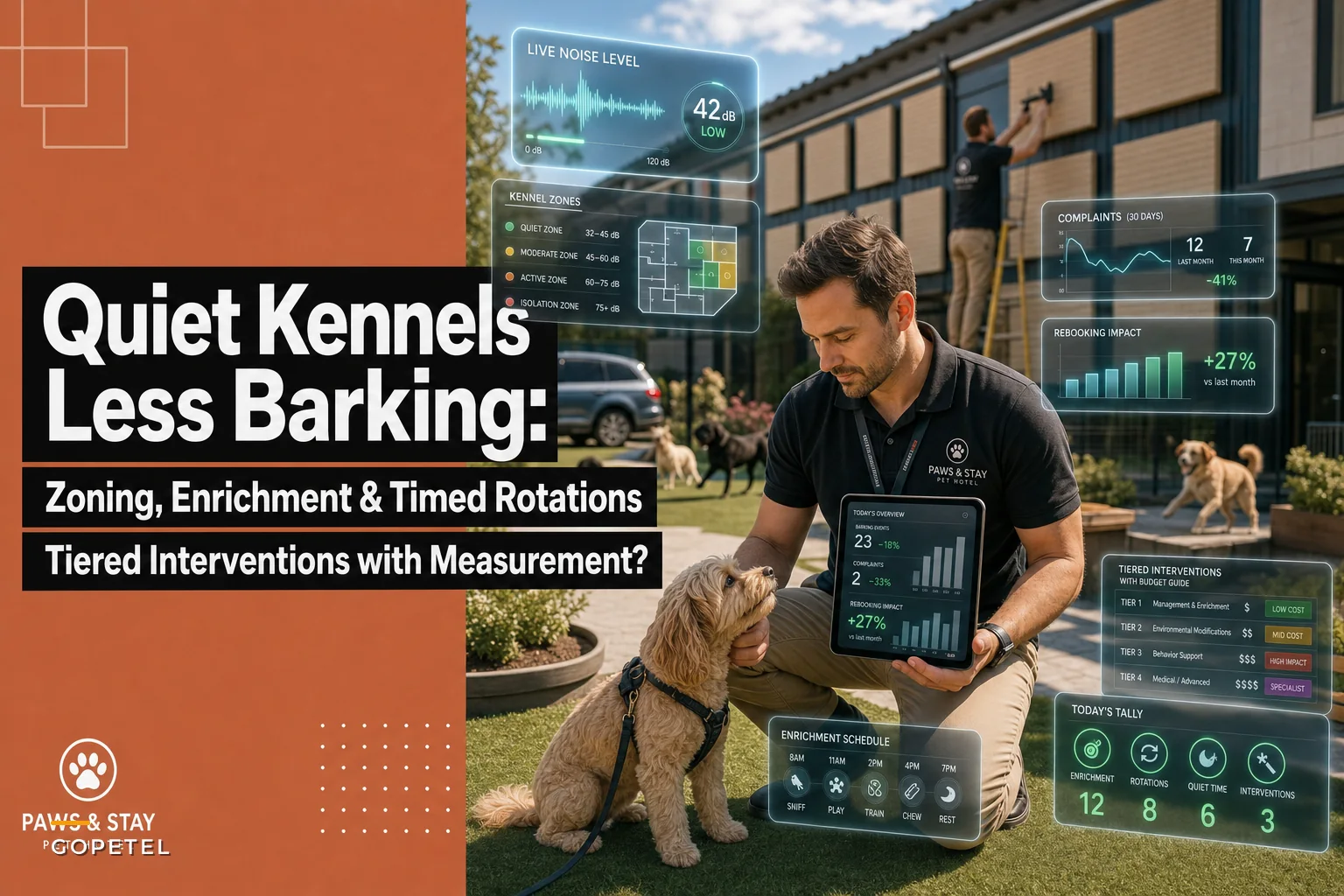

Barking is one of those problems where everyone has an opinion and nobody has a baseline. Someone insists the new white-noise machine helped. Someone else swears the afternoon enrichment block is what calmed things down. Meanwhile the dog in Run 14 is still setting off the whole back row at 6am, your morning staff are fried, and a guest just left a two-star review mentioning "constant barking."
The real issue isn't that barking happens. It's that most facilities throw money and effort at it blind — buying acoustic panels, shuffling dogs around, adding play sessions — without any way to tell which change actually reduced complaints or protected rebookings. You end up spending $4k on foam that might've done nothing, while the free fix (changing which dogs face each other) sits untried.
This post is about building a pet hotel barking reduction SOP that's tiered by cost, sequenced so cheap fixes go first, and wired to a measurement plan so you know what's actually working. Not vibes. Numbers tied to each change.
Why barking spreads the way it does
Before spending a dollar, it helps to understand the mechanics, because they dictate where interventions actually pay off.
Barking in a kennel is rarely one dog being loud. It's a chain reaction. One dog triggers — door opens, cart rolls by, a reactive dog locks eyes with a neighbor — that dog sets off the two next to it, and within fifteen seconds the whole zone is going. Hard concrete floors, block walls, and metal gates bounce sound around until a single bark becomes a wall of noise.
-
Trigger windows are predictable. Morning feeding, shift change, the first play group leaving, and the 5–7pm pickup rush account for the majority of sustained barking. It's not random. It clusters.
-
Line-of-sight is the quiet multiplier nobody adjusts. Dogs that can see each other across an aisle escalate far faster than dogs that can't. Usually the cheapest fix available and the last one anyone tries.
-
Boredom barking looks different from reactive barking. Mid-afternoon lulls produce a slower, droning, attention-seeking bark. That's an enrichment gap, not an acoustic one — throwing sound panels at it does nothing.
If you've already worked through layout and flow issues in your kennel zoning and layout planning, you've got a head start. A lot of noise control is really zoning control wearing a different hat.
The tiered intervention model
The mistake most owners make is treating every fix as equal and reaching for whatever's top of mind — usually the expensive physical retrofit. A smarter approach budgets interventions into tiers, runs the cheap and fast ones first, measures, and only escalates to capital spend when behavioral and zoning fixes have been exhausted.
Never miss a booking or detail again.
GoPetel simplifies pet hotel operations by managing every reservation and pet profile seamlessly.
- Centralized booking management
- Automated client notifications
- Staff and kennel scheduling
No credit card required
Here's the framework:
| Tier | Intervention type | Typical cost | Lead time | What it targets |
|---|---|---|---|---|
| 1 | Behavioral schedules & rotation timing | ~$0 (labor only) | Immediate | Trigger-window barking, chain reactions |
| 2 | Quiet-zone rules & line-of-sight blocking | $50–$400 | Days | Visual triggers, escalation spread |
| 3 | Enrichment programming | $100–$600/mo | 1–2 weeks | Boredom/attention barking |
| 4 | Sound-absorbing retrofits | $1.5k–$8k+ | Weeks | Reverberation, baseline ambient noise |
The logic is simple: don't spend Tier 4 money to solve a Tier 1 problem. A dog barking because he can see a reactive neighbor doesn't need acoustic panels — he needs a visual barrier that costs forty bucks. You only know the difference if you've worked the tiers in order and measured between them.
Tier 1 — Behavioral schedules and rotation timing
This is the free tier, and it's usually the highest-leverage one.
-
Map your current trigger events against a timeline for one full day — every door open, feed, group move, and pickup.
-
Identify the stack points where three or more triggers overlap.
-
Offset them by 10–15 minutes each so dogs settle between stimulations.
-
Feed the loudest zone first, before the quieter dogs wake into the noise, not after.
-
Rotate the order daily or weekly so the same dogs aren't always last and most agitated.
Rotation also covers which dogs go where. Barkers cluster badly when grouped. Interspersing calmer dogs between known vocal ones breaks the chain-reaction physics.
Tier 2 — Quiet-zone rules and line-of-sight blocking
Quiet zones are both physical and procedural. Designate a run block as low-stimulation — away from aisles, doors, and high-traffic paths — and reserve it for anxious dogs, seniors, or guests flagged as noise-sensitive.
-
Frosted film or vinyl on lower gate panels so dogs can't lock eyes
-
Hanging dividers or stall curtains between aisle-facing runs
-
Angled gate inserts that block direct sightlines but keep airflow
The rules matter as much as the physical setup: no cart staging in the quiet block, no radios, staff keep voices down, and pickups for those dogs get routed through a different path when possible.
Tier 3 — Enrichment programming
Enrichment targets the barking that scheduling and barriers can't touch — the boredom drone. Frozen food puzzles, licking mats, scatter feeding, short solo walks, and midday sniff breaks all redirect energy that otherwise comes out as vocalizing.
The key is timing enrichment to the lull, not the chaos. The mid-afternoon dead zone — roughly 1–3pm at most facilities — is when boredom barking peaks and when staff are often on break. Dropping a frozen Kong into every run at 1:30 is cheap, repeatable, and measurable.
If you're already running tailored programs for anxious or special-needs guests, like the setups covered in our special-needs boarding system, enrichment slots in naturally — you're just extending it to noise management.
Tier 4 — Sound-absorbing retrofits
Only after the first three tiers do acoustic retrofits make sense. These address the reverberation problem — the hard surfaces that turn one bark into a wall of noise. Options include ceiling-mounted acoustic baffles, wall panels rated for washdown environments, and rubberized flooring that dampens both impact and echo.
This is real money, and often involves permits and install coordination, which is exactly why you don't start here. If Tiers 1–3 already dropped your complaint rate meaningfully, you might only need panels in one problem zone instead of the whole building — turning an $8k project into a $2k one.
The measurement plan — this is the part everyone skips
Without measurement, you can't tell the difference between "the panels worked" and "it got quieter because the loud dog checked out Tuesday." You'll credit the wrong fix and waste the budget next time.
The point of a measurement plan is to tie complaints and rebooking impact to each specific intervention. That means changing one tier at a time and watching the numbers before stacking the next.
Track these:
-
Complaint count — formal (reviews, front-desk mentions) and informal (staff logs). Log the zone and time when possible.
-
Sustained barking events — a quick staff tally of episodes lasting over roughly 30 seconds, logged by zone and time block. This is your leading indicator; it moves before reviews do.
-
Rebooking rate for noise-sensitive guests — dogs flagged as anxious or owners who previously mentioned noise. Did they come back?
-
Staff stress flags — informal, but burnout from a loud back row is real and shows up in turnover.
The sequencing rule: run one tier for two to three weeks, measure, then layer the next. If you deploy rotation changes and enrichment and panels all in one week, you've learned nothing about which one earned its keep.
A simple logging workflow that doesn't burden staff: morning and evening, whoever's on floor does a 30-second tally — zone, time block, number of sustained barking episodes, any trigger they noticed. That's it. One clipboard or one shared phone note. At week's end, someone totals it against which intervention was live. Over a month you'll have a clean before/after per tier, and you'll know whether the $40 window film outperformed the $4k panels. It often does.
Here's how that measurement cycle fits into a repeating operational loop:
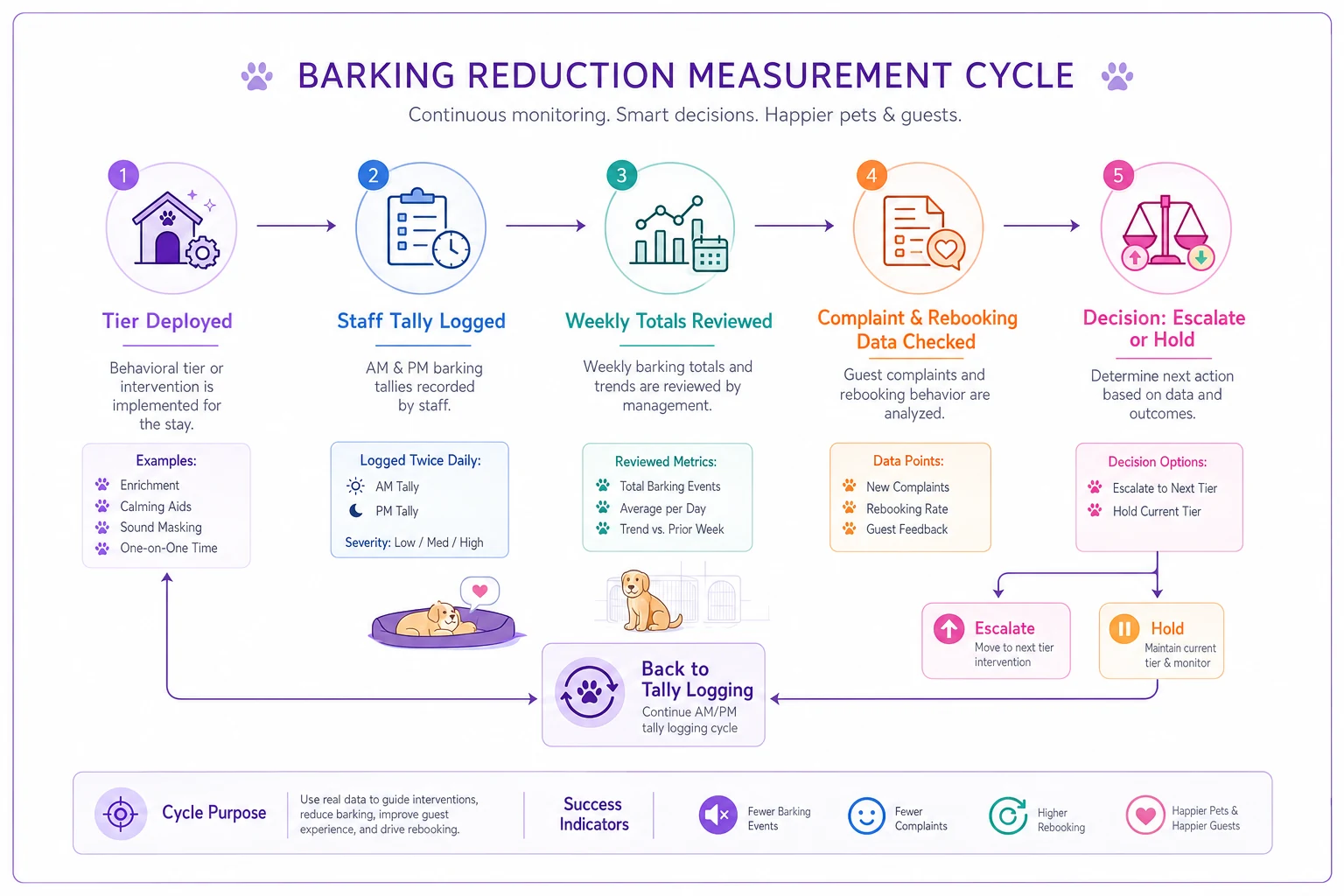
A simple logging workflow that doesn't burden staff: morning and evening, whoever's on floor does a 30-second tally — zone, time block, number of sustained barking episodes, any trigger they noticed. That's it.
Real scenario: a 48-run facility fighting the back row
A mid-size boarding facility — roughly 48 runs, suburban, heavy weekend and holiday occupancy — had a recurring problem: the back two rows of runs faced each other across a narrow aisle, and that aisle doubled as the cart path to the laundry. Noise-related complaints were showing up in about one in eight reviews, and three repeat clients with anxious dogs had quietly stopped rebooking.
Tier 1 (free): They moved cart runs off the back-aisle path during settle times and offset feeding by 15 minutes between the two rows. Sustained barking tallies in the back zone dropped noticeably in the first two weeks — not solved, but a clear dip.
Tier 2 (~$180): Vinyl film on the lower gate panels of the facing runs, killing the line of sight. This was the big one. Chain-reaction episodes in that zone fell by a little over half.
Tier 3 (~$200/mo): Frozen enrichment dropped into the back row at 1:30 daily knocked out most of the afternoon drone.
They never got to Tier 4 for the whole building. After measuring, they added panels to one corner zone that was still hot — roughly a $1,900 job instead of $7k. Noise-related review mentions fell to around one in twenty-five over the following quarter, and two of the three lapsed anxious-dog clients rebooked once owners noticed the difference at pickup.
The win wasn't any single fix. It was working cheap-to-expensive and measuring between each step, so they spent around $2,300 total instead of $7k and knew exactly why it worked.
When this makes sense — and when it doesn't
This approach makes sense when:
-
You have recurring, zone-specific noise rather than one random loud guest
-
Complaints or lapsed rebookings are traceable to noise
-
You're tempted to make a big acoustic purchase and want to validate cheaper fixes first
This is a bad idea when:
-
You skip the measurement and run all tiers at once — you'll waste the learning
-
The barking is a single reactive dog issue, which is a behavioral-screening and intake problem, not a facility-wide program
Who should skip the full tiered system: A very small facility — say under 15 runs — with occasional noise probably doesn't need the formal measurement overhead. Fix the line-of-sight, stagger feeding, done. The tiered model earns its keep once you're big enough that noise is systemic and capital decisions are on the table.
Keeping the SOP alive
A barking reduction SOP isn't a one-time project. Triggers shift as your guest mix changes, and a layout that ran quietly in spring can turn into a problem row during holiday overbooking. Build a quarterly review into the plan: pull the barking tallies, check complaint trends, and confirm the interventions you installed are still pulling their weight.
The facilities that stay quiet aren't the ones that spent the most on acoustic panels. They're the ones that treated barking as an operational problem with a budget and a scoreboard — fixing the free stuff first, measuring honestly, and only spending capital where the numbers said it was needed. Do that consistently, and the back row stops eating your reviews, your staff morale, and your repeat bookings.
The facilities that stay quiet aren't the ones that spent the most on acoustic panels. They're the ones that treated barking as an operational problem with a budget and a scoreboard — fixing the free stuff first, measuring honestly, and only spending capital where the numbers said it was needed. Do that consistently, and the back row stops eating your reviews, your staff morale, and your repeat bookings.
Ready to optimize your pet hotel operations?
Join hundreds of pet hotels using GoPetel to save time, improve pet care, and increase booking reliability.