

Most pet hotels treat reviews like weather. Something that just happens to them. A bad one lands on a Tuesday, everyone panics in the group chat, the owner fires off a defensive reply at 11pm, and then things go back to normal until the next one hits. That's not reputation management. That's reputation reaction.
The facilities that actually control their online rating aren't the ones with fewer problems. They're the ones catching problems inside the building before those problems become public posts. And the raw material to do this already exists in your operation — CCTV footage, stay-audit notes, medication records, feeding logs, incident forms. All sitting in silos, completely disconnected from the moment a client is deciding whether to be angry or forgiving.
A real pet hotel reputation management system isn't a review-monitoring tool. It's an evidence pipeline. It takes what your QA and incident processes already produce and routes it into remediation, recovery scripts, insurer-ready documentation, and the KPIs that actually predict revenue. Here's how that connects — and where it typically breaks.
The gap nobody maps: between "something happened" and "someone posted"
There's a window after a stay ends where the client is forming an opinion but hasn't committed to it publicly. Usually somewhere between pickup and about 72 hours later. That window is where reputation is actually won or lost, and almost no facility has a defined process for it.
A pattern that comes up constantly: a dog goes home with a small scratch, or the client felt staff seemed rushed at pickup, or the pet was just "off" for a day after returning. Nothing catastrophic. The front desk either didn't notice or noticed and didn't log it. The client stews. Three days later a 2-star review shows up mentioning "seemed understaffed" and "my dog came home stressed." Now you're arguing about a version of events you can't reconstruct, because nobody wrote anything down and the camera footage rolled over four days ago.
The core failure is straightforward. Your operational data and your reputation outcomes live on opposite sides of a wall. Incidents get logged for liability. Stay audits get done for quality. Reviews get handled by marketing or the owner. Three separate worlds, none of them talking. The evidence that could have turned a detractor into a rebooking was technically captured — it just never got connected to the client relationship at the moment it mattered.
Why this breaks worse as you grow
At one location with an owner who knows every regular, this problem stays mostly hidden. The owner remembers that Bella's mom is anxious, sees her at pickup, reads the room, and smooths it over on instinct. The reputation system is essentially one person's memory and emotional intelligence.
Never miss a booking or detail again.
GoPetel simplifies pet hotel operations by managing every reservation and pet profile seamlessly.
- Centralized booking management
- Automated client notifications
- Staff and kennel scheduling
No credit card required
-
You add a second shift. The person at pickup wasn't the person who noticed the dog was off mid-stay. The context dies at shift change.
-
You add a second location. The owner can't be in two lobbies. Recovery now depends on whoever happens to be working that day.
-
Volume rises. At 30 stays a week you can eyeball it. At 300 you physically can't track which clients had a rough stay and might need a follow-up.
What happens consistently across multi-site operators is that review scores don't decline gradually as they grow — they fall off a cliff at the exact point the founder stops personally touching every stay. The operation got bigger; the reputation system stayed the size of one person's attention.
The evidence pipeline, start to finish
Think of this as a conveyor belt that moves a single stay from "something got flagged" all the way to either a recovered client or a documented, insurer-ready file. Five stages.
1. Capture (the inputs you already have)
Your pipeline pulls from sources you're mostly already generating:
-
Stay-audit logs — the QA checks your staff run during a stay (mood notes, appetite, play behavior, condition on arrival vs. departure)
-
CCTV / camera events — timestamped footage, especially around play groups, feeding, and any incident
-
MARs (Medication Administration Records) — proof meds were given correctly and on time
-
Incident reports and waivers — the formal record when something goes wrong
-
Feeding and elimination logs
The mistake is treating each of these as a compliance chore filed separately. In a working system, they all carry the same identifier: the stay. That's the thread that lets you reconstruct any single dog's experience later.
If your stay-audit and incident capture is still loose, that's the foundation to fix first — the guest-experience QA and recovery system built around stay audits and a proper incident-reporting, e-sign and retention workflow are what make the rest of this pipeline possible. Garbage capture, garbage recovery.
2. Triage (deciding what actually needs action)
Not every flagged stay needs the same response. This is where most manual processes fall apart — either everything gets escalated (staff burn out and start ignoring flags) or nothing does.
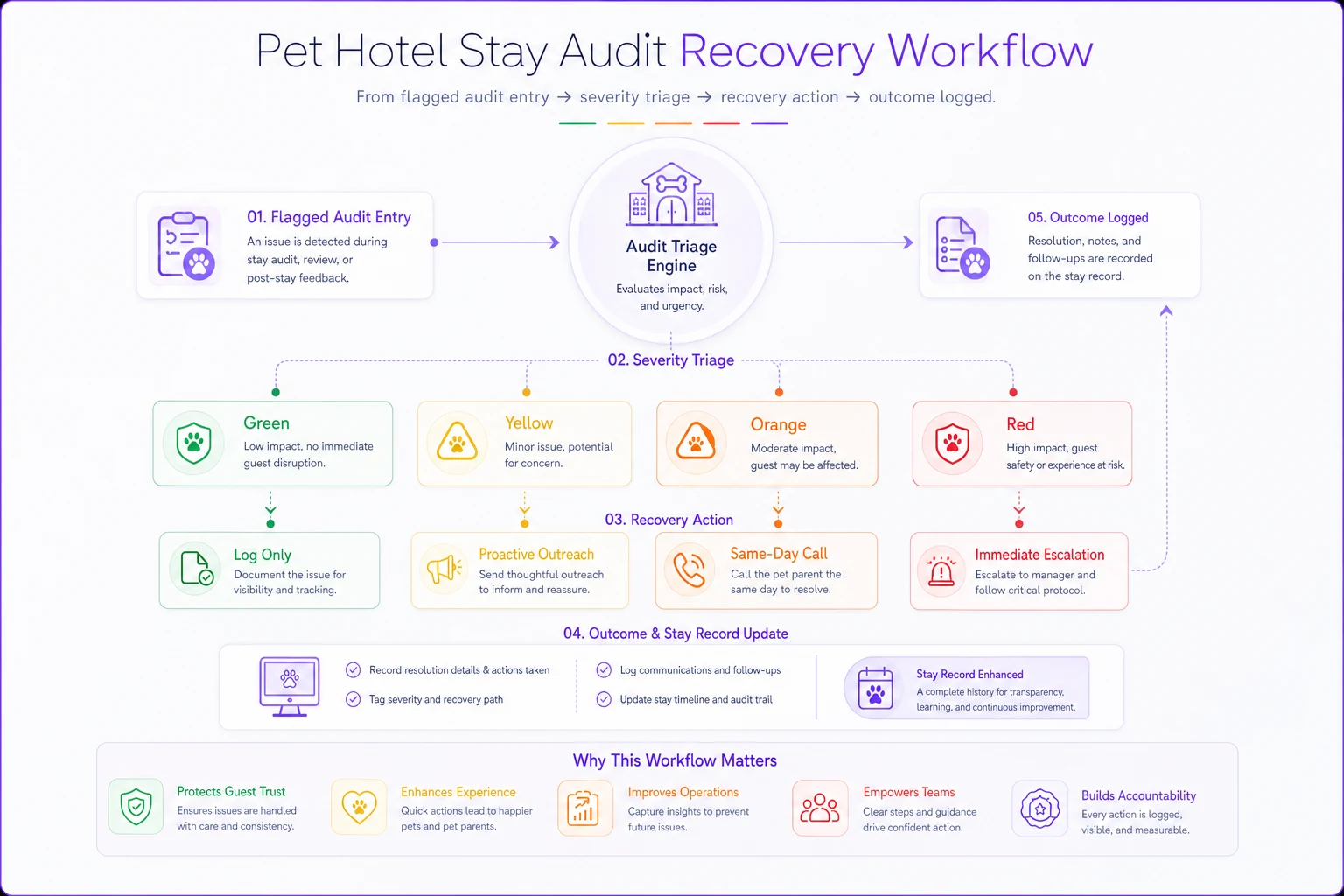
A simple severity map keeps it sane:
| Severity | Trigger examples | Response window | Owner |
|---|---|---|---|
| Green | Minor note, dog slightly quiet, no client concern voiced | Log only, optional check-in | Front desk |
| Yellow | Client seemed unhappy at pickup, minor scratch, missed enrichment | Follow-up within 24h | Shift lead |
| Orange | Injury requiring first aid, med timing issue, food refusal 2+ days | Same-day call + documented plan | Manager |
| Red | Vet visit, escape attempt, serious behavioral incident | Immediate call + insurer/legal prep | Owner/GM |
The insight most people miss: yellow is where the money is. Red incidents are rare and you already treat them seriously. Green doesn't move the needle much. But yellow — the "eh, probably fine" stays — is exactly where silent detractors are created. A facility that only reacts to red is leaking one-star reviews from a hundred yellows it never followed up on.
3. Remediation and scripted recovery
Once a stay is triaged, it routes to a recovery flow. Scripting these isn't about making staff robotic — it's about making sure the right thing happens even when the person doing it is 22, tired, and it's their fourth week on the job.
-
Proactive outreach, same or next day. "Hi — wanted to check in, Cooper seemed a little quiet on day two so we gave him extra one-on-one time. How's he settling back in?" You reached out before they complained.
-
Acknowledge with specifics, not apology-spam. Reference the actual stay data. Vague "sorry you had a bad experience" reads as scripted; "his afternoon play group got moved because we had two intact males in the yard" reads as competent.
-
Offer a concrete recovery gesture tied to their next visit, not a refund reflex. A comped enrichment add-on or a slot hold beats cash back for both margin and the relationship.
-
Log the outcome back onto the stay record. Did they rebook? Did the tone change? This closes the loop and feeds your KPIs.
> GRAPH: Stay flag to recovery — process flow > Illustrate the workflow from a flagged stay audit entry through severity triage (Green / Yellow / Orange / Red), into the appropriate recovery action (log only → proactive outreach → same-day call → immediate escalation), and finally to outcome logging on the stay record.
Clients rarely leave because something went wrong. They leave because something went wrong and no one acknowledged it. Recovery is mostly about being the one to bring it up first.
4. Insurer-ready evidence packs
For orange and red stays, the same pipeline should assemble a defensible file — while the evidence is still fresh. This is the part that saves real money, and that almost everyone handles badly, because they end up scrambling to reconstruct it weeks later when a demand letter arrives.
-
Timestamped incident report with staff on shift
-
Relevant CCTV clips (not "we have footage" — the actual pulled, time-boxed clips)
-
MAR entries proving medication compliance
-
Signed waivers and intake documents for that pet
-
Stay-audit history showing condition on arrival vs. incident
-
Communication log with the client
A fast, well-documented, transparent response to a serious incident is also your best reputation defense. Clients who get a calm, evidence-backed, honest response to a real problem often stay loyal. Clients who get stonewalling go straight to Google — and then to a lawyer.
5. KPIs mapped to LTV
This is where reputation stops being a vanity metric. Track these monthly:
-
Detractor recovery rate — % of yellow/orange stays where the client rebooked within 90 days
-
Silent-detractor volume — flagged stays with no client complaint but no rebooking either (your blind spot)
-
Time-to-first-contact — hours between a flag and staff reaching out
-
Review conversion — % of recovered clients who later left a positive review
-
Incident-to-review leakage — % of orange/red incidents that turned into public negative reviews
The number that shifts how owners think is tying recovery rate to lifetime value. If a boarding regular is worth roughly $1,800–$2,400 a year and rebooks for three or more years, recovering one detractor a week isn't a customer-service nicety — it's five figures of protected revenue annually. The follow-up call has a real ROI.
A real scenario
A two-location boarding and daycare operation running somewhere around 280–320 stays a month combined was sitting at a 4.1 rating and couldn't figure out why occupancy kept dipping in shoulder seasons. Their incident logging was fine — waivers signed, injuries documented. But there was no bridge between a rough stay and any follow-up. Pickup happened, the client left, and that was it.
They built the pipeline in pieces over about a quarter. Stay audits started flagging yellow-tier stays. A shift lead took ownership of same-day outreach on anything yellow or above, using a short set of scripts. Camera clips got pulled and attached to any orange incident within 24 hours rather than stored as a vague "we'll grab it if we need it later."
Within roughly four months, the star rating moved — slowly, from 4.1 to about 4.4. But the more meaningful change was upstream. They found they'd been generating somewhere around 15–20 silent detractors a month — clients who had a mediocre stay, said nothing, and simply didn't rebook. Proactive outreach recovered a solid chunk of them. The negative reviews that still trickled in got responses backed by actual timestamps and footage, which completely changes the tone of the conversation if you've ever argued with a client over "what really happened."
When this makes sense — and when it doesn't
When to build this:
-
You're past roughly 150 stays a month and the owner can no longer personally touch every pickup
-
You have more than one shift or location
-
You've had at least one incident that got expensive because documentation was thin
-
Your rating looks fine but your rebook rate quietly isn't
When it's overkill:
-
Single location, one owner, under about 80 stays a month who genuinely knows every client. At that size the owner's memory is the system, and formalizing it adds overhead you don't need yet. Build the habit of same-day follow-up, skip the infrastructure.
Who should not do this:
-
anyone whose capture is broken. If your stay audits are inconsistent and your incident logs are half-empty, don't build a recovery pipeline on top of unreliable data. Fix capture first, then connect it.
When your capture is solid and volume demands coordination, this pipeline protects revenue and prevents reputational surprises. If capture is broken, stop and fix that first.
Where software quietly earns its keep
You can run a version of this manually with spreadsheets and a disciplined shift lead. Plenty of good operators do. Where it falls apart is coordination at volume — remembering to pull footage before it overwrites, making sure yellow flags don't slip through on a busy holiday weekend, matching an incident to the right waiver to the right MAR entry across two locations.
Automate pulling relevant CCTV clips before the retention window expires to avoid scrambling for evidence later.
That's the unglamorous work AI-assisted operational software handles well: watching every stay record for flags, auto-assembling evidence packs while footage still exists, nudging the shift lead when a follow-up window is closing, and rolling all of it into monthly reputation KPIs without anyone manually exporting five different reports. It doesn't replace the judgment call or the human phone call — it just makes sure the belt keeps moving so the right conversation happens at the right time.
The takeaway
Reputation isn't managed at the point where a review gets posted. By then it's already decided. It's managed in the 72 hours after a stay, using evidence you're already collecting but currently not connecting to anything.
Tie the capture to the triage, the triage to a recovery script, and the whole thing to KPIs that reflect what a loyal client is actually worth over years — and review crises stop feeling like weather. They become something you saw coming and quietly handled before it ever made it online.
Tie the capture to the triage, the triage to a recovery script, and the whole thing to KPIs that reflect what a loyal client is actually worth over years — and review crises stop feeling like weather. They become something you saw coming and quietly handled before it ever made it online.
Ready to optimize your pet hotel operations?
Join hundreds of pet hotels using GoPetel to save time, improve pet care, and increase booking reliability.