

Most pet hotels track the wrong side of quality. They obsess over the disasters — the bite incident, the escaped dog, the angry review — and treat everything below that threshold as "fine." But the stays that quietly go 80% right are the ones bleeding you revenue. The dog that came home smelling off. The owner who never got a photo update on day two. The pickup where nobody mentioned the limp until the client noticed it in the parking lot.
None of those trigger a complaint. They just quietly kill the rebook.
A real pet hotel QA program isn't about catching catastrophes. It's about measuring the gap between "the stay was okay" and "the stay was good enough that they'll book again without shopping around." That gap is where your lifetime value lives, and almost nobody measures it deliberately.
Why quality feels invisible until the rebook rate drops
The core problem with boarding is that the guest can't talk. The dog can't tell you the kennel was too loud, that feeding ran late twice, or that nobody did the extra walk the owner paid for. The owner only sees the edges — drop-off and pickup — and infers everything in between.
So quality becomes a story the owner builds from small signals. Did the staff know the dog's name? Was the paperwork right? Did the photo updates actually show their dog doing something, or a generic shot of a play yard?
The pattern you see across a lot of facilities: owners think they delivered an 8-out-of-10 stay, but the client scored it a 6 based entirely on what they could actually see. A 6 doesn't rebook — it "keeps its options open." The facility never finds out why, because the client doesn't complain. They just don't come back, and the owner blames pricing or a new competitor down the road.
That's the trap. Without structured checks, you're managing a service you can't see, judged by signals you're not tracking, scored by a customer who won't tell you the number.
The three layers most QA setups are missing
When pet hotels do try to run quality control, it usually collapses into a single closing checklist — "kennel clean, water full, belongings bagged" — handled by whoever's working that night. That's a hygiene check, not a QA program. A real program has three distinct layers, and they each answer a different question.
Never miss a booking or detail again.
GoPetel simplifies pet hotel operations by managing every reservation and pet profile seamlessly.
- Centralized booking management
- Automated client notifications
- Staff and kennel scheduling
No credit card required
Stay-level audits answer: did this specific stay meet spec? Not the facility overall — this dog, this reservation, these add-ons. Was the paid extra walk actually delivered? Was the medication given on schedule per the medical stay records? Was the feeding plan followed?
Sampled checks answer: is the operation drifting? You can't deep-audit every stay, so you pull a sample and inspect it hard. These catch systemic problems — a shift that consistently skips midday walks, a groomer who's rushing, a kennel zone that runs behind on turnaround.
Recovery answers: when a stay went wrong, did we save the relationship? Most facilities have no recovery process. Something goes sideways, the client goes quiet, and the account silently churns.
Here's how the three connect: stay-level audits catch individual misses, sampled checks catch pattern misses, and recovery converts a caught miss into a retained client. Skip any one layer and the other two lose most of their value. Audits with no recovery just document your losses. Recovery with no audits means you only catch the loud complaints — which are a fraction of the actual damage.
Stay-level audits: what to actually inspect
The mistake here is auditing the kennel instead of the promise. A clean kennel tells you the space was maintained. It tells you nothing about whether the client got what they paid for.
Audit against the reservation, not the room. Every stay carries a set of explicit and implicit promises: the base care, the add-ons, the special instructions, the communication cadence. Your stay audit should answer yes or no on each one.
A practical stay-audit checklist:
-
Feeding schedule followed and portions matched the intake form
-
Medications administered on time, with a second-signature log on anything critical
-
Every paid add-on delivered (extra walks, one-on-one play, enrichment, bath before pickup)
-
Special instructions honored (separate from other dogs, no rawhide, specific bedding)
-
Communication cadence met — the owner got the updates promised at their tier
-
Any incident, however minor, logged with a timestamp and a note
-
Belongings inventoried at check-in and returned complete
-
Physical condition at pickup matches or exceeds condition at drop-off
Prioritize auditing add-on delivery — it's the most predictive item on the list.
Run this on every stay above a certain value, and on a sample of the rest. Higher-tier and longer stays are your LTV concentration — those deserve full audit coverage. A five-night holiday stay with three add-ons warrants more scrutiny than a single overnight.
The insight most owners miss: the add-on delivery line is the single most predictive item on the whole list. When a client pays extra for one-on-one play and it doesn't happen — or happens but they can't tell it happened — you've charged premium money for an invisible service. That's the fastest way to train a client to stop buying add-ons. And add-ons are usually your best margin.
Sampled checks: catching drift before it costs you
You can't deep-audit 100% of stays without hiring someone whose entire job is auditing, which most facilities can't justify until they're fairly large. Sampling is how you get coverage that actually works economically.
Pull a random sample each week — somewhere around 15–20% of completed stays — and audit them at the same depth you'd audit a VIP stay. Rotate the sample across shifts, staff, kennel zones, and days of the week so nobody can "perform for the audit."
What sampling catches that individual audits miss is pattern. One skipped midday walk is a miss. The same walk skipped on Tuesdays and Thursdays is a staffing problem — probably a coverage gap on those days. One late medication is human error. Late medications clustering on the closing shift is a workflow problem, likely a handoff that's breaking between shifts.
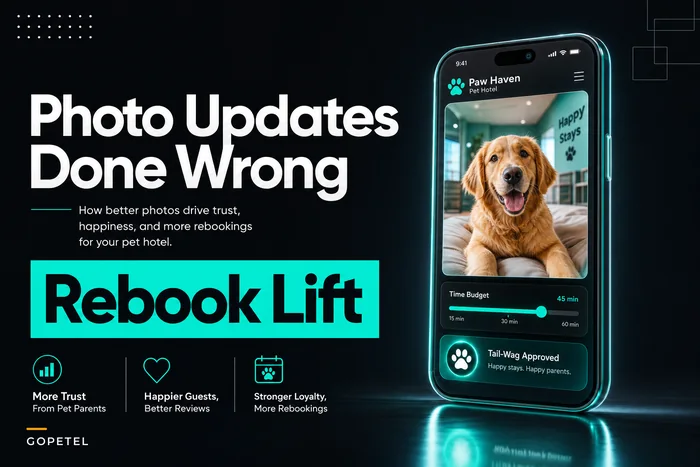
A real example of this: a mid-size facility running sampled checks noticed stays in one kennel zone showed "photo update sent" but timestamps clustered at the end of the day instead of spread through it. One staffer was batching all photos at 4pm because the play-yard rotation left no time earlier. The photos were technically delivered, but owners got a single late dump instead of updates through the day — which reads as neglect even when the actual care was fine. That's exactly the kind of gap a time-budgeted photo update plan is built to prevent, and sampling is how you catch that the plan isn't being followed.
Sampling also protects you politically. When you tell a staffer "you skipped a walk," it's an accusation. When you say "our sampled checks show midday walks are getting missed on Tuesdays across the whole team," it becomes a systems conversation. People defend themselves against the first and help you fix the second.
Recovery scripts: turning a miss into a retained client
This is the part almost every facility skips. You caught a miss — through an audit, or because the client flagged it. Now what?
Most places wing it. The manager apologizes, maybe comps something random, and hopes it blows over. That's not recovery — it's damage control with no consistency and no way to measure whether it worked.
A recovery script is a pre-built response tied to the type of miss, with a defined make-good and a defined follow-up. The point isn't to sound scripted — it's to make sure every recoverable client actually gets recovered, instead of recovery depending on whether the manager was having a good day.
A simple recovery tier structure:
| Miss type | Example | Make-good | Follow-up |
|---|---|---|---|
| Communication miss | Owner didn't get promised updates | Sincere acknowledgment + photo recap of the stay | Personal note before next booking window |
| Service-delivery miss | Paid add-on not delivered / not visible | Refund the add-on + comp it on next stay | Confirm the fix in writing on rebook |
| Care-experience miss | Dog stressed, minor issue at pickup | Discount + free daycare trial to rebuild trust | Manager check-in call within 48 hours |
| Serious miss | Injury, health decline, safety issue | Full transparency, vet cost coverage as appropriate, significant credit | Direct owner relationship, not front-desk handoff |
The script isn't the words — it's the decision. Front-desk staff shouldn't have to improvise whether a missed walk warrants a $10 credit or a free night. The tier tells them. That consistency is what makes recovery measurable, because now you can track: how many misses, what type, what make-good, and whether the client rebooked.
The counterintuitive part: a well-recovered miss often produces a more loyal client than a flawless stay. A stay that goes perfectly is just expected. A stay where something went wrong and the facility owned it, fixed it, and followed up — that's the story the client tells their friends. Recovery, done right, is a retention tool disguised as an apology.
Mapping QA to revenue: the number that changes the conversation
None of this earns budget or attention until you connect it to money. And the connection is more direct than most owners assume.
The metric that ties it together is ROI per recovered booking. Start with your average client's lifetime value — not their next stay, their whole relationship. If an average boarding client stays with you for three years at roughly four stays a year averaging around $280 a stay, that client is worth somewhere in the range of $3,000–$3,500 in gross revenue over their life with you, before add-ons.
A client who has one bad, unrecovered stay in year one and churns doesn't cost you one $280 stay. They cost you the remaining $2,700-ish of that relationship. That's the real cost of the miss, and it's the number your QA program is protecting.
Here's how the math plays out in practice:
-
Count the misses your QA program surfaces in a month (audits + sampled checks + client-flagged).
-
Estimate what fraction of those clients would have silently churned without recovery — conservatively, a meaningful share of unrecovered service misses don't rebook.
-
Multiply the churn-risk clients by your average remaining LTV.
-
Track how many you actually recover with the scripted make-goods.
-
Subtract the cost of the make-goods (comps, refunds, staff time).
The make-goods are cheap relative to the LTV. Comping a $40 add-on and a free daycare day to save a $2,700 relationship isn't a cost — it's the highest-ROI spend in the building. When you frame QA this way, it stops being an operational nicety and becomes a revenue line.
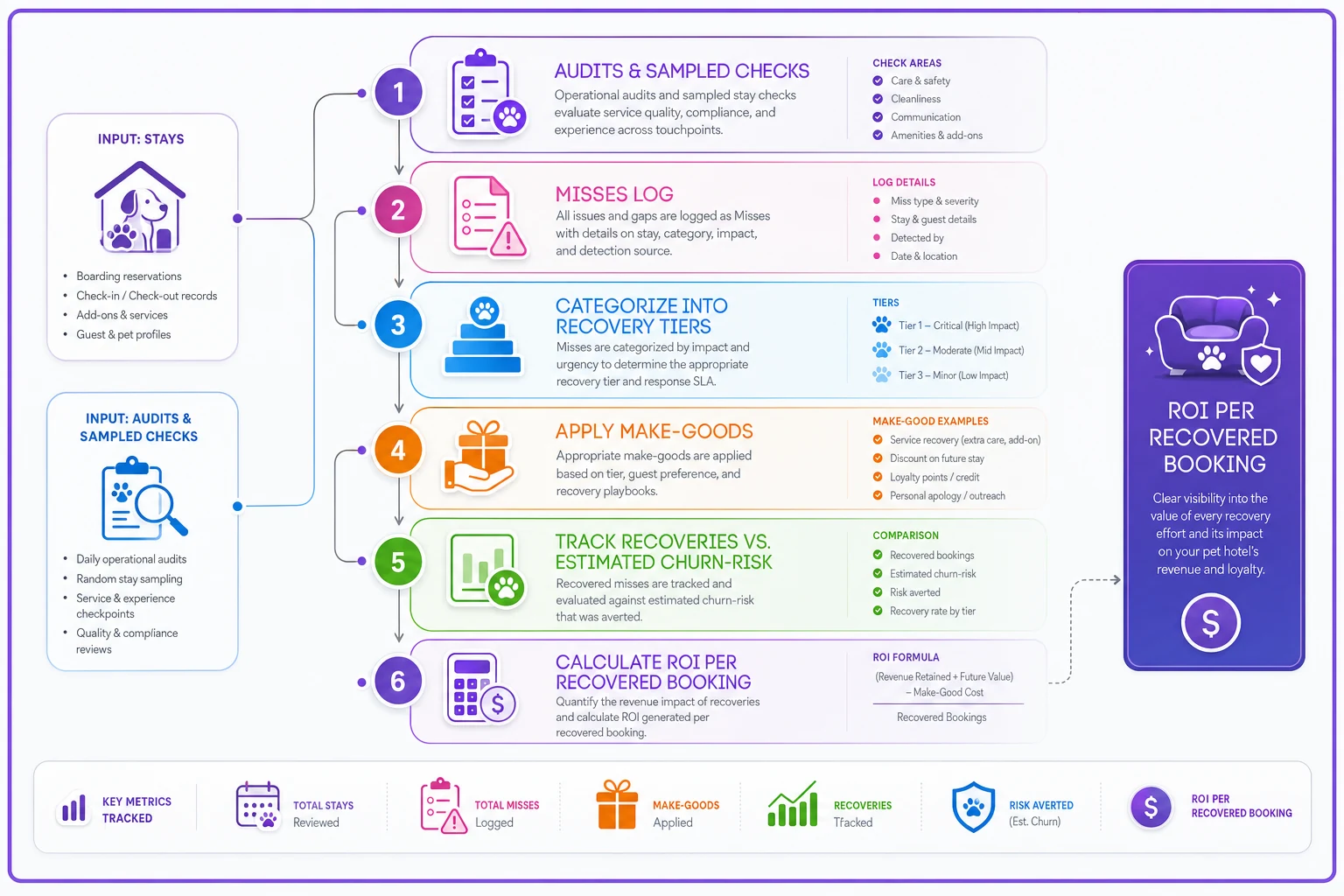
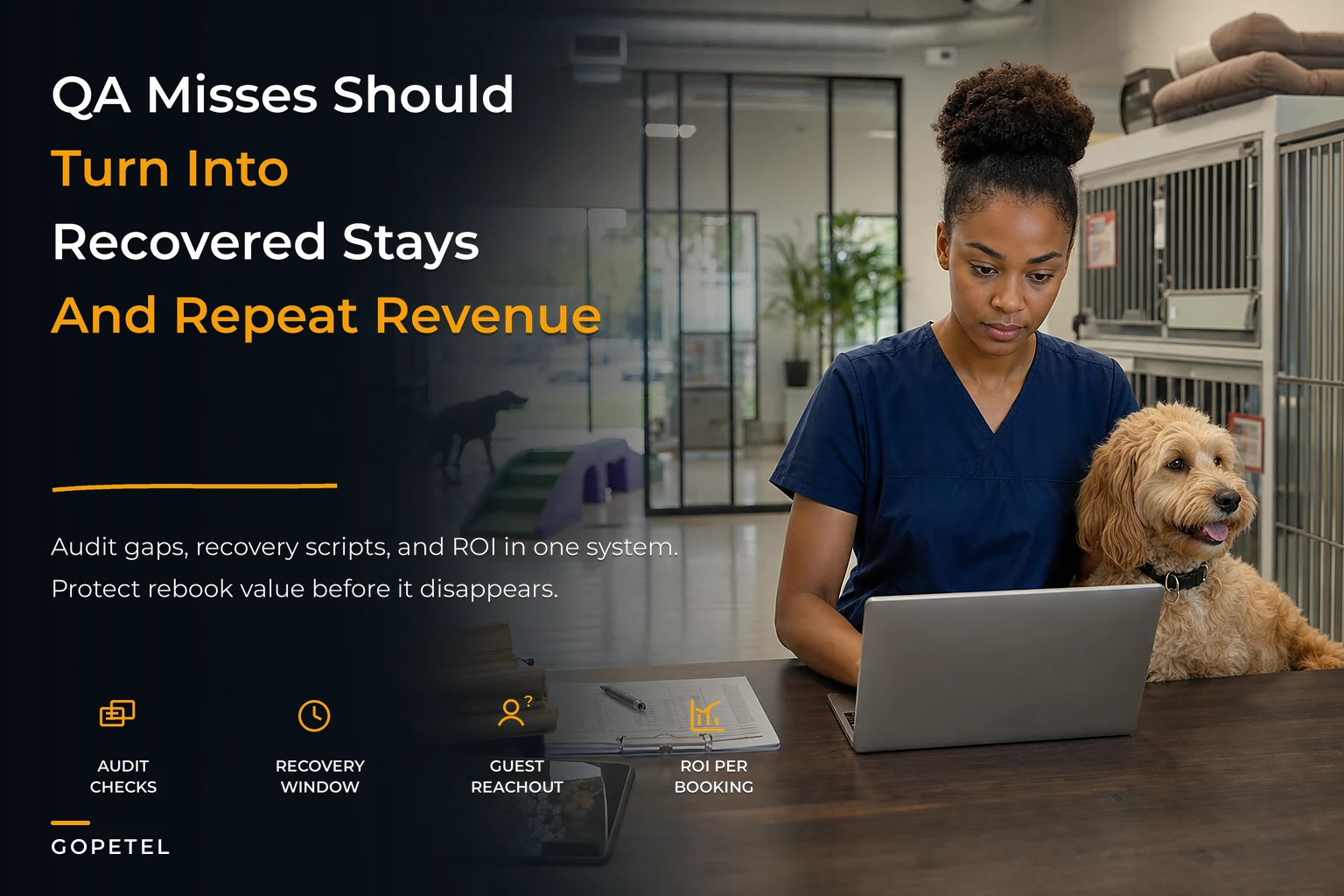
This workflow ties the operational steps to the revenue math so you can show QA as a direct ROI driver.
This is the same logic behind a broader client-lifecycle and rebooking system — QA is the front end of that system. It's where you detect the risk early enough to act on it, instead of discovering churn six months later when the booking calendar looks thin.
A real scenario
A single-site facility with roughly 40 kennels was running around 320–350 stays a month with no formal QA beyond a closing checklist. Rebook rate sat somewhere in the mid-60s, and the owner figured that was just the market.
They started with stay-level audits on every stay over $200 and a weekly 15% random sample on everything else. Within the first month, the audits surfaced a consistent problem: paid enrichment add-ons were being logged as sold but delivery wasn't documented, and roughly a third of the sampled add-on stays had no evidence the enrichment actually happened.
They built three recovery tiers and trained the front desk on them. Nothing complicated — a defined make-good and a defined follow-up per miss type.
Over the following couple of quarters, rebook rate moved into the low-to-mid 70s. The bigger shift was in add-on revenue: once delivery was audited and made visible to owners — a quick note or photo tied to the add-on — clients started trusting the add-ons and buying them at a noticeably higher rate. The recovery scripts turned a handful of would-be churned holiday clients into repeat bookers. The comps and refunds cost the facility a few hundred dollars a month; the retained relationships were worth many multiples of that.
Nothing in there was a heroic fix. It was just seeing the misses on purpose and having a consistent response.
Where software fits — and where it doesn't
You can run a QA program on paper. Plenty of small facilities start that way, and it beats nothing. But it breaks in predictable ways as volume grows.
Sampled checks fall apart manually because random sampling, rotated across shifts and zones, is tedious to do by hand and easy to fudge. Stay-level audits fall apart because you need the reservation data — add-ons sold, instructions given, updates promised — sitting right next to the audit so you're checking against the actual promise, not from memory. And ROI mapping is basically impossible on paper because you can't easily connect a specific miss to a specific client's rebook behavior months later.
This is where operational software with some AI automation earns its keep — not as a gimmick, but for the boring parts that humans do badly at scale. Pulling a weekly random sample automatically. Flagging when a paid add-on has no delivery record before the stay closes. Watching for pattern drift — the Tuesday walk gap, the batched photos — and surfacing it before it becomes a churn problem. Tying each recovery make-good to the client record so you can actually see whether recovery is working.
The judgment stays human. Whether a miss deserves a free night, how to talk to an upset owner, when to escalate a health issue — that's you and your team. The software just makes sure the misses get seen, the samples get pulled, and the money math stays connected to reality.
When a full QA program makes sense — and when it's overkill
It makes sense when: you're running enough volume that misses are hiding in the noise (roughly a couple hundred stays a month or more), when you sell meaningful add-ons, or when your rebook rate is lower than it should be and you can't explain why.
It's overkill when: you're a very small operation doing a handful of stays a week where the owner personally touches every dog. At that scale, you are the QA program, and formalizing it adds process without adding visibility.
Who should not start here: if your core care delivery is still inconsistent — feeding gets missed, medications are unreliable, turnaround is chaotic — fix the operation before you audit it. QA measures whether you're hitting spec. If you don't have a spec yet, build the SOPs first, then layer QA on top to keep them honest.
The facilities that get the most out of this are the ones already doing decent work but leaking retention they can't see. For them, QA isn't about doing better care — it's about proving the care, catching the quiet misses, and converting them into the rebookings and lifetime value that were slipping out the door unnoticed.
The stays you never hear a complaint about are the ones worth watching most closely. Silence isn't satisfaction — sometimes it's just a client quietly deciding not to come back.
Ready to optimize your pet hotel operations?
Join hundreds of pet hotels using GoPetel to save time, improve pet care, and increase booking reliability.