


Most pet hotels run experiments the way they run their thermostat — reactively, and usually a week too late. Somebody notices occupancy is soft, so they throw a 15% off coupon on the booking page. Then peak season hits, demand spikes, and nobody touches pricing because they're too busy surviving. The result is a year of scattered, half-measured tests that never compound into anything useful.
The problem isn't that owners don't experiment. It's that they experiment at the wrong time, with the wrong gating rules, measuring the wrong thing. A discount test during your slowest February week tells you almost nothing about how that same offer performs in June. And a packaging test launched during a holiday rush will get contaminated by demand you'd have captured anyway — so you "win" with a bundle that actually cannibalized full-price nights.
A real pet hotel experimentation calendar fixes this by treating the year as a sequence of windows, each with its own purpose, its own staffing reality, and its own guardrails. You stop asking "should we run a promo?" and start asking "what is this specific window for, and what are we allowed to test given our throughput and margin right now?"
Why most experiments quietly fail
Before building the calendar, it's worth understanding the three failure modes that waste most pet-hotel experiments.
Seasonal contamination. You test a weekday package in late November. Bookings climb. You declare victory and roll it out. But November climbs anyway because of the holidays — the package did nothing, or worse, it discounted stays you'd have sold at full rate. Running a test inside a high-demand window is like weighing yourself right after drinking a gallon of water.
Throughput collisions. A new grooming add-on or an extended daycare tier looks great on a spreadsheet, but it only works if your staff can physically deliver it. Launch it during a period where your kennel turnaround is already maxed, and the experiment doesn't measure demand — it measures your team's breaking point. You end up with angry reviews instead of clean data.
No gating rules. Nothing kills margin faster than a promotion that fires when you're already full. If your discount code has no blackout logic tied to forecasted occupancy, you're paying people to book nights they'd have paid full price for. This is the exact leak covered in our piece on pricing governance for blackouts, corporate discounts and experiments — and it's the single most common reason a "successful" test loses money.
The fix for all three is the same: tie every experiment to a window and a gate. The window decides when you're allowed to learn something clean. The gate decides whether you're allowed to run it at all given current staffing, throughput, and margin exposure.
The four experiment windows in a pet hotel's year
Every facility's demand curve is a little different, but almost all of them break into four functional windows. Your dates will shift, but the logic holds.
Never miss a booking or detail again.
GoPetel simplifies pet hotel operations by managing every reservation and pet profile seamlessly.
- Centralized booking management
- Automated client notifications
- Staff and kennel scheduling
No credit card required
| Window | Typical months | Demand profile | What it's good for | What NOT to test here |
|---|---|---|---|---|
| Build | Jan–Feb, late Sept | Soft, low variance | Price elasticity, new packages, channel tests | Anything needing full staff |
| Ramp | March–May | Rising, predictable | Packaging validation, upsell rates, deposit rules | Deep discounts |
| Peak | Summer, major holidays | High, volatile | Nothing. Lock everything. | Any new variable |
| Recovery | Sept–Oct, January | Falling, reflective | Retention offers, rebook incentives, win-back | New capacity-heavy services |
The biggest mistake owners make is trying to learn during Peak. Peak is for execution, not experimentation. You've forecasted it, you've staffed it, and introducing a new variable only adds noise and risk. Save your curiosity for the soft windows where a failed test costs you a quiet Tuesday instead of a fully-booked holiday weekend.
The Build window is where real pricing knowledge gets made. Demand is low and stable, which means when you change a price and something moves, you can actually attribute it. Late January is worth ten times more than July for understanding true price sensitivity.
Gating rules: the part everyone skips
A window tells you when. A gate tells you whether. This is where experiments stop being gambling.
Gate 1: Staffing headroom
Before any test that adds service load — a new add-on, longer hours, a care tier — check whether you have the labor slack to deliver it without pulling people off core duties. A simple rule works here: the experiment can't push any shift above around 85% of its task capacity. If your afternoon crew is already running at 90% during turnaround, a new "evening enrichment" package isn't a demand test. It's a burnout test.
Gate 2: Throughput headroom
This one's about physical flow, not people. If the experiment touches intake, cleaning, feeding, or kennel turnaround, you need slack in the bottleneck. Adding a premium check-in experience sounds harmless until you realize check-in is already your choke point and you've just made every arrival slower. Measure the bottleneck first. Test around it, never through it.
Gate 3: Margin cannibalization
The quietest killer. Every discount or bundle has to clear a simple question: how many of these buyers would have paid full price anyway? If you offer a 3-night bundle at 12% off and 70% of takers were already 3-night bookers, you just handed away margin for bookings you already owned. A rough cannibalization check:
-
Estimate baseline volume for the behavior you're incentivizing (e.g., 3-night stays).
-
Project how many of those would occur with no offer.
-
Count only the incremental bookings as the experiment's upside.
-
Subtract the discount cost applied to the baseline bookings too — because they got the discount anyway.
-
If net margin is negative, the test fails the gate regardless of how good the top-line looks.
Running this math before launch, not after, is what separates a disciplined calendar from a coupon habit.
A quick gating workflow looks like this:
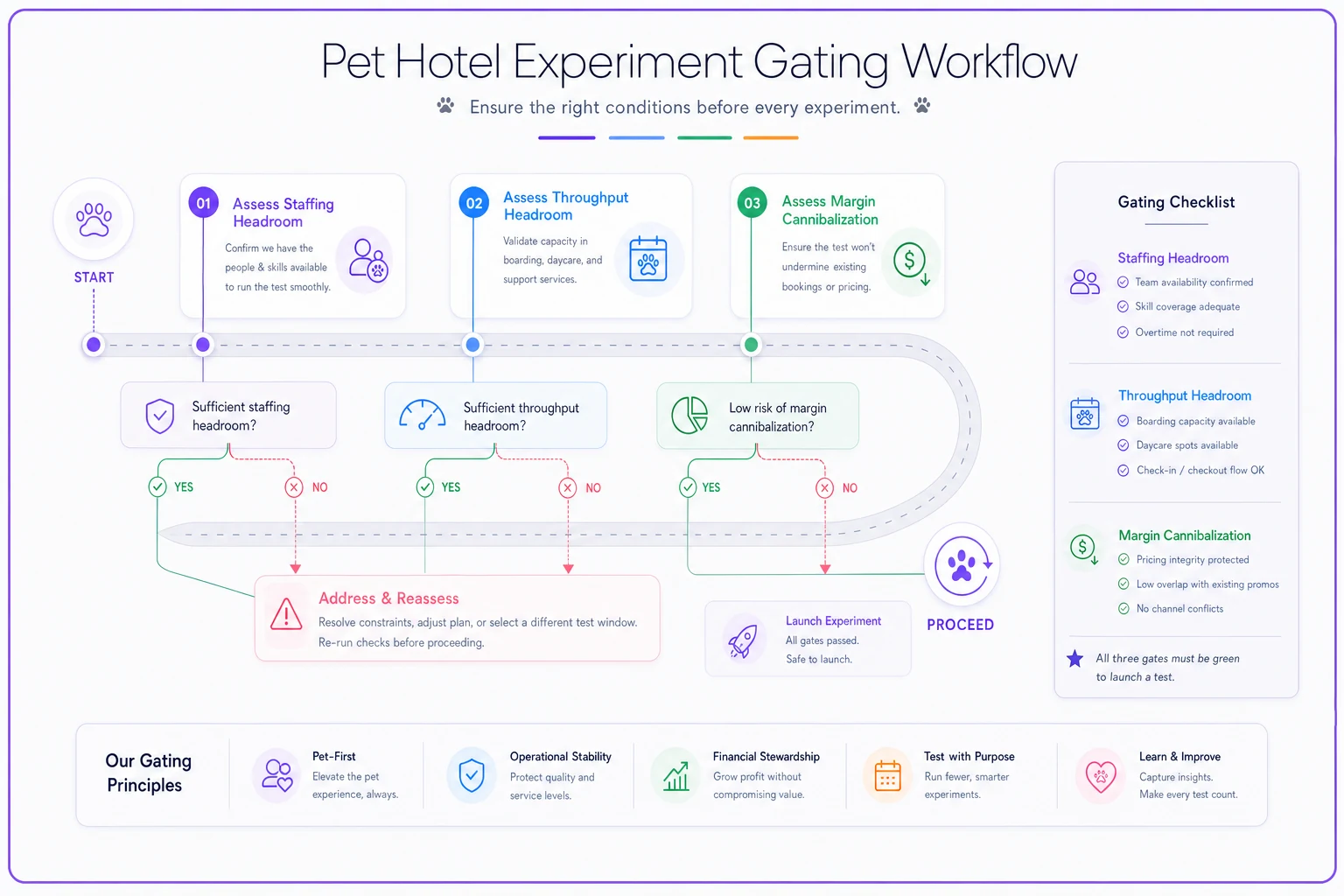
If any gate fails, the test is postponed or killed, no exceptions.
Sequencing: why order matters more than content
The order of your experiments matters more than the individual tests themselves. Run them in the wrong sequence and each one pollutes the next.
The reliable sequence goes price → packaging → channel, and it's worth understanding why.
You test price elasticity first, in the Build window, because everything downstream depends on knowing what your demand actually responds to. If you don't know your elasticity, you can't price a package correctly or evaluate a channel's true profitability.
Then you test packaging in the Ramp window, using the price knowledge you just earned. Now you can build bundles with confidence instead of guessing at the discount depth. This connects directly to how you design tiers that don't wreck operations — the structural side of which we cover in the service-design work around bundles and tiers.
Finally you test channel shifts, because channel performance only makes sense once your price and packaging are stable. Testing a new OTA or referral source while your prices are also moving means you can't tell which variable caused the result. Our write-up on channel scoring and a demand calendar pairs naturally with the channel phase — it gives you the scoring rubric to decide which channels even deserve a test slot.
Run these out of order — channel before price, say — and you'll make confident decisions on contaminated data. That's worse than not testing at all, because now you trust a wrong answer.
Sample-size and measurement: keeping tests honest
A test you can't read is a test you shouldn't run. Pet hotels have a particular challenge here — booking volumes are often too low to reach textbook statistical significance quickly, which tempts owners to either call tests early or run them forever.
-
Set a minimum exposure, not a perfect sample. For a pricing test, aim for enough booking volume that a single large group reservation can't swing the result. Often that means running the test across a full booking cycle (2–4 weeks of lead-time-adjusted demand), not a weekend.
-
Measure against a matched baseline, not last year. Compare the test window to a comparable non-test window with similar demand, adjusting for seasonality. Year-over-year comparisons carry too much noise from weather, local events, and economic shifts.
-
Pick one primary metric per test. Price tests → net revenue per available kennel-night. Packaging tests → incremental margin after cannibalization. Channel tests → contribution margin per booking after channel cost. Secondary metrics are for context, not for declaring a winner.
A quick checklist before you call any test "done":
-
[ ] Did it run across a full booking cycle, not a single weekend?
-
[ ] Was it compared to a matched, seasonally-adjusted baseline?
-
[ ] Did I isolate a single variable, or did three things change at once?
-
[ ] Did I run the cannibalization math on the baseline buyers?
-
[ ] Did I wait for lead-time to play out before reading results?
-
[ ] Would this result still hold in a different window, or is it window-specific?
Run price tests for a full booking cycle to avoid lead-time noise.
If you can't check all six, you have a hunch, not a result.
A real scenario
A mid-sized facility — around 40 kennels, two locations' worth of staff pooled on a shared roster — had a habit of launching a "weekday special" every time occupancy dipped. 20% off Monday through Thursday, no blackout logic, fired year-round.
On paper the specials "worked": weekday occupancy was up. But when they ran the cannibalization math, roughly half the weekday discount bookings were regulars who already booked weekdays. They were discounting loyal, already-committed demand. The real incremental lift was thin, and during ramp-up months the discount was actively eating into nights that were filling on their own.
They rebuilt around a windowed calendar. Weekday elasticity testing moved to the Build window only. The blanket discount got blackout rules tied to forecasted occupancy — if a date was projected above around 80% booked, no discount fired. Packaging tests moved to spring, sequenced after the price learning. Nothing new launched during summer at all.
The outcome wasn't a dramatic revenue explosion — it was cleaner than that. Discount spend dropped noticeably, weekday occupancy held roughly flat (confirming the discount hadn't been driving most of it), and margin on weekday nights improved by a few meaningful points. More importantly, they stopped guessing. Every offer had a reason, a window, and a gate.
Where software quietly earns its keep
None of this requires fancy tooling to design — a spreadsheet and discipline will get you most of the way. But it does require three things that are painful to do by hand at scale: forecasting occupancy by lead time, enforcing blackout and gating rules automatically, and keeping test results attached to the right baseline.
Where an AI-assisted operations platform helps is in the enforcement layer. A gating rule that depends on forecasted occupancy is only as good as your ability to actually block a discount code the moment a date crosses its threshold. Doing that manually means someone remembers to update blackout dates every week — and they won't, every week. Automating the gate means your calendar's rules are real, not aspirational. When booking, staffing, and margin data live in one place, matching a test window to a clean baseline takes minutes instead of an afternoon of CSV exports.
The point isn't the automation. The point is that a calendar full of good rules does nothing if those rules don't fire reliably. Software is just how you make the gates hold when you're too busy to watch them.
When this calendar makes sense — and when it doesn't
It makes sense when you're running enough volume that experiments can actually be read, you have at least one soft window a year, and you've been losing margin to reactive discounting. If you've ever rolled out a promo and couldn't say with confidence whether it made money, you need this.
It's a bad idea when you're brand new and still don't know your own demand curve. You can't sequence experiments on a baseline you don't have yet — spend your first year just measuring before you start testing. Same goes if you're in a survival crunch. Experimentation requires slack, and a facility running flat-out at 95% occupancy year-round has no room to learn safely.
Who should skip it entirely: tiny facilities where a single test would swing your whole month. The sample sizes are too small to read, and the risk of a failed test is too concentrated. Grow first, test later.
Pulling it together
A seasonal experimentation calendar isn't about running more tests. It's about running fewer, better-sequenced ones in the windows where you can actually trust the result — and gating every single one against the staffing, throughput, and margin reality of that moment.
Price first, packaging second, channel last. Learn in the soft windows, execute in the peaks, and never let a discount fire into demand you already own. Most pet hotels already have the instinct to experiment. What they're missing is the structure that turns scattered promos into compounding knowledge. Build the calendar, hold the gates, and by this time next year you'll be making pricing and packaging decisions from evidence instead of from the gut.
Price first, packaging second, channel last. Learn in the soft windows, execute in the peaks, and never let a discount fire into demand you already own. Most pet hotels already have the instinct to experiment. What they're missing is the structure that turns scattered promos into compounding knowledge. Build the calendar, hold the gates, and by this time next year you'll be making pricing and packaging decisions from evidence instead of from the gut.
Ready to optimize your pet hotel operations?
Join hundreds of pet hotels using GoPetel to save time, improve pet care, and increase booking reliability.