


Most pet hotels don't lose margin because their base rates are wrong. They lose it in the gaps between decisions — a corporate discount that never expired, a "summer special" that somehow ran through October, a manager who quietly comped nights to smooth over a complaint, a membership perk that stacked on top of a holiday surcharge nobody meant to waive.
Individually, each of these looks small. A $15 discount here, a comped bath there. But when you add up every unauthorized override, expired promo code, and "just this once" exception across a year, the leak is usually bigger than any single line on your rate card. And the frustrating part is that none of it shows up cleanly in your P&L. It hides inside your average daily rate looking slightly lower than it should, and nobody can quite explain why.
This is a governance problem, not a pricing problem. You can have the smartest rate strategy in your market and still bleed money because there's no clear system for who can change prices, when discounts apply, what gets tested versus locked, and how a pricing change actually rolls out without wrecking staffing or occupancy math.
So let's build that system.
Why promotion leaks happen everywhere (not just at your place)
The pattern is remarkably consistent across facilities. Pricing authority starts with one person — usually the owner. Every discount, every exception, every "let's try a Tuesday special" runs through their head. It works fine at 20 kennels.
Then you grow. You hire a GM, maybe a front-desk lead who handles bookings. You sign a couple corporate accounts. You launch a membership program. Suddenly there are five or six people who can influence what a customer actually pays — but there's still only one person who understands why prices are set the way they are. Nobody wrote it down. The logic lives in the owner's memory.
That gap is where leaks breed. A front-desk employee gets a pricing question they can't answer, so they improvise. A manager wants to hit an occupancy target, so they discount aggressively without checking margin. A corporate contract gets signed with a flat rate that looked fine in February but destroys you during Thanksgiving week. None of these people are doing anything malicious. They're filling a vacuum where clear rules should be.
What breaks at scale is coordination. When one person owned pricing, coordination happened inside their head. When six people touch it, you need an actual structure — or you get six slightly different pricing behaviors that no forecast can predict.
The RACI layer: who can actually touch price
Before you fix guardrails or blackouts, you have to answer a boring but critical question: who's allowed to do what? A simple RACI (Responsible, Accountable, Consulted, Informed) map for pricing decisions solves more problems than most owners expect, because it kills the ambiguity that leads to improvised discounting.
Never miss a booking or detail again.
GoPetel simplifies pet hotel operations by managing every reservation and pet profile seamlessly.
- Centralized booking management
- Automated client notifications
- Staff and kennel scheduling
No credit card required
Here's a realistic version for a mid-sized pet hotel:
| Pricing Decision | Responsible | Accountable | Consulted | Informed |
|---|---|---|---|---|
| Base rate changes | GM | Owner | Bookkeeper | Front desk |
| Standard promos (seasonal, weekday) | Marketing/GM | Owner | GM | Front desk, staff |
| Corporate account rates | GM | Owner | Bookkeeper | Front desk |
| One-off customer discounts | Front desk (up to limit) | GM | — | Owner (monthly report) |
| Service-recovery comps | Front desk (capped) | GM | — | Owner |
| Pricing experiments | GM | Owner | Bookkeeper | Whole team |
The key insight most people miss: the "Informed" column is where leaks get caught. If the owner is never informed of accumulated one-off discounts, they never see the pattern until year-end. A monthly "exceptions report" — every discount, comp, and override outside the standard rate card — turns invisible leaks into a visible number. That one habit alone changes behavior, because staff know it's being tracked.
Pro-tip: make the exceptions report a recurring calendar item so it actually gets reviewed each month.
Notice too that front desk does have discount authority — but it's capped. Governance isn't about removing flexibility. It's about bounding it. A front-desk lead who can approve up to $25 in service recovery without asking anyone moves faster and makes customers happier than one who has to text the owner every time a dog's blanket got lost.
Guardrails: blackouts and priority rules that hold under pressure
The most expensive pricing mistakes happen when demand is highest, because that's when your guardrails get tested hardest. Peak weeks are exactly when a stray discount code or an over-generous corporate rate costs the most — every night you give away could have sold at full price to someone else.
Guardrails come in two flavors: blackouts (when a discount simply doesn't apply) and priority rules (who gets the kennel when everyone wants it).
-
No stacking. A membership perk cannot combine with a seasonal promo cannot combine with a corporate rate. Pick one, and always the one better for the customer within a defined ceiling.
-
Peak blackouts. Major holidays, local event weekends, and any period where your forecast shows you'll fill regardless — discounts turn off automatically.
-
Expiration dates on everything. Every promo has a hard stop. Every corporate rate has a review date, not a "forever" handshake.
This is the same discipline that makes membership programs survivable rather than destructive. If you've wrestled with passes and perks bleeding into peak dates, the mechanics overlap heavily with what's covered in designing passes, blackout rules and fulfillment controls — governance is really the connective tissue that keeps all of those programs from colliding.
Priority rules matter just as much. When you're at 95% occupancy on a holiday weekend, who bumps whom? A discounted corporate booking made two weeks ago, or a full-rate loyal client who books every month? Without a written priority rule, that decision gets made emotionally at the front desk, and it's usually wrong. A simple hierarchy — full-rate repeat clients > full-rate new > corporate contract > discounted/promo — removes the argument and protects your best revenue.
Tying pricing changes to occupancy and staffing (the runway checklist)
Here's the part almost everyone skips: a pricing change is not just a number change. It's an operational change. Drop your weekday rate and you might fill kennels you didn't staff for. Raise your holiday premium and you might soften demand right as you've scheduled extra weekend labor.
Pricing decisions and staffing decisions are really the same decision viewed from two angles. Yet most facilities make them in separate meetings, weeks apart, and then act surprised when a promo fills the building on a day they were short two people.
-
Forecast check. Pull occupancy projections for the affected dates. Is this change meant to fill soft demand, or is it going to overheat an already-strong period?
-
Margin floor check. Does the new price stay above your per-kennel cost floor after all stacking scenarios? Model the worst case, not the average.
-
Staffing impact. If the change lifts occupancy by even 10–15%, do you have the labor to cover it? Cleaning turnaround, feeding, walks — all scale with heads in kennels.
-
Blackout conflict check. Does this collide with any existing promo, membership perk, or corporate rate? Where's the stacking risk?
-
Communication check. Does front desk know the rule, the dates, and the exact language to use with customers who ask?
-
Expiration set. When does it end? Who's responsible for turning it off?
-
Measurement plan. What number tells you if this worked — and when do you check it?
Run this before every meaningful pricing move and the "oops we filled up and couldn't cover it" scenario mostly disappears. The checklist forces the pricing decision and the staffing decision into the same conversation.
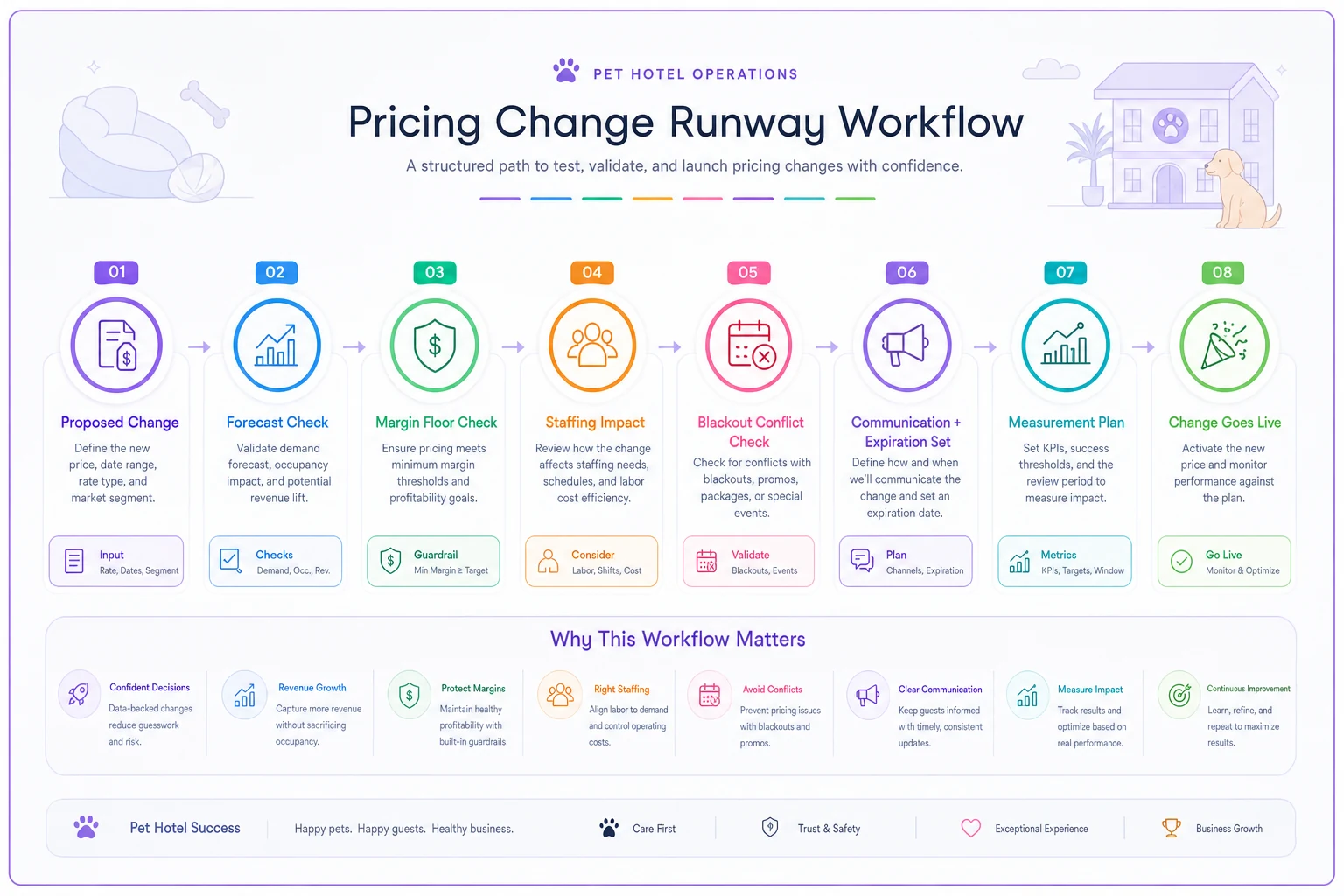
PRICING CHANGE FLOW Proposed change │ ▼ Forecast check ──── fails ──→ Revise or hold │ passes │ ▼ Margin floor check ── fails ──→ Revise rate │ passes │ ▼ Staffing impact ──── gap found ──→ Adjust labor or dates │ covered │ ▼ Blackout conflict check ── conflict ──→ Resolve stacking rule │ clear │ ▼ Communication + Expiration set │ ▼ Measurement plan defined │ ▼ Change goes live
The checklist forces the pricing decision and the staffing decision into the same conversation.
Experiments: how to test price without gambling
Most pet hotels don't really run pricing experiments — they run pricing hunches. Someone tries a weekday special, it feels like it did something, and it either quietly continues or quietly dies. No control, no clean measurement, no real decision at the end.
A real experiment is lightweight but disciplined. You don't need a data science team; you need a template you fill out the same way every time:
-
Hypothesis "Lowering Tuesday–Wednesday rates by 12% will lift weekday occupancy from ~55% to 70%+ without cannibalizing weekend full-rate bookings."
-
What changes the specific rate, the specific dates.
-
What stays fixed everything else, so you can actually attribute the result.
-
Duration long enough to see a pattern — usually 4–6 weeks for weekday behavior.
-
Success threshold the number that means "keep it," defined before you start.
-
Kill condition the number that means "stop this now."
Writing the kill condition down beforehand is what separates experiments from wishful thinking. It's very easy to keep a losing promo alive because it feels like it's working. A pre-committed threshold protects you from your own optimism.
This connects directly to broader utilization strategy — experiments are how you find the pricing and packaging combinations that actually move occupancy, which is the whole point of treating pricing, packaging and utilization as one connected system rather than a stack of one-off tactics.
A real scenario
A roughly 45-kennel facility with two corporate accounts and a fledgling membership program noticed their average daily rate had drifted down about 6% over a year despite no change to the published rate card. Nobody could explain it.
They ran a one-month exceptions report — every discount, comp, and override. The picture got clear fast. One corporate account had a flat rate signed the previous winter that applied even on holiday weekends, giving away premium nights at off-peak pricing. Front desk had been comping baths freely for minor complaints, with no cap. And an expired "spring special" promo code was still live in the booking system, quietly applying to anyone who'd used it before.
None of it was dramatic on its own. Together it was leaking somewhere in the neighborhood of $1,800–$2,400 a month.
The fixes weren't fancy. They added a holiday blackout to the corporate contract at renewal, capped front-desk comps at $25 with a monthly report, killed the zombie promo code, and added the runway checklist to any new pricing move. Within two months the average daily rate had recovered most of the gap. No rate increase — just closing the leaks.
When tight governance is worth it — and when it isn't
Not every facility needs the full apparatus. If you're a single-owner operation at 25 kennels and you personally approve every booking exception, a heavy RACI matrix is overhead you don't need yet. The right move at that stage is just an expiration date on every promo and a running note of exceptions.
Governance becomes essential the moment more than two people can influence what a customer pays — a GM plus a front-desk team, corporate accounts, a membership program, or multiple locations. That's when informal memory stops scaling and the leaks start.
There's also a version of this that goes too far. If your guardrails are so rigid that front desk can't fix a legitimate service failure without three approvals, you'll lose customers to protect pennies. Governance should bound flexibility, not eliminate it. The goal is fast decisions inside clear lines — not slow decisions with no lines, and not no decisions at all.
Where systems help you keep it honest
The reason promotion leaks persist isn't that owners are careless — it's that catching them manually is genuinely tedious. Nobody wants to reconcile every booking against the intended rate by hand. That's exactly the kind of work worth handing to your booking and management platform.
When your operational software enforces the rules automatically — expiration dates that actually turn promos off, stacking logic that blocks conflicting discounts, blackout dates baked into corporate rates, and an exceptions report that surfaces every override without anyone building it by hand — governance stops depending on memory and vigilance. The rules live in the system, not in one person's head. Pricing changes can run through the runway checklist as a required step before going live, and occupancy forecasts can flag when a proposed discount is about to overheat a period you're not staffed for.
The practical value is straightforward: the software doesn't replace your judgment on pricing. It makes the leaks visible and the rules enforceable, so your good decisions actually stick instead of quietly eroding at the front desk.
Bringing it together
Strong pet hotel pricing governance isn't about locking everything down or squeezing every discount out of your business. It's about making sure the prices you intend to charge are the prices you actually collect — and that every promotion, corporate rate, and experiment fits inside a structure that protects both your margin and your ability to staff the building.
Start small. Map who can touch price. Put expiration dates on everything. Run one exceptions report and see what falls out. Add the runway checklist before your next pricing move. Each of these is a modest change individually, but together they close the gaps where margin has been quietly slipping out — the gaps that no rate card, however smart, can fix on its own.
Strong pet hotel pricing governance isn't about locking everything down or squeezing every discount out of your business. It's about making sure the prices you intend to charge are the prices you actually collect — and that every promotion, corporate rate, and experiment fits inside a structure that protects both your margin and your ability to staff the building.
Start small. Map who can touch price. Put expiration dates on everything. Run one exceptions report and see what falls out. Add the runway checklist before your next pricing move. Each of these is a modest change individually, but together they close the gaps where margin has been quietly slipping out — the gaps that no rate card, however smart, can fix on its own.
Ready to optimize your pet hotel operations?
Join hundreds of pet hotels using GoPetel to save time, improve pet care, and increase booking reliability.