

Most pet hotels handle corporate accounts backwards. They treat a veterinary clinic sending 40 dogs monthly the same as a family boarding their goldendoodle twice a year. Then wonder why staff drowns in billing disputes, why capacity planning falls apart, and why these supposedly "premium" clients become operational nightmares.
Corporate accounts—vet clinics, shelters, real estate companies housing pets during moves, insurance companies covering emergency boarding—operate on completely different timelines, payment expectations, and volume patterns than retail customers. When you onboard them without specific operational rules, they break everything.
The difference between corporate success and chaos comes down to three things: structured onboarding that sets capacity boundaries upfront, billing workflows that actually match how corporate procurement works, and SLA frameworks that prevent their volume from overwhelming your retail operations.
Why corporate accounts wreck pet hotel operations
Corporate clients fundamentally misunderstand how pet hotels work. A veterinary practice manager sees your facility as overflow space—somewhere to send post-surgery dogs when their recovery kennels fill up. They assume you can absorb unpredictable volume because "that's what partners do."
Meanwhile, you're trying to maintain around 85% occupancy for profitability while keeping a buffer for retail walk-ins and emergencies. When that vet clinic suddenly needs eight spaces on a Thursday because their HVAC failed, your entire capacity model breaks.
The billing disconnect makes it worse. Corporate clients expect net-30 or net-60 terms because that's how B2B works. But pet hotels run on tight cash flow—payroll every two weeks, food suppliers requiring payment on delivery, insurance premiums monthly. When $12,000 in corporate boarding sits unpaid for 60 days while you float operational costs, margins evaporate fast.
Then there's the service expectation gap. Corporate accounts assume priority access, dedicated support, and flexibility on policies because of their volume. Your front desk staff, trained to handle retail customers, suddenly fields calls from procurement officers questioning every line item and demanding detailed invoices your standard PMS can't generate.
Without proper pet hotel corporate accounts onboarding systems, these clients consume three times more operational resources while paying slower and demanding more than retail customers who just book and pay upfront.
The credit check matrix that predicts payment problems
Before accepting any corporate account, you need a credit evaluation framework that goes beyond standard business credit scores. Traditional credit checks miss the operational signals that actually predict payment problems for pet hotels.
Never miss a booking or detail again.
GoPetel simplifies pet hotel operations by managing every reservation and pet profile seamlessly.
- Centralized booking management
- Automated client notifications
- Staff and kennel scheduling
No credit card required
Start with payment history verification from similar service providers—not just their product suppliers. A construction company might pay lumber suppliers on time but consistently delay service invoices. Contact other pet care providers, commercial cleaners, or security companies they work with. Ask specifically about payment timing, dispute frequency, and how they communicate when something goes wrong.
Next, evaluate their internal payment processes. Companies with centralized accounts payable departments typically pay slower but more reliably than those where individual managers approve invoices. During onboarding, identify exactly who approves invoices, who cuts checks, and what documentation they require. A client needing purchase orders, detailed timesheets, and department codes will create significantly more administrative work than one who accepts a simple monthly statement.
Set credit limits based on operational capacity, not just financial risk. Even if a shelter can afford $50,000 monthly in boarding, can your facility actually handle 30% of capacity going to one client? Create a matrix:
| Client Type | Credit Limit | Capacity Cap | Payment Terms |
|---|---|---|---|
| Veterinary Clinics | $8,000/month | 15% of capacity | Net-30 |
| Insurance Companies | $5,000/month | 10% of capacity | Net-45 |
| Shelters/Rescues | $3,000/month | 20% of capacity | Net-15 |
| Real Estate Firms | $2,000/month | 5% of capacity | Payment upfront |
Require deposits for new corporate accounts—typically 50% of expected monthly volume. This isn't about trust; it's about protecting cash flow while you learn their booking patterns and whether they actually pay on time.
Building onboarding cadences that set boundaries
Corporate onboarding needs a completely different rhythm than retail customer setup. You're not just collecting vaccination records and emergency contacts—you're establishing operational boundaries that prevent future chaos.
Week 1 starts with an operational assessment call. Don't let sales or marketing run this; have your operations manager lead it. Cover their typical monthly volume, seasonal patterns, and emergency surge scenarios. When a vet clinic says they "occasionally" need overflow boarding, pin down specifics: How many dogs? How much notice? What medical conditions?
Document everything in a formal Service Level Agreement, not just email confirmations. Include:
-
Minimum booking notice (typically 48-72 hours for corporate)
-
Maximum monthly capacity allocation
-
Blackout dates when retail demand takes priority
-
Surge pricing triggers when they exceed allocated capacity
-
Cancellation penalties for last-minute changes
Week 2 focuses on billing setup. Have their accounts payable team—not the person who signed the contract—walk through your invoice format, required documentation, and payment process. Most corporate payment delays happen because invoices are missing required information, not because companies won't pay.
Create customer-specific billing profiles in your system. A veterinary clinic might need individual pet stay details with admission and discharge times. An insurance company might require claim numbers and policy references. Building these templates during onboarding prevents month-end scrambles.
Week 3 handles operational integration. Train specific staff members on this account's requirements. Set up dedicated intake forms that capture needed information upfront. Establish communication protocols—who they call for what, expected response times, escalation paths.
Week 4 runs a test transaction. Have them book a single pet through your standard process. Generate the invoice, submit it through their payment system, and identify any friction before real volume starts. Better to find out their procurement system requires three approvals during a test run than when you've got $8,000 in delivered services waiting on payment.
Run the test transaction in Week 4 during a low-demand day to avoid disrupting retail bookings.
Visualizing the four-week onboarding flow helps teams follow it consistently.
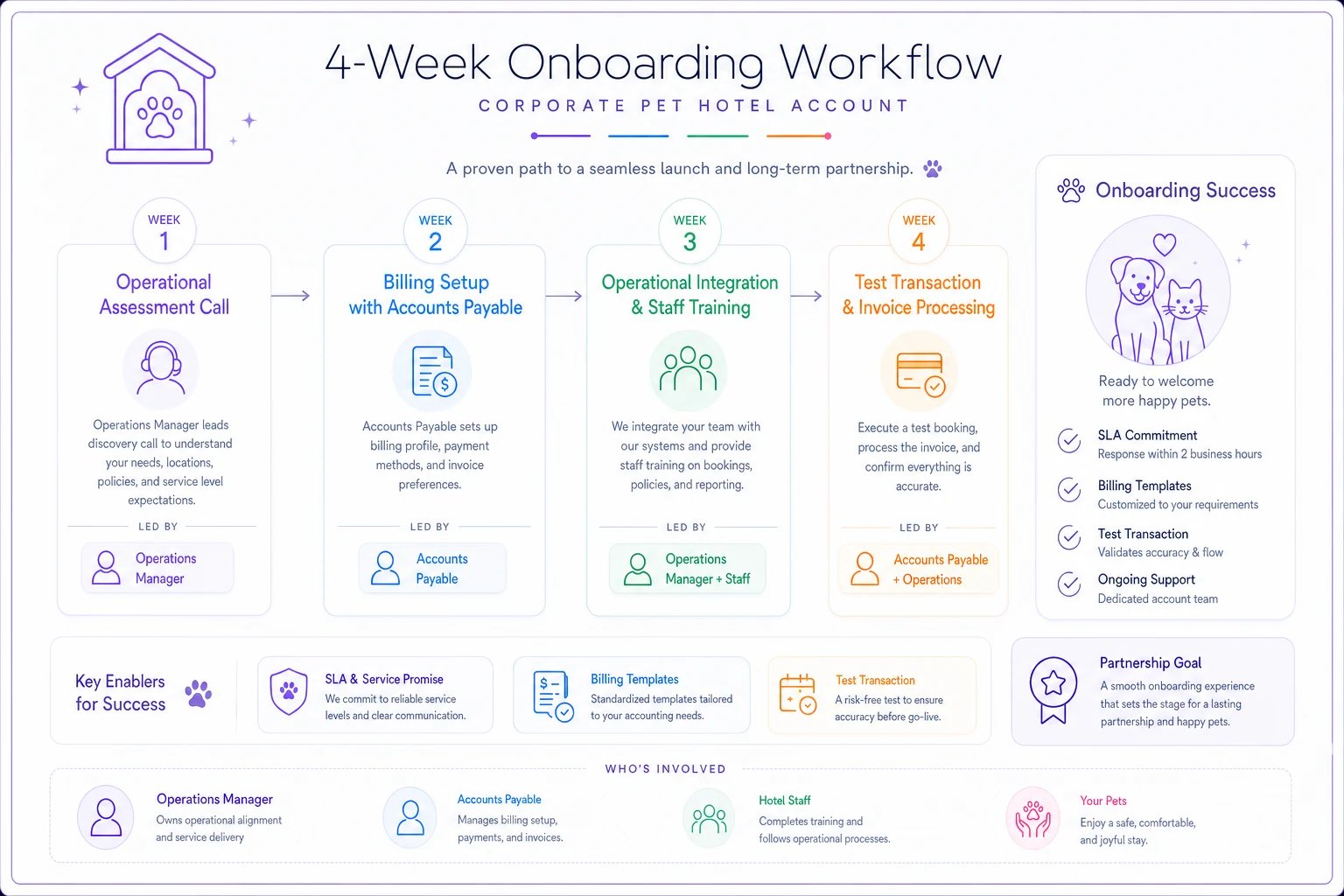
Keep the onboarding steps documented and versioned so each account follows the same cadence.
Net-term billing tied to capacity utilization
The biggest mistake pet hotels make with corporate billing? Offering the same net-terms regardless of how much capacity clients use. Low-volume accounts end up with generous payment terms while consuming disproportionate administrative resources.
Tie payment terms directly to capacity utilization and payment history instead:
Tier 1 (Under 5% monthly capacity): Prepayment required. These accounts don't generate enough volume to justify floating credit. Purchase boarding credits in advance or pay at drop-off like retail customers.
Tier 2 (5-10% capacity): Net-15 with credit card on file. Invoice monthly, but if payment hasn't arrived by day 16, automatically charge their card. Gives them convenience while protecting your cash flow.
Tier 3 (10-20% capacity): Net-30 with graduated late fees. First late payment adds 5%, second adds 10%, third triggers an account review. After six months of on-time payments, they can request Net-45.
Tier 4 (Over 20% capacity): Customized terms with revenue sharing potential. At this volume, they're essentially a channel partner. Consider Net-45 or Net-60 in exchange for guaranteed monthly minimums or preferred provider agreements.
Build automatic escalation into your billing workflow. Day 31: friendly reminder email. Day 35: phone call from accounting. Day 40: future bookings go on hold. Day 45: existing reservations require payment before pickup. Day 60: collections process begins.
Make these policies clear during onboarding, not after problems arise. A payment performance review every six months keeps things honest—good history earns better terms, delays trigger stricter requirements.
SLA templates and dispute prevention
Service Level Agreements for corporate accounts need to address the operational friction points unique to pet hotels. Generic B2B SLAs miss critical elements like medical emergency protocols, medication administration disputes, and capacity surge handling.
Spell out response times for different request types. Booking confirmations: 4 business hours. Medication administration requests: 2 hours if submitted by 3 PM, next business day otherwise. Emergency medical situations: immediate phone call, written follow-up within 24 hours.
Include specific language about capacity during peak periods. Something like: "Client understands that during holidays, school breaks, and summer months (June-August), available capacity may be limited to 10% of total facility regardless of typical allocation. Bookings during these periods require 14-day advance notice and may incur surge pricing of 25-40% above standard rates."
Address medication administration disputes head-on, especially for veterinary referrals. Your SLA needs to be explicit: "Medication administration follows standard boarding protocols, not veterinary clinic procedures. Medications requiring administration more than twice daily, injections beyond insulin, or monitoring beyond visual observation incur additional fees and may be declined based on staff capability."
Create dispute resolution workflows before small issues become relationship-ending problems:
-
Initial complaint logged in writing within 5 business days
-
Operations manager reviews within 48 hours
-
If unresolved, escalate to ownership with proposed resolution within 5 days
-
If still disputed, third-party mediation before any legal action
Quarterly business reviews also help catch friction early. If a shelter consistently books last-minute and disrupts capacity planning, address it during the review—not during a crisis.
Capacity protection rules that preserve retail revenue
Corporate accounts will consume every available space if you let them. Without strict controls, you'll find yourself turning away profitable retail customers to accommodate lower-margin corporate volume.
Implement dynamic capacity allocation that adjusts based on historical demand patterns. During slow seasons (typically February, November), corporate accounts can access up to 30% of capacity. During peak retail periods, limit them to 10%. Track this monthly and adjust allocations quarterly based on actual utilization data.
Create a priority scoring system for competing corporate requests:
| Priority Factor | Points |
|---|---|
| Advance notice (per day) | +1 |
| Payment history (on-time %) | +0-20 |
| Average stay length | +2 per night |
| Medical complexity | -5 to -15 |
| Weekend vs weekday | Weekday +10 |
When multiple corporate clients need space simultaneously, highest score gets priority. This rewards advance booking, prompt payment, and longer stays—while deprioritizing the patterns that cause the most operational disruption.
Set up automated capacity monitoring that alerts when corporate bookings approach limits. At 75% of allocated capacity, email the account manager about remaining availability. At 90%, require manager approval for additional bookings. At 100%, automatically decline new requests with a clear explanation.
Surge pricing should be baked into corporate agreements from day one. When corporate demand exceeds allocation, rates increase 25%. During retail peak periods, corporate surge hits 40%. This either naturally limits demand or compensates for lost retail revenue—either way, you're protected.
Communication protocols and escalation trees
Corporate accounts need different communication workflows than retail customers. A family boarding their dog wants updates and photos. A veterinary clinic sending post-surgical patients needs medical status reports and discharge summaries that integrate with their record-keeping.
Establish account-specific communication patterns based on client type. For veterinary referrals:
-
Intake confirmation with photo within 2 hours
-
Daily medical status updates by 10 AM
-
Medication administration logs every evening
-
Discharge summary within 24 hours of pickup
For insurance and property management companies:
-
Booking confirmation with reference numbers
-
Weekly utilization reports
-
Monthly billing summaries
-
Quarterly account reviews
Designate specific staff as corporate account liaisons. Not everyone handles a procurement officer who questions every $3 treat charge, or a veterinary technician needing detailed medical updates. Train 2-3 people specifically on corporate communication standards and let them own those relationships.
Create escalation protocols that prevent corporate contacts from overwhelming operations. Level 1: Front desk handles booking and basic questions. Level 2: Shift supervisor addresses service concerns and special requests. Level 3: Operations manager handles billing disputes and capacity issues. Level 4: Owner involvement for contract modifications or anything affecting the broader relationship.
Template every standard communication. Intake confirmations, status updates, billing inquiries, capacity warnings—all of it. Staff can personalize within the template, but the structure stays consistent. This is where operational software with workflow automation genuinely helps—standardizing outputs without adding manual steps for your team.
Payment protection without damaging relationships
The worst corporate account situation? They owe $15,000, have 12 dogs currently boarding, and payment is 45 days late. You need their volume but can't sustain the cash flow gap. This scenario happens when payment protection wasn't built into onboarding—not when it fails midway through a relationship.
Require rolling deposits that adjust with volume. Start with one month's average billing as deposit. As monthly volume increases, adjust the deposit requirement within 30 days. If a vet clinic jumps from $3,000 to $8,000 monthly, that deposit needs to reflect the new reality.
Implement service holds that protect operations without creating confrontation. When an account hits its credit limit or passes payment terms, future bookings go on hold—but current stays continue normally. This prevents the awkward situation of threatening currently boarded pets while still maintaining leverage for payment.
Offer structured payment plans when clients hit temporary budget constraints. Plenty of corporate clients want to pay but face internal approval delays. A plan like 50% immediately, 25% in 15 days, final 25% in 30 days keeps the relationship intact. Add a small administrative fee to cover cash flow costs—most clients expect it and it keeps things professional.
Early payment incentives also work better than most people expect. A 2% discount for payment within 10 days, 1% within 20 days. Many accounts payable departments actively look for these, and getting paid 20 days earlier is worth 2% of the invoice.
For accounts over $5,000 monthly, require ACH setup. Credit card processing fees eat margins at that volume. For smaller accounts, keep cards on file but charge only after proper notice—it maintains trust while ensuring you're not chasing payments indefinitely.
What proper corporate onboarding actually looks like in practice
A pet hotel in Denver learned this the hard way. They landed a contract with a regional veterinary chain—six clinics, projected 50 boardings monthly, roughly $35,000 in revenue. Six months later, they nearly lost the business.
Without proper onboarding, the clinics treated them like overflow parking. Last-minute drops of post-surgical dogs, no standardized intake process, constant disputes about medication administration, invoices rejected for missing purchase order numbers. The account consumed around 30% of their administrative time while payments averaged 67 days late.
After implementing structured onboarding, things changed. Capacity limits meant the clinics booked in advance. Standardized intake forms captured required information upfront. Automated billing with account-specific invoice requirements eliminated rejections. Payment terms tied to volume both incentivized growth and protected cash flow.
Administrative time dropped significantly, payments landed consistently at Net-30, and revenue from the account grew to $48,000 monthly because smoother operations allowed them to handle more volume. The clinics were actually happier with the structured process—it made their internal operations easier too.
Building operational systems that let corporate accounts scale
Corporate accounts represent real growth potential for pet hotels that have the operational infrastructure to handle them. Retail customers provide stable base revenue, but corporate relationships can shift a small facility into a different tier of operation—if the systems are there to support it.
The facilities doing this well aren't necessarily the biggest or fanciest. They're the ones with operational discipline: clear processes, consistent communication, and workflows that hold up under volume. Corporate clients value predictability and professionalism over amenities. Give them that through proper onboarding, and they'll become your most profitable, least demanding customers.
Most pet hotels find their sweet spot somewhere around 20-30% corporate volume. Enough to provide predictable revenue and reduce marketing costs, not so much that one client's problems tank the whole business. The best setups tend to be 5-8 corporate accounts each taking 3-5% of capacity—risk spread, operations manageable, and no single relationship holding too much leverage.
Start with one corporate account and actually stress-test your systems before adding more. Use them as a live case for credit evaluation, capacity management, and billing workflows. When that relationship runs smoothly—payments on time, capacity managed, minimal friction—then expand.
Channel scorecards help evaluate whether corporate accounts actually improve margins versus retail channels. And strong deposit and cancellation policies protect revenue when corporate clients change plans. Together, these systems create the operational foundation that turns corporate chaos into something actually worth scaling.
Ready to optimize your pet hotel operations?
Join hundreds of pet hotels using GoPetel to save time, improve pet care, and increase booking reliability.