


Most pet hotels track bookings by source—website, phone, walk-ins, maybe Rover or DogVacay. But tracking where bookings come from misses the real question: which channels actually make you money after accounting for commissions, operational overhead, and customer lifetime value?
The disconnect between booking volume and profit per channel creates a blind spot that compounds over time. You end up optimizing for whatever brings the most bookings while your highest-margin sources quietly dry up from neglect.
There's nothing complicated about this in theory—it's just that most operators are too busy running the facility to sit down and do the math by channel. When they finally do, the numbers are usually uncomfortable.
The hidden economics eating your margin
Channel economics in pet boarding get messy fast. That Rover booking might bring a new customer, but between the 15–20% commission, the extra verification work because platform profiles are almost always incomplete, and the fact that platform customers rarely book direct afterward—you're looking at maybe 40% of your normal margin on that booking. Meanwhile, the regular who calls in directly costs you nothing in fees, books far enough out that you can actually plan staffing, and usually adds daycare or grooming on top.
The operational burden varies a lot too. Third-party platforms dump bookings into your system with minimal information. Staff end up spending 15–20 minutes per booking chasing vaccination records, confirming pickup times, explaining policies the platform never communicated. Corporate accounts need special billing setups and purchase orders, but they book predictable volume months out. Walk-ins disrupt morning operations but often become loyal direct bookers if you handle them right.
Even your own channels perform differently. Website bookings capture everything upfront. Phone bookings tie up staff but give you a real shot at upselling premium suites when standard runs fill. Email inquiries take forever to convert but tend to involve extended stays or recurring needs.
Building your channel scorecard
Start with true margin per channel. Pull three months of bookings and work backwards.
Never miss a booking or detail again.
GoPetel simplifies pet hotel operations by managing every reservation and pet profile seamlessly.
- Centralized booking management
- Automated client notifications
- Staff and kennel scheduling
No credit card required
Direct Channel Economics
-
Revenue per booking
-
Minus
payment processing (2.9% for cards)
-
Minus
operational time cost (booking, verification, communication)
-
Minus
bad debt or chargebacks
-
Equals
Net margin per booking
For a typical $45/night booking over 3 nights ($135 total):
-
Payment processing
$3.92
-
Staff time (10 minutes at $18/hour)
$3.00
-
Net margin
$128.08 (94.9%)
Third-Party Platform Economics
-
Revenue per booking
-
Minus
platform commission (15–20%)
-
Minus
payment processing (included but delayed payout)
-
Minus
operational time cost (usually 2–3x direct bookings)
-
Minus
dispute resolution overhead
-
Equals
Net margin per booking
Same $135 booking through Rover:
-
Platform commission (17.5%)
$23.63
-
Extra staff time (20 minutes)
$6.00
-
Dispute insurance/overhead
$2.00
-
Net margin
$103.37 (76.6%)
That 18% margin difference on every single booking adds up. A facility doing 200 bookings monthly loses close to $5,000 per month if half come through third-party channels instead of direct.
The lifetime value gap nobody talks about
Where a customer comes from changes how they behave over time—sometimes dramatically. The retention patterns across different acquisition channels are worth looking at closely:
Booking Behavior by Acquisition Channel
| Channel | First-Year Rebooking Rate | Avg Bookings/Year | Typical Add-Ons |
|---|---|---|---|
| Direct website | 67% | 4.2 | Daycare, grooming |
| Phone | 71% | 5.1 | Premium suites, extended stays |
| Referral | 83% | 6.3 | Multiple pets, recurring |
| Third-party platform | 31% | 1.8 | Minimal |
| Walk-in | 52% | 2.9 | Last-minute needs |
| Corporate account | 89% | 11.2 | Predictable volume |
Platform customers treat you like a commodity. They found you through search results, they'll find someone else the same way next time. Direct customers chose you specifically—they read your policies, looked at your photos, decided to trust you enough to book without a platform as the middleman.
Corporate accounts can feel high-maintenance to set up, but the lifetime value difference isn't close. One corporate relocation contract bringing 10 bookings annually at standard rates beats 30 one-off platform bookings once you account for commissions and overhead.
Operational routing rules that preserve sanity
You can't eliminate low-margin channels overnight without losing volume—especially in slow seasons. But you can create operational rules that gradually shift your channel mix while keeping occupancy stable.
Peak Period Channel Prioritization
-
Direct bookings get first access to availability
-
Platform availability releases only after 80% occupancy from direct channels
-
Walk-ins accepted only for premium suites at surge pricing
-
Corporate accounts maintain reserved allocation regardless of demand
Information Capture Requirements
-
Complete profiles (vaccination records, emergency contacts, pet details)
Book immediately
-
Partial profiles from platforms
Require completion before confirmation
-
Missing critical information
24-hour deadline or release the space
Payment Term Variations
-
Direct bookings
-
Platform bookings
Full prepayment required (platform handles)
-
Corporate accounts
Net-30 billing with volume commitments
-
Walk-ins
Payment at drop-off, no exceptions
Automate profile completion reminders so staff don't waste time chasing missing vaccination records.
This naturally advantages direct channels where you control the booking flow, and disadvantages platforms that hand you almost no customer data.
Contract templates for different channel relationships
Stop treating all channels the same in your terms and conditions. Each channel relationship needs its own framework.
Direct Booking Terms
-
Standard cancellation policies
-
Loyalty program eligibility
-
Direct communication preferences
-
Marketing opt-in opportunities
Platform Addendum Requirements
-
Guest acknowledges platform policies don't supersede facility rules
-
Disputes go through platform first; facility rules apply for everything else
-
No guarantee of future platform availability
-
Clear statement that platform pricing may differ from direct pricing
Corporate Account Agreements
-
Volume commitments (minimum monthly bookings)
-
Dedicated reservation process
-
Preferred pricing in exchange for commitment
-
Billing cycles and terms
-
Specific contact protocols for their employees
Referral Partner Agreements
-
Vet clinics
Reciprocal referral tracking
-
Groomers
Shared customer handling protocols
-
Property managers
Move-in special terms
-
Dog trainers
Package deal frameworks
Each agreement should specify communication channels, operational requirements, and pricing structures that reflect the real cost of serving that channel. Generic terms create gray areas that almost always end up costing you.
Experiments to shift mix without losing volume
The goal isn't to dump platforms overnight—it's to reduce dependence gradually while building direct relationships. A few approaches that actually work in practice:
The Conversion Bridge Offer
-
Every platform booking gets a "next visit direct" offer at checkout
-
20% discount on their next booking if booked directly
-
Exclusive access to holiday reservations
-
Free add-on service (nail trim, extra playtime)
-
Must book within 30 days for a future stay
Track conversion rates. Even 25% conversion on that offer significantly improves unit economics over time.
Channel-Specific Availability Windows
-
Direct bookings
Reserve 60 days out
-
Corporate accounts
Reserve 90 days out
-
Platforms
Reserve maximum 30 days out
-
Walk-ins
Day-of only, based on availability
This pushes planners toward direct booking while keeping your platform presence for last-minute needs.
Loyalty Program Exclusivity
-
Build a points program available only for direct bookings
-
Every night earns points
-
Points unlock priority booking, suite upgrades, free services
-
Platform bookings explicitly excluded
-
Clear value communication at every touchpoint
One facility implemented this and saw direct bookings climb from 45% to 68% of their mix within six months—not because they stopped taking platform bookings, just because customers had a real reason to come back direct.
The Corporate Account Hunt
-
Actively pursue relationships with businesses that have predictable boarding needs:
-
Property management companies (temporary housing)
-
Relocation services
-
Local businesses with traveling employees
-
Insurance companies (emergency boarding)
-
Real estate agents (staging homes)
One relocation contract can replace dozens of platform bookings with predictable, high-margin volume.
Measuring what matters: channel performance metrics
Track these monthly by channel, not just overall.
Revenue Metrics
-
Gross revenue per channel
-
Net revenue after all costs
-
Revenue per available kennel night by channel
Operational Metrics
-
Booking-to-confirmation time
-
Incomplete booking rates
-
Staff time per booking
-
Support tickets per booking
Customer Metrics
-
Lifetime value by acquisition channel
-
Rebooking rates
-
Add-on service attach rates
-
Referral generation by source
Strategic Metrics
-
Channel concentration risk (no channel over 40%)
-
Direct booking growth rate
-
Platform dependency ratio
-
Channel shift velocity
Most facilities don't have this data organized in a usable way. Start with whatever you can pull and build from there—imperfect data tracked consistently beats perfect data you never look at.
When channels actually complement each other
Not every channel competes with the others. Some genuinely fill different roles, and forcing a rigid hierarchy ignores that.
Platforms work well for:
-
Geographic expansion testing
-
Slow period fill
-
One-time overflow handling
-
Market pricing intelligence
Corporate accounts provide:
-
Baseline volume guarantees
-
Predictable scheduling
-
Premium service opportunities
-
Referral networks
Direct bookings deliver:
-
Highest margins
-
Best customer relationships
-
Upsell opportunities
-
Brand building
The right mix depends on where you are. New facilities might accept 60% platform bookings while building reputation. Established facilities should target 70%+ direct with platforms as overflow. Neither extreme is universally right—it depends on your market, your occupancy, and how aggressively you're willing to work on conversion.
The technology layer that makes this manageable
Manual channel tracking across spreadsheets breaks down fast. You need systems that automatically tag bookings by source, calculate true margin per channel, track customer journey from acquisition through lifetime, alert when channel mix drifts from targets, and generate channel-specific availability.
Here's a quick visual of the automated workflow that handles tagging, margin calculation, and routing.
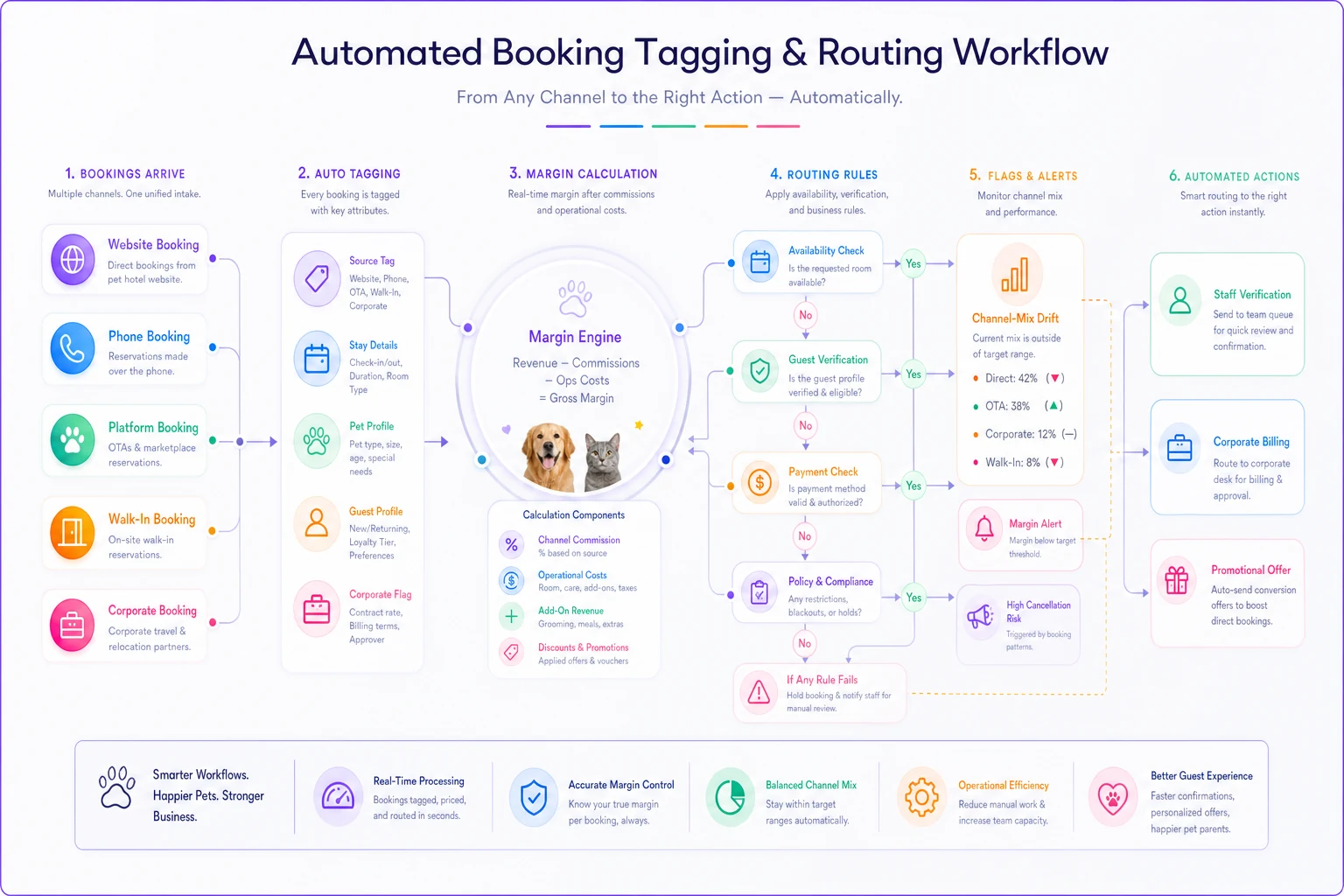
AI-powered operational platforms can monitor channel performance in real-time, automatically adjust availability rules based on demand patterns, and flag which platform-acquired customers are most likely to convert to direct booking based on behavior signals. That last piece—knowing which platform customers are worth pursuing—is something you basically can't do manually at any reasonable scale.
The same systems that handle verification workflows and capacity management can handle channel attribution properly, something that's nearly impossible with paper logs and basic scheduling tools. When every booking flows through a centralized platform, channel optimization becomes about setting rules rather than chasing data.
Building your channel transition plan
Start with reality: measure your current channel mix and true margins. Most facilities discover their "best" channel is actually costing them money once you do full cost accounting.
Month 1–2: Baseline measurement
-
Tag all bookings by source
-
Calculate fully-loaded margins
-
Identify customer journey patterns
-
Document operational overhead by channel
Month 3–4: Test initial shifts
-
Implement one conversion experiment
-
Adjust availability windows slightly
-
Create channel-specific terms
-
Track leading indicators daily
Month 5–6: Scale what works
-
Double down on successful experiments
-
Begin actively pursuing corporate accounts
-
Strengthen direct booking incentives
-
Refine operational routing rules
Month 7–12: Systematic optimization
-
Target specific channel mix ratios
-
Automate routing rules
-
Build channel-specific marketing
-
Continuously test new approaches
The shift happens gradually then suddenly. Facilities that commit to this typically see 20–30 point improvements in direct booking percentage within a year—worth somewhere in the range of $30,000–50,000 in recovered margin for an average facility. Those aren't dramatic outlier results; they reflect what happens when you stop letting platforms capture margin you earned.
The competitive reality ahead
Platform aggregators keep taking bigger cuts while providing less value. Rover's commission has increased twice in three years. New platforms launch constantly, fragmenting the market further. Meanwhile, venture-backed roll-ups are acquiring facilities and undercutting independents on price, making platform differentiation nearly impossible.
The only sustainable advantage is direct customer relationships. Every platform booking is a borrowed customer who could disappear when algorithms change or a competitor bids higher for placement. Every direct booking is an owned relationship that compounds in value over time.
Your channel strategy determines whether you're building an asset or renting someone else's customer base. A facility doing $400,000 annually can easily lose $50,000–70,000 to poor channel mix. That's the difference between barely surviving and building something actually sellable.
The facilities still thriving in five years will be the ones that used platforms as acquisition tools while building direct relationships—not the ones dependent on whatever platform dominates by then. Stop letting channels choose you. Build the scorecard, run the experiments, shift the mix. Your margins depend on owning your customer relationships, not renting them from platforms that see you as interchangeable inventory.
Ready to optimize your pet hotel operations?
Join hundreds of pet hotels using GoPetel to save time, improve pet care, and increase booking reliability.