


Late pickups don't look expensive on the surface. One owner shows up forty minutes past checkout, apologizes, pays nothing, and leaves. No big deal, right?
The problem is what that late pickup did to the kennel behind it. That run was supposed to be cleaned, dried, and ready for a 2 PM check-in. Now your cleaning crew is standing around, the incoming guest is at the front desk with a confused dog, and your front staff is improvising. Multiply that across a holiday weekend and you've got a throughput problem disguised as a customer-service problem.
Most pet hotels treat late pickups as a billing question — "do we charge them or not?" — when it's actually an operations question. The fee is almost beside the point. What matters is whether the late pickup blocks the next booking, and whether your team can handle it without a confrontation at the desk.
This is a focused walkthrough of how to build a late pickup policy that keeps runs flowing, collects the fees you're owed, and gives your staff exact words to use so nobody freezes up.
Why late pickups quietly wreck your day
Here's the operational chain most owners miss.
A boarding run isn't "free" the moment a dog leaves. It needs turnaround — strip bedding, sanitize, dry, restock, inspect. Depending on your protocol that's anywhere from 25 to 50 minutes of labor, and the run can't be booked again until it's done. If your check-in window opens at 2 PM and a dog is supposed to be out by 11 AM, you've built in a buffer for exactly that reason.
A late pickup eats that buffer. When a guest leaves at 1:15 instead of 11, your turnaround team now has 45 minutes to do a 40-minute job before the incoming dog arrives. On a slow Tuesday, fine. On the Sunday after Thanksgiving when you're at 95% occupancy, that buffer doesn't exist — you've overbooked the run on paper because the math assumed an on-time exit.
Facilities running near capacity take more damage per late-pickup incident than half-full ones, because there's no slack to absorb it. The busiest days — the ones where every night counts — are exactly when a single late pickup cascades into a double-booked run, a delayed check-in, and a front desk scrambling to hold it together.
There's also a quieter cost. Late pickups train your best customers to be late. If the family who boards six times a year learns there's no consequence, they'll keep rolling in at 1 PM "because it's easier." You're not dealing with careless one-timers — you're dealing with your regulars optimizing around a policy you never enforced.
The real consequence isn't the fee you missed
Put rough numbers on this so it stops feeling abstract.
Never miss a booking or detail again.
GoPetel simplifies pet hotel operations by managing every reservation and pet profile seamlessly.
- Centralized booking management
- Automated client notifications
- Staff and kennel scheduling
No credit card required
Say you run 40 runs and average around $55–$70 a night. On a sold-out holiday weekend, a late pickup that forces you to turn away an incoming guest costs you that night's revenue — call it $60 — plus whatever goodwill you burn with the family who drove over for a check-in that wasn't ready. If that happens even three or four times across a peak season, you're looking at a few hundred dollars in lost nights, and that's before you count staff overtime from a blown turnaround schedule.
The bookings you couldn't take are the bigger hit. When your 2 PM check-ins slip to 3 PM because runs aren't ready, you compress your whole afternoon intake. That's the same bottleneck broken down in the day-of check-in choreography map — except here the cause is upstream, sitting in a run that should've been empty two hours ago.
The fee matters, but mostly as a behavior tool. The throughput is the real asset you're protecting.
The graded fee model: stop charging one flat late fee
The most common mistake is a single late fee — "$25 if you're late." It fails in both directions. For the person 20 minutes late, $25 feels punitive and sparks an argument. For the person three hours late who blocked an incoming guest, $25 is a bargain and doesn't come close to covering your loss.
| Time past checkout | What it actually costs you | Suggested fee | Framing to the client |
|---|---|---|---|
| 0–30 min | Minor; buffer usually absorbs it | Grace period, no charge | "No worries, you're within our grace window." |
| 31–90 min | Turnaround gets tight; staff waiting | Half a daycare day (~$18–$25) | "We do have a late-pickup fee after our grace window." |
| 91 min–end of business | Likely blocks a same-day booking | Full daycare day (~$35–$45) | "Because this pushes into the afternoon, it's a full late-day charge." |
| Past closing / overnight | Forces an unplanned extra night | Full boarding night + after-hours fee | "This becomes an additional boarding night at our standard rate." |
Adjust the numbers to your market.
Two things make this work. First, the grace period — a 30-minute buffer kills most of the disputes because the majority of "late" pickups are 10–20 minutes, and nobody wants to fight over those. Second, the fees escalate to mirror your real exposure, which makes them defensible. You're not being arbitrary; you're pricing the slot the late pickup occupied.
Adjust the numbers to your market. A premium facility in a high-cost metro will run higher. The structure is what matters.
Set expectations before they ever arrive
The single biggest reason staff can't enforce a late fee is that the client claims they "never knew." And often they're telling the truth — the policy was on page 4 of a waiver they signed eight months ago.
-
At booking. A one-line checkbox
"I understand checkout is 11 AM and late pickups are subject to graded fees." Not buried in the waiver — a separate, specific acknowledgment.
-
In the pre-arrival confirmation. When you send the reminder a day or two before the stay, restate the checkout time and the fee in plain language.
-
The morning of pickup day. A short reminder
"Reminder — [Dog] is scheduled for pickup by 11 AM today. A grace period applies until 11:30; fees start after that."
That morning reminder is the quiet MVP. People aren't trying to abuse you — they genuinely forget checkout is 11 AM when they're juggling a flight and a dog. A nudge at 8 AM reshapes their morning. Facilities that add a day-of pickup reminder often see late pickups drop before they even start enforcing fees, which tells you most of the problem was never really about money.
If you're using scheduling software, these reminders can fire automatically off the pickup date — a message template tied to the booking so your front desk isn't manually texting forty families every morning.
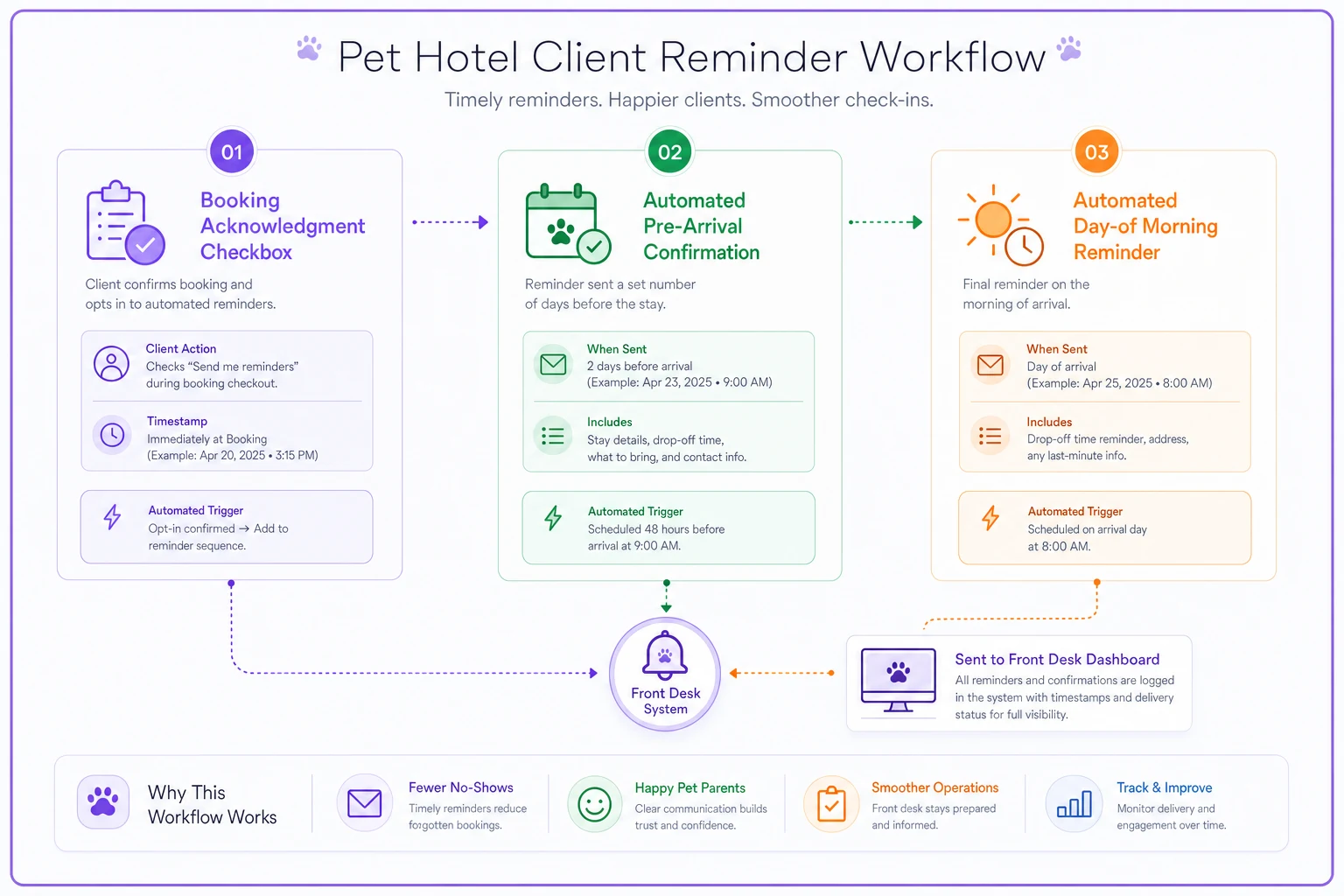
A reminder that depends on a busy staffer remembering to send it won't happen on the day you need it most. AI-assisted operational platforms handle exactly this kind of timed, conditional messaging so the communication layer runs whether or not someone remembers to trigger it.
Scripts: give your team the exact words
Front desk staff don't enforce policies they have to improvise. The moment a friendly regular says "oh come on, it was only an hour," an untrained staffer caves — because confrontation is uncomfortable and they don't have a line ready.
Standard late pickup (within fee range): > "Thanks for coming to get [Dog]! Just a heads up, we're past our grace window, so there's a late-pickup charge of [X] on the account today. I'll add that now — total comes to [Y]." Say it warmly, state it as fact, keep moving. The tone is "this is routine," not "you're in trouble."
Client pushes back: > "I totally understand — mornings get away from all of us. The fee's in place because that run was booked for an incoming guest this afternoon, so we hold the timing pretty firmly. It's [X] today." Notice the script explains the why — the incoming booking — without apologizing or offering to waive it. That one sentence turns an arbitrary-feeling fee into a reasonable one.
Overnight / past-closing: > "Since we're past closing, tonight becomes an additional boarding night plus an after-hours fee. [Dog]'s all settled and comfortable — do you want to pick up first thing tomorrow, or arrange after-hours?"
When to actually waive (and let staff know it's allowed): Give the desk a clear, narrow waiver rule so they're not guessing. Something like: first-time offense within 45 minutes, waive with a verbal warning logged. Everything else, charge. When staff know exactly when they're permitted to waive, they stop waiving everything out of discomfort.
The escalation ladder for the hard cases
Most late pickups resolve at the desk. A few don't — the client who refuses to pay, the overnight no-contact, the one threatening a chargeback or a bad review. You need a ladder so the front desk hands these off instead of absorbing them.
-
Level 1 — Front desk Applies the graded fee per the chart. Logs it. Done.
-
Level 2 — Shift lead / manager Client disputes or refuses. Manager restates the policy, references the signed acknowledgment, offers the documented waiver only if it fits the rule. Authorizes a payment plan if needed.
-
Level 3 — Owner / operations Chargeback filed, threatened legal action, or a repeat offender you may need to fire as a client. This is also where you decide whether to require a card-on-file preauth for future bookings.
What makes the ladder actually function is that each level has authority the one below doesn't. Front desk cannot waive a full-night charge. A shift lead can. That separation is what keeps your regulars from learning that enough pushback at the desk gets them off the hook.
For repeat offenders, the most effective lever is a card on file with clear authorization to charge the fee. If you've already built deposit and enforcement rules — the kind laid out in the no-show deposit and cancellation playbook — late-pickup fees slot right into the same billing infrastructure. Same preauth, same consent language, same reconciliation.
Your dispute-evidence kit
When a client disputes a charge with their card company, "they were late" is not evidence. You lose chargebacks because you can't document the timeline. Build a small evidence kit so disputes are winnable before they happen.
-
The signed booking acknowledgment showing checkout time and fee policy
-
Timestamped pre-arrival and day-of reminders that were sent
-
The actual pickup timestamp (door log, system check-out time, or camera timestamp)
-
A one-line staff note on the incident
who, when, what was charged, what was said
-
The fee schedule the client agreed to
This sounds like a lot until you realize most of it already exists if your system timestamps check-outs and stores reminder logs. The gap is usually the staff note — the human layer confirming the interaction. Make that a required field at checkout so it's captured in the moment, not reconstructed three weeks later when the chargeback lands.
Reconciliation: make sure the fees you charge actually land
Plenty of facilities apply late fees and never collect them. The charge gets added to the account, the client leaves, the card never gets run, and it quietly falls off during month-end.
-
Each week, pull a report of all late-pickup fees applied.
-
Cross-check against payments collected.
-
Flag any applied-but-uncollected fees.
-
For card-on-file clients, charge them per your authorization.
-
For others, send a short invoice with the evidence kit attached.
-
Log anything genuinely waived — so you can see if one staffer is waiving everything.
That last step matters more than it looks. When you track waivers, you spot patterns — a particular shift that never enforces, a particular client who's gotten a pass four or five times. You can't manage what you don't log.
When a strict policy is a bad idea
A graded fee system isn't automatically right for every facility.
If you're a small daycare running at 40% occupancy with loose checkout times and no incoming-booking pressure, aggressive late fees mostly create friction for nothing. You're not losing nights, so you're just annoying customers. Start with the reminders and a soft grace policy, and only add teeth when occupancy tightens.
If your clientele is heavily corporate or long-stay, late pickups are rarely your bottleneck, and a rigid fee chart can sour relationships that are worth far more than a late charge. Handle those case by case.
And if your checkout and turnaround timing is genuinely sloppy on your side — runs aren't ready until 3 PM regardless of when dogs leave — then late pickups aren't actually your constraint. Fix the turnaround first. Charging clients for a bottleneck you created won't survive the first honest complaint.
Real scenario: a 36-run facility going into peak season
A mid-size boarding facility, around 36 runs, kept hitting the same wall every holiday weekend: late pickups blocking afternoon check-ins. They had a flat $20 late fee on paper that the front desk waived roughly 70% of the time because arguing wasn't worth it. On their busiest Sundays, two or three blocked runs would push afternoon check-ins back by an hour and generate a handful of frustrated incoming families.
They changed three things. A graded fee chart with a 30-minute grace window. An automated day-of pickup reminder sent at 8 AM tied to each booking's pickup date. And four laminated scripts at the desk with a clear waiver rule — first offense under 45 minutes only.
The reminder did most of the work. Within the first big weekend, a chunk of the chronic late pickups simply showed up on time. The late pickups that remained got charged consistently because staff finally had words to say and backing from the chart. Over the following peak stretch, blocked afternoon runs dropped to near-zero, and the fees they did collect — a few hundred dollars across the season — were almost secondary to the fact that check-ins ran on schedule again.
The owner's own framing was telling: they thought they had a billing problem, but it turned out to be a reminder-and-script problem with a billing component.
The takeaway
Late pickups are a throughput issue wearing a customer-service costume. The money you lose isn't mainly the uncollected $20 — it's the blocked run, the delayed check-in, and the regulars who've learned there's no reason to hurry. Build it in the right order: reminders first (they prevent most of the problem), then a graded fee that matches real operational damage, then scripts so your team actually enforces it, then a reconciliation routine so the fees don't evaporate. Keep the evidence so disputes are winnable, and give your staff an escalation ladder so the hard cases don't land entirely on them. Do that, and late pickups stop being the thing that quietly eats your best weekends.
Ready to optimize your pet hotel operations?
Join hundreds of pet hotels using GoPetel to save time, improve pet care, and increase booking reliability.