

A dog comes off the play yard at 4:40pm favoring its back right leg. The attendant isn't sure if it's a strain, a cut pad, or something that needs a vet tonight. The on-site manager is already juggling pickups. Nobody wants to be the person who "overreacted" and charged a client for a vet visit that turned out to be nothing — and nobody wants to be the person who waited until morning on a limp that turned out to be a torn cruciate.
That gap between "something's off" and "a vet has eyes on it" is where tele-triage lives. For boarding facilities, telemedicine triage isn't about diagnosing anything. It's about running a repeatable decision process, documenting it cleanly, and connecting to the right vet fast enough that the outcome — and your paper trail — both hold up.
Most facilities already do some version of this. The problem is the informal version falls apart under scrutiny. When an owner disputes a charge, when an insurer asks for records, or when a stay turns into a claim, "we called the vet and they said watch it" is not a defensible record. This post is about making telemedicine triage in pet boarding structured, consistent, and audit-ready — without turning every hangnail into a two-hour ordeal.
Why informal tele-triage quietly fails
The breakdown usually isn't the medical judgment. Attendants are often good at spotting when something's off. The failure is in everything around that judgment:
-
No consent on file for remote assessment. Intake paperwork covers emergency vet care but says nothing about tele-consults, sharing photos or video with a third-party vet, or who pays for the call.
-
Inconsistent triage thresholds. One attendant escalates vomiting immediately; another waits for three episodes. No shared line.
-
Lost context. By the time someone loops in a vet, nobody can say exactly when symptoms started, what the pet ate, or whether it's on medication.
-
Unclear billing. Who's getting charged for the tele-call, and did anyone tell the client before the charge hit their card?
-
No clean record afterward. Notes live in a group text, a whiteboard, or someone's memory.
This usually surfaces at the worst moment — during a dispute. An owner comes back from vacation to a $280 charge they weren't warned about, or a pet goes home and declines, and their own vet asks what the boarding facility observed and when. If the answer is a shrug, you've lost both the relationship and any protection a good record would have given you.
It's the same structural weakness that shows up in medical-boarding SOPs for chronic care and vet escalation — the medicine is manageable, but the documentation and escalation chain is where facilities bleed money and trust.
The intake layer: consent and triage authorization
Everything downstream depends on getting consent right at check-in. Not generic "we may seek emergency care" language — specific authorization for remote assessment.
Never miss a booking or detail again.
GoPetel simplifies pet hotel operations by managing every reservation and pet profile seamlessly.
- Centralized booking management
- Automated client notifications
- Staff and kennel scheduling
No credit card required
-
Explicit tele-consult consent — permission to describe symptoms, share photos/video, and share the pet's record with a remote vet or vet portal.
-
Spending thresholds with tiers. A pre-authorized dollar limit for tele-calls and follow-on care (e.g., up to $150 without re-contacting the owner, $150–$500 with a reasonable attempt to reach them, above $500 only with explicit approval unless it's life-threatening).
-
Preferred vet and relationship. The pet's own vet, whether records can be pulled, and whether the owner wants their vet contacted first.
-
Reachability plan. Primary and backup contacts, plus a stated fallback if nobody answers within a defined window.
-
Billing acknowledgment. A clear statement that tele-consult fees and any medication or supply costs are the owner's responsibility, and how they'll be charged.
Pull the tele-triage authorization into its own short, signed section at intake so there's no ambiguity about what they agreed to.
The mistake facilities make is burying this in a wall of waiver text. The consent that actually protects you is the consent the owner understood. Pull the tele-triage authorization into its own short, signed section at intake so there's no ambiguity about what they agreed to.
The triage checklist that keeps decisions consistent
The point of a triage checklist isn't to make attendants into clinicians. It's to make the escalation decision identical no matter who's on shift at 4:40pm on a Sunday.
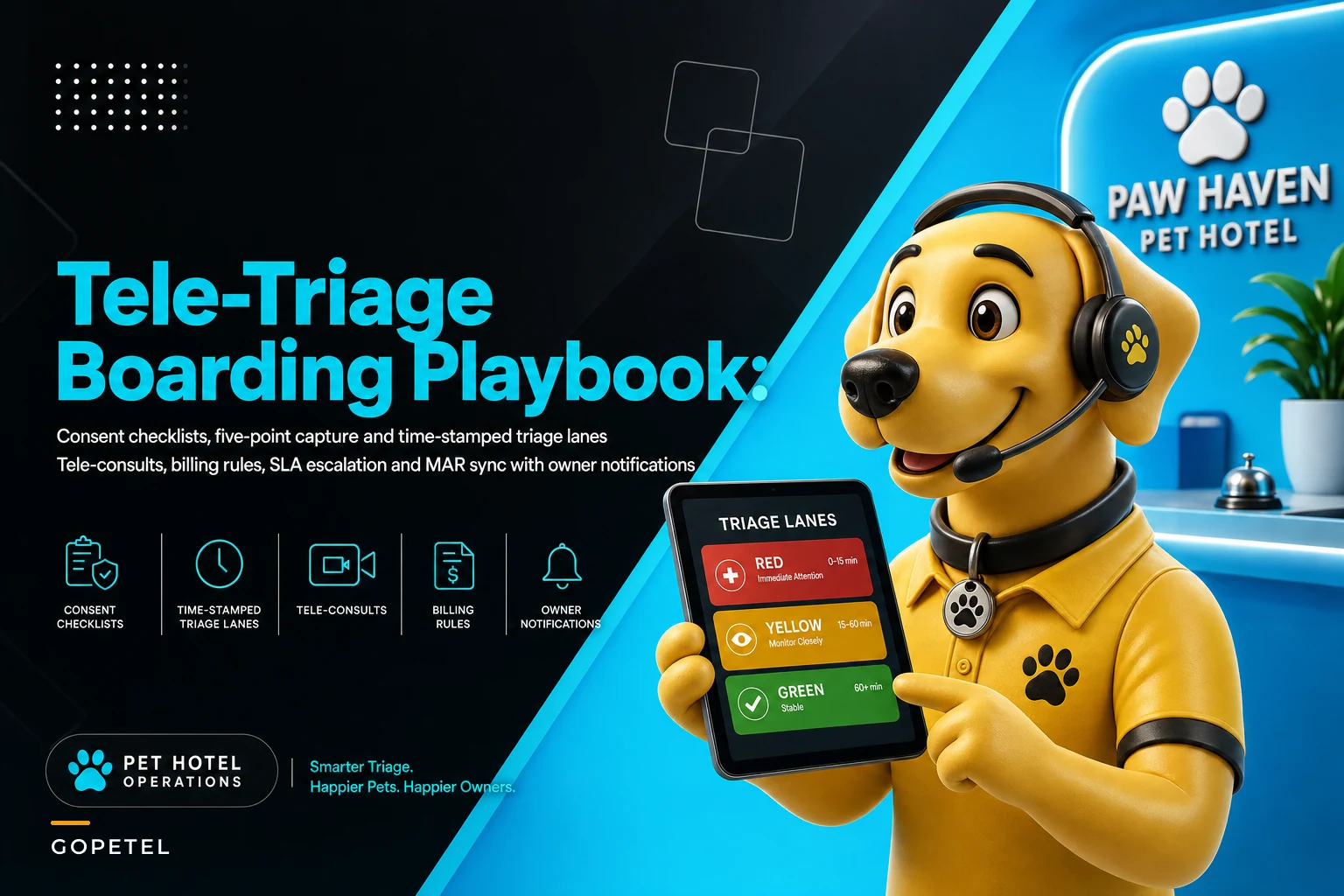
A workable structure sorts observations into three lanes:
| Lane | Examples | Action | Window |
|---|---|---|---|
| Red — immediate | Difficulty breathing, bloat/distended abdomen, seizure, collapse, uncontrolled bleeding, suspected toxin ingestion, heatstroke signs | Go straight to emergency vet protocol, notify owner in parallel | Now |
| Yellow — tele-triage | Mild limp, single vomit/diarrhea episode, not eating one meal, minor skin irritation, eye discharge, lethargy without other signs | Start tele-consult workflow, document, monitor | Within 1–2 hrs |
| Green — monitor & log | Soft stool, mild anxiety, scratching, one skipped treat | Log observation, recheck on a timer | Recheck in 4 hrs |
The red lane doesn't go through tele-triage at all — it goes straight into your emergency response plan with vendor scripts. Telemedicine is the wrong tool when minutes matter. Keeping that boundary sharp is what prevents a staffer from wasting ten minutes on a photo upload while a pet is in genuine distress.
For the yellow lane, the attendant captures a standard set of data before anyone calls a vet:
-
Onset — when did you first notice it?
-
Baseline — eating, drinking, elimination, energy over the last 24 hours.
-
Specifics — which leg, what color, how many episodes, duration.
-
Context — meals, play intensity, any known conditions or meds.
-
Visuals — two or three clear photos, or a short video of the gait or behavior.
That five-point capture is the difference between a tele-consult that wraps in six minutes and one where the vet spends the whole call asking questions the attendant should have already answered.
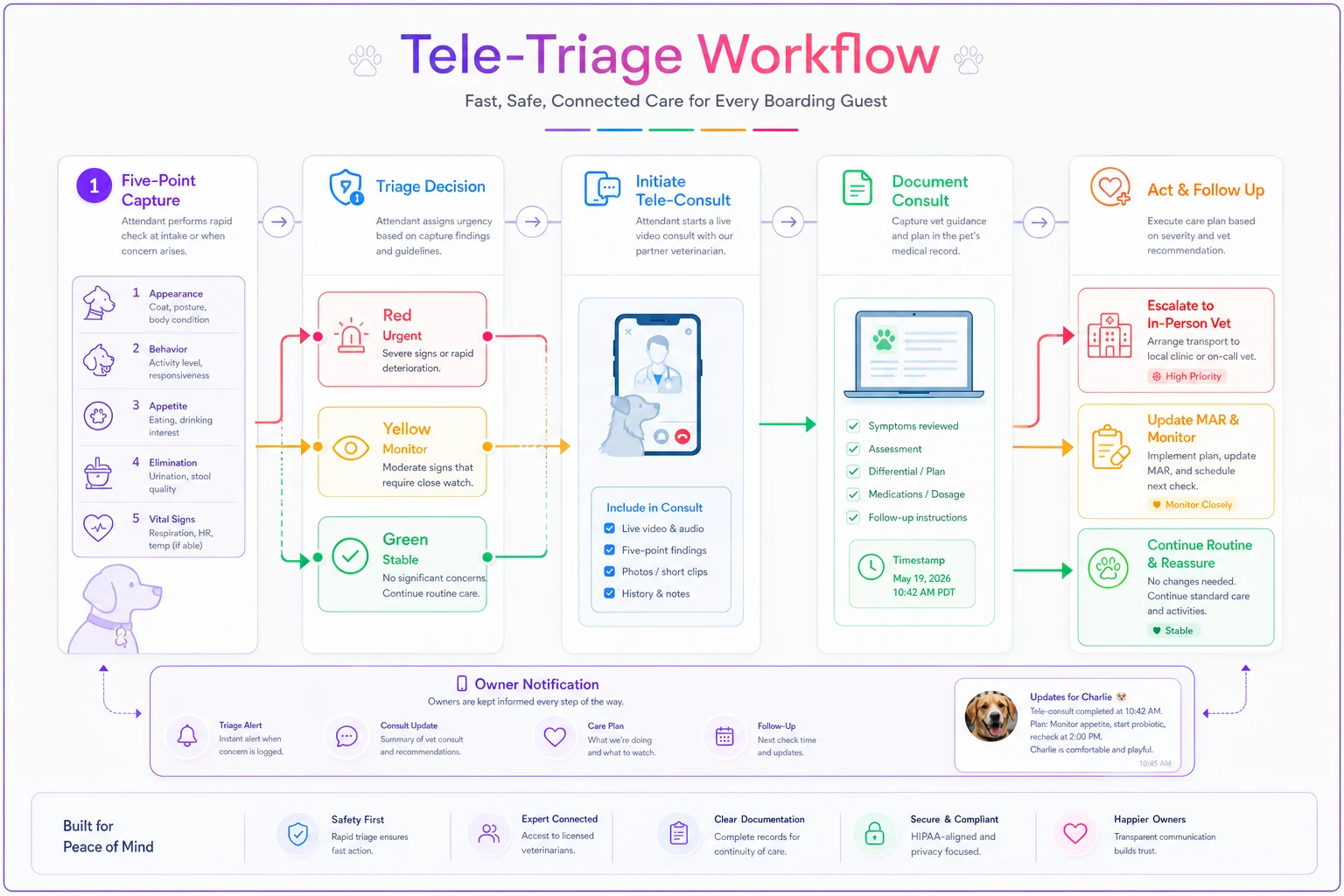
A simple visual of the flow can help staff follow the lanes and capture steps consistently.
Keep the triage checklist focused on the capture and the decision boundary — not clinical decision-making beyond the attendant's scope.
Tele-call scripts that cut the fumbling
When an attendant gets a vet on the line, the call should run on rails. A loose "um, so the dog's kind of limping" opener wastes the vet's time and yours. A tight script also produces cleaner documentation because the structure forces complete information.
A usable yellow-lane script skeleton:
-
Identify "This is [name] at [facility]. Calling about a tele-consult for [pet], a [breed/age], owner [name]. We have tele-consult consent on file and a spending threshold of [$X]."
-
Present "Onset was approximately [time]. Observed: [specific signs]. Over the last 24 hours: [eating/drinking/elimination/energy]. Known conditions/meds: [list]."
-
Share "I'm sending [photos/video] now via [channel]."
-
Ask "Does this need in-person care tonight, or is monitoring appropriate? If monitoring — what specifically should we watch for, and what would trigger escalation?"
-
Confirm "To confirm: [recommendation]. Recheck triggers: [list]. Any medication or action on our end: [yes/no + details]."
-
Close "Noted. I'll document this consult and the recommendation on the pet's record."
That last line matters more than it looks. Verbalizing that you're documenting the call signals to the vet that this is a real record, and it reminds the attendant to actually write it down.
The common failure is scripts that live in a binder nobody opens. Keep the active script on the same screen or sheet where the attendant is logging the observation, so following it is the path of least resistance — not an extra step.
Data-import patterns: PDF and API
The pet's history is only useful during a tele-consult if you can get it in front of the vet quickly. There are two realistic patterns, and most facilities end up using both depending on the relationship.
PDF / document-based. The owner uploads vaccination records and prior vet notes at intake, or you receive a records PDF from their vet. These sit in the pet's profile. The advantage is universality — any vet will accept a PDF. The downside is the data is unstructured, so an attendant has to read through it to find what's relevant mid-consult.
API / vet-portal integration. Some vet practices and corporate groups offer portal access or an API that lets authorized records flow in structured form — vaccine status, chronic conditions, active meds, recent visits. Faster and less error-prone during a call, but it requires a relationship and the owner's consent to connect.
| Pattern | Setup effort | Speed during consult | Best for |
|---|---|---|---|
| Owner-uploaded PDF | Low | Slow (manual read) | Most clients, one-off stays |
| Vet-provided records PDF | Medium | Slow–moderate | Pets with a known primary vet |
| Vet portal / API feed | High upfront | Fast, structured | Medical boarders, chronic-care pets, corporate vet partners |
The practical move: default everyone to PDF uploads at intake, and build API connections only with the one or two vet partners who handle your medical and high-frequency cases. Don't try to integrate with every vet in town — the ROI isn't there for a pet that boards twice a year.
Billing and capture rules
The charge dispute is the most avoidable failure in tele-triage, and it's almost always a communication problem rather than a pricing problem.
-
Define what's billable before anything happens. Tele-consult fee, medication cost, supplies, after-hours surcharge. Spell it out at intake.
-
Charge against the pre-authorized threshold. If the owner approved up to $150 for tele-care, charges inside that band don't need a fresh approval — but they still need a notification.
-
Notify at or near the moment of charge. A short message
"We did a tele-consult for Bailey tonight for a mild limp; vet recommended monitoring. Consult fee of $X applies per your intake agreement." That single message kills most disputes before they start.
-
Log the authorization source. Who approved, or which pre-auth threshold it fell under, with a timestamp.
-
Separate the facility's fee from pass-through costs. Owners accept pass-through vet costs far more easily when they're itemized separately from your handling fee.
A facility running 30–40 stays a week will typically see a handful of tele-consults a month. At $60–$90 per consult, that's real revenue — but the facilities that actually keep it instead of refunding it after complaints are the ones that notified the owner the same evening rather than letting the charge surface as a surprise at pickup.
SLA-backed escalation tied to MARs and vet relationships
The piece that ties everything together is a defined service-level agreement around escalation — not a vague "we'll call someone" but an actual clock.
-
Attendant identifies a yellow-lane issue → completes five-point capture within 15 minutes.
-
Manager review → confirms lane within 15 minutes (or immediately for borderline red).
-
Tele-consult initiated → with primary vet or tele-partner within 30–60 minutes.
-
Owner notification → in parallel, not after.
-
Fallback trigger → if no vet is reached within the defined window, escalate to backup vet or the emergency protocol.
For pets on medication, this ladder has to connect directly to the Medication Administration Record (MAR). If a tele-consult results in a dose change, a skipped dose, or a new medication, the MAR gets updated in the same workflow — not on a separate sheet someone updates later. The most dangerous gap in chronic-care boarding is a vet recommendation that never makes it onto the MAR, so the next shift administers the old dose. Linking the consult outcome to the MAR update closes that loop.
Your vet relationships also determine whether these SLAs are realistic. A single local vet who takes calls when they can isn't an SLA — it's a hope. Facilities that take medical boarding seriously have a defined tele-partner or an emergency vet with agreed response expectations, so the 30–60 minute window is backed by an actual agreement, not goodwill.
Where software quietly carries the load
None of this requires software to exist — you can run tele-triage on paper. But paper is where consistency and audit-readiness break down, because every handoff depends on someone remembering to transcribe, notify, and file.
Where an AI-assisted operational platform earns its place is in the connective tissue: pulling the pet's consent, thresholds, and records onto one screen the moment a triage is opened; prompting the attendant through the five-point capture so nothing gets missed; auto-notifying the owner when a charge posts against their pre-authorized threshold; and timestamping every step so the record builds itself as the workflow runs. The goal isn't to replace judgment — it's to make the documented, correct path the easiest one to follow at 4:40pm when everyone's already stretched. That's the difference between a clean audit trail and a group text you're trying to reconstruct three weeks after the fact.
A short real scenario
A mid-sized boarding facility — around 50 runs, handling a mix of standard and medical-boarding stays — kept losing tele-consult charges to disputes. Owners would come back, see a $75–$120 charge, and push back because nobody had told them it was coming. Refunds plus the staff time spent arguing added up to a few hundred dollars a month, and a couple of clients didn't rebook.
They tightened three things: a standalone tele-consult consent with a pre-auth threshold at intake, a same-evening notification whenever a consult charge posted, and a fixed five-point capture before any vet call. Nothing fancy.
Over the following months, disputes on tele-charges dropped to nearly zero, consults ran faster because the vet wasn't digging for details, and — the part that surprised the owner — a few clients specifically mentioned how reassured they felt getting a clear, prompt message when their dog had an off day. The process that protected the facility legally also made it look more professional to the people who mattered.
When this is worth building — and when it isn't
Build a full tele-triage playbook if you handle medical boarding, chronic-care pets, longer average stays, or you've already had a dispute or a close call. The documentation and escalation structure pays for itself the first time a stay goes sideways.
Keep it lightweight if you run short stays with mostly healthy pets and low volume. You still want consent, a simple three-lane checklist, and a notification habit — but you don't need API integrations with vet portals for a facility that sees a tele-consult once a month.
This is a bad idea if you're trying to use tele-triage to avoid in-person vet care to save money. That's not what it's for. Red-lane cases go to a vet, full stop. Telemedicine triage is a decision and documentation layer — not a substitute for hands-on care when a pet actually needs it.
The facilities that get this right treat tele-triage as an operational discipline: consistent capture, clear consent, prompt notification, and a record that assembles itself as you work. Get those pieces connected and the hard moments — the 4:40pm limp, the midnight vomit, the dispute three weeks later — stop being chaos and start being something you can actually stand behind.
Ready to optimize your pet hotel operations?
Join hundreds of pet hotels using GoPetel to save time, improve pet care, and increase booking reliability.