


Pet hotel staff retention sits around 47% industry-wide. That means you're replacing roughly half your team every year, spending somewhere in the range of $2,800 per hire once you factor in recruiting, training, and the lost productivity while someone new gets up to speed. Most owners throw money at the problem—higher starting wages, signing bonuses, random perks—without ever figuring out why their best kennel techs leave after 8 months while mediocre ones somehow stick around for years.
The real problem usually isn't compensation. It's that pet hotels run people operations like they're still operating out of someone's backyard in 1995. No clear progression paths. No objective performance standards. No connection between what someone does on a Tuesday morning and what the business actually needs. Just vibes-based management and hoping good people don't walk out.
You need an actual people-ops system, not better hiring ads on Indeed.
Why traditional retention tactics fail in pet boarding
Most pet hotel owners approach retention backwards. They hear someone's leaving for $2 more per hour at the clinic down the street, so they panic-raise everyone's wages. Three months later someone else leaves for a completely different reason, and now they're stuck with higher labor costs and the same turnover problem.
Pet boarding has specific operational pressures that generic HR advice just doesn't touch. A kennel tech at 6am managing 40 dogs who all need medication, feeding, and outdoor time isn't the same as a retail associate folding shirts. The physical demands, the emotional labor of handling anxious animals, the constant client communication—that creates a particular type of burnout that more money won't fix.
What makes it worse is the skill progression mismatch. Someone might be excellent at morning feeding routines but completely lost during intake. Traditional job descriptions treat "kennel technician" as one thing when it's actually closer to 15 different competencies that develop at different rates. Without a way to recognize and reward specific skill growth, your top performers feel stuck while underperformers coast on seniority. That gap shows up directly in your retention numbers.
Then there's seasonality. July 4th week you need triple the staff. Come September, those same people have nothing to do. Most facilities handle this badly—either keeping everyone on reduced hours (kills morale) or letting people go (kills trust). Neither approach builds the stable team you actually need.
The anatomy of a working people-ops system
A functional people-ops system for pet hotels has five interconnected components that most operators either skip entirely or implement in isolation.
Never miss a booking or detail again.
GoPetel simplifies pet hotel operations by managing every reservation and pet profile seamlessly.
- Centralized booking management
- Automated client notifications
- Staff and kennel scheduling
No credit card required
Pay bands tied to actual business metrics. Not market surveys or what the competition pays—what each role contributes to your cost-per-stay. If your average boarding stay generates $180 in revenue and costs $112 to deliver, you know exactly what each position can sustainably earn. A Level 1 Kennel Tech handling basic feeding might justify $14-16/hour based on handling 25 dogs per shift. A Level 3 Tech who can also do behavior assessments and minor medical protocols might justify $19-22/hour because they enable premium service tiers.
Competency maps that actually match your SOPs. Not a generic "communication skills" checklist—specific, measurable abilities tied to your real workflows. Can they complete morning feeding for 30 dogs in 90 minutes? Can they identify and document the five most common health concerns during intake? Can they run your cleaning protocol without supervision? Each competency should connect to standard operating procedures that already exist in your operation.
The 30-day map covers baseline survival skills—basically, can they work a shift without creating problems. The 90-day map covers full autonomy—can they handle any normal situation without asking for help. Clear expectations, less guesswork about who's actually ready for more.
Structured interview scorecards that predict real job performance. Instead of "tell me about yourself," you're scoring specific scenarios. Show them a photo of a messy kennel and have them walk through their cleaning sequence. Give them a mock schedule with 15 dogs requiring different feeding times and see how they'd organize it. Behavioral anchors like these correlate with success far better than personality assessments or reference checks.
Transparent promotion ladders with specific triggers. Not "when we think you're ready" but "when you've demonstrated these 8 competencies for 30 consecutive days." This kills the favoritism perception and gives motivated employees a real target to aim at. More importantly, it helps you identify who's actually ready versus who just interviews well.
Retention experiments with measurable ROI. Not "let's try free lunch Fridays and see if people seem happier" but structured tests with defined success metrics. If you spend $400/month on a late-shift differential, does it reduce turnover on that shift by at least one person per quarter? If yes, that $400 saves $2,800 in replacement costs. If no, kill the experiment and try something else.
Here's a simple workflow showing how the five components link together.
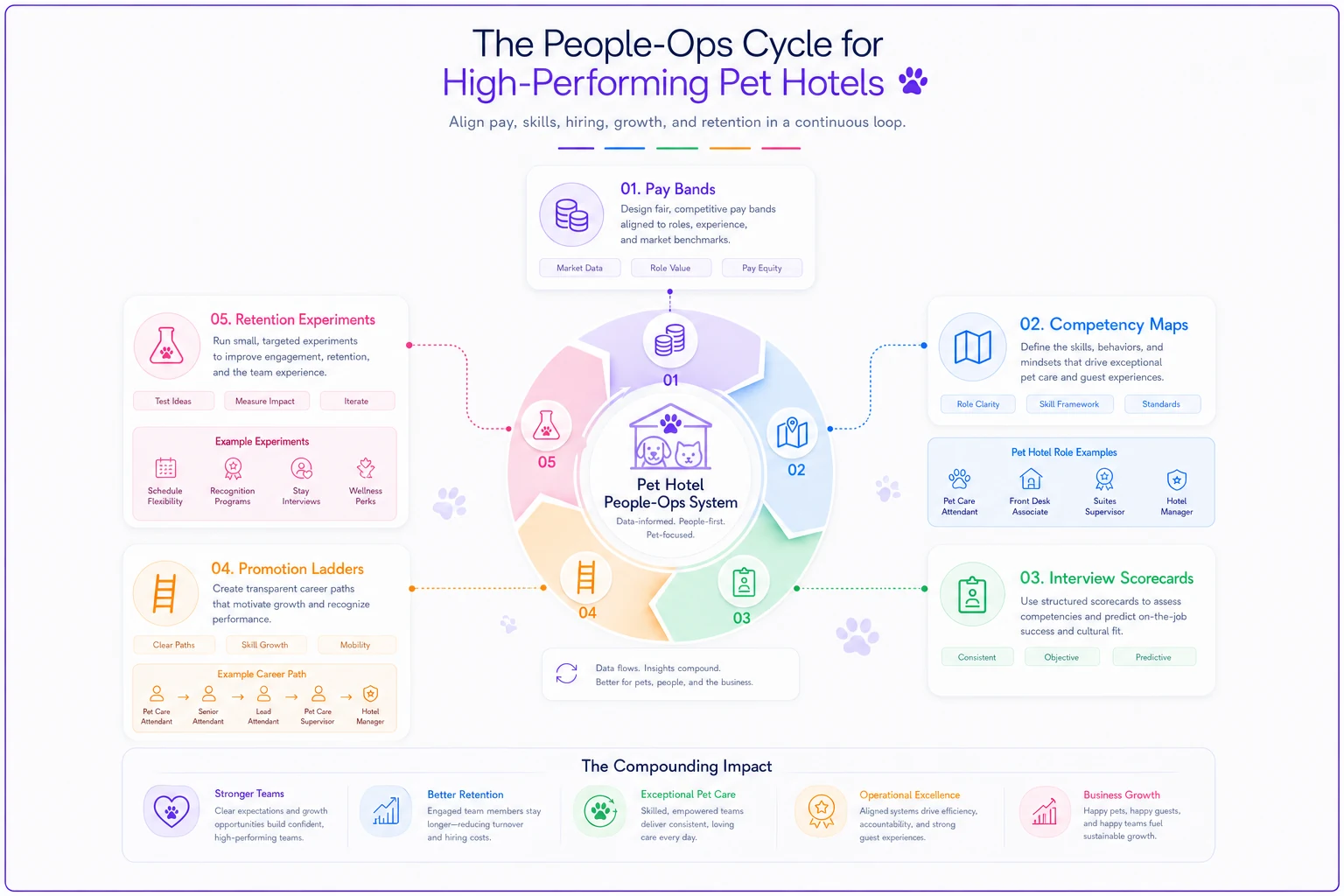
This shows how each component feeds into the next and creates a repeatable process for hiring, developing, and retaining staff.
Building pay bands that reflect operational reality
Traditional pay scales in pet hotels don't make a lot of sense. Usually they're based on tenure ("you get a raise after a year") or desperation ("we'll pay whatever to fill this shift tonight"). Neither approach connects compensation to actual value.
Start with your unit economics. Pull your last 90 days of data and calculate the true cost-per-stay—labor, supplies, overhead, margin target. For most 20-30 kennel facilities, this lands around $35-45 per dog per night in direct costs against $55-75 in revenue.
Now map every role to their impact on that equation. Your morning shift lead who ensures 40 dogs get fed, medicated, and exercised on schedule directly enables $2,200-3,000 in daily revenue. At $18/hour they cost about $144 per shift—roughly 5-6% of enabled revenue. That math holds up.
Compare that to an afternoon floater who mainly does spot cleaning and helps with pickups. They're supporting maybe $800-1,200 in daily revenue. Same $18/hour means 12-18% of enabled revenue. That doesn't work long-term.
This creates natural pay bands:
-
Entry roles that support operations
$13-15/hour (10-12% of enabled revenue)
-
Core roles that execute operations
$16-19/hour (8-10% of enabled revenue)
-
Lead roles that coordinate operations
$20-24/hour (6-8% of enabled revenue)
-
Supervisor roles that optimize operations
$25-30/hour (4-6% of enabled revenue)
Within each band, progression happens through competency acquisition, not time served. Someone who masters medication administration in 6 weeks moves up faster than someone who takes 6 months. Quick learners get rewarded; slower developers still have a clear path. Both outcomes are better than the alternative.
| Role band | Hourly range | Percent of enabled revenue |
|---|---|---|
| Entry roles that support operations | $13-15/hour | 10-12% of enabled revenue |
| Core roles that execute operations | $16-19/hour | 8-10% of enabled revenue |
| Lead roles that coordinate operations | $20-24/hour | 6-8% of enabled revenue |
| Supervisor roles that optimize operations | $25-30/hour | 4-6% of enabled revenue |
Within each band, progression happens through competency acquisition, not time served. Someone who masters medication administration in 6 weeks moves up faster than someone who takes 6 months. Quick learners get rewarded; slower developers still have a clear path. Both outcomes are better than the alternative.
Competency mapping that matches real workflows
Generic competency frameworks fail because they don't reflect what actually happens during a shift. "Customer service skills" means nothing when you're trying to figure out if someone can handle a diabetic dog's insulin schedule while an aggressive dog in the next kennel is losing its mind.
Start by documenting what actually needs to happen in each role, hour by hour. A morning kennel tech's shift looks something like:
-
Review overnight notes (5 minutes)
-
Prep medications for 15-20 dogs (20 minutes)
-
Execute feeding sequence based on dietary restrictions (45 minutes)
-
Rotate dogs through outdoor areas in compatibility groups (90 minutes)
-
Document any health or behavior concerns (15 minutes)
-
Clean and sanitize vacated kennels (45 minutes)
Each of those breaks into specific, observable competencies. "Prep medications" alone is five different skills: reading logs correctly, identifying pills accurately, following dosage instructions, documenting administration, recognizing adverse reactions.
Your 30-day competency map might cover:
-
Complete basic feeding routine for up to 20 dogs independently
-
Identify and report the 5 most common health concerns
-
Execute standard cleaning protocol to pass spot inspection
-
Handle basic client questions at pickup
-
Follow established dog-rotation schedule without creating conflicts
Your 90-day map expands to:
-
Manage complex feeding requirements including special diets and medications
-
Make real-time decisions about dog compatibility and grouping
-
Handle minor behavioral issues without escalation
-
Complete intake procedures including vaccination verification
-
Train new hires on basic procedures
These aren't soft skills or personality traits. They're specific, measurable abilities tied directly to operational efficiency. Someone either can or cannot complete morning feeding for 20 dogs in 45 minutes. No subjectivity required.
Track medication prep times to identify training gaps quickly.
Someone either can or cannot complete morning feeding for 20 dogs in 45 minutes. No subjectivity required.
Interview scorecards that predict performance
Most pet hotel interviews are a waste of everyone's time. "Do you love animals?" Of course they'll say yes. "Can you work weekends?" They need the job, so yes. "How do you handle stress?" They'll say something about deep breathing or teamwork.
Build scorecards around actual job scenarios instead. Five to seven situations they'll realistically face, scored on their problem-solving approach.
Scenario 1: "It's 7am. You have 30 dogs to feed. Five have special diets, three need medication, and one is food aggressive. Walk me through your first 30 minutes."
Good answer: Mentions reviewing notes first, prepping special diets separately, establishing a feeding order based on medication timing, identifying the food aggressive dog's location. Bad answer: "I'd just go kennel by kennel and figure it out."
Scenario 2: "A client calls angry because their dog came home with a small scratch. You don't see anything in the notes about it. What do you do?"
Good answer: Acknowledges the concern, asks for details, checks records and who worked that shift, offers to document and have management follow up. Bad answer: "I'd tell them dogs play rough sometimes."
Scenario 3: "You notice a dog hasn't eaten for two meals and seems lethargic. The owner is unreachable. What's your process?"
Good answer: Documents observations specifically, checks for other symptoms, alerts supervisor immediately, prepares for a potential vet visit, keeps trying owner via all contact methods. Bad answer: "I'd wait and see if they eat dinner."
Score each response 1-5 with specific behavioral anchors. A "5" on scenario 1 means they mentioned documentation, efficiency tactics, and safety considerations. A "3" means they had a basic plan but missed key details. A "1" means no structured approach at all.
Over time you'll find that candidates scoring 20+ across all scenarios have dramatically lower turnover in the first 90 days than those scoring under 15. Takes a few hiring cycles to validate, but the pattern shows up pretty consistently.
Promotion ladders that eliminate favoritism
Nothing kills morale faster than watching the owner's friend get promoted while someone who's been grinding for two years stays stuck. When promotion decisions are based on tenure or vague "readiness," resentment builds because nobody knows the actual rules.
Build explicit promotion triggers tied to demonstrated competencies and business needs.
Kennel Tech I → Kennel Tech II:
-
Complete all 30-day competencies with zero supervision for 30 consecutive days
-
Pass medication administration test with 100% accuracy
-
Handle at least one full shift solo without issues
-
Train at least one new hire on basic procedures
-
Zero safety incidents in past 60 days
Kennel Tech II → Lead Tech:
-
Complete all 90-day competencies consistently for 60 days
-
Successfully handle at least 3 difficult client situations independently
-
Create or improve at least one operational procedure
-
Maintain area at 95%+ cleanliness scores for 30 days
-
Other team members request to work their shifts
Lead Tech → Shift Supervisor:
-
Successfully coordinate at least 10 high-volume shifts (30+ dogs)
-
Reduce area-specific incidents by 25% over 90 days
-
Complete basic P&L training and understand unit economics
-
Handle scheduling for at least 2 team members effectively
-
Implement at least one cost-saving or revenue-generating idea
Someone exceptional might move from Tech I to Lead in 6 months. Someone average might take 18 months. Someone who never develops the competencies doesn't get promoted—period. High performers see a real path forward. Low performers either improve or self-select out. Both are good outcomes.
Retention experiments with measurable outcomes
Most retention initiatives fail because they're built on assumptions, not data. Free pizza doesn't fix a toxic supervisor. Casual Fridays don't compensate for a schedule that changes every week. You need structured experiments with clear success metrics.
Start with exit interview data—but not the generic HR kind. Track specific reasons people leave, when they leave (both tenure and time of year), and what role they were in. You'll usually find patterns. Afternoon shift workers leaving 3x faster than morning shift, or people hired in November quitting by February.
Problem: High turnover in afternoon shifts (2pm-8pm) Hypothesis: The shift is unpopular due to work-life balance Experiment: Offer +$2/hour differential for afternoon shifts Success metric: Reduce afternoon shift turnover by 30% over 90 days Cost: ~$320/month (assuming 20 hours/week) ROI: Preventing one turnover per quarter saves $2,800 in hiring costs = roughly 775% ROI
Problem: New hires quitting within first 30 days Hypothesis: Overwhelming learning curve without enough support Experiment: Assign paid mentors (+$1/hour when training) for first 2 weeks Success metric: Increase 30-day retention from 60% to 80% Cost: ~$80 per new hire ROI: Saving 2 out of 10 from quitting saves $5,600 in wasted hiring costs
Problem: Experienced staff leaving for competitors paying $1-2 more Hypothesis: They value other benefits beyond base pay Experiment: Offer a "perfect month bonus"—$200 for zero absences or tardies Success metric: Reduce experienced staff turnover by 25% Cost: $200/month for eligible employees ROI: Retaining one experienced employee per quarter saves significant recruitment and knowledge loss
Track these ruthlessly. After 90 days, either double down on what works or kill what doesn't. The afternoon differential might work brilliantly. The perfect month bonus might create resentment when someone misses it due to a legitimate illness. You won't know until you test it with real data.
Connecting individual performance to business outcomes
The biggest missed opportunity in pet hotel people-ops is the gap between what employees do and what the business actually needs. Your kennel tech has no idea that their slow feeding routine creates a backup that delays afternoon pickups, frustrates clients, and hurts rebooking rates. They just think they're doing their job fine.
Close that gap by making business metrics visible—not to micromanage, but to give people context for why the work matters.
-
Dogs boarded vs. capacity (shows why efficiency matters)
-
Incident rate (shows why safety protocols exist)
-
Client complaints and compliments (shows why service standards matter)
-
Labor cost as a percentage of revenue (shows why productivity matters)
Then connect individual contributions to those numbers directly. "When Sarah reduced feeding time by 10 minutes through better organization, we could take 3 more same-day bookings worth $180." "When Marcus caught that medication error, we avoided a potential $5,000 vet emergency and a devastating review."
That kind of context transforms routine tasks into meaningful work. People follow specific procedures more carefully when they understand what breaks down if they don't. Better yet, they start identifying their own improvement opportunities without management constantly pushing.
The technology layer that makes it sustainable
Manual tracking of competencies, performance data, and retention experiments breaks down around 10 employees. Spreadsheets get stale, nobody updates them consistently, and the whole system quietly falls apart.
This is where operational software becomes essential—not as a magic fix, but as infrastructure that makes good people-ops practices actually stick. AI-powered platforms can track competency demonstrations through daily task completions, flag when someone's ready for promotion based on their actual record, and automatically calculate ROI on retention initiatives without someone manually pulling numbers every quarter.
The goal isn't to replace human judgment. You still need managers making promotion decisions. You still need to design the retention experiments. But now those managers have objective data to work with instead of gut feelings, and the experiments track themselves instead of relying on someone remembering to check a spreadsheet.
When individual performance connects to business outcomes automatically—faster feeding time captured, difficult client situations documented, safety incidents logged—you build an objective record that makes fair promotion decisions easier and surfaces your real top performers instead of just the most visible ones.
Making people-ops a competitive advantage
Pet hotel staff retention doesn't have to hover around 47%. Facilities that implement structured people-ops systems consistently hit 70-80% annual retention, cutting recruiting costs by tens of thousands per year while improving service quality at the same time.
The difference isn't higher wages or better perks. It's treating people operations with the same rigor you'd apply to pet care protocols. Clear expectations, objective measurement, transparent advancement, and real connection to business outcomes—that combination turns "just a job" into something worth staying for.
Start with pay bands tied to your actual economics, not market surveys. Build competency maps that reflect real workflows, not generic skills. Create promotion triggers that reward performance, not tenure. Run retention experiments with measurable ROI. Connect individual contributions to business results so every role has visible meaning.
Pet hotel people-ops has industry-specific challenges that generic HR advice won't solve—the physical demands, emotional labor, seasonality swings, and uneven skill development create problems that require specific solutions. Build systems designed for your actual operational reality, and retention starts to become a predictable outcome instead of a constant struggle.
Your next hire shouldn't be a dice roll on whether they'll last 6 weeks or 6 years. With the right infrastructure, you can predict, develop, and retain the team that enables growth rather than constraining it.
Ready to optimize your pet hotel operations?
Join hundreds of pet hotels using GoPetel to save time, improve pet care, and increase booking reliability.