

Most pet hotels treat customer success like something that happens at the front desk during checkout. You hand back the dog, say a few nice things about how good they were, maybe mention the holidays are filling up fast, and hope the owner books again. That's not a system. That's a wish.
The problem with running rebooking on charm alone is that it doesn't survive volume. When you're doing 40 stays a month, your team remembers the regulars and can improvise the follow-up. At 300+ stays a month, that improvisation collapses. Good clients slip through. First-timers who would've become loyal never hear from you again. And your staff—already stretched—end up doing emotional labor that produces inconsistent results anyway.
A real customer-success funnel fixes this by turning one-off stays into predictable lifetime value. Not through more phone calls or a bigger front desk, but through timed educational journeys, honest LTV segmentation math, and low-touch automation that runs quietly in the background.
The core mistake: treating every client the same after checkout
There's a pattern that shows up constantly. A pet hotel invests real money to acquire a new client—ads, referral incentives, Google reviews, whatever. That client boards once. Then nothing. The same generic "we miss your pup!" email goes to the person who boards twice a year and the person who could easily board eight times if you nudged them right.
That's the flaw at the center of most pet hotel customer success efforts: the follow-up isn't tied to who the client actually is or where they are in their relationship with you.
Think about the difference between these two clients:
-
A local dog owner who travels for work every 6–8 weeks
-
A family who boards once a year during summer vacation
If you send them the same message on the same schedule, you're either annoying the annual family or under-communicating with the frequent traveler who could be your bread and butter. Both are lost value, just in opposite directions.
The fix starts with accepting a slightly uncomfortable truth: not all clients deserve the same amount of your attention, and pretending they do wastes both money and staff time.
Segmentation and the LTV math that should drive everything
Before you automate a single message, you need to know what a client is actually worth. Most owners have a vague sense—"regulars are good"—but never put numbers to it. That vagueness is expensive because you can't tell where to spend effort.
Never miss a booking or detail again.
GoPetel simplifies pet hotel operations by managing every reservation and pet profile seamlessly.
- Centralized booking management
- Automated client notifications
- Staff and kennel scheduling
No credit card required
LTV = average stay value × stays per year × expected years as a client × (1 + add-on rate)
Let's run a realistic example. Say your average stay runs about $210 (a few nights plus a bath). A frequent traveler boards maybe 6 times a year and sticks around for roughly 3 years before they move or their dog ages out. Add in grooming and daycare add-ons at around 20%.
That's roughly $210 × 6 × 3 × 1.2 = about $4,500 in lifetime value.
Now the annual family: same $210 stay, once a year, maybe 4 years, fewer add-ons. That's closer to $900 over the relationship.
Both clients matter. But a client worth $4,500 justifies a very different follow-up investment than one worth $900. Once you see that gap in dollars, the segmentation almost designs itself.
Here's a segmentation structure that works for most facilities:
| Segment | Rough behavior | Annual LTV range | Follow-up intensity |
|---|---|---|---|
| Frequent / high-value | Boards 5+ times a year, uses add-ons | $1,200–$1,800/yr | High—personal touches, priority booking |
| Steady mid-tier | 2–4 stays a year | $500–$900/yr | Medium—timed reminders, seasonal offers |
| Occasional / seasonal | 1 stay a year, usually holidays | $150–$300/yr | Low—automated, cheap-to-run nudges |
| First-timers (unclassified) | 1 stay, no history yet | Unknown | Onboarding journey to sort them |
The last row is where most facilities leave money on the table. First-timers are unclassified—you don't yet know if they're a $4,500 client or a $900 client. The goal of your early journey isn't to sell them; it's to find out who they are and give them a reason to come back a second time, because the second stay is where loyalty actually forms.
Timed educational journeys: the part that builds trust before it sells
A journey is just a sequence of messages triggered by where a client is in their relationship with you—not by a calendar blast to your whole list.
The word "educational" matters here. The instinct is to make every follow-up a pitch: book now, holidays are filling up, here's 10% off. That works occasionally, but it burns out fast and trains clients to only respond to discounts. Educational touches do something better—they build confidence in leaving their pet with you, which is the real barrier to rebooking, especially for anxious owners.
A first-timer journey might look like this:
-
Day of checkout — A warm summary of their pet's stay. What they ate, how they slept, one specific behavioral note ("Milo warmed up to the play group by day two"). This isn't a sale. It's proof you paid attention.
-
Day 3 — A short piece of genuinely useful content
how to help a dog re-adjust to home routine after boarding, or signs of post-boarding stress and when it's normal. You're being helpful when they're not even thinking about booking.
-
Day 10 — A soft check-in. "How's Milo settling back in?" Still no hard pitch.
-
Day 21 — Now you introduce rebooking, framed around their pattern. "Planning any trips this fall? We'd love to have Milo back." If you know their travel tends to cluster, you time this to it.
-
Day 45 — A last low-key touch, then they roll into the standard segment cadence based on how they've behaved.
Four of the five touches give value before asking for anything. That ordering is the whole point. When you compare facilities that lead with education versus those that lead with offers, the education-first sequences almost always produce higher second-stay conversion—and the second stay is the hinge that separates a one-off from a lifetime client.
For the deeper mechanics of moving clients through repeat stays, this pairs closely with an operational client-lifecycle and rebooking system, which handles the booking-side logic behind these touches.
How the journeys connect to the rest of your operation
A customer-success funnel doesn't live in a vacuum. It feeds on data your operation already produces, and it breaks the moment that data is wrong or missing.
The workflow in plain terms:
> Stay happens → team logs details (feeding notes, behavior, add-ons used) → notes feed the checkout summary and journey triggers → client behavior classifies them into a segment → segment sets long-term cadence → next booking updates the whole loop.
Here's a simple visual of that workflow.
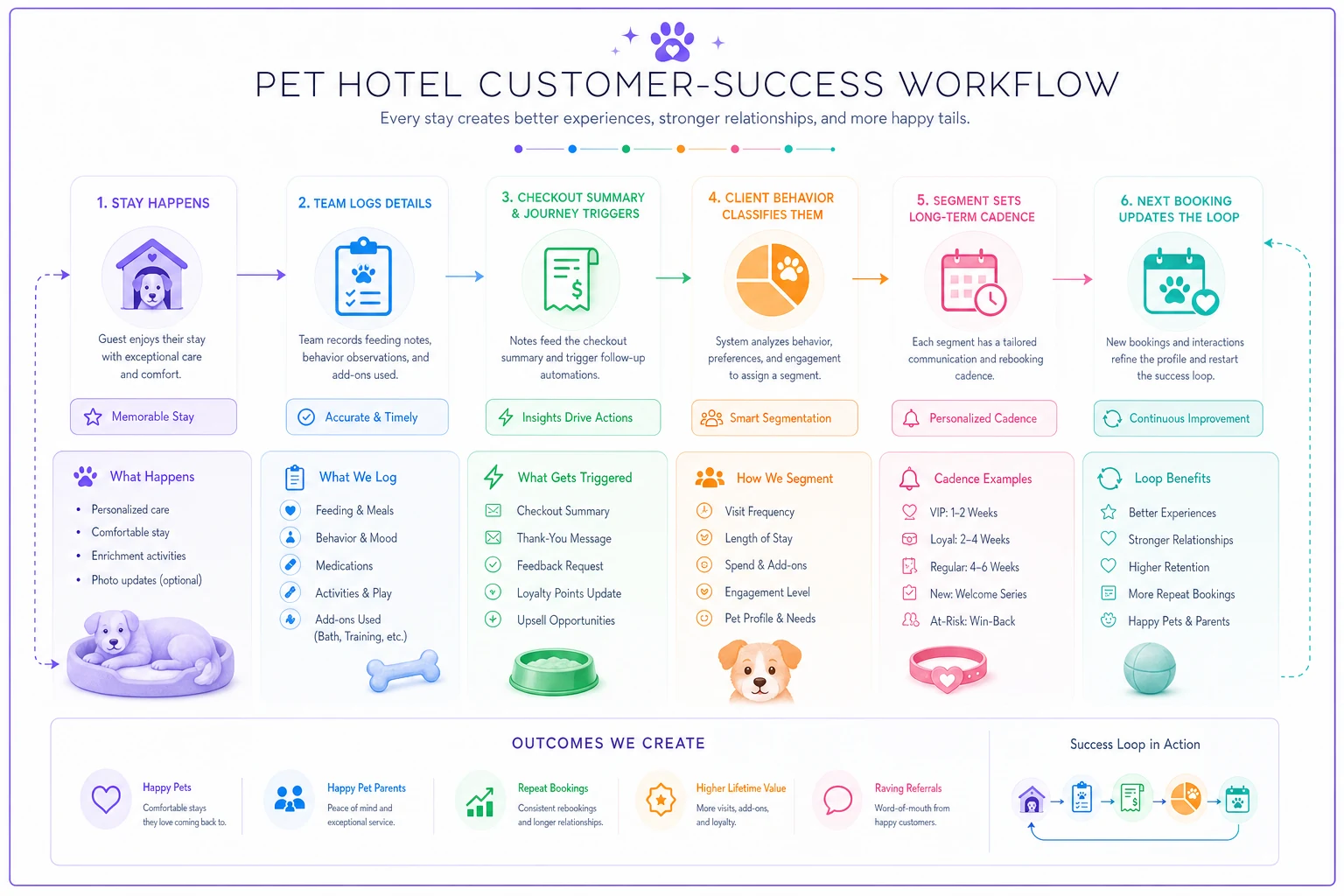
Where this chain snaps is almost always at the data-entry step. If your staff don't consistently log which dog used daycare or which owner asked about grooming, your journeys go generic—and generic journeys don't convert. The customer-success system and your stay-quality system are joined at the hip. The quality of your follow-up is only as good as what you captured during the stay. If you haven't tightened that side yet, the ideas in turning stay audits into repeat revenue feed directly into the raw material these journeys need.
At scale, the coordination problem gets harder. One location with one manager can eyeball this. Three locations with rotating staff cannot. Consistency has to be built into the process, not held in someone's head.
Low-touch automation that protects staff time
The constraint every pet hotel operator actually cares about: none of this can add work to a front desk that's already slammed during the 4pm checkout rush.
The routine, predictable parts should run automatically, and staff only step in where a human genuinely adds value. This is where AI-assisted operational tools earn their place—not by replacing the personal touch, but by handling the timing, the triggers, and the drafting so your team isn't manually chasing anyone.
An AI-enhanced workflow platform can watch for the checkout event, pull the stay notes your team already logged, and draft a personalized summary message that a staff member can approve in ten seconds instead of writing from scratch. It can watch client behavior and quietly move someone from "first-timer" into "frequent" without anyone updating a spreadsheet. It can hold back a rebooking nudge from someone who just booked—the kind of embarrassing mistake manual lists make constantly.
-
Automated journey timing, segment classification, standard summaries, seasonal nudges, suppressing messages to already-booked clients
-
Human high-value segment personal calls, anything involving an anxious owner, recovery after a complaint, judgment calls on special cases
Use suppression rules to avoid sending rebooking nudges to clients who already booked.
Done right, your staff spend their limited relationship time on the clients worth $4,500, and the $900 clients still get a consistent, professional experience that costs you almost nothing to deliver.
A real scenario
A mid-sized facility—one location, around 60 kennels, roughly 280–320 stays a month—was doing everything on manual reminders. Their front desk sent rebooking texts "when they had a minute," which in practice meant during slow weeks and never during busy ones. Repeat-booking rate hovered somewhere around 34%.
They didn't overhaul anything dramatic. They built a first-timer journey, split their existing clients into three segments based on stay frequency, and let the routine touches run automatically while keeping personal calls for their top tier.
The first thing that changed was staff time—the front desk stopped spending scattered hours each week on follow-up they were doing inconsistently anyway. Within about four months, second-stay conversion for first-timers climbed noticeably, and overall repeat bookings moved into the low-to-mid 40s. Nothing miraculous, no doubled revenue overnight. But on their volume, even a high-single-digit lift in rebooking added up to a meaningful number of nights they weren't capturing before—without hiring anyone.
The interesting part wasn't the top-line number. It was that the predictability changed. Rebooking stopped being tied to how busy the week was.
When this makes sense—and when it doesn't
This is worth building when:
-
You're consistently above ~150 stays a month and can't personally track follow-up anymore
-
You have enough client history to actually segment (a few months of clean data minimum)
-
Your stay-quality and note-logging are already decent
This is a bad idea when:
-
Your intake and stay notes are a mess. Automating on top of bad data just scales the mess.
-
You're a very small facility where the owner genuinely does remember every client—at that size, the personal touch beats any system.
-
You're trying to use it as a discount machine. If every journey ends in a coupon, you'll erode margin and train clients to wait for deals.
If your rebooking problem is really a service problem—dogs coming home stressed, owners quietly unhappy—no funnel will fix that. Fix the experience first. Automation makes a good operation better; it makes a bad operation's problems more visible.
Bringing it together
The shift that matters isn't technological. It's moving from thinking about individual stays to thinking about client relationships with real dollar values attached.
Once you know a frequent traveler is worth roughly five times an annual family, it becomes obvious where to spend effort and where to let a quiet automated cadence carry the load. Good stay notes feed better journeys. Better journeys build the trust that drives second stays. Second stays generate the behavior data that sharpens your segments. Sharper segments tell you exactly where your team's limited attention belongs.
That loop is what turns a facility full of one-off bookings into one with a predictable base of clients who keep coming back—without asking your already-busy staff to carry it all on memory and good intentions.
The shift that matters isn't technological. It's moving from thinking about individual stays to thinking about client relationships with real dollar values attached.
Once you know a frequent traveler is worth roughly five times an annual family, it becomes obvious where to spend effort and where to let a quiet automated cadence carry the load. Good stay notes feed better journeys. Better journeys build the trust that drives second stays. Second stays generate the behavior data that sharpens your segments. Sharper segments tell you exactly where your team's limited attention belongs.
That loop is what turns a facility full of one-off bookings into one with a predictable base of clients who keep coming back—without asking your already-busy staff to carry it all on memory and good intentions.
Ready to optimize your pet hotel operations?
Join hundreds of pet hotels using GoPetel to save time, improve pet care, and increase booking reliability.