
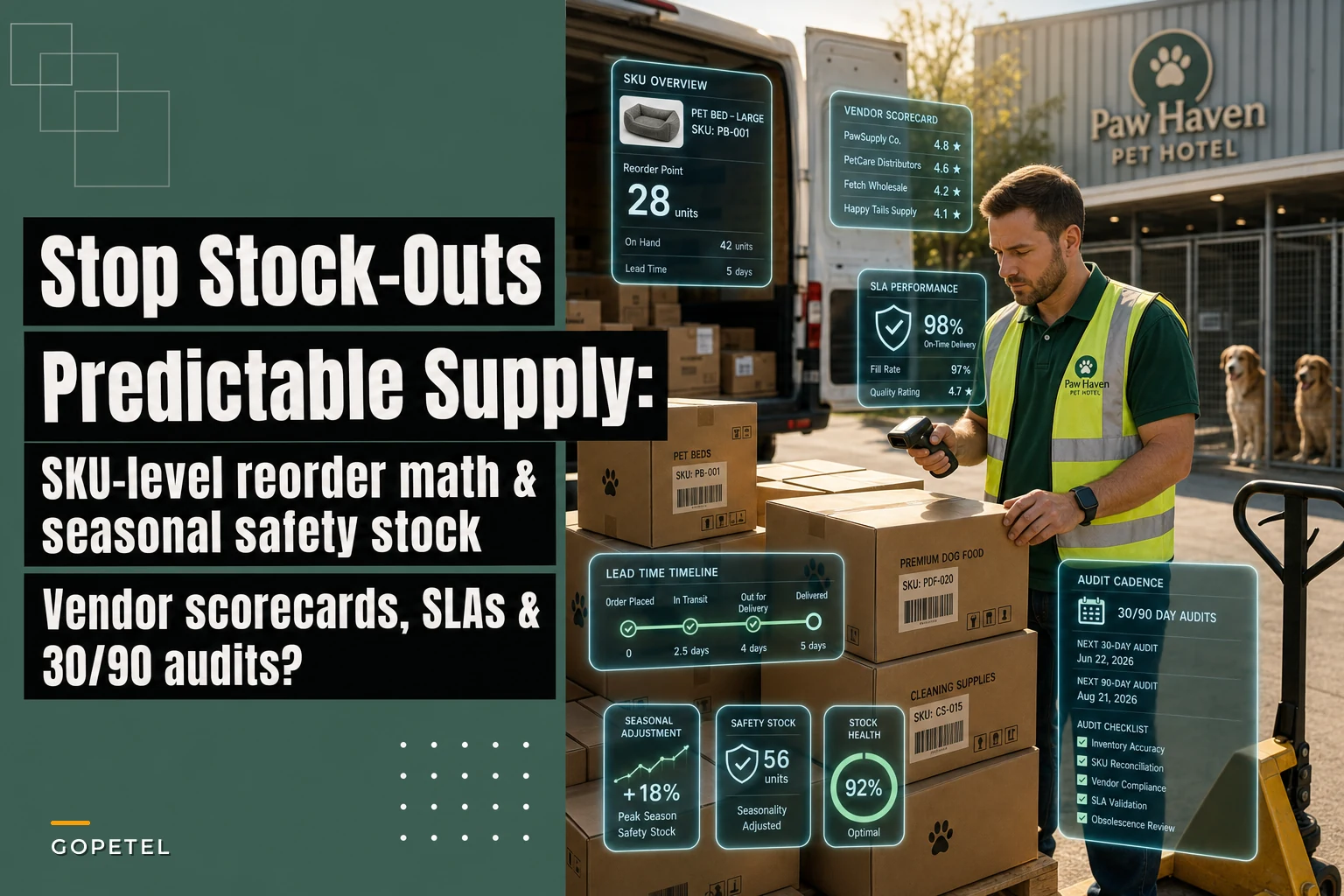

The busiest Saturday of the year is not the time to discover you're down to four rolls of kennel liner and one jug of the disinfectant your infection protocol actually requires. But that's exactly when it happens, because occupancy and consumption move together, and most pet hotels order on gut feel or "whenever the shelf looks low."
The problem with "when the shelf looks low" is that it treats every SKU the same. A bag of house kibble and a bottle of parvo-grade disinfectant have completely different consumption curves, lead times, and consequences when they run out. Lumping them together is why you end up with a storage room full of slow-moving toys and an empty bin where the critical stuff should be.
This playbook is narrow on purpose. It's about the math and the vendor discipline behind pet hotel inventory procurement—specifically SKU-level reorder points that flex with occupancy, vendor scorecards that hold suppliers accountable, SLA clauses for the supplies you literally cannot operate without, and an audit cadence that keeps the whole thing honest.
Why occupancy seasonality breaks normal reorder logic
Most reorder formulas assume roughly steady demand. Pet hotels don't have steady demand. You might sit at 55% occupancy on a random Tuesday in February and hit 100% for eleven straight nights over the winter holidays. Your consumption of consumables doesn't just rise—it can more than double per day, and it does so predictably.
The operational trap is this: a fixed reorder point—say, "reorder liner when you hit 20 rolls"—works fine at 55% occupancy. At 95% with a longer weekend, you burn through those 20 rolls before replenishment even arrives. The reorder point was correct for the average and wrong for the peak, which is the only time it actually matters.
What tends to show up across facilities that run tight is that consumption per occupied kennel-night is remarkably stable per SKU. A dog at your facility uses roughly the same amount of pad, bag, food, and cleaning product per night whether it's July or January. So the fix isn't to guess seasons—it's to tie reorder math to occupied kennel-nights, then let your occupancy forecast drive the number.
If you already run a lead-time aware occupancy forecast, this is the part that makes it pay off operationally instead of just informing pricing.
SKU-level reorder math that actually flexes
Forget one global reorder rule. Every consumable SKU needs its own numbers, and only four inputs matter:
Never miss a booking or detail again.
GoPetel simplifies pet hotel operations by managing every reservation and pet profile seamlessly.
- Centralized booking management
- Automated client notifications
- Staff and kennel scheduling
No credit card required
-
Usage per occupied kennel-night (U) — how much of this SKU one occupied kennel consumes in a night.
-
Lead time in days (L) — from the moment you place the order to the moment it's on your shelf and usable.
-
Forecasted occupancy during that lead time — expected occupied kennel-nights over the next L days.
-
Safety buffer — extra cover for demand spikes and vendor slippage, sized by how critical the SKU is.
Reorder Point = (U × forecasted occupied kennel-nights during lead time) + safety buffer
A worked example makes this concrete. Say you run 40 kennels and you're looking at absorbent floor pads.
-
Usage
about 1.5 pads per occupied kennel-night (U = 1.5)
-
Lead time
4 days from your distributor (L = 4)
-
Forecasted occupancy over the next 4 days during holiday week
~90%, so roughly 40 × 0.90 × 4 = 144 occupied kennel-nights
-
Expected consumption during lead time
1.5 × 144 = 216 pads
-
Safety buffer for a critical-ish SKU
~30%, so about 65 pads
Reorder point ≈ 281 pads. When your on-hand count drops to about 280, you order.
Now compare that to a slow February week where the same 4-day window forecasts ~55% occupancy: 40 × 0.55 × 4 = 88 kennel-nights, 132 pads consumed, plus buffer ≈ 172. Your reorder point drops to around 170. Same SKU, same lead time, two very different trigger points—because occupancy changed. That's the entire point. A static number would have you over-ordering in February or stocking out in December.
One mistake people make: calculating U once and never revisiting it. Usage drifts—new protocols, a change in disinfectant dilution ratio, a switch to a different pad size. Recheck U during your audits.
Not every SKU deserves the same attention
You'll have somewhere between 60 and 200 SKUs depending on your services. Running tight reorder math on all of them is a waste. Sort them into three tiers based on consequence of stock-out, not dollar value.
| Tier | What belongs here | Stock-out consequence | Safety buffer | Reorder discipline |
|---|---|---|---|---|
| Critical | Disinfectants tied to infection protocol, medications you stock, prescription/therapeutic diets, first-aid essentials | Can't legally or safely operate; health risk | 30–50% | Tight SKU math + vendor SLA |
| Operational | Floor pads, waste bags, house food, laundry supplies, general cleaner | Scramble, overtime, unhappy guests | 15–25% | SKU math, standard vendors |
| Convenience | Toys, treats, retail add-ons, branded extras | Minor; substitute or skip | Minimal | Simple min/max, reorder in bulk |
The insight most owners miss: a cheap SKU can be your most critical one. A $9 bottle of the specific disinfectant your outbreak protocol names is far more critical than a $40 case of premium treats. Tier by consequence and your ordering priorities suddenly make sense.
Your critical tier is usually small—often 8 to 15 SKUs. That's a manageable list to actually protect with real vendor commitments.
Vendor scorecards: stop grading suppliers on price alone
Price is the easiest number to compare, which is why most facilities over-index on it. But a supplier who's 6% cheaper and misses one delivery during peak week just cost you more than 6%. You need to grade vendors on the things that actually break operations.
-
On-time delivery rate — did orders arrive by the promised date?
-
Order accuracy — right SKU, right quantity, no substitutions without approval
-
Fill rate — percentage of your order actually fulfilled vs. backordered
-
Damage/quality — condition on arrival, correct lot/expiry
-
Responsiveness — how fast they answer a problem or an urgent reorder
-
Price competitiveness — yes, still matters, just not alone
A simple weighted score works. Weight on-time delivery and fill rate heavily for critical-tier suppliers; weight price a bit higher for convenience-tier ones. A vendor scoring below 3.5 on critical supplies for two consecutive months is a vendor you start dual-sourcing away from before peak season—not during it.
Weight on-time delivery and fill rate heavily for critical-tier suppliers.
A realistic pattern: a facility discovers their cheapest food distributor has a fill rate around 82% during holidays—meaning nearly one in five orders comes up short exactly when they're full. On price alone, that vendor looked fine. On the scorecard, they were quietly forcing last-minute pet-store runs at retail prices and burning staff time every peak weekend. That's the kind of thing a scorecard surfaces that a price comparison never would.
SLA clauses for the supplies you can't operate without
For your critical tier, a friendly supplier relationship isn't enough. You want written commitments. It doesn't need to be a lawyer-heavy contract—just a few clauses that make expectations explicit and give you something to stand on when things slip.
-
Guaranteed lead time, with a defined maximum (e.g., "delivered within 3 business days of order").
-
Fill-rate commitment during your named peak windows—give them your heavy dates in advance.
-
Substitution rules
no swapping your protocol disinfectant or therapeutic diet for an "equivalent" without written approval.
-
Priority/emergency provision
a defined path and turnaround for urgent reorders.
-
Remedy for misses
expedited shipping at their cost, or a credit, when they blow the committed lead time.
-
Price-hold window so a mid-season increase doesn't wreck your margin math.
The practical move that actually gets you these terms: commit volume. Consolidate your critical-tier spend with one or two vendors and use that commitment as leverage. A supplier who knows they've got your steady disinfectant and food business is far more willing to guarantee peak-week fill rates than one competing for occasional orders.
Receiving QA: the step everyone skips and later regrets
Ordering well means nothing if what shows up isn't checked. A rushed receiving process is how expired product, wrong lots, short counts, and damaged goods slip into your storeroom—and how your inventory numbers quietly go wrong, throwing off every reorder point you built.
-
[ ] Count matches the packing slip and your original PO (short-ships are common and often uncredited)
-
[ ] Correct SKU—not a "close enough" substitution you didn't approve
-
[ ] Expiry/lot dates recorded for anything perishable or regulated (food, meds, disinfectant)
-
[ ] No damage, leaks, broken seals, or crushed packaging
-
[ ] Cold-chain items were actually cold on arrival
-
[ ] Inventory count updated immediately, not "later"
-
[ ] Any discrepancy photographed and logged for the vendor scorecard
That last point is where receiving QA and vendor scorecards connect. Every short-ship, wrong SKU, or damaged case you log at the dock becomes a data point on that vendor's monthly score. Receiving isn't just quality control—it's how you generate the evidence that makes your vendor conversations real.
The most common receiving failure is trusting the delivery driver's paperwork and signing without counting. The pallet says 12 cases, the slip says 12, you sign—and there are 10. You paid for 12, your system now thinks you have 12, and three weeks later you hit an unexplained stock-out because your reorder math was running on a number that was wrong from day one.
The 30/90 audit cadence that keeps the numbers honest
Reorder points decay. Usage drifts, vendors quietly change lead times, someone starts double-stocking a SKU "just in case." Without a regular check-in, your carefully built math slowly stops matching reality. Two cadences handle this without turning into a full-time job.
Every 30 days — the light count (critical + operational tiers only):
-
Physically count critical-tier SKUs and compare to system on-hand.
-
Spot-check 8–10 high-movement operational SKUs.
-
Flag any variance over ~5% and find the cause (theft, miscount, unlogged receiving, waste).
-
Note any lead-time changes vendors mentioned and update those reorder points.
-
Review the month's receiving discrepancy log and update vendor scorecards.
Every 90 days — the deep audit (everything):
-
Full physical count across all tiers.
-
Recalculate usage-per-kennel-night (U) for every consumable using last quarter's actual consumption ÷ actual occupied kennel-nights.
-
Rebuild reorder points with the fresh U values and current lead times.
-
Identify dead stock—convenience-tier SKUs that haven't moved in 90 days—and stop reordering them.
-
Re-score all vendors for the quarter and decide on any dual-sourcing or contract changes.
-
Check for expiring stock and rotate or use it before it becomes a write-off.
Recalculating U every quarter is the step that separates facilities whose reorder math stays accurate from those whose numbers slowly become fiction. Occupancy patterns and protocols change; your U should track them.
A realistic before/after
A roughly 35-kennel facility was ordering on a "when it looks low" basis and getting burned every long weekend. During peak weeks they'd run out of floor pads and their protocol disinfectant two or three times a season, forcing staff on pet-store runs at retail—a few hundred dollars each time, plus the labor and the stress of doing it while full. Their storage room, meanwhile, held six months of slow-moving retail treats tying up cash.
They rebuilt it: tiered their SKUs, set occupancy-driven reorder points on the critical and operational tiers, put a 3-day SLA on disinfectant and house food with their main distributor, and started running the 30/90 count. Over the next couple of seasons, peak-week emergency runs dropped to near zero, and clearing out dead convenience stock freed up a meaningful chunk of tied-up cash.
Nothing dramatic—no miracle numbers. Just steadier supply and fewer Saturday scrambles. Which, when you're full, is exactly the outcome that matters.
Where software quietly earns its keep
You can run all of this on a spreadsheet, and plenty of good operators do. Where it starts to strain is the recalculation and the triggers. Recomputing occupancy-driven reorder points across 80 SKUs every quarter, watching on-hand counts against those points daily, and keeping vendor scorecards current from your receiving log is a lot of manual upkeep—and it's the kind of upkeep that gets skipped the week you're busiest, which is the week it matters most.
This is where an operational platform that connects your occupancy forecast to inventory does real work: reorder points that adjust as your forecasted occupancy shifts, low-stock alerts that fire on the flexed trigger instead of a static number, and receiving discrepancies that roll straight into vendor scorecards without anyone re-keying anything. The math doesn't change—you're just not the one maintaining it by hand every quarter. That reliability also connects supply planning to the rest of your operation, the same way tight turnaround feeds throughput—like the timing discipline in parallel-task cleaning SOPs or the capacity work in zoning and layout for throughput.
Getting started without boiling the ocean
Don't try to build the whole system in a weekend. Start narrow, and work through it in order:
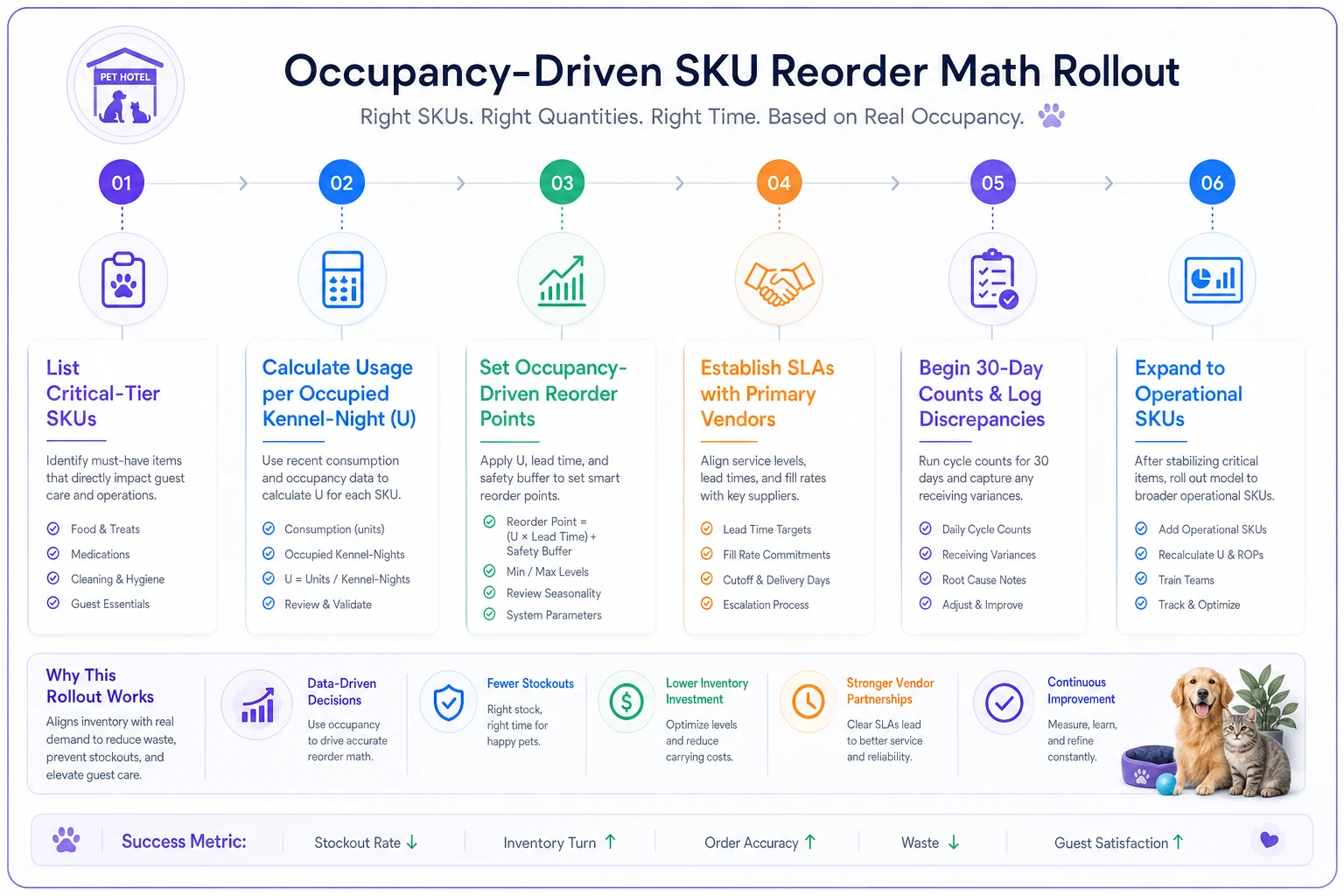
A simple rollout workflow:
-
List your critical-tier SKUs first—usually under 15. Protect those before anything else.
-
Calculate U for just those SKUs using last quarter's numbers.
-
Set occupancy-driven reorder points on the critical tier.
-
Put a basic SLA in place with your one most important vendor.
-
Start the 30-day count on critical SKUs only.
-
Expand to operational-tier SKUs once the critical tier is running clean.
The goal isn't perfection across 200 SKUs on day one. It's making sure the handful of supplies that can actually stop your operation are never the ones running out at 100% occupancy. Get the critical tier right, and the rest is just steady refinement.
The goal isn't perfection across 200 SKUs on day one. It's making sure the handful of supplies that can actually stop your operation are never the ones running out at 100% occupancy. Get the critical tier right, and the rest is just steady refinement.
Ready to optimize your pet hotel operations?
Join hundreds of pet hotels using GoPetel to save time, improve pet care, and increase booking reliability.