

Most pet hotel owners treat insurance as a line item. You get a quote, you pay it, you file it in a drawer, and you don't think about it again until something goes wrong or your renewal comes back 30% higher with no explanation. That's the expensive way to handle pet boarding insurance, and it's the default at probably three out of four facilities.
The problem isn't carelessness. It's that insurance lives in a completely different language than operations. Your policy talks about "exclusions," "subrogation," "duty to defend," and "reservation of rights." Your floor talks about check-ins, feeding schedules, group play, and turnaround times. Nobody's job is to sit in the middle and translate one into the other. So the two systems drift apart, and the gap is exactly where claims get denied, premiums creep up, and a single bad incident turns into a business-threatening situation.
This article is about closing that gap — not by becoming an insurance expert, but by building a small set of operational controls that make your facility measurably cheaper and safer to insure. That means modelling what incidents actually cost you, mapping specific contract clauses to your SOPs, and building an audit kit that lets you walk into a renewal conversation with evidence instead of hope.
The real reason premiums drift up (and it's not your claims history)
Two facilities with nearly identical size and claims records can pay wildly different premiums. The difference usually isn't luck. It's how legible each operation is to the underwriter.
Underwriters price uncertainty. When they can't see how you handle vaccinations, group play, medication, or a dog that gets loose, they assume the worst and price accordingly. A facility that can produce a documented infection-control protocol, incident logs, and staff training records looks like a lower-variance bet — and gets priced like one. A facility that says "we're very careful, our staff is great" looks like a black box, and black boxes are expensive to insure.
The first mistake most owners make is thinking premiums are purely a function of past claims. In practice, premiums are a function of demonstrated control. Claims history matters, but a clean history with no documentation behind it is weaker than a slightly messier history backed by strong systems. Underwriters are betting on your future, and your systems are the best evidence of what that future looks like.
The second mistake is confusing "having insurance" with "being covered." Policies are full of conditions — things you have to do for coverage to hold. If your policy requires vaccination verification and you can't prove you verified, the insurer can deny the claim after the incident, when you have zero leverage. You paid premiums for years and get nothing at the moment you need it.
Incident-cost modelling: know what things actually cost before the insurer tells you
Before you can decide what to insure, what to self-fund, and where to tighten operations, you need a rough model of what incidents actually cost. Most owners have never done this. They have a vague fear of "a big lawsuit" and no real sense of the everyday costs quietly eating into their margin.
Never miss a booking or detail again.
GoPetel simplifies pet hotel operations by managing every reservation and pet profile seamlessly.
- Centralized booking management
- Automated client notifications
- Staff and kennel scheduling
No credit card required
Break incidents into tiers by frequency and severity. Here's a realistic breakdown for a mid-sized facility running somewhere around 40–60 kennels:
| Incident type | Rough frequency | Typical direct cost | Hidden/indirect cost |
|---|---|---|---|
| Minor scuffle in group play | Monthly-ish | $0–$150 vet check | Staff time, client trust, refund/credit |
| Kennel-acquired illness (kennel cough, etc.) | A few times a year | $150–$600 vet bills | Outbreak risk, deep cleaning, cancelled bookings |
| Medication error | Occasional | $0–$500 | Serious liability if chronic-care dog |
| Escape / lost dog | Rare | $500–$5k+ | Reputation damage, potential lawsuit |
| Serious injury or death | Very rare | $5k–$50k+ | Litigation, deductible, premium spike |
The point of this table isn't the exact numbers — yours will differ. The point is that the frequent, small incidents often add up to more annual cost than the rare catastrophic ones, and they're the ones insurance won't help with because they fall under your deductible. If minor scuffles and illness are costing you a few thousand dollars a year in vet checks, refunds, and lost nights, that's an operational problem, not an insurance problem. No policy fixes it. Only better group-play rules and infection control do.
Once you've tiered your incidents, you can make actual transfer decisions. High-frequency, low-cost stuff you self-fund and prevent. Low-frequency, high-cost stuff you transfer to the insurer. The mistake is buying low deductibles to cover the small stuff you should just prevent, while carrying limits too thin for the catastrophic events that actually justify insurance.
A quick way to build your model
-
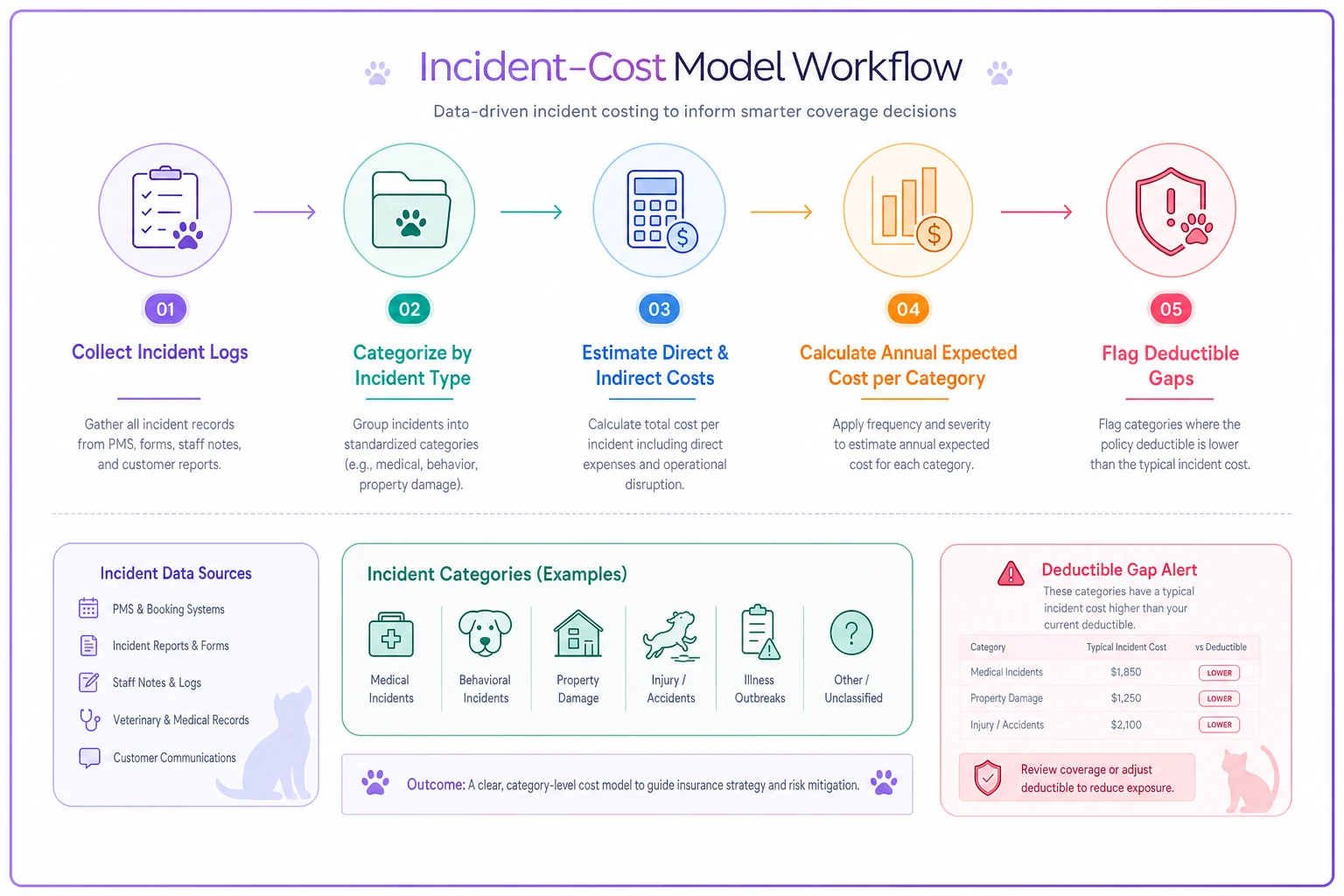
Pull the last 24 months of incidents from your logs. If you don't have logs, that's finding number one, and it's a serious one.
-
Categorize each by type and tag the direct cost — vet bills, refunds, credits, replacements.
-
Estimate the indirect cost roughly
staff hours, cancelled bookings, comped stays.
-
Multiply frequency by average cost to get an annual expected cost per category.
-
Flag anything where your deductible is lower than the typical incident cost — that's coverage you're overpaying for.
Owners who go through this once almost always find the same thing: they're over-insured on the trivial and under-insured on the ruinous.
Here's a quick visual of the incident-cost modelling workflow.
Owners who go through this once almost always find the same thing: they're over-insured on the trivial and under-insured on the ruinous.
Mapping contract clauses to your SOPs
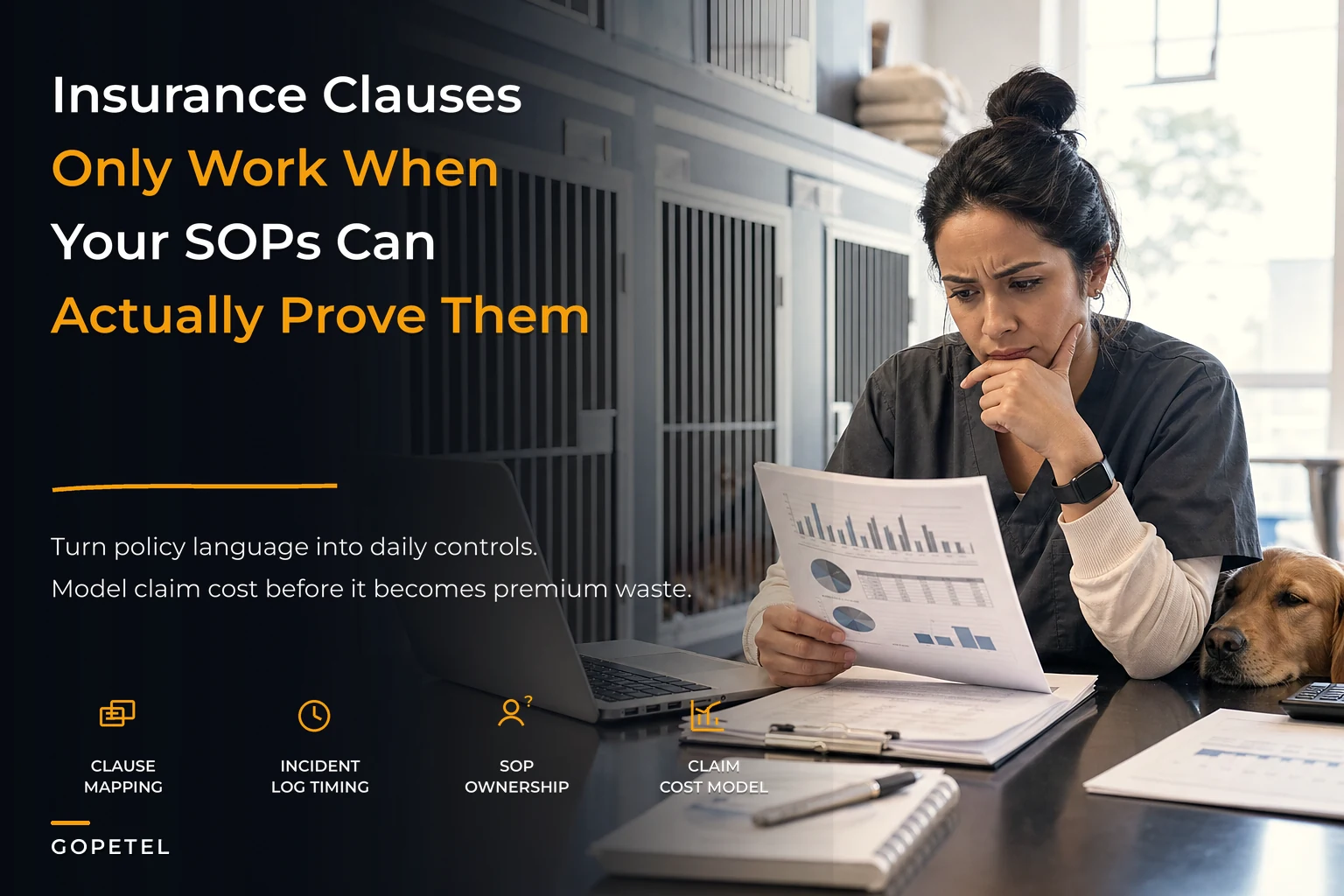
This is the part almost nobody does, and it's where the biggest wins hide. Your insurance policy and your client boarding agreement both contain clauses that only protect you if a specific operational behavior actually happened. If the behavior didn't happen — or you can't prove it did — the clause is decorative.
Take a common one: most policies exclude or limit coverage for animals that weren't properly vaccinated. Your client contract probably requires proof of vaccination. But the operational control that ties those two together is a verification step at intake with a stored, dated record. Miss that step, and you've broken the chain between your contract, your SOP, and your coverage. The clause exists; the protection doesn't.
-
Vaccination requirements (policy exclusion + contract clause) → intake verification SOP with stored proof and expiry tracking.
-
Duty to report incidents promptly (policy condition) → incident-reporting workflow that timestamps and captures details the same day.
-
Assumption of risk / liability waiver (contract clause) → signed-before-service SOP so no dog enters without a current signed agreement.
-
Medication administration limits (often a coverage carve-out) → documented MAR and vet-escalation process.
-
Communicable disease handling (exclusions common) → infection-control protocol with cleaning logs and isolation steps.
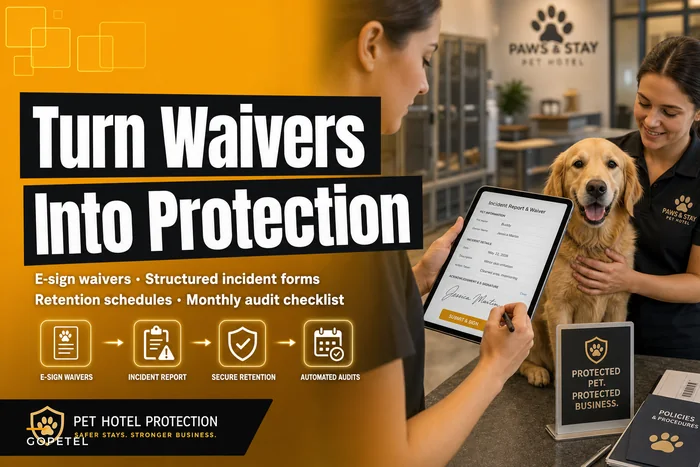
The waiver piece deserves more attention, because a signed waiver that isn't operationally enforced is one of the most common false comforts in this industry. A well-built incident-reporting, e-sign and retention workflow is what turns a waiver from a piece of paper into something that actually holds up — you need the signature captured before service, stored, and retrievable years later when a claim surfaces.
Same logic applies to disease. Your policy almost certainly limits communicable-disease claims, which means your real defense is prevention and documentation. A proper infection-control and compliance framework does double duty: it prevents the outbreak and produces the cleaning and isolation records that demonstrate control to an underwriter.
The coordination problem this creates
Each clause maps to an SOP, and each SOP requires a staff member to do a specific thing at a specific moment — often during a busy check-in when three dogs are barking and a client is running late. The verification gets skipped "just this once." Multiply that across a few hundred check-ins and you've got a system where the paper says one thing and the reality says another.
This is where centralizing the checks pays off. When your intake system won't let a booking proceed without the vaccination record attached and the waiver signed, the clause-to-SOP link enforces itself instead of relying on a tired person at the front desk. AI-assisted operational platforms can handle this quietly in the background — flagging an expired vaccine, prompting the missing signature, timestamping the incident report the moment it's filed. Not as a gimmick, just as a way to make sure the operational control your coverage depends on actually happens every single time. The value isn't the automation itself; it's that the gap between your policy and your floor stops opening.
Make your booking flow require vaccine proof and a signed waiver before confirming a reservation so the intake step can't be skipped.
The value isn't the automation itself; it's that the gap between your policy and your floor stops opening.
The insurer audit kit
Renewals go one of two ways. Either you hand over last year's numbers and take whatever price comes back, or you walk in with a kit that lets your broker argue your case. The second approach is where owners routinely knock real money off their premium — not because the risk changed, but because they made the risk visible and controlled.
What belongs in the kit:
-
Written SOPs for intake, group play, feeding, medication, cleaning, and emergency response — dated and versioned.
-
Vaccination compliance rate — what percentage of stays had verified records (aim to show near-total).
-
Incident log summary for the trailing 24 months, categorized and with resolution notes.
-
Staff training records — who's trained on what, and when they were last refreshed.
-
Infection-control logs showing cleaning cadence and any isolation events handled.
-
Waiver completion rate — proof that signed agreements precede service.
-
Facility and safety records — fencing checks, kennel maintenance, fire and emergency drills.
-
Vendor and corporate account terms, if you handle them, showing liability is clearly allocated.
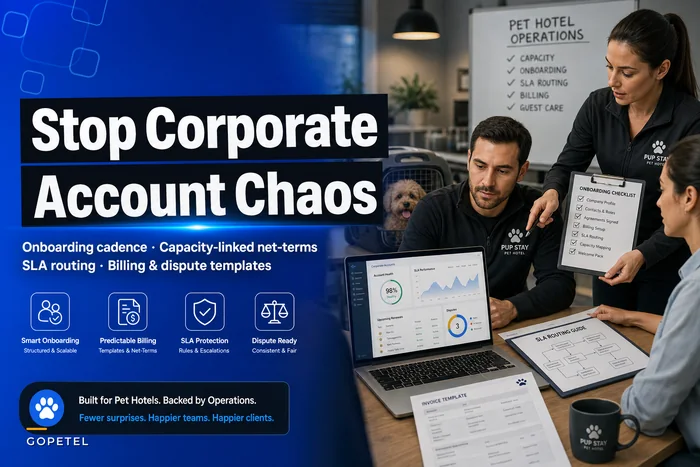
That last point matters more than owners expect. If you take corporate or referral accounts, the liability arrangements in those relationships affect your risk profile, and clean onboarding, billing and SLA documentation for corporate accounts gives an underwriter evidence that you're not absorbing risk you didn't agree to.
A broker who can present this kit is in a completely different negotiation than one who can only offer "they've been in business eight years and seem responsible." Facilities that build this out often find the first renewal after assembling a proper kit is the moment premiums finally stop climbing — sometimes they actually come down.
A real scenario
A boarding facility with about 45 kennels was renewing at roughly $14k–$16k a year, up from around $11k two years prior, with no major claims to explain the increase. Their broker had nothing to push back with. Digging in, the owner found two problems: vaccination verification was inconsistent — records existed for maybe 70% of stays — and there were no incident logs at all. Minor scuffles were handled verbally and forgotten.
They spent a season fixing the operational side. Every booking required a verified vaccine record before the dog could be confirmed. Every incident, however minor, got logged the same day with a photo and a note. Cleaning logs went from "we do it daily" to actually recorded.
Nothing about the facility physically changed — the systems around it did.
At the next renewal, the broker walked in with a 24-month incident summary, a vaccination compliance rate near 98%, and a stack of SOPs. The premium settled back down into the low $12k range. More importantly, six months later a client threatened a claim over a dog that got a minor bite in play. Because there was a same-day incident report, a signed waiver, and verified vaccination on file, the situation resolved without a payout. The systems that lowered the premium were the same systems that killed the claim.
When this makes sense — and when it doesn't
When it's worth the full build: If you're running more than about 25 kennels, taking corporate accounts, offering group play, or handling any medication, you have enough incident surface area and enough premium at stake to justify modelling costs, mapping clauses, and building an audit kit. The math almost always works out.
When to keep it lightweight: A very small operation — a home-based setup with a handful of dogs and no group play — probably doesn't need a full incident-cost model. You still want signed waivers and vaccination proof, but you're not going to move an underwriter with a data kit. Focus on the basics.
Who should NOT try to DIY the coverage decisions: If your facility does medical boarding, chronic-care, or takes on higher-risk breeds and situations, don't self-model your coverage limits alone. Build the operational controls and audit kit yourself — that part you own — but have a broker who specializes in animal-care risk actually set your limits and read your exclusions. The gap between what a generic policy covers and what a medical-boarding facility needs is exactly where people get burned.
Where facilities usually go wrong as they scale
Single-site owners can often hold the clause-to-SOP links in their head. They know which dogs are behind on vaccines, they remember the scuffle from Tuesday, they trust their two staff members. That informal system works right up until it doesn't.
The break comes with scale. Add a second location, add a night shift, add seasonal staff during the holidays, and the knowledge that lived in one person's head no longer covers the floor. Verification skips start happening. Incident logs get inconsistent between sites. One location's cleaning cadence quietly diverges from the other's. The underwriter sees this as increased variance — and prices it. Worse, when a claim hits at the weaker site, the documentation isn't there to defend it.
Facilities that stay cheap to insure as they grow treat their controls as a system rather than a set of good habits. SOPs are written down and enforced by the booking flow, not by memory. Incidents are logged in one central place across all sites in a consistent format. The audit kit updates itself as data accumulates rather than being reconstructed in a panic every twelve months. That consistency is what an underwriter is really paying attention to, and it's what protects you when something goes wrong at 2am at the location you weren't standing in.
Insurance stops being a mysterious drawer item the moment you understand what it's actually pricing: your ability to control and document your own operation. Build the model, map the clauses to your floor, keep the kit current — and you'll find you're not just paying less. You're running a genuinely safer facility, which was the point all along.
Ready to optimize your pet hotel operations?
Join hundreds of pet hotels using GoPetel to save time, improve pet care, and increase booking reliability.