

Most pet hotels don't fail because of one catastrophe. They get wobbly because a handful of smaller things happen in the same 72 hours — a laundry vendor misses two pickups, a kennel tech calls out sick during a holiday rush, the booking system glitches, and a dog with a chronic condition needs a vet run. Any one of those is manageable. Stack them together and a well-run facility turns into a scramble, with the people absorbing the chaos usually being the ones least equipped to make continuity decisions on the fly.
That's the gap this playbook addresses. Not emergency response for a single pet — that's a separate discipline with its own drill cadence. This is about keeping the whole operation running when the inputs you depend on (vendors, staff, utilities, software) fail at the same time you're near full capacity. Pet hotel operational resilience comes down to how fast you detect a failure, how cleanly you can switch to a backup, and whether the person on shift knows what to do without calling you at 11pm.
Why continuity breaks differently in a pet hotel than in other businesses
A restaurant can close for a night. A retail store can lock the doors. A pet hotel can't. You're holding live animals under a duty of care, often across kennel-nights booked and paid for weeks in advance. That constraint changes everything about how you plan for failure.
The core issue is that your operation runs on a chain of dependencies that are mostly invisible until one snaps. Clean bedding depends on laundry capacity. Laundry depends on working machines and water heating. Cooling depends on HVAC and power. Feeding depends on inventory, which depends on delivery. Record-keeping depends on your booking software being up. Every single one of those has a failure mode, and most pet hotels have exactly zero documented backups for any of them.
What happens across a lot of facilities is that owners plan for the dramatic failures — fire, flood, a serious medical incident — and completely ignore the boring ones that actually happen monthly. A vendor missing a delivery doesn't feel like a crisis until you're out of a prescription diet for a 14-day medical boarder and the backup supplier needs 48 hours to fulfill. The dramatic stuff gets drills. The boring stuff gets improvised, and improvisation at 90% occupancy is where margin and reputation leak out.
The four systems that actually need continuity coverage
Resilience planning gets overwhelming when you try to protect everything equally. You can't. The goal is identifying which dependency failures would stop you from safely housing animals, and building failover only for those.
Never miss a booking or detail again.
GoPetel simplifies pet hotel operations by managing every reservation and pet profile seamlessly.
- Centralized booking management
- Automated client notifications
- Staff and kennel scheduling
No credit card required
| System | Primary failure mode | Realistic impact window | Needs a documented failover? |
|---|---|---|---|
| Vendors (laundry, food, medical supply, waste) | Missed pickup/delivery, supplier goes under | 24–72 hrs before it hits pets | Yes — this is the #1 gap |
| Facilities (HVAC, power, water, plumbing) | Outage during heat, cold, or peak occupancy | Minutes to hours | Yes — safety-critical |
| Staffing (no-shows, cluster sickness, turnover) | Coverage drops below safe ratio | Same-shift | Yes — surge runbooks |
| Systems (booking software, payments, records) | Outage, data loss, access lockout | Hours | Yes — manual fallback |
Notice what's not on there: marketing, single-pet medical events, pricing. Those matter, but they're not continuity risks in the "we might not be able to safely run tomorrow" sense. Keeping the scope tight is what makes the plan usable instead of a 40-page binder nobody opens.
Vendor failover is the part everyone skips
A facility signs a laundry contract, it works fine for two years, and the relationship becomes invisible infrastructure. Then the vendor raises prices, loses a driver, or quietly starts missing the Thursday pickup. Nobody's watching, because there was never a signal defined for "this vendor is failing."
A vendor-failover SLA fixes that by writing down, per critical vendor, three things: what counts as a failure, how long until you switch, and who you switch to. It sounds bureaucratic until the Thursday it saves you.
-
The trigger — e.g., "two consecutive missed laundry pickups" or "food order not confirmed within 24 hours of scheduled delivery."
-
The backup — a named secondary vendor you've already onboarded, with pricing agreed and a minimum order you can place on short notice.
-
The bridge — what you do manually to cover the gap (local laundromat runs, a cash-and-carry grocery trip for food, an emergency pharmacy for meds).
-
The owner — the role responsible for pulling the trigger, not a person's name.
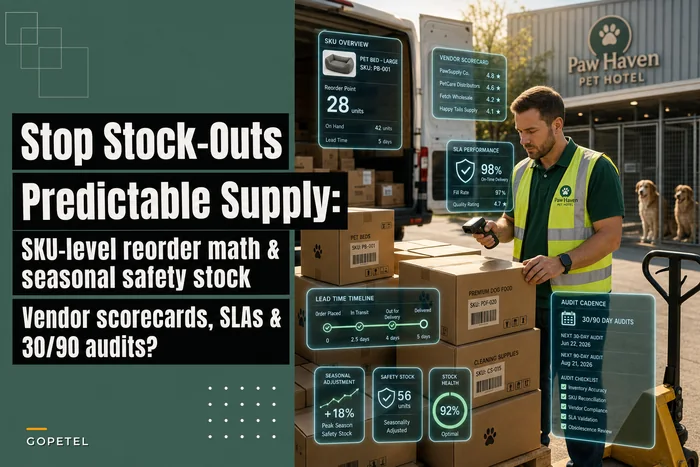
The scorecard side of this ties directly into procurement. If you're already tracking reorder points and vendor reliability — the kind of SKU-level discipline covered in an inventory and procurement playbook with vendor scorecards — your failover triggers can lean on the same data. A vendor that's been late three times this quarter shouldn't be your sole supplier for anything a pet depends on.
Surge-capacity runbooks: tie everything to kennel-nights, not gut feel
Most pet hotels treat their busy periods as a staffing problem and stop there. But surge stresses every dependency simultaneously — more laundry, more food, more waste, more water, more cleaning chemical, more everyone-touching-the-booking-system-at-once.
The unit that makes this plannable is the kennel-night. If you know your occupancy forecast, you know your projected kennel-nights, and almost every operational load scales off that number. Laundry volume per kennel-night. Food consumption per kennel-night. Staff-hours per kennel-night. Waste pickups per kennel-night. Once you have those ratios, a surge runbook stops being vague anxiety and becomes arithmetic.
A typical example: a 60-run facility that normally sits around 55–65% occupancy knows its laundry vendor is scoped for roughly 40 kennel-nights of linen per day. Over Thanksgiving week they'll hit 90%+, pushing well past 50 kennel-nights daily for six straight days. That's not a staffing issue — that's a laundry capacity breach that a normal pickup schedule physically can't absorb. The runbook should already say: at more than 45 projected kennel-nights per day, add the Saturday pickup and pre-stage 30% extra bedding. Nobody should be discovering that at 6am on the Wednesday before Thanksgiving.
The surge runbook should answer three questions in advance
-
At what kennel-night threshold does each system break? Find the ceiling for laundry, food inventory, waste, and staffing ratios individually. They're rarely the same number.
-
What's the pre-stage action for each? Extra bedding, a bulk food order, a temporary second waste pickup, pre-booked relief staff. Pre-staging beats scrambling every time because your backups also get busy during the same holiday.
-
What's the demand release valve? If you physically can't support more kennel-nights safely, where do you stop taking bookings? A resilience plan that assumes infinite intake isn't a plan.
That last one is uncomfortable because it means voluntarily turning away revenue. But the facilities that quietly overbook surge weeks are the ones generating incident reports, review crises, and burned-out staff who quit in January.
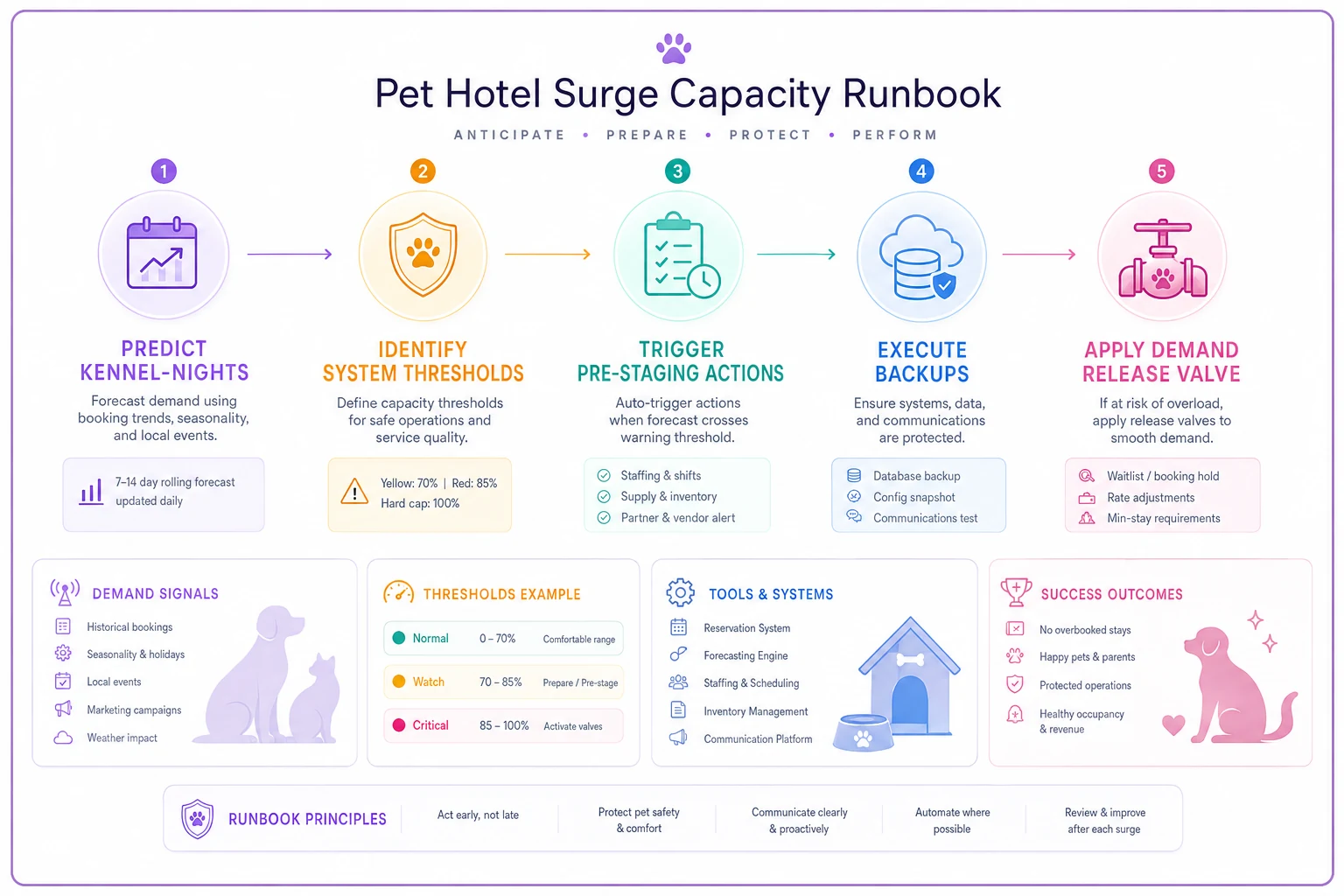
A quick diagram of the runbook flow makes it easier to brief the team.
Facilities and systems: the fast-failure category
Vendor and surge failures give you a day or two of warning. Facility and system failures don't. HVAC dying during a July heat wave is a same-hour emergency. A booking platform outage during holiday check-in is a same-morning scramble. These need pre-wired responses, not plans you build during the event.
For facilities, the continuity question is: what's the manual bridge until the fix arrives? Spot coolers and fans staged before summer. A backup generator sized at least for cooling and critical lighting, tested quarterly — not "we have a generator somewhere." Named HVAC and plumbing contractors with an understood response expectation. You want the repair to land inside the window before pets are at risk, and you want to know your coverage before you need it.
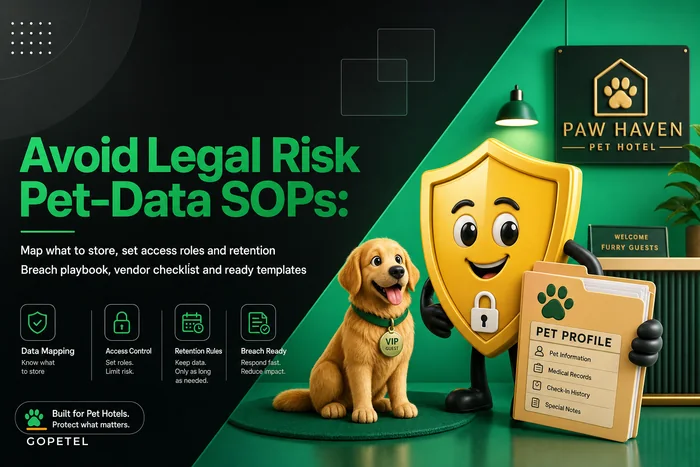
For systems, the fallback is almost always paper. When the booking software goes down mid-check-in, can your front desk still take in a pet safely? That means a printed or offline-accessible roster of today's arrivals and departures, feeding and medication notes, and emergency contacts. This connects directly to how you govern records access in the first place — the controls described in keeping client data out of legal danger with records, access roles and a breach playbook matter doubly here, because your offline fallback can't become an uncontrolled stack of printouts with client phone numbers left on a counter.
The mistake that shows up constantly: facilities assume "the cloud" means they're covered, so they keep nothing locally. Then the internet drops for four hours and the team genuinely doesn't know which dogs get which medication, because that information only lived behind a login.
Role-based checklists: continuity has to survive the owner being unreachable
Most pet hotel continuity plans live in the owner's head. Which means the plan doesn't exist when the owner is on a flight, asleep, or the one who's sick. Real resilience means the shift lead can execute without you.
That's why continuity has to be role-based, not person-based. The checklist says "the shift lead does X," so it works no matter who's holding that role that day. A new hire covering a Sunday should be able to open the binder (or the tablet) and know exactly what a laundry failure or a power outage requires of them.
-
Shift lead — owns real-time failover triggers
calls backup vendors, initiates manual record-keeping, decides when to stop surge intake within pre-set rules.
-
Facility/maintenance owner — owns HVAC, power, water, generator testing, and the contractor call list.
-
Manager/owner — owns vendor contracts, insurer relationships, the quarterly drills, and any decision that exceeds the shift lead's pre-authorized limits.
-
Front desk — owns the offline arrival/departure roster and client communication scripts during a system outage.
Pre-authorize spending limits for shift leads so continuity actions don't stall while someone waits for approval.
The authorization piece is where this often falls apart. If the shift lead isn't allowed to spend $200 on an emergency laundromat run without calling the owner, they won't — they'll let the gap grow until someone with authority wakes up. Pre-authorizing spending limits for continuity actions is one of the highest-leverage, lowest-cost things an owner can do.
Quarterly tabletop drills: cheap, boring, and the thing that actually works
A plan nobody has rehearsed is a document, not a capability. Drills matter not because of the walkthrough itself, but because rehearsal surfaces gaps you can't see on paper. Run a tabletop where the laundry vendor "fails" and you might discover your named backup actually requires a two-week account setup you never completed. Better to find that in a conference room than at 50 kennel-nights of soiled bedding.
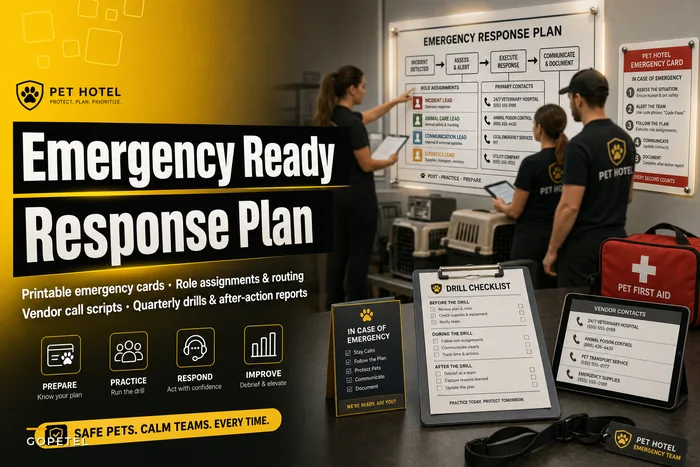
A tabletop drill is just a scenario played out verbally with the team — usually 45 minutes, once a quarter. You read the scenario, people say what they'd do, and you write down every place the plan is vague or broken. The single-pet emergency version of this — the ready-to-print response plan with vendor scripts and a quarterly drill cadence — is a good model to borrow the rhythm from. Continuity drills just widen the lens from one animal to the whole operation.
-
Q1 — Vendor failure. Two critical vendors fail in the same week. Walk the failover and bridge actions.
-
Q2 — Facility failure during peak heat or cold. HVAC or power goes down at high occupancy.
-
Q3 — Surge + staffing collapse. Holiday-level kennel-nights with two no-shows on the same shift.
-
Q4 — Systems outage. Booking and payment systems down during check-in. Run the paper fallback for real.
After each drill, update the runbook with whatever broke. A drill that produces zero edits usually means nobody took it seriously.
A real scenario
A mid-size facility — around 45 runs, roughly 65% average occupancy, a single owner-operator plus six staff — kept getting hit by the same category of problem. Over about eight months they dealt with a laundry vendor missing pickups twice during busy weeks, an HVAC compressor failing on a hot Saturday, and a booking-system outage during a Friday check-in rush. None of it was catastrophic, but the pattern was expensive: emergency overnight laundromat runs, a rushed HVAC repair at premium weekend rates, two refunded stays after a check-in meltdown, and a few one-star reviews mentioning "disorganized." Direct and indirect costs over those eight months landed somewhere around $7k–$9k, plus staff morale damage that's harder to price.
What changed wasn't a big investment. They spent about a day writing vendor-failover triggers with named backups, mapped laundry and food load to kennel-nights so surge weeks had pre-staging rules, printed an offline arrival/med roster the front desk updates daily, and ran one tabletop drill per quarter. The next busy season had plenty of problems — there always are — but the laundry gap got bridged in an hour without the owner being called, and the holiday surge ran without a single refunded stay. The quieter outcome was the one that mattered most: the owner stopped being the single point of failure for every decision.
When a full continuity system is overkill
Not every facility needs all four runbooks documented to this depth. A small operation running 10–15 runs at low occupancy, with the owner on-site nearly every shift, can realistically get away with lighter coverage — a backup vendor list and a generator plan might be enough. The overhead of quarterly drills and role-based authorization starts paying off as you grow past the point where you personally see everything, or when you add a second location and the owner-in-the-building safety net disappears.
Where it becomes non-negotiable: multi-site operations, facilities that take medical or high-value boarders, anyone running above roughly 70% occupancy during peaks, and any business where the owner is trying to step back from daily shifts. In those cases the lack of a continuity system isn't a theoretical risk — it's a bill you'll pay eventually, you just don't know the date yet.
The group that should be most cautious: facilities that think they have continuity covered because it's all in the owner's head. That's the most fragile arrangement possible, because it feels safe right up until the owner is the thing that's unavailable.
The one-page scorecard that keeps it alive
The whole system collapses back into chaos if resilience becomes a once-a-year binder review. The fix is a single-page scorecard a manager can check monthly — not a report, just a pulse. Something like: are all critical vendors currently backed by a named, onboarded secondary? Has the generator been tested this quarter? Is the offline roster being updated daily? Did we run this quarter's drill? Are spending authorizations current? Green, yellow, or red on each.
The value of one page is that it actually gets looked at. A 30-page continuity manual gets written once and never opened again. A scorecard that lives by the office door gets glanced at, and a red box nobody can explain becomes a conversation before it becomes a 6am emergency.
Pet hotel operational resilience isn't about predicting the specific disaster. It's about building a system where the predictable categories of failure — vendors, facilities, staffing, systems — each have a defined trigger, a named backup, a manual bridge, and someone authorized to act without waiting for you. Do that, and the week when four things go wrong at once stops being the week that defines your reputation. It just becomes a Tuesday the team handled.
Ready to optimize your pet hotel operations?
Join hundreds of pet hotels using GoPetel to save time, improve pet care, and increase booking reliability.