


Most pet hotels don't actually know which of their services make money. They know the facility makes money (or doesn't), and they know boarding is the backbone. But ask an owner what the gross margin is on their grooming add-on, or whether their new daycare program is quietly eating staff hours that boarding paid for, and you usually get a shrug and a guess.
That gap is the whole problem. When you run every service out of one shared pool of labor, kennel space, and capital, the profitable ones end up subsidizing the unprofitable ones—and you can't see it on a bank statement. A pet hotel revenue portfolio strategy forces each service to stand on its own: its own unit economics, its own demand assumptions, its own claim on throughput. Only then can you make a real decision about whether to grow it, fix it, or shut it down.
This isn't a pricing article. It's about how the whole service mix works together, where it breaks as you add offerings, and how to run disciplined experiments before you sink money into something that looks good on a spreadsheet and bleeds you on a Tuesday.
Why service mix quietly breaks as you grow
A single-service operation is easy to reason about. You have kennels, you fill them, you clean them. Margin is mostly a function of occupancy and labor.
The trouble starts the moment you bolt on a second and third revenue line—daycare, grooming, training, enrichment, transport, retail. Each one feels like "free upside" because the building and the front desk are already there. But every new service does three things simultaneously:
-
It competes for the same labor hours
-
It competes for the same physical space during peak windows
-
It introduces its own failure modes (no-shows, cancellations, capacity caps)
What tends to happen in these businesses is that the second or third service is where the facility looks busier but the margins get thinner. The owner adds grooming, revenue climbs 15%, and six months later net profit is flat or down. The grooming hours came out of the same people who were turning kennels, so turnaround slowed, and a couple of boarding nights got lost to a dirty-run backlog nobody traced back to the groomer's schedule.
That's the core insight: services don't fail in isolation, they fail by stealing throughput from each other. A portfolio view is the only way to see those trades before they cost you.
Step one: build unit economics per service
You can't manage a portfolio you can't measure. Before any growth decision, every service needs its own contribution margin—not blended, not "the whole business made X."
Never miss a booking or detail again.
GoPetel simplifies pet hotel operations by managing every reservation and pet profile seamlessly.
- Centralized booking management
- Automated client notifications
- Staff and kennel scheduling
No credit card required
What most owners skip is allocating the shared costs honestly. The front desk, the cleaning crew, the manager's time—those get consumed differently by each service. A rough but useful way to do it is to assign labor by the actual minutes a service pulls from each role.
A simplified unit-economics table for four common services might look like this:
| Service | Avg price | Direct cost | Labor minutes | Allocated labor $ | Contribution margin | Margin % |
|---|---|---|---|---|---|---|
| Standard boarding (night) | $52 | $6 | ~22 | $11 | ~$35 | ~67% |
| Daycare (day) | $34 | $3 | ~35 | $17 | ~$14 | ~41% |
| Bath/groom add-on | $45 | $9 | ~55 | $27 | ~$9 | ~20% |
| Transport (round trip) | $40 | $14 fuel | ~40 | $20 | ~$6 | ~15% |
Those numbers are illustrative—yours will differ—but the pattern holds almost everywhere. Boarding carries the business. Daycare is decent but labor-heavy. Add-ons like grooming and transport look like revenue but run on thin margins once you charge them for the time they actually consume.
Assign labor by the actual minutes a service pulls from each role.
The mistake is reading that table and concluding "kill grooming." You shouldn't—grooming often drives retention and rebooking even when its standalone margin is weak. The point of unit economics isn't to rank-and-cut. It's to know which services you're keeping for cash and which you're keeping for strategic reasons, so you stop pretending the thin ones are profit centers.
Step two: size the market before you build capacity
A lot of expansion mistakes come from building capacity for demand that isn't there. Owners see a competitor offering training, assume there's a market, and sink $8k–$12k into a program that books four sessions a month.
You don't need a market research firm. Two or three heuristics you can run on the back of a napkin will get you most of the way there:
-
Existing-base pull-through. What share of your current clients could plausibly buy this? If you have around 600 active clients and a realistic 8–12% would use monthly grooming, that's roughly 48–72 recurring buyers. Multiply by price and margin to get a floor.
-
Local density check. Count comparable providers within your drive radius and estimate how saturated the service already is. A town with four established groomers is a different bet than one with none.
-
Capacity-to-demand ratio. Figure out the minimum weekly volume that makes the service break even on its dedicated costs, then ask honestly whether your base plus walk-in demand clears that line in a normal (not holiday) week.
The pattern worth remembering: services that sell to your existing base are far safer bets than services that require you to acquire new customers. Grooming for current boarders is a near-certain market. A standalone training business that needs cold acquisition is a venture, not an add-on—and should be evaluated like one.
Step three: gate everything on throughput
This is the part that separates a portfolio strategy from a wish list. Every service you add has to pass through your real bottleneck, and your bottleneck is usually either kennel turnaround, groomer chair-time, or front-desk capacity during check-in windows.
Throughput gating means you write explicit rules that stop a service from being sold when it would starve a higher-margin one. A few examples of rules that actually hold up in operations:
-
No grooming appointments scheduled during the 7–10am check-out block (protects boarding turnaround)
-
Daycare capped at a hard number that leaves cleaning staff enough margin to turn boarding runs by 2pm
-
Transport slots gated to routes that already clear a per-stop margin threshold
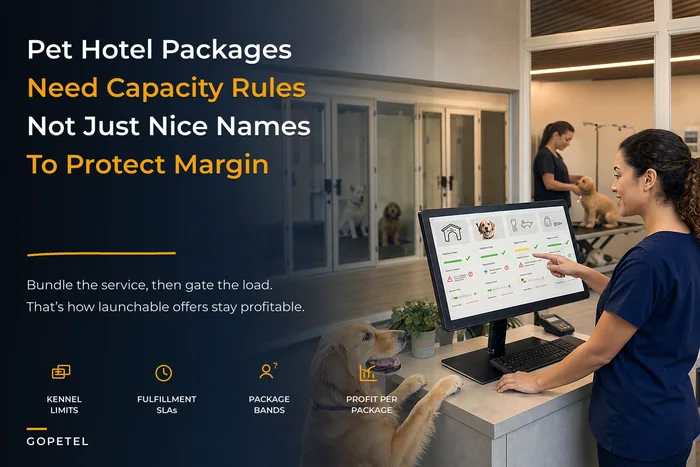
If you've built service bundles, the gating gets even more important, because a bundle can pull three services into a single day and quietly blow past capacity on all of them. The work of designing offers that don't break your operation is its own discipline—there's a full breakdown in Packages that protect throughput: a service-design system to launch bundles and tiers that scale that pairs directly with this portfolio approach.
A service's margin on paper is meaningless if it displaces a higher-margin service during the only hours that matter. You gate for the peak, not the average.
Go / no-go: run experiments, don't place bets
The reason pet hotels over-invest in new services is that they skip the experiment and go straight to the build-out. Most services can be tested at low cost before you commit any real capital.
A simple go/no-go experiment template has five fields:
-
Hypothesis — "At least 30 current clients will pre-book monthly grooming at $45."
-
Minimum viable test — offer it manually to the next 150 check-ins, no new hires, no new equipment.
-
Success threshold — the number that justifies the real investment (bookings, margin, repeat rate).
-
Kill threshold — the number below which you stop, no emotional override.
-
Time box — 30 to 45 days, then decide.
When a new service actually makes sense
-
It sells to your existing base with minimal acquisition cost
-
It fills off-peak capacity rather than fighting for peak hours
-
It lifts rebooking or retention even at a modest standalone margin
-
It passes its throughput gate without starving boarding
When it's a bad idea
-
It only works at full staffing you can't reliably schedule
-
Its margin depends on peak-hour slots you already sell out
-
It requires capital before you've validated real demand
-
It adds a new failure mode (specialized care, liability) you aren't set up to manage
Who should NOT add services right now
If your core boarding operation still loses nights to slow turnaround, or your check-in process is bottlenecked, adding a service will amplify the chaos, not hide it. Fix the backbone first. A struggling foundation doesn't get stronger by stacking more weight on it.
The medical and membership edge cases
Two service types deserve special caution because they break the normal portfolio math.
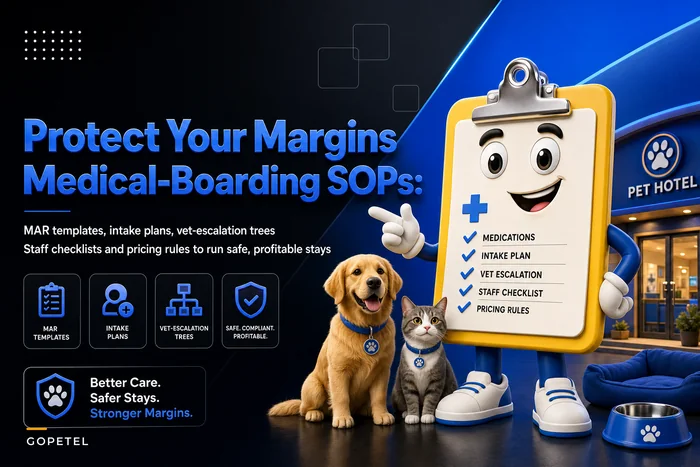
Medical boarding looks lucrative—higher nightly rates, less price sensitivity—but its real cost structure is labor and liability, not kennel space. Medication administration, vet escalation, and documentation can consume staff time in ways that wreck your allocation model if you don't price for it. The operational guardrails matter enormously here; the medical-boarding SOPs for chronic care, MARs and vet-escalation trees walk through what that service actually requires before you count it as profit.
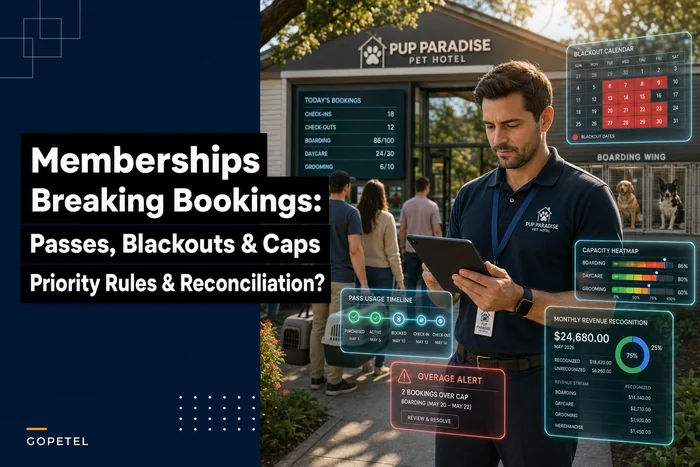
Memberships and passes are the other trap. They look like guaranteed recurring revenue, but they quietly override your gating rules—a member with "unlimited daycare" shows up on your busiest day and you can't say no. If the membership design doesn't include blackout rules and fulfillment caps, it becomes a liability against your highest-demand capacity. The mechanics of designing passes that don't wreck your booking flow are covered in how to design passes, blackout rules and fulfillment controls, and they're worth reading before you launch any recurring product.
A real scenario: the daycare that paid for itself in pilot
A mid-size facility—around 40 runs, roughly $70k in monthly revenue—wanted to add structured daycare. The owner was ready to spend close to $15k on a play-yard build-out and two new hires.
Instead they ran a 90-day pilot. For the first month they offered daycare only to existing boarding clients, capped at a number their current staff could absorb without new hires, and gated it so no daycare intake overlapped the morning check-out rush. They tracked three things: fill rate, incremental margin after allocated labor, and whether daycare users boarded more often.
The results were uneven but useful. Daycare filled to about 60–70% of the cap most weekdays—short of the owner's optimistic guess, but enough to clear its allocated costs. The more telling number: daycare users rebooked boarding noticeably more often than non-users, which changed the math entirely. Daycare wasn't a strong profit center on its own, but it was a strong retention engine.
So the go-decision flipped. Instead of the big play-yard build, they scaled daycare modestly with one part-time hire, kept the throughput gate, and treated it as a retention tool rather than a revenue line. That decision only existed because the pilot separated "does it make money standalone" from "does it make the portfolio healthier."
The 90-day pilot playbook
Here's the structure that turns a vague "let's try it" into a disciplined decision. Run it in three 30-day phases, and tie each phase to a staffing, inventory, and CAPEX decision table.
Days 1–30: Validate demand, zero new capital. Offer the service manually to your existing base. No hires, no equipment, no build-out. You're testing whether anyone actually buys it at the price your unit economics require. Decision at day 30: did bookings clear the demand threshold? If not, kill it here—you've spent almost nothing.
Days 31–60: Test operations under real load. If demand passed, now stress the throughput gate. Add the minimum staffing needed and watch whether the new service degrades your core metrics—turnaround time, check-in speed, boarding fill. Track allocated-labor margin, not blended revenue. Decision at day 60: does it hold its gate and its margin?
Days 61–90: Decide the CAPEX scenario. Only now do you model the real investment. Build a simple decision table across three scenarios:
Visual of the 90-day pilot workflow:
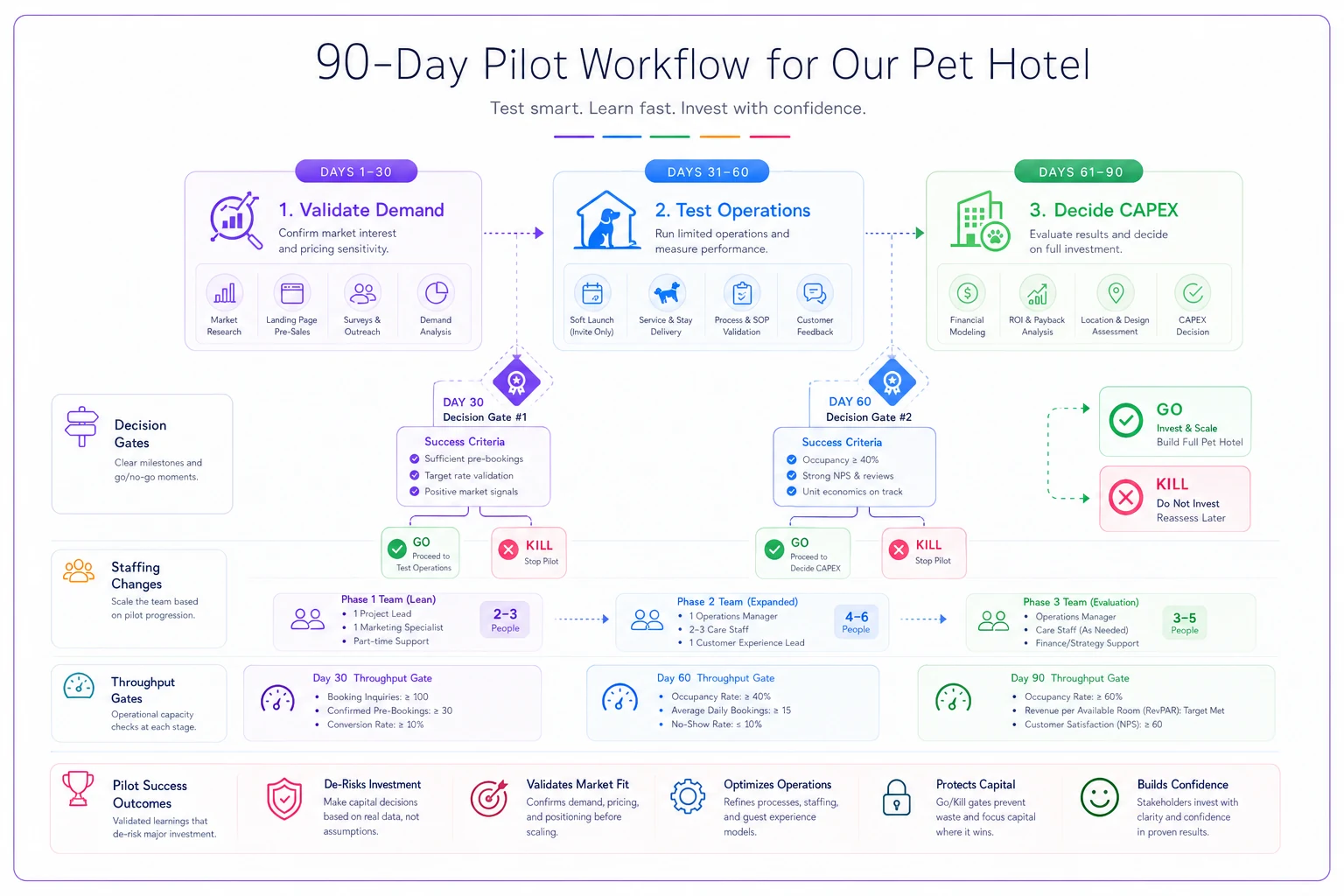
Refer to the decision table below to map scenarios to staffing and CAPEX choices.
| Scenario | Demand assumption | Staffing | CAPEX | Decision rule |
|---|---|---|---|---|
| Conservative | Pilot fill holds flat | Existing + 1 PT | Minimal / none | Scale if margin > threshold at current volume |
| Base | Fill grows ~20% with marketing | +1 FT | Moderate build-out | Scale if 2 straight months clear gate |
| Aggressive | Fill doubles | +2 FT | Full CAPEX | Only if base case already proven for 60 days |
The discipline is forcing yourself to earn the aggressive scenario. Most over-investment happens because owners budget for the aggressive case and staff for it before the conservative case is even proven.
Running the portfolio as a system, not a pile of services
The owners who get this right stop thinking "what else can I sell" and start thinking "what does each service cost my throughput, and what does it give back." That shift changes everything downstream.
It means some services stay even though their margin is thin, because they drive rebooking. It means some tempting add-ons get killed in week three of a pilot before they ever touch your capital. It means your gating rules protect boarding—the service that actually pays the rent—from being nickel-and-dimed to death by lower-margin offerings competing for the same Tuesday morning.
The tools you use matter less than the discipline. Whether you track this in a spreadsheet or in an operations platform that can surface per-service margin and flag when a new offering starts eating into turnaround time, the job is the same: keep each service accountable for its own economics, and make every expansion earn its way through a real pilot before it earns your money.
A pet hotel isn't one business—it's a small portfolio of services sharing a building and a staff. Run it like a portfolio, and you'll stop guessing which parts are carrying the rest.
Ready to optimize your pet hotel operations?
Join hundreds of pet hotels using GoPetel to save time, improve pet care, and increase booking reliability.