

Most pet hotels don't decide to build a fragile tech stack. It just accumulates. You start with a booking system. Then payments needs to talk to accounting. Then you bolt on a review-request tool, a vaccine-record uploader, a photo-update app, an SMS reminder service. Each connection gets solved with whatever was fastest that week — a Zapier zap here, a native integration there, a copy-paste export on Fridays.
For a while it works. Then peak season hits, one vendor pushes an update, and a payment webhook silently stops firing. Nobody notices for six days. By the time you catch it, you've got twelve unreconciled deposits and a very confused bookkeeper.
That's the real cost of point fixes: they don't fail loudly. They fail quietly, at the worst possible time, and they fail one at a time until you're spending your Sundays playing detective across four dashboards.
This is a playbook for thinking about integration as a system instead of a pile of patches. The goal isn't to name specific tools — it's to give you vendor-agnostic rules for routing data, testing rollbacks, and holding your integrations to actual service levels, plus a governance checklist that ties your business rules to the integration patterns underneath them.
Why point fixes feel smart and age badly
A low-code fix solves the problem in front of you. That's its whole appeal. You need bookings to create invoices, so you wire booking → invoice and move on. Cheap, fast, works the day you build it.
The problem is that each fix only knows about the two systems it connects. It has no idea what else depends on that data. So when your booking platform changes how it labels a "confirmed" stay versus a "pending" one, the invoice trigger watching for the old label just… stops. No error. No alert. The zap runs, sees nothing to do, and reports success.
What you see across a lot of small operators is that the fragility isn't in any single connection — it's in the count. Ten integrations, each with 99% monthly reliability, don't give you 99% reliability overall. They compound. You end up with something breaking roughly every couple of weeks somewhere in the chain, and because each break is small, you never justify fixing the root cause.
There's a related trap worth naming: integration sprawl by department. Front desk builds a reminder automation. The owner builds a KPI export. A manager builds a review-request flow. None of them know about the others, and all three pull from the same booking data in slightly different ways. A single field change breaks three things owned by three people, and nobody's sure who's responsible.
This is the exact pattern behind so many pet hotels still running on manual exports and brittle KPI pipelines — the automations technically exist, but they're too fragile to trust, so someone keeps a spreadsheet "just in case."
The shift: from connections to orchestration
Orchestration is a boring word for a simple idea. Instead of dozens of point-to-point wires, you route your important data through a defined path with rules about what happens at each step, what happens when a step fails, and how you know it failed.
Never miss a booking or detail again.
GoPetel simplifies pet hotel operations by managing every reservation and pet profile seamlessly.
- Centralized booking management
- Automated client notifications
- Staff and kennel scheduling
No credit card required
The difference looks like this:
| Aspect | Point-fix approach | Orchestrated approach |
|---|---|---|
| Structure | Many direct A→B connections | Data flows through defined stages with rules |
| Failure behavior | Silent, isolated, hard to trace | Logged, alerted, contained |
| Vendor swap | Rebuild every connection touching that vendor | Swap one adapter, rules stay intact |
| Ownership | Scattered across whoever built each zap | Centralized, documented flow |
| Testing | Test in production, find out live | Rollback and replay before going live |
| Scaling to 2nd site | Rebuild everything per location | Reuse the same routing logic |
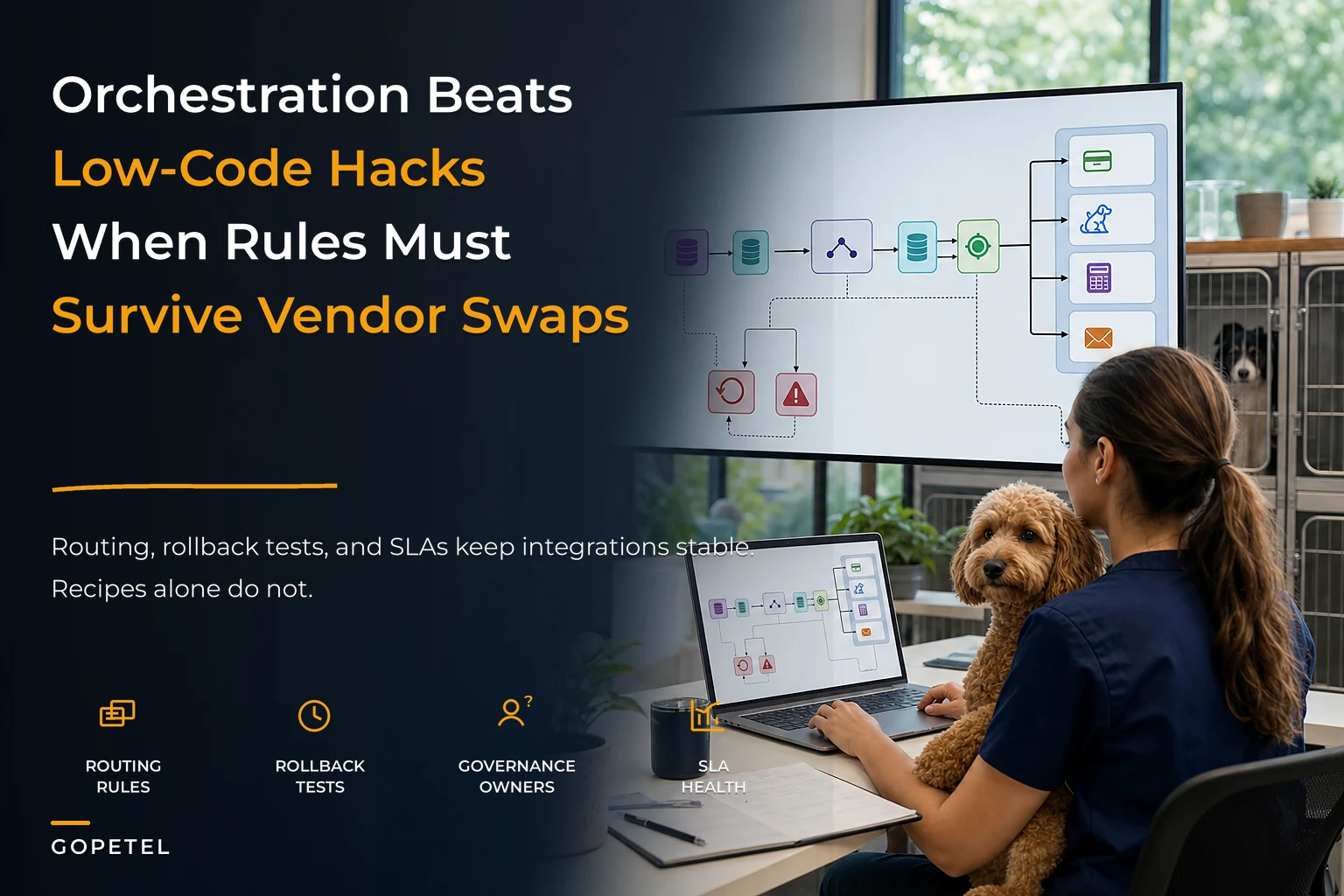
A simple flow chart can make these stages easier to picture.
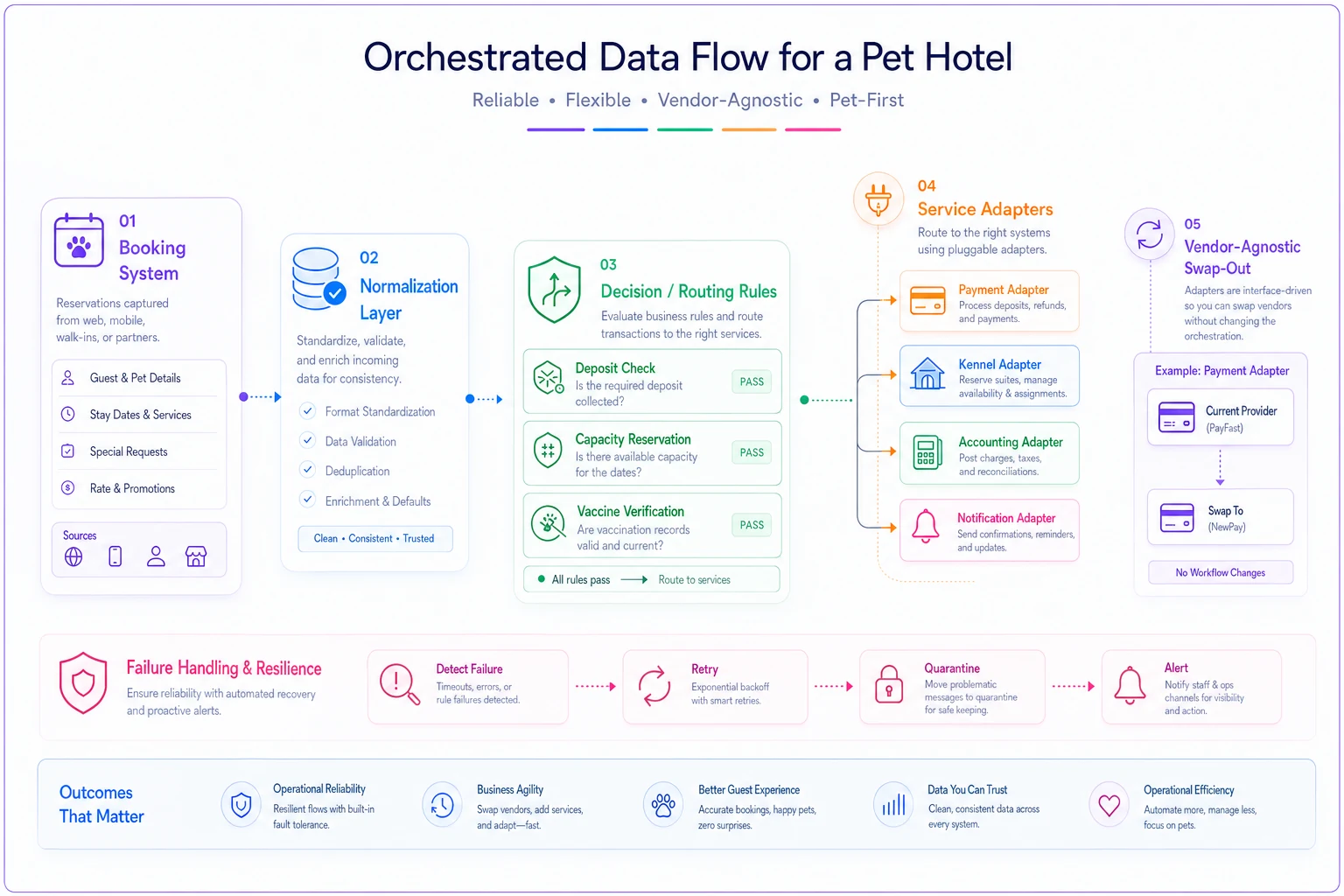
The orchestrated version costs more thought upfront. That's the honest tradeoff. But the payoff shows up the first time a vendor changes something and you fix it in one place instead of hunting through nine automations.
The key insight most owners miss: you don't need orchestration for everything. A review-request email that occasionally misfires is fine to leave as a simple automation. Orchestration is for the flows where a silent failure costs real money or real trust — payments, deposits, vaccine verification, capacity and availability sync. Spend your effort there.
Vendor-agnostic routing rules
The whole point of being vendor-agnostic is that your logic shouldn't care which payment processor or booking platform you use — only what the data means. That means putting a thin translation layer between your business rules and each vendor.
In practice, routing rules for a pet hotel usually come down to a few decisions:
-
What's the source of truth for each data type? Bookings live in one system. Payments in another. Pet medical records maybe a third. Decide, explicitly, which system "owns" each fact — and make every other system read from the owner, not from a copy.
-
What triggers a downstream action, and in what order? A confirmed booking might need to: reserve capacity, request a deposit, send a confirmation, and flag missing vaccine docs. Order matters. You don't want a confirmation email going out before capacity is actually reserved.
-
What data gets normalized before it moves? Vendors label things differently. Normalize statuses, date formats, and IDs once, at the entry point, so downstream rules never have to guess.
-
What's idempotent? This one's underrated. If a webhook fires twice — and it will — will you charge the deposit twice? Every money-touching step needs to be safe to run more than once.
A typical example: a booking gets confirmed, the orchestration layer normalizes it into a standard internal format, checks whether a deposit rule applies, requests the deposit, waits for confirmation, then reserves the kennel and sends the guest confirmation. If the deposit fails, capacity isn't held and the guest gets a payment-retry message instead of a false confirmation. One flow, clear order, no double-charges.
The reason this matters more as you grow: routing logic written this way survives a vendor swap. When you eventually move from one booking platform to another — which most multi-site operators do — you're rewriting the adapter that speaks to the new vendor, not the entire web of business logic. Same principle behind good SOP versioning across multiple sites: the rules stay stable, the implementations underneath can change.
Rollback testing: the part everyone skips
Most pet hotel automations have never been tested for failure. They were tested once, when they worked, and then trusted forever.
Rollback testing means you deliberately break things in a safe environment and confirm the system does the right thing. Not to be thorough for its own sake — because finding out live, during a holiday rush, is brutal.
A practical rollback test cycle:
-
Replay a real (anonymized) booking through the flow and confirm every downstream step fires correctly.
-
Kill a step mid-flow — simulate the payment processor timing out — and confirm the system pauses, retries, or fails cleanly instead of leaving a half-booked stay.
-
Fire a duplicate webhook and confirm nothing double-charges or double-books.
-
Feed it bad data — a malformed date, a missing pet ID — and confirm it quarantines the record and alerts someone instead of silently dropping it.
-
Confirm you can undo. If a batch of bookings imported wrong, can you roll them back without hand-editing each one?
Operators who do even a lightweight version of this catch the fragile flows before they cost money. The ones who don't discover their retry logic doesn't exist during their busiest week of the year.
You don't need a fancy staging environment to start. Even a simple habit — before any integration change goes live, run one real record through it and one deliberately broken record through it — catches most disasters. Ten minutes of testing saves weekends of cleanup.
Service levels for integrations you don't own
You already think in SLAs for the human side of your business — response times, turnaround windows. Your integrations deserve the same treatment, even though you don't control the vendors.
-
Freshness How stale can this data be before it's a problem? Availability sync that's 6 hours behind will double-book you.
-
Latency How fast must a critical action fire? A deposit request that lags 4 hours loses no-show protection.
-
Failure alerting Every money- or safety-critical flow needs to shout when it fails, not log quietly.
-
Reconciliation cadence How often do you verify that two systems actually agree? Payments vs. bookings should reconcile daily, not monthly.
Set a threshold for each critical flow and monitor against it. When a vendor's reliability quietly slips — and they do slip — you'll see it in your freshness or reconciliation numbers before it turns into twelve unmatched deposits.
One more thing worth watching: vendor changes to their free tiers and rate limits. A flow that worked fine at 200 bookings a month can start silently throttling at 600. Growth breaks integrations that were never tested at volume.
A real scenario
A single-location boarding and daycare facility running around 300–350 stays a month had wired everything through a mix of native integrations and a couple of low-code automations. Bookings created invoices, invoices synced to accounting, and a separate flow sent deposit requests.
Their booking platform pushed an update that changed how cancellations were tagged. The deposit-refund automation kept treating certain cancellations as active stays. For about five weeks, roughly a dozen cancellations didn't trigger the right refund/hold logic, and a handful of deposits sat in limbo. Nothing errored — every automation reported success.
The bookkeeper caught it during month-end reconciliation, which meant untangling five weeks of records by hand. A lost weekend, a couple of awkward client calls, and somewhere around $1,800–$2,200 in deposits that had to be manually sorted — two clients refunded twice by accident during the cleanup.
After the mess, they did three unglamorous things: designated the booking platform as the single source of truth for stay status, added a daily payments-to-bookings reconciliation check with an alert on any mismatch, and started running one real plus one broken record through any flow before changing it. Nothing fancy. But the next time a vendor changed a label, the reconciliation alert flagged it the next morning instead of five weeks later. The problem went from a lost weekend to a ten-minute fix.
The contrast between those two outcomes — five weeks of silent failure versus a next-day alert — is basically the whole argument for treating integrations as operations rather than set-and-forget automations.
The governance checklist: mapping business rules to integration patterns
This is the part that keeps orchestration from rotting back into sprawl. Every critical business rule should map to a documented integration pattern, with an owner. Run through this before you add or change any integration:
-
Which business rule does this serve? If you can't name it, you probably don't need the integration.
-
What's the source of truth for each data type it touches? Written down, not assumed.
-
Is the sequence of downstream actions defined and ordered?
-
Is every money-touching step idempotent (safe to run twice)?
-
What happens on failure — retry, pause, quarantine, or alert?
-
Who gets alerted, and how fast, when it breaks?
-
What's the freshness/latency SLA for this flow?
-
How and how often does it reconcile against its source of truth?
-
Can it be rolled back without manual record-by-record editing?
-
Who owns this flow? A named person, not a department.
-
Has it been tested with a broken/duplicate record, not just a happy-path one?
-
Will it survive a vendor swap without rewriting the business logic?
If you keep this checklist next to your integrations and actually fill it out, you get something most pet hotels never have: a map of how your data actually moves, what depends on what, and where the fragile spots are before they break. Most owners are surprised how quickly it exposes flows that nobody owns and flows that have never been tested outside of the happy path.
When orchestration makes sense — and when it doesn't
When it's worth it:
-
You're running multiple critical flows where a silent failure costs money or trust (payments, deposits, vaccine verification, availability sync).
-
You're planning a second location, or already run one. Orchestrated logic reuses; point fixes multiply.
-
You've already been burned by a vendor change breaking something quietly.
-
Your booking volume has grown past the point where you can eyeball every discrepancy manually.
When it's overkill:
-
You're a small single-site operation with two or three simple automations and low volume. A well-labeled Zapier setup and a weekly reconciliation might be genuinely enough.
-
The flow in question isn't critical — a review request that occasionally misfires doesn't need failure containment.
Who should not do this yet: if your underlying data is a mess — inconsistent client records, duplicate pet profiles, no clear source of truth — orchestration will just automate the chaos faster. Clean the data model first. Orchestration organizes good data; it can't fix bad data.
The honest takeaway
Pet hotels end up trapped in brittle low-code fixes not because of laziness or bad tools. It's that every individual fix was a reasonable decision at the time, and nobody's job was to look at the whole picture. The sprawl is invisible until it isn't.
You don't have to rip everything out and rebuild. Start with your two or three highest-stakes flows — the ones where a silent failure costs deposits or double-books a peak-season kennel. Give each one a source of truth, a failure plan, an alert, and a reconciliation check. Run one broken record through it. That alone puts you ahead of most operators.
The same discipline that keeps your kennel turnaround predictable and your channel margins visible applies to the plumbing underneath your software. Treat integrations like operations, not like magic that runs itself — because the ones that run themselves are exactly the ones that fail quietly.
The same discipline that keeps your kennel turnaround predictable and your channel margins visible applies to the plumbing underneath your software. Treat integrations like operations, not like magic that runs itself — because the ones that run themselves are exactly the ones that fail quietly.
Ready to optimize your pet hotel operations?
Join hundreds of pet hotels using GoPetel to save time, improve pet care, and increase booking reliability.